Necessary Birdsongs.

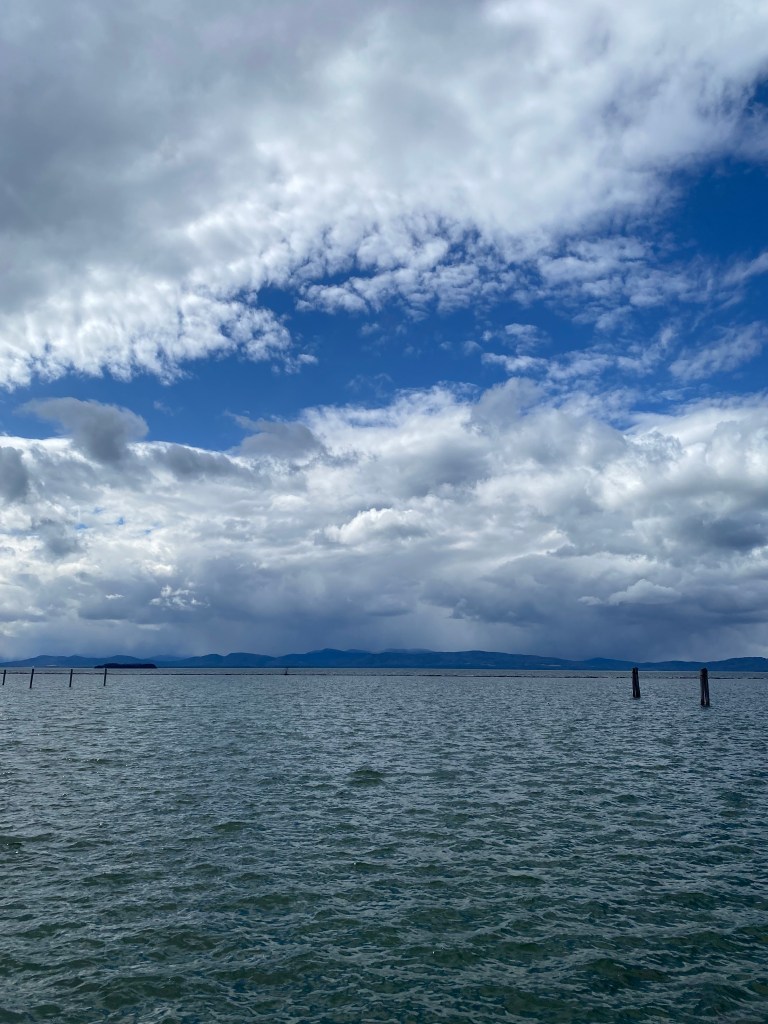
Lake Champlain

Mid-March, the unlovely muddy Vermont: I bend beneath the snarled rose bushes, seeking green nubs pushing through the wet earth. By June, this world will be verdant, lush, those old roses a tangle of green, tiny blossoms each a delicate bouquet of pale pink. These roses, planted by someone doubtlessly long passed over into the other world, ruggedly fence my house, their flowers such a dear sweet fragrance.

In this brown world, I wander to the places where, in springs past, I’ve heard the early songs of redwing blackbirds. Yesterday, I hear these birds, not the full chorus yet, but the warm-up crew. We are well before the yard clean-up and gardening season. The town roads are rutted, hard to travel, and the summer folks have not yet returned. Hidden in this clump of cedars, the blackbirds steadily, without any fuss, go about their blackbird lives. Not so many weeks away, marsh marigolds will blanket these wetlands — dazzling yellow, killer green — but for now, the dun palette of silvery cedar, umber earth, the birdsong melodies yanking us along to spring.

“Dear March—Come in—”

I stand outside eating a cheese sandwich stuffed with a handful of the lettuce I bought for my cat Acer. The trees across the road shake furiously in a wind as if outraged. What’s your complaint, I wonder.

Such a strange winter: a handful of skiing days, no ice skating, the hard cold a distant memory. The yuck of this winter has been the lack of sunlight, the sodden clouds that have lingered from last year’s rainy summer through January’s gloom. We kvetch. My own antidote is the early morning, my insistence that writing, that order and beauty, are a transformative might. There’s nothing new in that approach; it’s the ancient path of seeking luminosity, of Rumi’s words that the wound is where the light comes in.

In March, of course, sudden sunlight in your living room is apt to reveal the dirty cat hair clusters balled beneath your couch, the cobwebs trailing from the ceiling corner, drenched in dust. Make of it what you will.

Oh March, my long-time friend, giver of fine weather, betrayer with your miserable cold snowstorms. In the lengthening days, the sun returns like a long-ago lover. My friend the sun and I take long walks, my sunny friend whispering in my ear that brighter lovelier days are already here.

A few lines from Emily Dickinson:

Dear March—Come in—
How glad I am—
I hoped for you before—
Put down your Hat—
You must have walked—
How out of Breath you are—
Dear March, how are you, and the Rest—
Did you leave Nature well—
Oh March, Come right upstairs with me—
I have so much to tell—

Vermont Town Meeting Day.

Here’s Vermont Town Meeting Day in a nutshell: lousy coffee for a buck, the cash box in the hands of sweet kids who are raising money for field trips the school board quit funding years ago.

My father calls Town Meeting Day the purest form of democracy. And democracy, hoo boy, what a fascinating creature this is.

On this Town Meeting Day in Greensboro, the moderator drank water from a Daffy Duck glass that he said he’d used for the past thirty town meetings (not a tall tale). Knitting and side conversations, Presidential primary voting, school budget voting, knitting and more knitting, talk about housing and logging and, inevitably, taxes and delinquent taxes.

Late afternoon, a cold drizzle fell. On the playground, the kids had left a bucket of stick stew. I had about a hundred things yet to do that afternoon, but I squatted beneath the white pine and checked out the lean-to the kids had built from branches that had fallen in a winter storm. As we head into this election year, let’s remember the kids keep the world real. Savor some spring stick stew.

Democracy is not something you believe in or a place to hang your hat, but it’s something you do. You participate. If you stop doing it, democracy crumbles.

— Abbie Hoffman

‘Soon it will be the sky of early spring…’

Wild February!

At noon, I stand talking to the road crew in a sparkling snowfall. I wax on about the prettiness of snow on the emerging earth. The crew, who’s endured the strange vagaries of mud season in December, the fickleness of Vermont’s winter weather made weirder by climate change, humor me with a nod.

Fifty degrees and rain forecasted for today, followed by more, followed by bitter cold, then rain and wind, the sun I lean towards…. Late winter, again, and I remember when I could distinguish the years: the spring we boiled sap from March 1 to the 31st. The year we made 540 hard-earned gallons, two of us and a five-year-old, and I wore through three pairs of gloves carrying in wood and feeding the arch.

Walking around my snow-scattered garden, I envision where I will plant the bare root Japanese lilac I’ve ordered, for me or someone else to admire and love. The path down to my compost is both icy and soft mud, the conundrum of winter reluctantly losing its teeth to spring. The true joy is the inevitability, the earth’s order to proceed from twinkling snowflake to downy crocus, the planet’s sheer opinionlessness regarding skunks and black flies.

The road crew and I kick around a few more pithy remarks about government corruption, and then we head along….

From my one of my favorite Louise Glück poems, March:

The sea doesn’t change as the earth changes;
it doesn’t lie.
You ask the sea, what can you promise me
and it speaks the truth; it says erasure.

Finally the dog goes in.
We watch the crescent moon,
very faint at first, then clearer and clearer
as the night grows dark.
Soon it will be the sky of early spring, stretching above the stubborn ferns and
violets.

Boots on the Land, the Ice.

I’m meeting someone, late afternoon, who’s late, so I wait. The February sun has dropped into the horizon and clouds, and the day’s softening snow is tightening up, freezing again. I’m along one of the glacial lakes, a deep cut in the earth created by the planet’s unstoppable movements. It’s an old, old lake, not a newer pond formed by a human dam construction. Across from where I stand is the beach where I swam last fall, evenings and weekends. The water is shallow for a short stretch and then deepens quickly. My youngest had just gone to college. I would swim out as far as I could, then lie on the shore beneath the shaggy cedars, reading and watching the loons dive and reappear.

February exposes the bones of Vermont, the land’s steepness, the flatness of ice, the pale grace of a white birch in a hemlock forest. That afternoon, the stranger tells me a story of how the land was divided in families, re-divided and swapped, sold. Around this side of the lake, the state highway was built nearly on the water, and from here it’s easy to see the challenges of traffic and how the road hampers runoff from the mountains. It’s a familiar story that plays out in particulars in all but the wildest places.

On my way home, I stop at the town reservoir and walk a short distance over its ice. Walking on ice is always a kind of magic, a temporary thing. I don’t see the two bald eagles who live here: another day, perhaps.

Roadside View.

In these tail-end days of January, I’m alone midafternoon when I stop by the edge of the road. We’ve endured a cold for days that’s not so much bitter but a raw damp that my brother says reminds him of the ocean. The kind of weather for wearing wool sweaters all day, that make you wrap your hands around cups of coffee. So many years ago, I lived for a winter in an apartment on a brick Main Street building in Brattleboro. The building was heated by radiators, clanging and spewing steam all over that large building, in a heating design where I was mere witness, the grateful recipient.

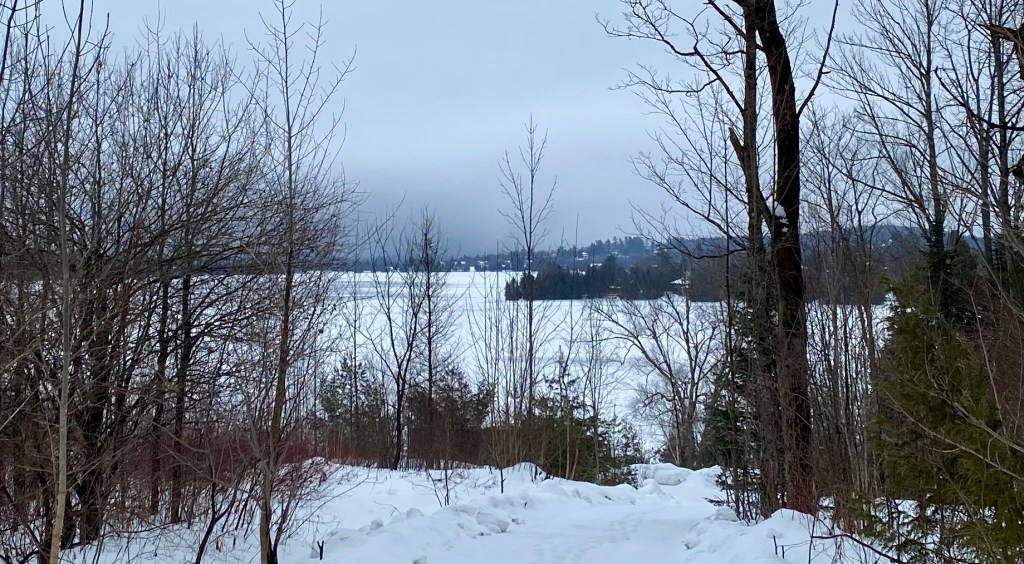
This dreary afternoon, I follow three-toed turkey tracks down a driveway. In the snowy field, the large birds set up a clanging holler when they spy me, ruffling feathers and jostling. It’s just me, I’d like to tell them, a small woman who’s forgotten her mittens and hat. I stand for a bit. Down the hillside, the frozen lake spreads immensely around the spits and coves of the shoreline: breathtakingly awesome.

After a bit, the turkeys seem to care little about my dull presence, gleaning through the thin granular snow.