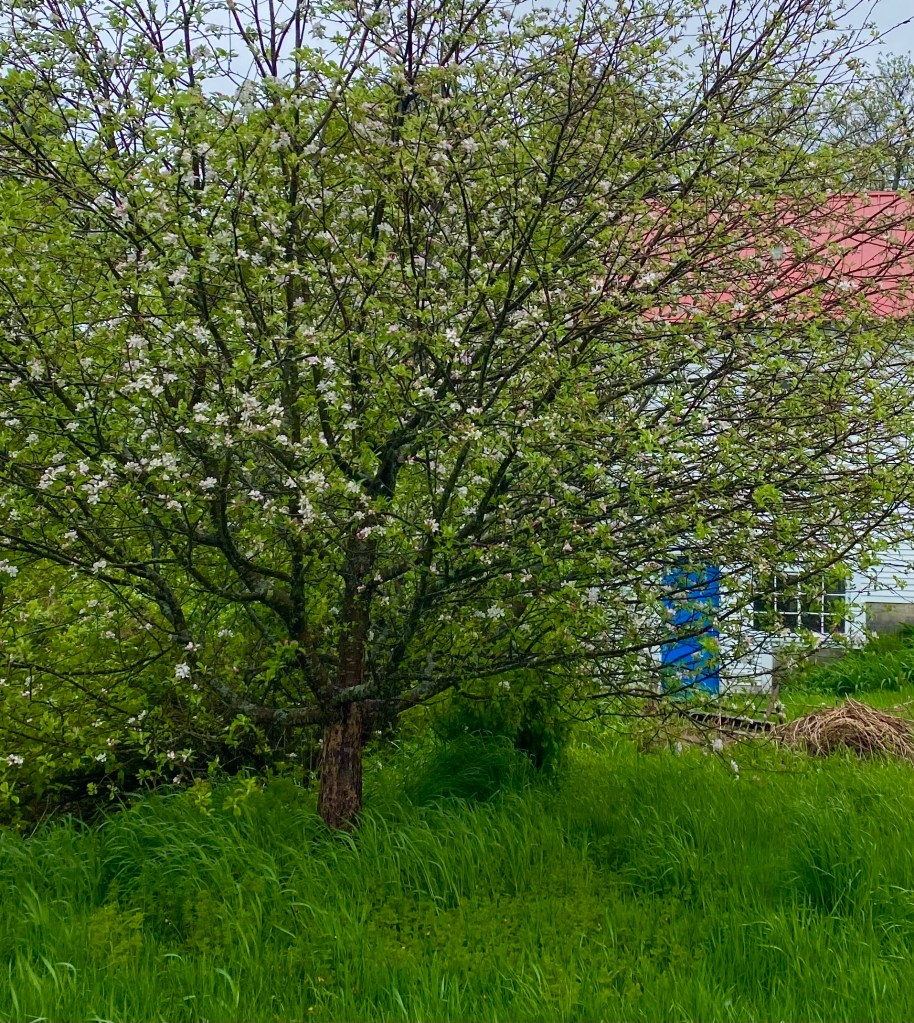
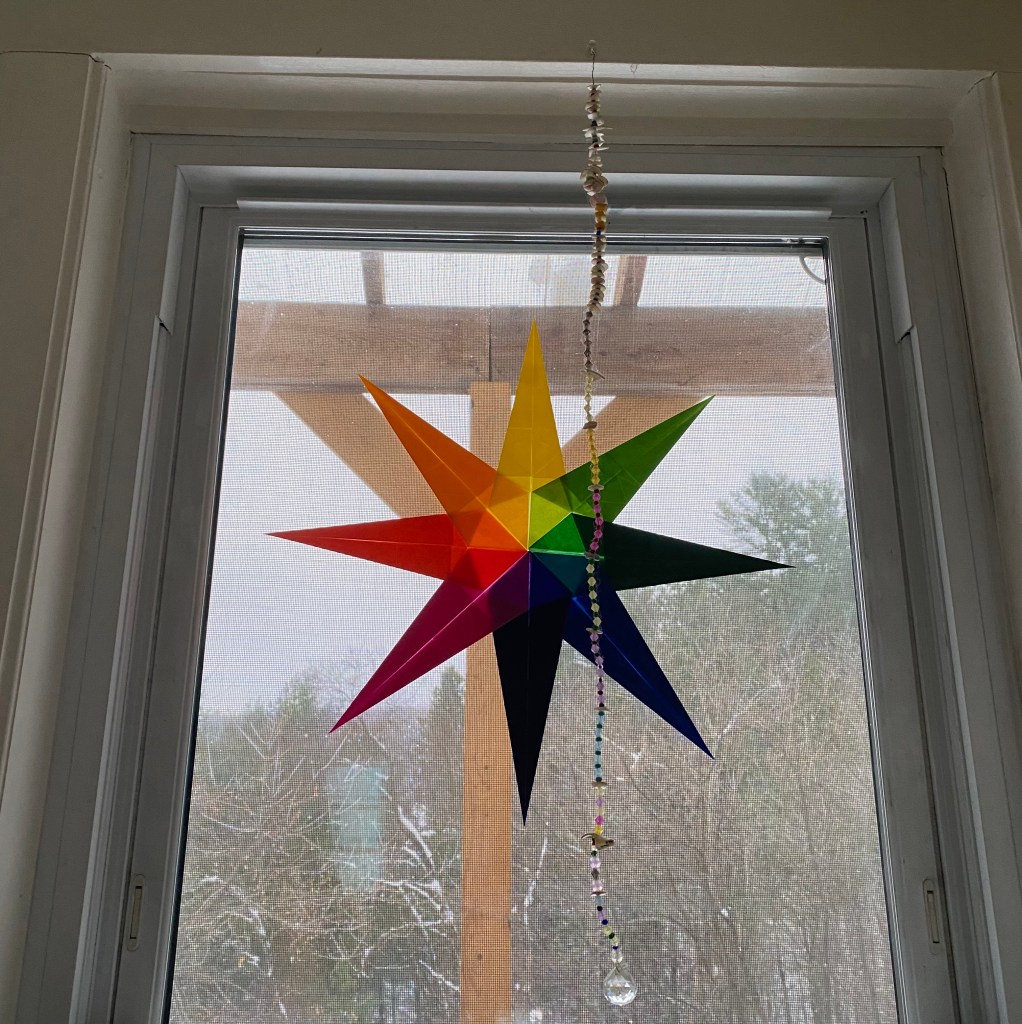
Calendar (and actual) spring…

In my rinse-and-repeat pattern of this long winter, driving back from Dartmouth in the late morning, sunlight sprawling over the brown fields, the tree limbers along the interstate beginning the season’s cutting, I notice the Connecticut River has thawed. Unmutable sign the back of this mighty winter has cracked.

Home, my yard half-buried yet in twig-strewn snow, the ash buckets mark their winter resting place, a chaos of cinders that touch the edge of the quartz-pebbled rose garden my youngest and I made, years ago.

Later, a friend stops by with good cheer and belated and welcome Christmas presents. The sun is yet bright. We walk, slowly, slowly, on the short stretch of dead-end road before my house. I point to a robin perched in a pin cherry. She spies last summer’s hornet nest spun into the lilacs, a nest on the neighbor’s windowsill.

We were once neighbors ourselves. In mud season, we walked with our little kids up and down our back road, taking our time as the kids searched for frog eggs in the roadside ditches and tender green folds pushing up through matted brown leaves in the forest: the first spring beauties and trout lilies, bloodroot. Now, during my last hospitalization, her son repaired my daughter’s car, stayed for dinner and conversation.

Too snowy and wet to sit down, I lean against my car’s bumper. A robin chirps in the neighbors’ sugar maple, an expanse of curved trunk and branch and twig. Such a meager peep peep this rust-bellied hand-sized creature makes, prying winter away, thrusting our world towards nest building, egg laying, song.

“Against Panic” by Molly Fisk

You recall those times, I know you do, when the sun  

lifted its weight over a small rise to warm your face,   

when a parched day finally broke open, real rain   

sluicing down the sidewalk, rattling city maples   

and you so sure the end was here, life a house of cards   

tipped over, falling, hope’s last breath extinguished   

in a bitter wind. Oh, friend, search your memory again —   

beauty and relief are still there, only sleeping. 

Snow geese and cancer and macaroni and cheese.

My friend walks into my kitchen. The windows are shrouded in the remains of last night’s darkness. She bends down and looks at my face, reminding me of those enervating conversations in ERs with doctors. After a careful moment, she pronounces, You look good. My house is warm; her sentence warms me more.

In the St. Johnsbury hospital, she drops me at the laboratory door. A receptionist sends me down the hall, in search of elevators. A woman in the waiting room follows rickety me in my winter boots, and repeats the directions. I wander down halls empty of people, interspersed with lit Christmas trees in what seem to me random corners and notches. Someone calls my name. I turn and look, and of course this is my friend, who for a fleeting moment I don’t recognize in her bundled coat, surgical mask.

Not far from the Canadian border, St.Johnsbury has a faded charm from its former heyday of logging and Fairbanks scales. This December morning, the day sputters, promising no sunlight, maybe a few rosy strands in the opening daybreak. In my strange fog, I wonder if the light mirrors Siberia. My blood is drawn and spun. Waiting for the verdict, I stare out the window, the layers of coal and washed-thin blue and last night’s pale snow. Beside me, a man introduces himself says he owns a garage and towing business. I pull down my mask and offer my name. My voice is so muted he can hardly hear me, but I ask him to tell me about his plowing so far this winter. While we wait, he obliges me. My hands, he says, will never be clean enough for hospitals.

Siberia, I think, Siberia, as the garage owner pinpoints roads. The daylight notches up a bit. Save for my friend, waiting elsewhere, I know no one here, but this winter landscape of snow and pale mountain, the livelihood of working with hands and backs and people, is familiar to me as my thumb knuckles, the loneliness of lingering over the morning’s last cup of cooling black coffee, pondering some decision that’s wormed itself in the day.

So disease, cancer, that forbidding word, burrows in. The disease is me; the blood is mine; the nurse explains numbers, says hematocrit, hemoglobin. Less than a handful of weeks into this journey, I know my blood courses with immutable facts, ragingly powerful chemistry. The blessing to leave is laid upon me.

Home again from distant Siberia — is it midmorning? afternoon’s mire? — my friend sweeps ashes from my wood stove and nourishes gleaming coals with birchbark and splinters, odd pieces of end wood. This day unfurls, somber and patient, settling into winter’s long haul. I offer a piece of my daughter’s gingerbread. For hours now, we’ve talked about migrating snow geese and cancer and macaroni and cheese. She asks if I would take her on a nighttime walk — I envision the throb of spring peepers, the redolent rotting slop of thawing earth — indeed, a pleasure I might give back, to one of my shepherds holding me steady as I wobble down my back steps.

Rowing in autumn…

In a cold rain, my friend and I set off walking. It’s a joke between us. When we were neighbors, I would call and ask her to meet me for a walk.

It’s sleeting, she’d say.

Only a little.

Invariably, she’d join me, gung-ho.

The rain lets up, though, as we walk up a muddy path, cross streams, pause to admire where a view might be through dense mist. The woods are gold and black, redolent with the humus-y scent of fallen leaves, this summer’s bounty already turning back into the damp soil. I remember her oldest son, now a teacher himself, standing on a chair in my kitchen, rolling out dough for sugar cookies, happy. Rain or snow probably fell then, too.

This is familiar forest to me, as I lived here for so many years. But I grew up surrounded by New Hampshire forest, and the exquisite beauty of New England fall, its sharp bite reminding us of winter, is as familiar to me as the backs of my hands. While the greater political world is utterly unfamiliar — which way will this go? — this path, our conversation, is balm for my soul. Both our lives have gone rocky ways, and yet here we are in rain, pressing on, pocketing especially pretty leaves.

On my way home from our soggy walk, I stop at the coffee shop and spread out my papers and laptop on a table. I’m standing there, thinking (or maybe dreaming), when a long-ago acquaintance appears. We sit and talk for a bit. There was a quarrel in the past between us. As she speaks, I feel the blood quickening in my rain-damp flesh, from my cheeks to my sodden toes. Here it is again, how experience shapes and changes us. Our culture pushes us, pushes us as women, to smooth the edges, say all’s well, be polite, diminish ourselves and pretend we’re still in the land of childhood, when the grownup woman world is a vast sea of star and moonlight, treacherous waves, radiant beauty, and the great unknown. At the end of our conversation, there’s no conclusion, no tidy wrap-up, just the two of us rowing together for a bit, handing the oar back and forth.

This precise moment… Now.

My daughter and I drink coffee at the kitchen table and talk about the election. Sun pours in through the glass doors. A cat lies on the table between us, purring, utterly blissful.

At 19, it’s her first presidential ballot. At 19, I was a different kind of young woman, holed up in a far-off-the-path cabin with a boyfriend, determined to forge my future in “the smithy of my soul….” My daughter’s generation was shaped in the smithy of the pandemic. Last week, I tore off the New Yorker cover and clipped the illustration of Harris to our kitchen calendar, a white star gleaming on her earlobe. My daughter and I wonder, if Harris, then what? If not, then what? There’s no answers, yet, to any of this, the future yet to be revealed. We fry eggs, butter toast, brew more coffee.

Later, in the night, I’m out in my fat wool sweater and Danskos, holding a cup of hot honey tea, looking for the northern lights. The stars are crystalline, swirled through with white. The wind soughs through the white pines in the ravine behind my house, and a creamy half-moon, like a luscious unworldly melon slice — so tantalizing I’d like to hold it with both hands — hangs over my house.

I’m at the edge of my garden, that familiar place where, if I smoked cigarettes or drank scotch, I’d linger, contemplating the sunflower stalks and the village lights below. The night pretties up the village, wraps it up, so I can see how small this place really is. In the night, my heart opens toward the village; in the daylight, not so much.

The light from my house illuminates stray leaves sailing through the darkness, the great shift of autumn. Like so many of my friends, I’m at that place in life, kids growing and grown, where creative possibilities unfurl. I’m doing the things I’ve done nearly all my life: drinking tea, staring up at the wonder of the night firmament, contemplating which way I’ll jump. In the meantime, I’ve been housekeeping: edge away from that negative snarl, lean into what and who I know is true, the wind and the stars, the moving moon, this swallow of tea, this precise moment. Now.

“Problems that remain persistently insoluble should always be suspected as questions asked in the wrong way.”

— Alan Watts

“The real, long history of this place…”

Old West Church, Calais, Vermont, 1823…. The fieldstone foundation was laid 200 years ago. I’ve been tossed a lucky bone, and I’m reading here this afternoon. Recently, I swung by with a friend to check out the acoustics and ended up sitting and watching the sunlight shift through the space. The structure remains in the 19th century with no electricity.

In an interesting way, it seems fitting to do these things in the autumn when the light in our northern realm is shifting so rapidly. On each side, the days shorten. What began in April as a sprinkling on the forest floor of hepatica and trillium and spring beauties has flourished all summer in such a lush and lovely summer. Strangers remark, “What a summer of growth!” as if to make up for these past few years of soddenness, of rain and wildfire smoke from faraway (but apparently not that faraway) places.

At the transfer station, I pull up with my hatchback crammed with that metal lidded can of cat food cans, my bins of used paper and things I no longer want in my house. I’ve been coming here for decades now. On this peach of a September afternoon, the owner and I stand outside his office, our faces up to the sunlight and a circling hawk. I mention that I’d take a month more of these days, but I don’t want to be greedy. He looks at me and says, Let’s just be greedy and want that, anyway.

Autumn is the long weeks of the growing season’s finale, the landscape gold and crimson. But within the landscape are the tiny places where we walk and live: my garden’s pink glads, the neighbor’s blooming roses, the gold flush of the butternut tree I planted as a bare root stick, seven years ago, and the girls laughed at me. The tree stretches far above our heads now, and my girls marvel. Have faith, I remind them; beauty thrives from where we least expect it….

From Carolyn Kuebler’s gorgeous essay about Vermont:

The real, long history of this place goes even further
back, to the beginning of this landform as we know it, about twelve
thousand years ago when the glaciers drew back from the land and
various species, including humans, eventually moved in.

Evening gathering….

In the spring, I moved my remaining hollyhocks into the fenced vegetable garden to save these flowers from feasting groundhogs. Spring, summer churned along. Now autumn, my garden still blooms its rainbow. Gathering tomatoes and basil for dinner, scraps of birch bark and kindling to start a fire, I pause for a moment in the drizzle, soaking in the delicate petals, the mist brushing in for the night, the trees already doing each their own foliage thing — some gold and orange, some already shaken down to bare twigs, others green, green, as if in defiance of winter.

Across the valley, the coyotes call, once, twice, as if testing their voices.

I snip bunchy orange marigolds for my table, their centers spicy. Overhead, the geese are always winging away these days, gathering their Vs, heading for their winter quarters, elsewhere. The clustered sunflowers, in their different heights and states of disarray from gold petal to curled brown leaf, rustle with the fat little chickadees dipping in and out, scavenging. Oh, sunflowers, so easily grown: scattered seeds, my palms pressing soil, water and sunlight. For me and the birds I imagine I sow these beauties, but of course that’s not true at all. The sunflowers are the waving prayer flags of my garden, this small territory.

The neighbor boys pile their sweatshirts and run in their t-shirts, the smallest hustling in and out of the lilac bushes, hide-and-seek. Rain pitters on leaves. A T.S. Eliot line runs through my memory, that graceful dismal poet, “…music heard so deeply/That it is not heard at all…”

A few snippets of autumn.