Bear, darker than midnight.

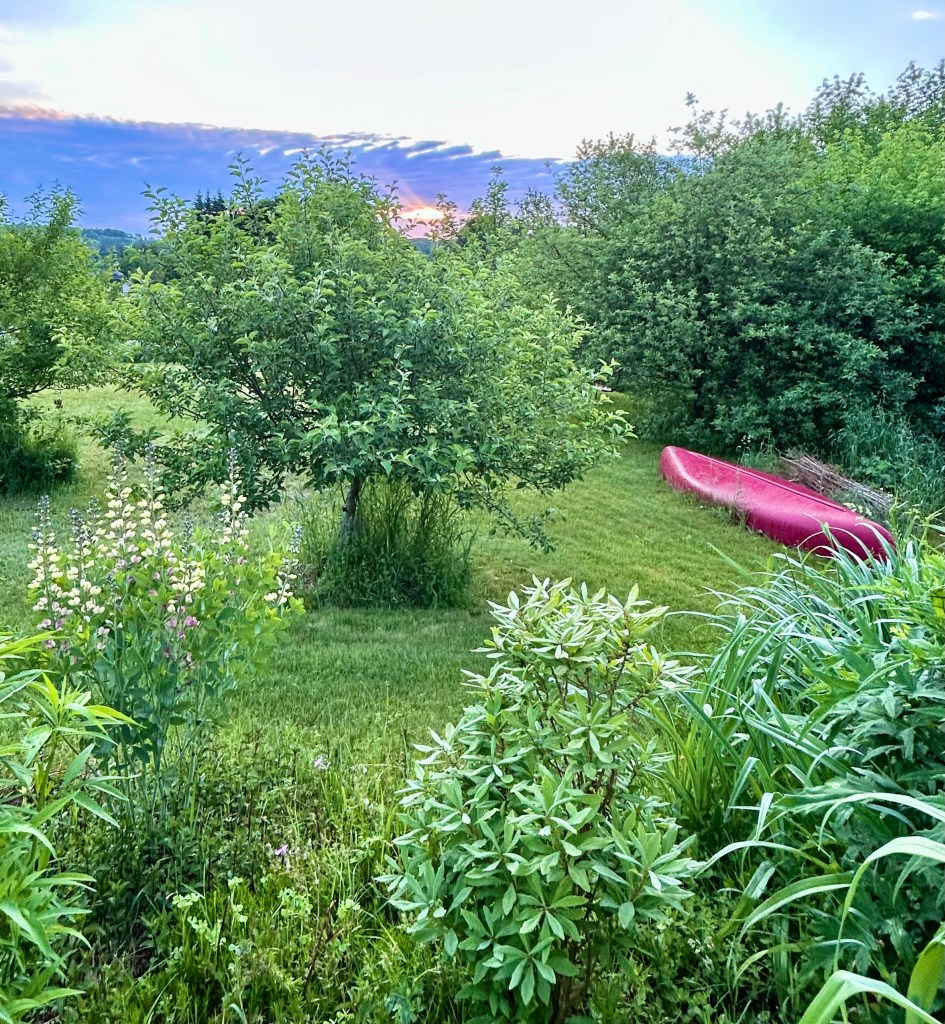
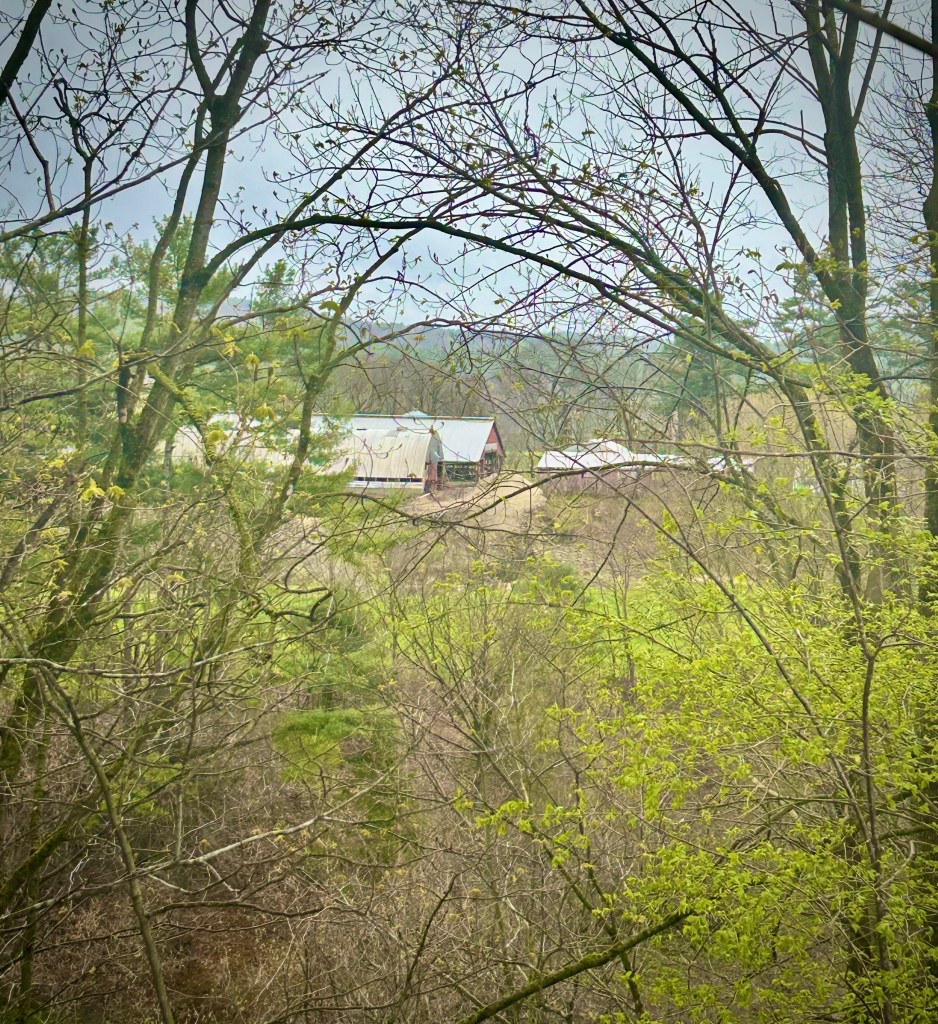
I’m walking up a fourth-class road when I spy a black shape moving along the upper end of the nearby hayfield. Vermont divides its roads into categories, from the interstates to dirt roads to the little-used former farm or forest roads that are snowed-cover in winter, mud-rutted in spring. I stand beside a wild apple tree, the blue view of the Worcester Mountains over my shoulder, and admire this bear, darker than midnight against the field’s glossy emerald. When green kindles in Vermont spring, it flourishes.

This place I’ve never walked, although I’ve seen maps and heard stories. The road treks uphill through the forest and dips down where Caspian Lake gleams, realm of summer visitors, but for the time, still the territory of the locals.

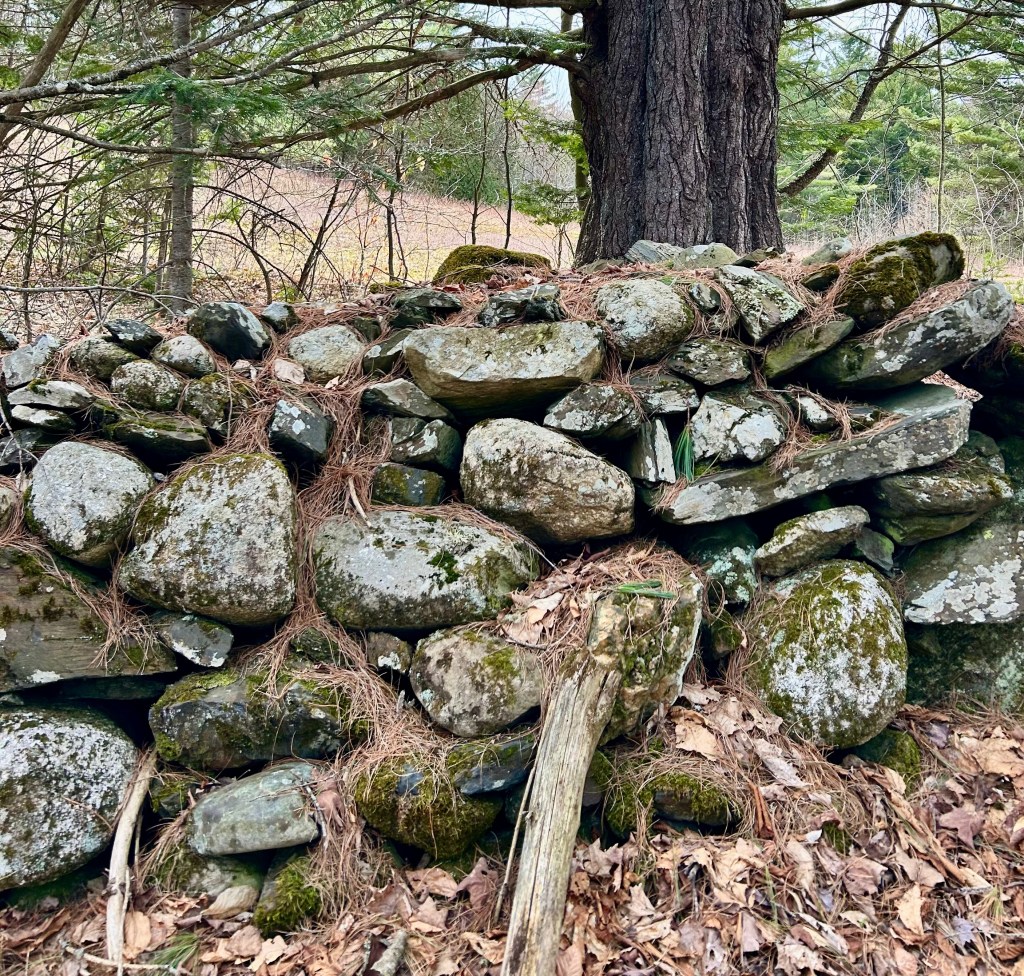
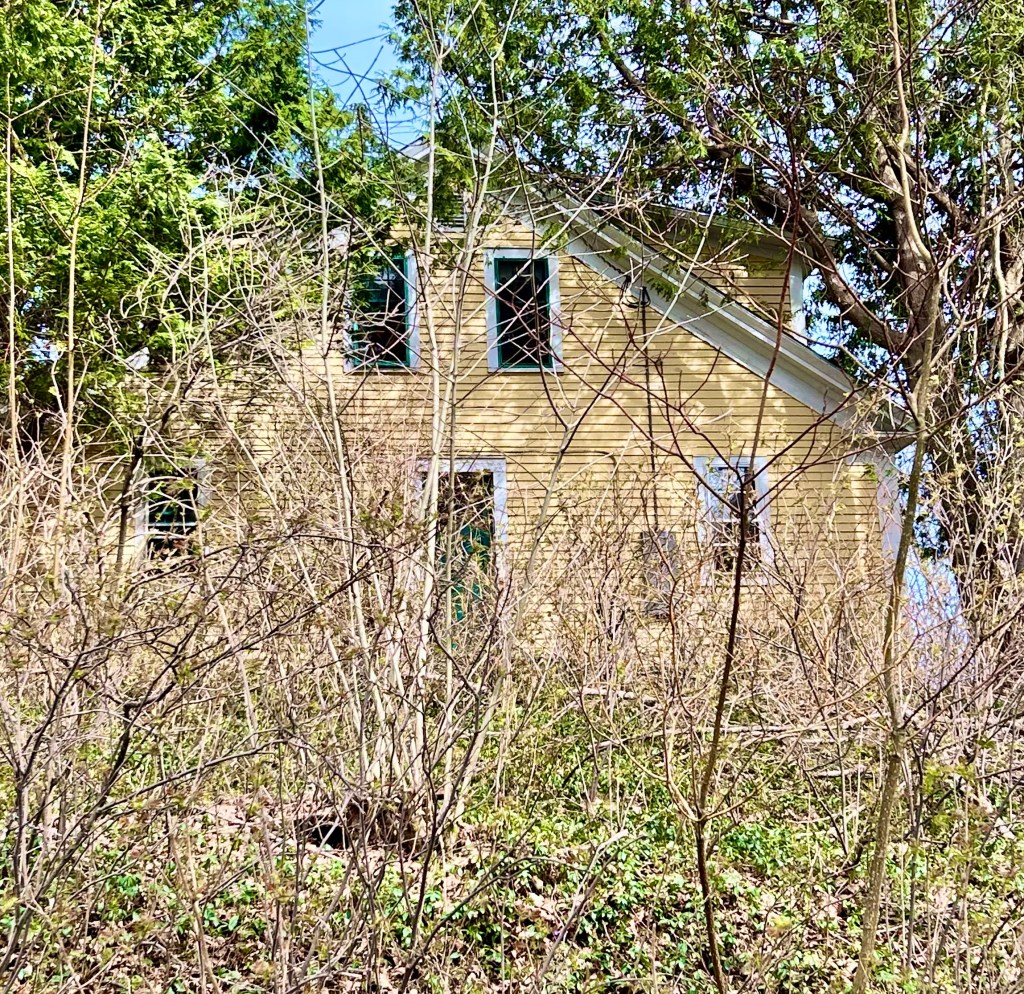
I find what I’m seeking and also what I’m not: the labor-dense stone walls whose once-upon-a-time fields are gone to forest, moss-covered cellar holes, twisted rusty remains of farm equipment. Peepers chorus. An old farmhouse with an enormous veranda on a hill must have once had a royal view of the lake, and endured bitter winter winds. Someone has tried to cut the wild reclamation from the house and mostly failed.

In the sunlight, I linger, wondering who lived here, their stories silent. The two-story house has large dormers and many windows; it’s not a fly-by-night, tossed-up structure. On my way home, I pause where I saw the bear, searching, but of course the bear has moved on. Three ducks fly low over my head. The earth exhales its sweetness of thawing mud, the turning-over of last autumn’s leaves, this summer’s great promise.

“Deep in the forest a call was sounding, and as often as he heard this call, mysteriously thrilling and luring, he felt compelled to turn his back upon the fire and the beaten earth around it, and to plunge into the forest, and on and on, he knew not where or why; nor did he wonder where or why, the call sounding imperiously, deep in the forest.” — Jack London

The truth is erasure.

Saturday morning, I chip at my day’s list, persistent: my thousand creative words, email that shouldn’t linger, the house chores of wood and compost. On the nearby trails, I ski and later drink coffee with my beloveds, and we ponder construction that will tie up this town, Hardwick, until the sundress-wearing season. At home again, I finish the 2025 taxes, stow things in boxes, preparing for a carpenter who will remove a kitchen wall and put a window in my kitchen. This plan I hatched while I was marooned in my house for months, struggling through chemo. Now, this winter, I wondered, Am I mad? Will I still proceed? But opening the heart of my house to the view of the village seems a hopeful act, a kind of creative resistance against dismal five-year survival statistics, an act of beauty in contrast to the darkening world.

I abruptly need the sky and the muddy earth beneath my boots. I consider phoning this friend or that friend to walk with me, but I doubt anyone will jump at the sudden request. On this ridgeline road, I see a friend who quickens my blood. We walk and talk for bit about the things that nourish my winter-worn soul: about the unexpected in our lives, about writing and doubt, an April event of poetry and art and food. About what Bashō called “the journey itself is home.”

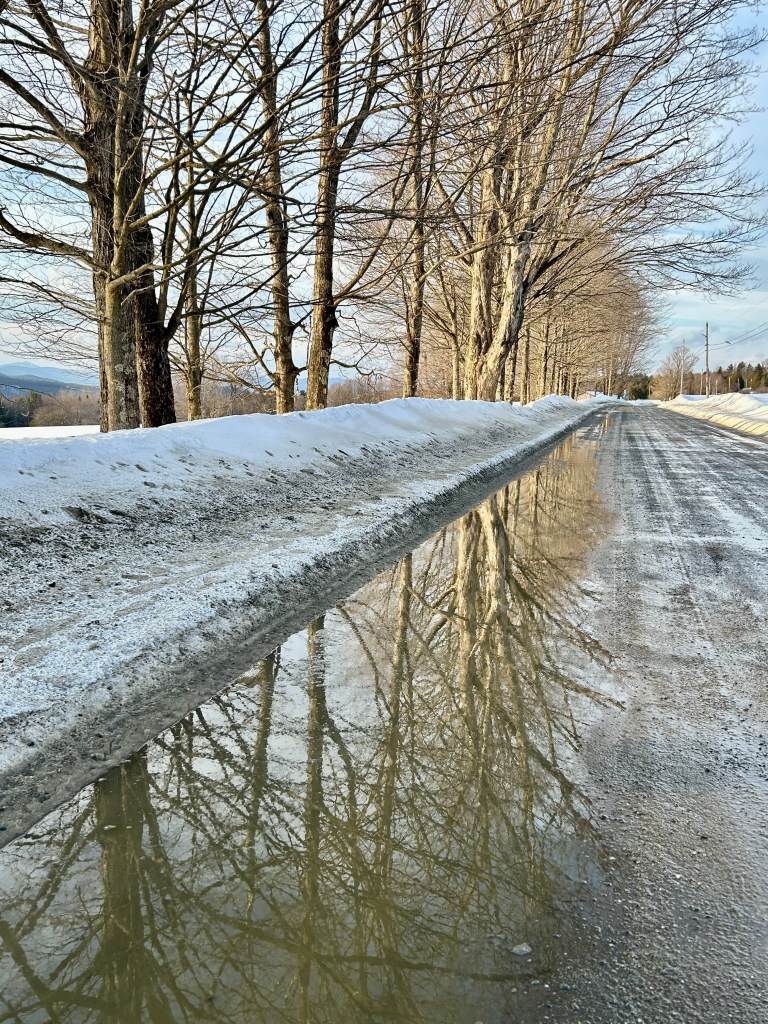
She heads home, and I keep on along the maples. All winter I’ve walked here. One frigid January, I’d gone too far and considered flagging a stranger in a car for a ride, but I didn’t. I kept on, as we all do. An eagle spreads its wings over a hayfield then disappears over a treeline. Blackbirds sing. A skunk waddles along the road. The snowbanks are above my head. The creature and I consider each other. Then, on our respective sides of the road, we each ease along. When I look back, the skunk is hurrying along, too.

Another spring. So many years I’ve lived through a New England winter, so many springs, and yet each March arrives as a surprise, a fresh reckoning. The wind smells of the opening earth. Twilight will soon be nestling in, and I’ll be home again, feeding my cats and the woodstove, eating a blood orange. A friend plans to visit, and we’ll keep each other company. Better to think of the days without names or numbers. Wiser to place these with a friend’s name, with skunk, puddle, blood moon.

You ask the sea, what can you promise me
and it speaks the truth; it says erasure.

… Nothing can be forced to live.
The earth is like a drug now, like a voice from far away,
a lover or master. In the end, you do what the voice tells you.
It says forget, you forget.
It says begin again, you begin again. ~ Louise Glück

Cold.

The cold lingers. A friend texts about walking, proposed temperature 5 degrees. It’s a balmy 3, the sun dazzling on fresh snow. A year ago, I sat miserably in her car, hardly able to walk around the high school — did I manage that loop twice? This end-of-January, we walk and talk. Later, sprawled before my woodstove, revising a manuscript that my cat uses as a nest, twilight and then darkness press against the windows. I have not forgotten how easily a body breaks, how rapidly the world shifts from wellness to suffering.

The world propels through flux, and while I’m (at least momentarily) emerging towards fuller health, so much human darkness deepens. My college student daughter phones from Burlington — Vermont’s big city on our own Great Lake — the streets jammed with protestors. The mayor issues a statement as officials prepare for an ICE invasion. “Stay steady,” she urges.

Under the moon hanging in the sky, we head downtown to the coffee shop to admire photographs of the northern lights. The photographer plays a short film of footage shot in locations the audience knows well, roads and lakes and a ridgeline above the village. Turns out, he wrote the music, too, weaving in calling coyotes and chirping crickets, loon songs. It’s no antidote, no balm, but a radiant reminder of the vast universe, of how the horizon shifts from black to pink to green, that we are driven by love of beauty, too. A steadiness.

On Frozen Fields

1 
We walk across the snow,
The stars can be faint,
The moon can be eating itself out,
There can be meteors flaring to death on earth,
The Northern Lights can be blooming and seething
And tearing themselves apart all night,
We walk arm in arm, and we are happy.

2
You in whose ultimate madness we live,
You flinging yourself out into the emptiness,
You - like us - great an instant,

O only universe we know, forgive us. ~ Galway Kinnell

Brief Thaw.

In the January thaw, a wind — balmy for winter — curls around my house, and all night long the chimes hung on the back porch jangle their melody. The chimes are the song of this house, in all the seasons of this northern climate.

Despite the thaw, the hours of these days are yet short. I wake ages before light bleeds over the horizon, my cats ready for breakfast, the woodstove in need of feeding, myself hungry for hot coffee and work. I gather what I can of my energy and cup this in my hands, gauging how the day lies ahead. Not so long ago, I could work, and work, and work. Offer me twenty dollars for a quick edit, and I’d jump. Post-cancer, post-chemo, not so.

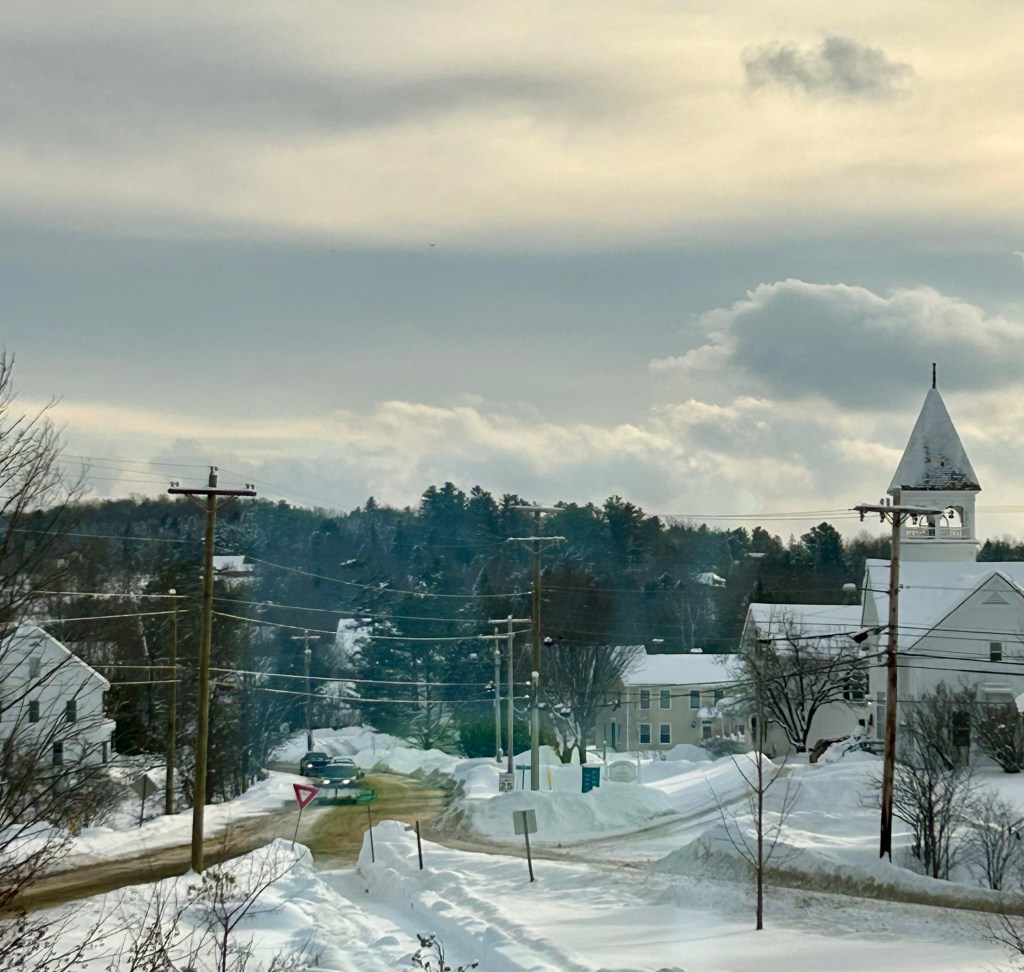
Walking downtown, I pass the coffee shop. Two friends at a window table wave at me to come in, come in. Inside, I shrug off my coat that’s in need of washing and set my backpack on the floor. We talk books and woodpile status, politics and the amnesia of American consciousness. Above the coffee shop is the yoga studio with the gleaming maple floors, where I stand at the window, watching traffic ebb into the diner parking lot. The river bends through the village here, heads westward beneath the cover of ice towards Lake Champlain, whose waters flow north. In the alley between this brick building and the next, the wind cuts upward. Snow drifts towards the sky.

There are days when I think that everything I know is upended. That snow has no mind for gravity.

Before dawn, I carry out ashes and stand in the dark, icicles dripping, cold breath from the snow grabbing my wrists. In the thaw, the earth smells of rotting compost, woodsmoke from my house and my neighbors’, the assured promise of spring, yet far in the offing.

… I work with the consciousness of death at my shoulder, not constantly, but often enough to leave a mark upon all my life’s decisions and actions. And it does not matter whether this death comes next week or thirty years from now, this consciousness gives my life another breadth… — Andre Lorde

Another Plot Point.

A friend inquires if my summer’s adrenaline, the post-chemo and post-surgery and cancer-remission wave of energy has waned, and, indeed, that has, the winter and cold and what’s called fatigue but is actually a lifeless bleak plain setting up quarters in my household.

Winter is a reckoning time. In a strange kind of way I begin to see the pieces of my life jostle into a pattern — childhood and college years and those years in my twenties when I ran back and forth across the country and then to northern Vermont, how I built a marriage and house, the young mothering years of children and friends, how we taught ourselves to sugar and run a business and I taught myself to write. Then I broke that life apart and took the children, created a new life, kept writing books, learned to view the world askance to keep danger from our door. Danger slunk in anyway. The world, indeed, is cause and effect, not a linear straight-shot but a dense sphere. Surely the human story is the same for you and me, with its endlessly profound and terrible and awesome variations.

This morning, the harsh cold has relented, just the slightest, snow sifting down, the blue dawn pushing away the night’s darkness.

I’m encouraged to seek “protective factors” which I glean as my daughters’ merriment, a purring cat on my chest as a I read by the woodstove, a walk with a friend on a snowy road. My heart longs for the season of those #10 Pond swims, with friends or without, the sun hot on my bare knees. Spectator to the loon world. Not iced coffee but hot coffee. Now, these days of small light. In a considered burst of optimism, I mail a carpenter a check in a card with snowy evergreens and seal our agreement. Come when the weather splits and put two more windows in my house. Open the view of the valley and the village. Another plot point.

What would people look like

if we could see them as they are,

soaked in honey, stung and swollen,

reckless, pinned against time? — Ellen Bass

100 Daffodils.

In this balmy late autumn, I walk with new acquaintances in an oak forest where I’ve never wandered. Oaks are sparse in the woods where I generally walk, these lovely-leaved beauties, the ground beneath them strewn with acorns, some broken, their centers chewed out.

I’m with other women who are unwillingly on a journey similar to mine — cancer and chemo, the shock of our worlds slashed apart. Our conversation drifts to the kindness of friends and strangers, and the flip side of kindness — a kind of harshness: why can’t you get on with your life since the chemo is finished? (a raw impossibility) and didn’t you eat enough kale? For the record, when my daughters were young, I grew three kinds of kale in my garden, fifty plants to carry us through the winter, fenced from the foraging deer. All that kale, so carefully tended, and yet, here’s the luck of your draw: cancer.

It’s a rare kind of privilege to walk with these women, listening, offering snippets of my own story. On this cloudy afternoon, these woods are light-filled through the barren branches, the poplars and beeches still shimmering patches of gold. One woman ventures, “All nature has scars.”

Every year, I dread this season of dwindling light, the creeping-in edgy cold, the giant fist of winter readying. And yet every late autumn, the falling leaves enchant, the wood stove’s warmth soothes, the moon gleams its crescent cut-out in the starry sky.

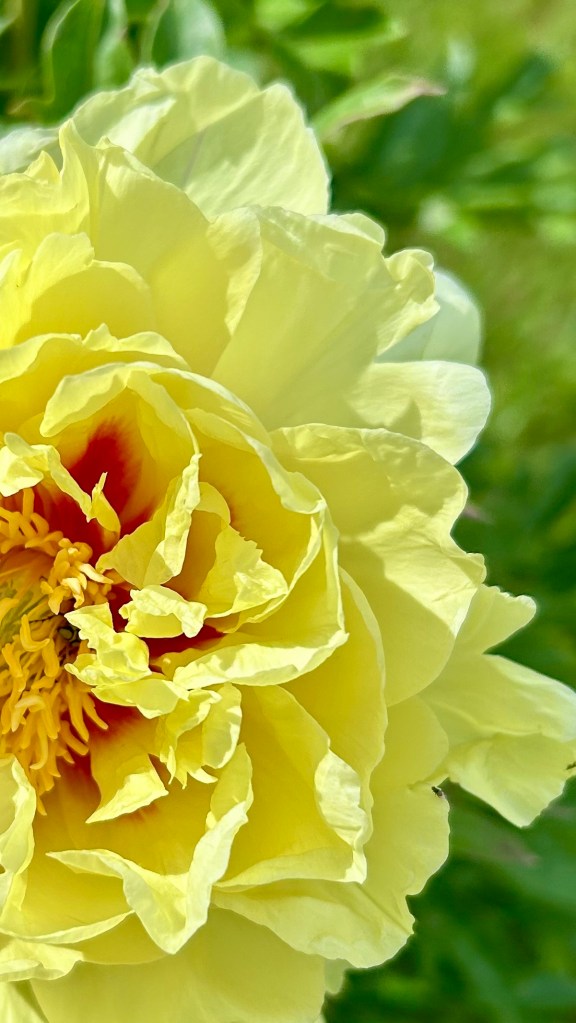
Writing this book about cancer has pushed me to read and gather facts and history, the scientific low-down. And yet, simultaneously, I appreciate more and more the great mystery of this universe. A friend counsels me that I can hold two things in one hand: knowledge and uncertainty. But these, too, are beyond numbers; this world’s mysteries are multitudes. My sister once remarked that cancer is the great leveler: it’s humbling. On a recent chilly morning, I planted one hundred daffodil bulbs: a meager offering to this sweet place where I live. The story behind these spring beauties will surely sink down and vanish into the sandy soil.

Auto Mirror

In the rear-view mirror suddenly
I saw the bulk of the Beauvais Cathedral;
great things dwell in small ones
for a moment.

Adam Zagajewski, translated from the Polish by Czeslaw Milosz and Robert Hass