I’m late to a meeting at the library I’ll participate in when I stop in the parking lot. In the wetlands behind the library, a red-wing blackbird sings. I can’t see the bird. This isn’t a flock; a bird calls and chirrups, that old familiar, unmistakable sound of spring. I’ve driven, in years past, on the hunt, just to hear this bird.
A few years ago, by chance I met a friend outside the Woodbury, VT, post office. We stood talking about something we found mutually so enjoyable, while in a winter-bare maple tree, a flock of these beauties sang. Spring! we marveled.
This year, I remember how long and hard mud season is, most rightfully a season worthy of its own true name. Hence, love of little things like tiny birds.
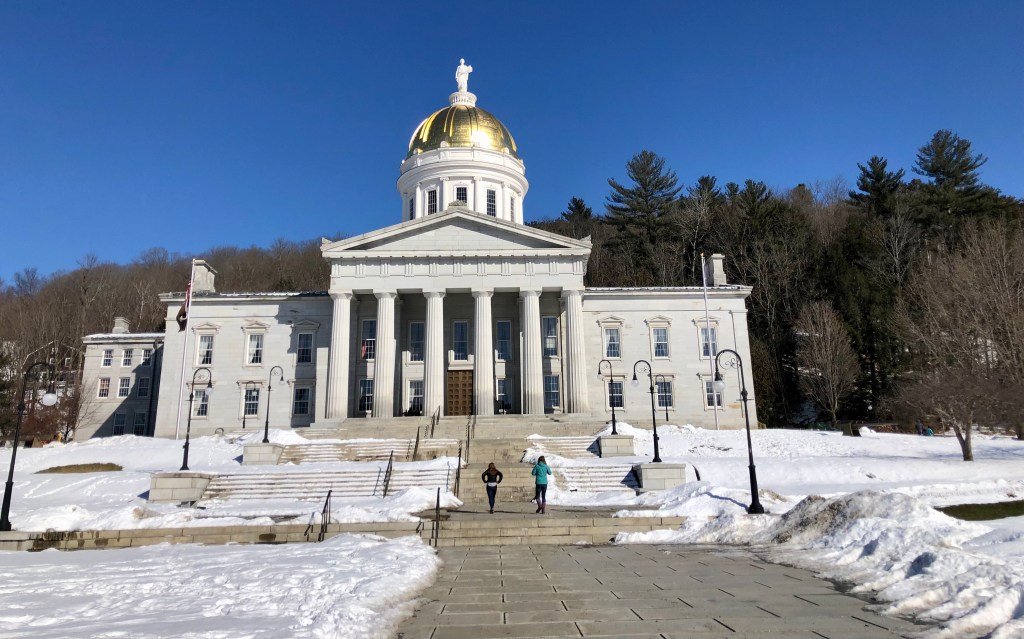
Sunday, we bought coffee and pastries in Montpelier (for a change of venue, a change of scene) and ate outside in the cold. There’s a pandemic, after all, and bakeries open on the weekend had closed their indoor seating anyway. None of us complained or even remarked — something I silently noted.
On this cold morning hardly anyone was walking. We passed a man sitting beside an apartment building, flossing his teeth. My youngest pointed out a bird gliding high above the state house. “Bald eagle.”
Bald eagles have recently been removed from the endangered species list in Vermont. I noted again how eagles are now part of our life. Last summer, in particular, we saw eagles frequently. I grew up in New Hampshire and never saw either an eagle or a loon my entire childhood. Now loons (also removed from the endangered species list) have always been part of my daughter’s life.
We walked up the street and then returned. The eagle was still silently gliding on its immense wingspan.
The air has turned this morning when I step outside in the dark with my bucket of hot stove ashes. Even without my coat, I’m not immediately shivering, and the cold doesn’t come at me with daggers on my face.
Beneath the starry sky, I gazed up at Ursa Major, a single gauzy cloud suspended overhead, as if in water. I’m reminded of frog’s eggs, those cushiony pillows I sought with my daughters when they were little. Every spring, we found clusters in ponds and in the ditches along our dirt road. We’d visit these clusters every day on our wanders. Sometimes the eggs hatched. Sometimes the clustered disappeared.
On this early February morning, beneath the stars, I stood for a few more quiet moments, thinking about stars and frogs’ eggs. Snow’s expected to move in soon, too.
As water given sugar sweetens, given salt grows salty,
The moon shines brilliantly tonight as I walk down the street to the co-op for cheese and cauliflower. Lady Moon: round as a dime and luminescent like no earthly thing.
In the best of times, January can rage like a shrieking stranger, a visitor who’s arrived with too many needs.
This year, time has slowed to incomprehensible. We wake; we do our things. Work and email. I paint a room. I endeavor to write another book. I keep Unstitched moving along.
The ordinary happens: snow falls. All day and into the night. When I wake in the morning, there’s inches and inches of fresh, sparkling snow. It’s not a blizzard, not feet upon feet. I have little trouble finding my Subaru in the morning. But the snow sugars our world for this day in utter beauty.
The rest of everything is still there — the pandemic, the crumbling American Empire, the chaos of human relationships in my house and all around — but walking home, the cold is so sharp that the snow squeaks beneath my boots. For a moment, I’m a child again, mystified that fluffy snow can yield a squeak. But there you go. A mystery incarnate.
Here’s an interesting essay emailed in by a reader about growing saffron in Vermont — yes, saffron & Vermont.
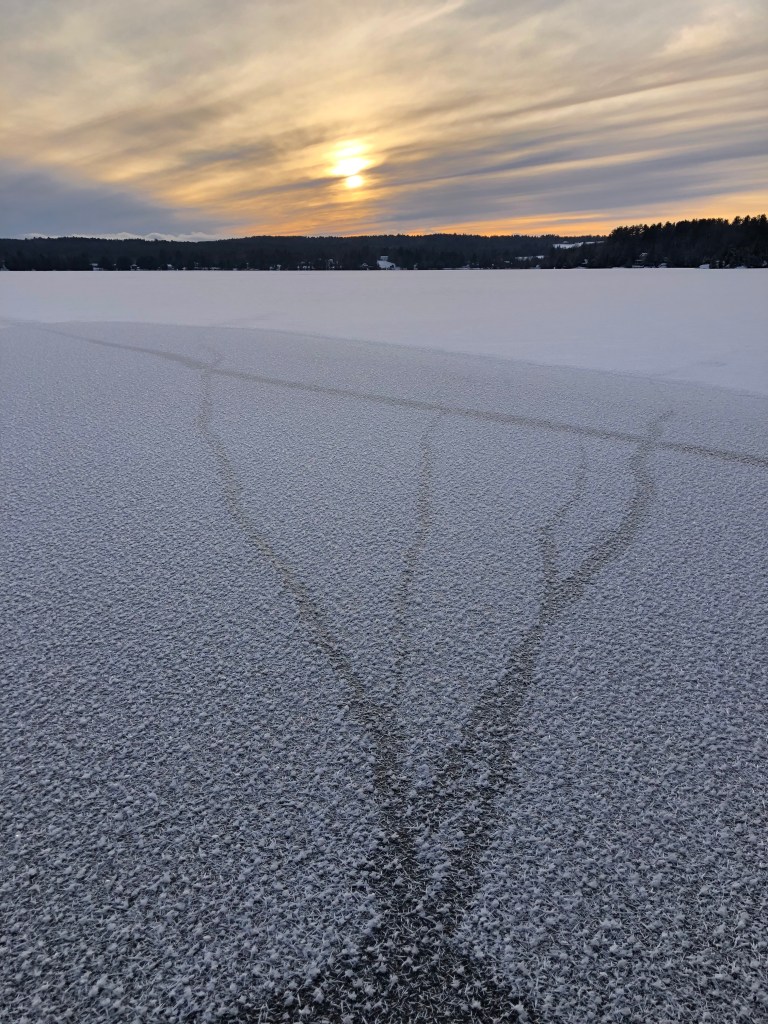
In the late afternoon, on a day just a little above zero, I walk through the woods down to edge of the lake. I come out of the woods where Porter Brook feeds into the lake, and the ice there, despite the cold, looks thinnish. There’s no one around at all. In the summer, that stretch of beach is noisy with vacationers. But now, even not a crow appears.
The post-holiday surge of Covid rages around us. These are not the cheeriest of days. My father, sister, nephew, and I — triangulated around the United States — decide to read and virtually converse about Benjamin Labatut’s When We Cease To Understand the World — in essence, the perfect title for our times.
Live in New England long enough, and you crave the return of ice, the experience of cold and clean winter, the turning around of seasons. The ice will pass, too. Cold, I crouch at the ice’s edge. A squirrel skitters out of the hemlocks and chitters at me before scampering off. Then it’s just me for a moment, and all that sky and the mysteries of the frozen lake. In January, the days give cold and a few extra minutes of sunlight….
Here’s the opening lines of Labatut’s book:
In a medical examination on the eve of the Nuremburg Trials, the doctors found the nails of Hermann Göring’s fingers and toes stained a furious red, the consequence of his addiction to dihydrocodeine, an analgesic of which he took more than one hundred pills a day. William Burroughs described it as similar to heroin, twice as strong as codeine, but with a wired coke-like edge, so the North American doctors felt obliged to cure Göring of his dependency before allowing him to stand before the court. This was not easy. When the Allied forces caught him, the Nazi leader was dragging a suitcase with more than twenty thousand doses, practically all that remained of Germany’s production of the drug at the end of the Second World War. His addiction was far from exceptional, for virtually everyone in the Wehrmacht received Pervitin as part of their rations, methamphetamine tablets that the troopers used to stay awake for weeks on end, fighting in a deranged state, alternating between manic furore and nightmarish stupor, with overexertion leading many to suffer attacks of irrepressible euphoria.
A 13-year-old or so boy is fishing at the edge of the pond when my friend and I walk down in the evening to swim. He nicely shuffles to one side, and then we’re off.
The evening sky this summer has been especially enchanting — muted in color, pale peach sky with gentle blue.When we’re finished swimming and laughing, we stand for a moment on the weedy shore, and I point out a luna moth dipping and rising — part of the evening charm, like an Impressionist painting. Suddenly, a bird pursues the moth, then swallows it. A ragged wing falls.


 Stony Soil Vermont