Understanding Ice.

Caspian Lake, Greensboro, Vermont

In the late afternoon, on a day just a little above zero, I walk through the woods down to edge of the lake. I come out of the woods where Porter Brook feeds into the lake, and the ice there, despite the cold, looks thinnish. There’s no one around at all. In the summer, that stretch of beach is noisy with vacationers. But now, even not a crow appears.

The post-holiday surge of Covid rages around us. These are not the cheeriest of days. My father, sister, nephew, and I — triangulated around the United States — decide to read and virtually converse about Benjamin Labatut’s When We Cease To Understand the World — in essence, the perfect title for our times.

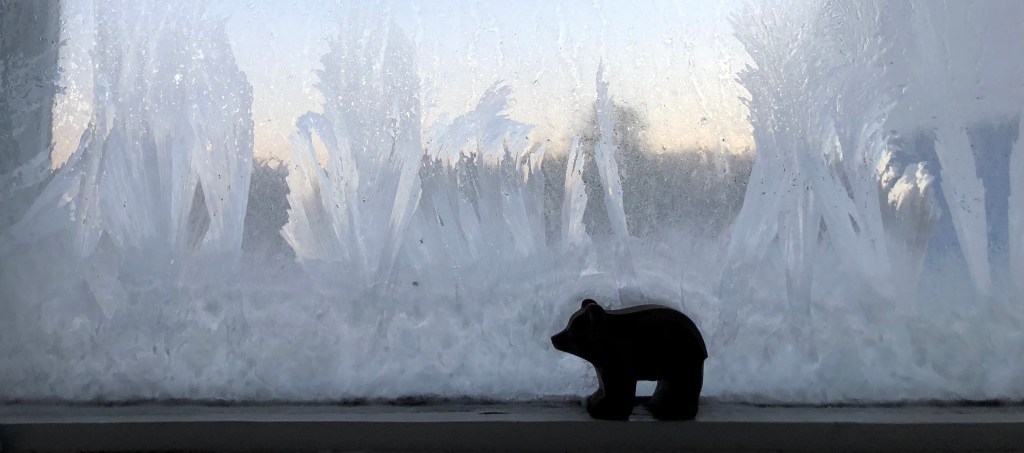
Live in New England long enough, and you crave the return of ice, the experience of cold and clean winter, the turning around of seasons. The ice will pass, too. Cold, I crouch at the ice’s edge. A squirrel skitters out of the hemlocks and chitters at me before scampering off. Then it’s just me for a moment, and all that sky and the mysteries of the frozen lake. In January, the days give cold and a few extra minutes of sunlight….

Here’s the opening lines of Labatut’s book:

In a medical examination on the eve of the Nuremburg Trials, the doctors found the nails of Hermann Göring’s fingers and toes stained a furious red, the consequence of his addiction to dihydrocodeine, an analgesic of which he took more than one hundred pills a day. William Burroughs described it as similar to heroin, twice as strong as codeine, but with a wired coke-like edge, so the North American doctors felt obliged to cure Göring of his dependency before allowing him to stand before the court. This was not easy. When the Allied forces caught him, the Nazi leader was dragging a suitcase with more than twenty thousand doses, practically all that remained of Germany’s production of the drug at the end of the Second World War. His addiction was far from exceptional, for virtually everyone in the Wehrmacht received Pervitin as part of their rations, methamphetamine tablets that the troopers used to stay awake for weeks on end, fighting in a deranged state, alternating between manic furore and nightmarish stupor, with overexertion leading many to suffer attacks of irrepressible euphoria.

A Little Meal

A 13-year-old or so boy is fishing at the edge of the pond when my friend and I walk down in the evening to swim. He nicely shuffles to one side, and then we’re off.

The evening sky this summer has been especially enchanting — muted in color, pale peach sky with gentle blue.When we’re finished swimming and laughing, we stand for a moment on the weedy shore, and I point out a luna moth dipping and rising — part of the evening charm, like an Impressionist painting. Suddenly, a bird pursues the moth, then swallows it. A ragged wing falls.

And so much for the make-believe world.

Sweetness

Rain.

This May has been exceptionally beautiful, with a profusion of blossoms and warmth. Living in a village now, we reap the benefits of lingering outdoors in the evenings, with no black flies gnawing our bare skin.

In this vaccinated world, a headiness rears, too. My daughters are suddenly gone, this way and that, one grown up, the other nearly so.

In the evening, I sit on the covered back porch, breathing in the scents of lilacs and rain.

The drama of spring unfolds around all of us, blessedly so, this year.

Twilight Walk

On these warm spring evenings, my daughters and I often walk through the town forest and circle around back to town along Bridgeman Hill Road. The woods are the solace of living in town, sprinkled now with spring beauties and red trilliums and gold trout lilies.

At the high school, we watch a young teen drive a pickup around the parking lot with his father, the truck lurching into gear as the teen finds that sweet spot between clutch and gas. As the dusk drifts down, watching this kid seems almost wildly hopeful as he turns and loops back again around that long parking lot.

This whole walk I’d been trailing my daughters, listening to the evening birdsong in the treetops, for some reason remembering the man who coached basketball for many years at the high school. He’d dug a basement for my former husband and me, many years, when we bought that first eight acres. I’d run into him a few years ago when we were both pumping gas. As the world goes in little towns, we’d each heard small strands of gossip about each other, and we caught up about what we were each doing for work.

Then I turned the key to my car and asked if he would listen to a grinding sound in my car’s engine.

Water pump, he said, and then asked if I needed help fixing it.

I thanked him and said no, I was fine. He went into his day, and I into mine. On my way to work that morning, the water pump failed.

The teen turns on the headlights. Back at my car, my daughter gets in the driver’s seat, ready to drive — not home, but somewhere, anywhere.

I make her wait, though; I don’t get in the car. I stand there for a moment longer, the night sprinkling down, the peepers singing, and that boy making a long slow turn in the parking lot. Around us, the ineffable mystery of the world widens around those two spots of light.

Old Photos

The couple who last owned our home mail us old photos. When they bought the house, the 100-year-old dwelling was in ragged shape. My daughters and I spend some time looking at how the house has changed, and how it hasn’t.

I bought the house in good shape, and now we’re wearing into it, scraping and chipping at its shininess with our use. In the spring, we’ll open all the windows and polish our house again. In the summer, I’ll paint, as paint perpetually falls off in New England.

Once, I had thought to sell and move when my youngest graduated from high school. Now, like everything else in our collective lives, the future is uncertain. Shelter in place — a phrase I once believed would never apply to our Vermont life — directs the shape of our lives.

In the afternoon, I ski through the woods on the nearby trails. Just as I click on my bindings, I remember last night’s dream of a snowy owl… and then I wonder, truth or reality? I stand there alone, in the cold and under the overcast sky, wondering. For just a moment, I’m not sure. Maybe I really did see that elusive owl. Then I push off into the woods, silent but for the sound of skis over snow.

Snow, Saturday, Living in History

Saturday morning, we wake to a snowfall — gorgeous fat flakes swirling down — the kind of sparkling snow that miraculously turns the world brand-new and utterly beautiful.

In early afternoon when I return from work, the girls have shoveled the paths and driveway and deck. Inside, they’re drinking tea in front of the wood stove and putting together a puzzle my sister sent from Virginia, a pretty blue puzzle with birds.

I stand at the glass door drinking coffee, thinking where I stood that morning, on the shores of Caspian Lake, its center obscured by drapes of falling snow. Bundled in hats and masks and scarves, I stood talking with another woman about the small town planning process. Then our conversation wandered into the oddities of human life, how determined we all are at times — and I’ll put myself firmly there — to keep our attention focused on our own little stamp of land and home, be it a postage-stamp-sized piece or hundreds of acres. Meanwhile, the snow, the rising and setting sun, the wandering woodland creatures, continue on.

Saturday afternoon, I claim my own place near the fire and read The New Yorker‘s recent “The Plague Year” by Lawrence Wright, reading aloud pieces to my daughters, saying, This is the history you’re living through. This is your story, too…. It’s a lesson for me, too, when I dream of living elsewhere, where sleet doesn’t fall, where the cost of living isn’t crazy-high, where the sun shines even in the heart of winter — a reminder for me to embrace my own accidental luck to live here.

Nations and states that have done relatively well during this crisis have been led by strong, compassionate, decisive leaders who speak candidly with their constituents. In Vermont, Governor Phil Scott, a Republican, closed the state early, and reopened cautiously, keeping the number of cases and the death toll low. “This should be the model for the country,” Fauci told state leaders, in September. If the national fatality rate were the same as Vermont’s, some two hundred and fifty thousand Americans would still be alive. 

— Lawrence Wright

More found stuff…