Wood.

Friday, the fire in the wood stove gone cold, I shovel out the ash and discover two honeycomb boxes. I’ve been cleaning this stove for three years now, but I’ve never taken these pieces apart. The manual cautions me to be gentle. So I’m gentle.

The first essay I had published in a slick magazine, Taproot, was for their Wood issue. In those days, we burned countless cords of wood every year, for the few cords in our house to the many more to make maple syrup. Wood was far more verb than noun in our house; we did wood.

In my wooden house, whose floor joists in the basement still have ribbons of bark, on my maple floor, I empty ash and soot and creosote into a metal sap bucket. I kindle the fire with crumpled newsprint and ripped cardboard. The cats sprawl on the rug, satisfied as the heat suffuses our house again.

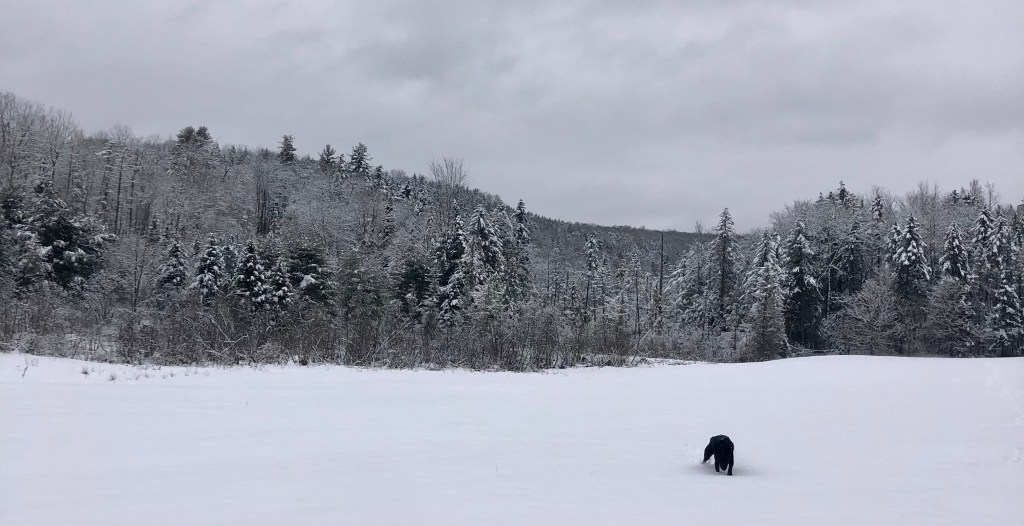
The late afternoon is raw and damp. So much snow has buried us in. I ski on a section of former railroad bed where I’ve never gone before, up a long slope fenced in by a cedar forest. There’s no one around, not a dog walker, not a snowmobiler, just me and the crows. At a crest, the valley below opens. I’m above a large dairy farm dug deeply by barns and fields and family generations into what had once been forest.

The sun has melted a section of trail to slush here. A cold wind blows down from the north. I stand here for a bit, stamping slush from a ski, then I turn, too, and head back through the forest.
“Things Take the Time They Take…”

Walking this afternoon, I’m reminded of Sylvia Plath’s line, The winter landscape hangs in balance now… What a long balance it might be. Nonetheless…

A pileated woodpecker swoops down from a branch above my head and disappeared into the woods. I take this as an auspicious sign. Ides of March. More snow moving in. Nonetheless….

Things take the time they take. Don’t
worry.
How many roads did Saint Augustine follow
before he became Saint Augustine?

— Mary Oliver

Wet Gloves, Grievances, Blessings.

It’s been awhile since I did a carpool or handoff along the road — once a mainstay of my life. Seems like I spent hours of motherhood waiting at some designated place. I leave early to have this little pocket of time, a few minutes, no more, to watch the sky darken. I bring a book, too, more out of habit than anything else.

Vermont highways are lonely and busy, with stretches of time where you can walk down the center line, and then times when you risk your life (actually) to walk those yellow strips. The girls are laughing when they arrive. I hand over my daughter’s gloves, warm from my car heater as I tried to dry out the wet remains of yesterday’s skiing. I stand talking, shivering in my sweater. I’m sweaty from skiing, and I’ve forgotten my coat. The girls are busy, busy, happy in a plan of their own, my daughter’s hair still in the braids I wove for her this morning.

The girls drive away. I head back to my car, sliding in my plastic-soled ski boots, and someone I’ve known for years pulls over and asks if I need help. Good lord, I laugh. Because our kids played together as toddlers, I feel I can start right in and so I do. I begin with the bathroom sink drain that I need to take apart, and how does anyone endure the college app process, and am I ever going to remember to clean the inside of my windshield, save for when the sun hits it and blinds me?

I’m really laughing by then, and she is, too. I lean against my car — again, shivering, shivering — while we exchange the usual kid and life updates of people who know each other but sometimes go years without talking. The cold air comes down in this sweet-spot crepuscular moment as the night slowly floods in. She leaves, and I stand for a moment, looking up for the first stars. Such little cares I’ve listed, the stuff of living, blessings more than grievances.

And then I’m on my way, too, leaving the river and road, at least for now.

History, Yellow Wallpaper, Gas Station.

On my way home, I stop to fuel my Subaru. A light snow falls, icy around the edges, barely sharp enough to tease my cheeks as I stand looking up. It’s after dark, and the people are coming and going in the convenience store with cups of coffee and bottles of wine and white paper cartons of fried food. The river curves behind the store and the attached garage, silently bending through town, water running beneath the frozen surface.

The evening before, my daughter asked me about The Yellow Wallpaper, the novella she’s reading for class. I remembered the free copy I picked up in high school, dirty and water-stained — a copy I probably snagged from my high school floor. This is the season of freeze and thaw, freeze and thaw, the long slow slog towards spring. In the late afternoons, skiing, the sunlight pushes through the forest. Some days, cold. Some days, warm. So it goes.

Life is a verb, not a noun.

— Charlotte Perkins Gilman

Laughter. Moonbeams.

Ice Fishing, Caspian Lake

A profound cold stills our world for a few days, narrows our lives. All night on Friday, the wind screams and howls. By Saturday afternoon, the wind drops. I ski out to the river. The air is broken glass, so sharp breathing hurts.

To celebrate my oldest daughter’s birthday, we eat at a little restaurant/bar in Plainfield where I haven’t been in fifteen years. We’re at a back table so cold that the other three keep on their jackets and I note the usefulness of my handknit sweater. This observation impresses no one except myself. My daughter orders a drink with a lemon peel. The food is scrumptious, rich with garlic.

In their zipped-up jackets, side by side, my daughters talk and laugh with their ongoing story that includes frozen pipes, getting lost, a red prom dress, what happens when a car is started at 27 below zero, and the IRS. Outside, a round moon is ringed with yellow luminescence, so brilliant the sky around the moon is blue, surrounded by night’s black. Our boots crunch over ice as we list the moon’s might: tides and weather, childbirth and madness, the beauty of moonbeams.

In writing you work toward a result you won’t see for years, and can’t be sure you’ll ever see. It takes stamina and self-mastery and faith. It demands those things of you, then gives them back with a little extra, a surprise to keep you coming. It toughens you and clears your head. 

— Tobias Wolff

Bobcat. Saw-Whet Owl.

I arrive a few minutes early to meet my friend for coffee and look for a window table to open my notebook. A writer I know just a little is eating a ham and cheese sandwich and asks me to sit down. He’s old enough to be my father if he began fatherhood at a young age, which I know he didn’t. He immediately tells me two things: he’s waiting for his back road to be sanded and he saw a bobcat in a tree behind his house that morning. He describes the cat’s reddish fur, and I ask detailed questions about the wild creature’s size and location and poise. My friend arrives and they keep talking about San Francisco, and then he tells us about studying with Joan Baez at The Institute for the Study of Nonviolence.

The bakery is at a busy intersection in Montpelier. Through the window, I see people in colored winter coats. Until the pandemic, I often brought my laptop to work at this bakery and the one across the street that closed a year or two ago. Two blocks up is the public library where I wrote long sections of my last book. None of these places I’ve returned to work. Like everyone else, my life has changed, my habits recreated.

The bakery is closing. The day moves along. My friend and I walk through Bear Pond Books. She buys me a novel, hugs me goodbye, and heads on her way. I walk the long way back to my car. That night, I dream about the saw-whet owl my daughter and I glimpsed in the woods behind our house. A toddler, she pointed at the hemlock branch where the tiny bird was nestled in the greenery, its eyes wide-open. We stood there for the longest time, wordless, our breath frosty clouds in the winter air.

“… nothing is a promise, but that beauty exists, and must be hunted for and found.”

— Joan Baez