My Long-Ago Mentor

The children’s librarian in the town where I grew up — Goffstown, New Hampshire — not only offered me first dibs on brand-new books (I began reading Judy Blume’s Deenie while walking home), she also came to my wedding. Every summer, I fill the glass purple vase she gave me for a wedding present.

So, when we were talking about the Giving Back issue at Kids VT — the magazine where I’m on staff — I wanted to write about Betsy Elliott. We aspired to write particularly about a few of the many people who give so generously, so meaningfully, without any expectation of return — maybe a kind of antidote to our troubled world. Here’s my short essay.


uyw

Fat Garden

A monarch butterfly followed me to the post office. Since the store closed last year, the village is quiet — only a garage and the post office remain open, and the post office keeps merely afternoon hours. Save for the elementary school, the town feels emptied out.

With no one around, I walked with the butterfly along the dirt road, until the winged beauty turned and fluttered over the weeds along the stream.

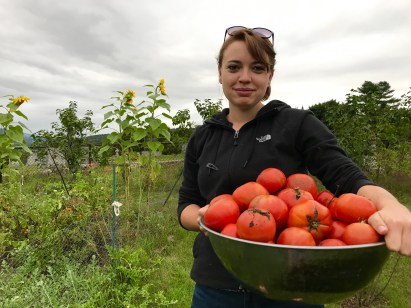
September: with the weather still warm, the frogs sang last night. Just before dusk, the girls and I picked a mountain — and then a mountain more — of tomatoes from the garden. More to put up. The younger daughter keeps track, satisfied, with our harvest.

IMG_3348

Symphony of Our Small World

In high school, hidden in the upstairs of my parents’ barn, I read Russian literature — The Brothers Karamazov and War and Peace — I read about life behind the Iron Curtain, Darkness at Noon, Solzhenitsyn.

Late last night, the cats and I read M. T. Anderson’s Symphony for the City of the Dead: Dmitri Shostakovich and the Siege of Leningrad, a book filled with hunger, fear, and love.

These summery, hot days continue to unfold, a world apart from coal-less winters in Russia. Our days are busy, jammed with my multiple work endeavors, with a daughter in middle school, and soccer practices and games, with her babysitting and my older daughter’s tender young adult life — can I build a tiny house? will I fall in love? — with pickling green beans and putting up salsa and somehow painting the upstairs floors while listening to Rumblestrip podcasts, and swimming at the end of the day as often as possible.

This life, messy with creativity and doubt, with love and grief, is lucky beyond belief. Thank goodness, I remember this at times.

Shostakovich states that at the beginning of the Seventh (Symphony) he depicts the peaceful life before the war in the quiet homes of Leningrad. But to a listener in Iowa it could mean the meadows and the rolling hills around his home. After the fantastic theme of war, Shostakovich has put into his music a lament for the dead — and the tears of a Russian mother and of an American mother are the same.

IMG_3286.jpg

We’re All Authors

Yesterday, while my 19-year-old fried beef for dinner yesterday, I kept handing her vegetables to chop — onions and garlic I just pulled, some leek thinnings, a few leaves of kale.

She chopped and stirred and talked. She gives me the story of her life, daily. Tempestuous and brave and loyal by nature, her life is chock-full. When I was that age, I drove an old VW bug I bought for $200 with waitressing cash. A boyfriend taught me to adjust the valves. I was shy, so terribly shy. When I tell my younger daughter just how shy I was, she doesn’t believe me. Last summer, a woman hollered out her car window at me for jaywalking in downtown Hardwick, I walked over to her, and — while she was marooned in construction traffic — I offered her an earful about driving too fast and why I jaywalk. Understandably, my daughter was mortified. Good lord, woman of that car, if you ever read this, I apologize.

Stories change. All our stories change, through grief and sadness, but through wonderfully fantastic things, too. I see my tall, lovely young-woman daughter pondering this — where do I want to steer my life? Interspersed with vegetable washing, I’m glad to be the listener, offering an occasional Socratic, What do you think you should do?

Anyone who listens to Steve Almond and Cheryl Strayed’s Dear Sugars podcast might want to check out Almond’s new book, Bad Stories: What the Hell Just Happened to our Country? 

Almond writes:

I’ve placed my faith in stories because I believe them to be the basic unit of human consciousness. The stories we tell, and the ones we absorb, are what allow us to pluck meaning from the rush of experience. Only through patient interrogation of these stories can we begin to understand where we are and how we got here.

IMG_2865.jpg

Postcard from Vermont, July

An elderly woman and I stand in the library’s open door, sheltered by the overhang, watching rain move in, great billows of fine drops rushing across the field.

Summer people visit the library on these steamy afternoons, in a their winding-down, relaxed, vacationing way. We’re different here, one man tells me. I like how we are in Vermont. 

Boys with their faces painted a greasy blue-and-black circle around the library and school, hiding in the woods and behind the greenhouse, in an elaborate game. Two best-friend girls stroll in, return books, ask for fish crackers, and request more books. When I leave that afternoon, the girls are still there, lying on the slide’s top platform, staring at the cloud-heavy sky, talking.

All afternoon, bits and pieces of people’s lives knock into mine: a woman applying for a job online, a saleswoman over the phone, a couple who needs a letter written.

Later, when I’m alone again, gathering strewn puppets and closing windows, I realize my phone has a message. Someone dialed my number without realizing it, and I stand in the doorway again, in the sweet post-rain scent, listening to that odd audio window of others’ conversation. A gangly-legged heron flies overhead, then disappears over the trees. I erase that unintended recording and lock up for the day.

When I was nineteen,
I told a thirty-
year-old man what a
fool I had been when
I was seventeen.
‘We were always,’ he
said glancing down, ‘a
fool two years ago.

— Donald Hall

IMG_2847.jpg

Define Our Life Thus

Walking home through the cemetery fields, I noticed how brown the grass is — pretty much withered.

That’s a particularly beautiful walk, high enough up above the village that I can see how Hardwick lies in a narrow valley along the river, cradled between forested mountains.

So much of my life often seems defined by absence — the children’s missing father, not enough money, shy of parenting patience, lacking skills to fence in my daughter’s chickens. And yet, here we live, nestled between these mountains, with two sweet cats and three laying hens.

Reminder to self: define by what is, not what isn’t.

IMG_2601.jpg

Montpelier, Vermont