A stranger in the post office asks me if I can free her mail from her box. It’s a narrow box, nearly at the bottom of the wall. I crouch down, extracting envelope by envelope, taking care not to tear the paper. It’s clear she hasn’t collected her mail in some time. She waits patiently while I tug with some effort. While I hand up envelopes and fliers and magazines, I talk and talk, rambling on about the mail and whatever inane thing drifts into my mind. Around us, people open their boxes, collect their stuff, and disappear. I keep at my project, now kneeling. Finished, I shut her box door.
She thanks me, and we go our separate ways. Walking home, I keep thinking about that simple thing, how easy it is to give to a stranger. There’s likely an obvious lesson here. But one thing is clear, I got as much from the mail extraction as this woman.
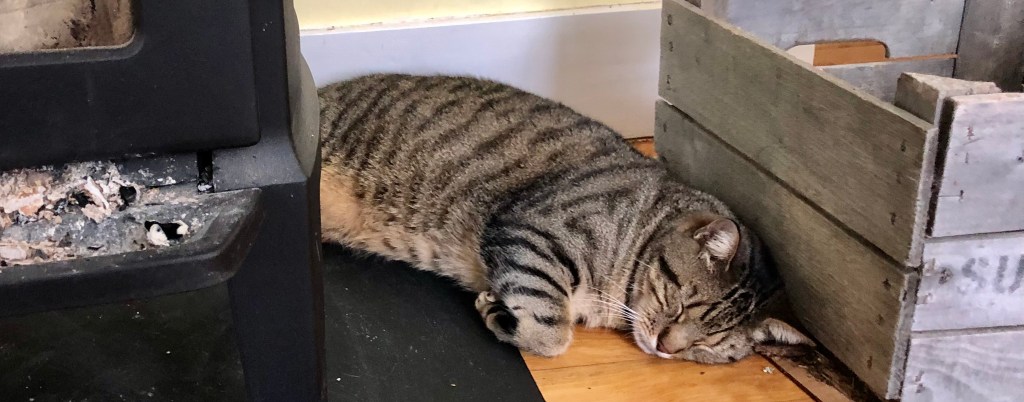
… A cold and soggy April. Miniature daffodils push up through black soil. I keep feeding my wood stove.
My teen and I are in an office filling out paperwork and the last question asks her how apprehensive she is about dental work.
She stares at me. “Why on earth,” she asks me in her reasonable way, “would I reveal anything like that?”
I note it’s a standard question. Her answer: that’s a ridiculous question.
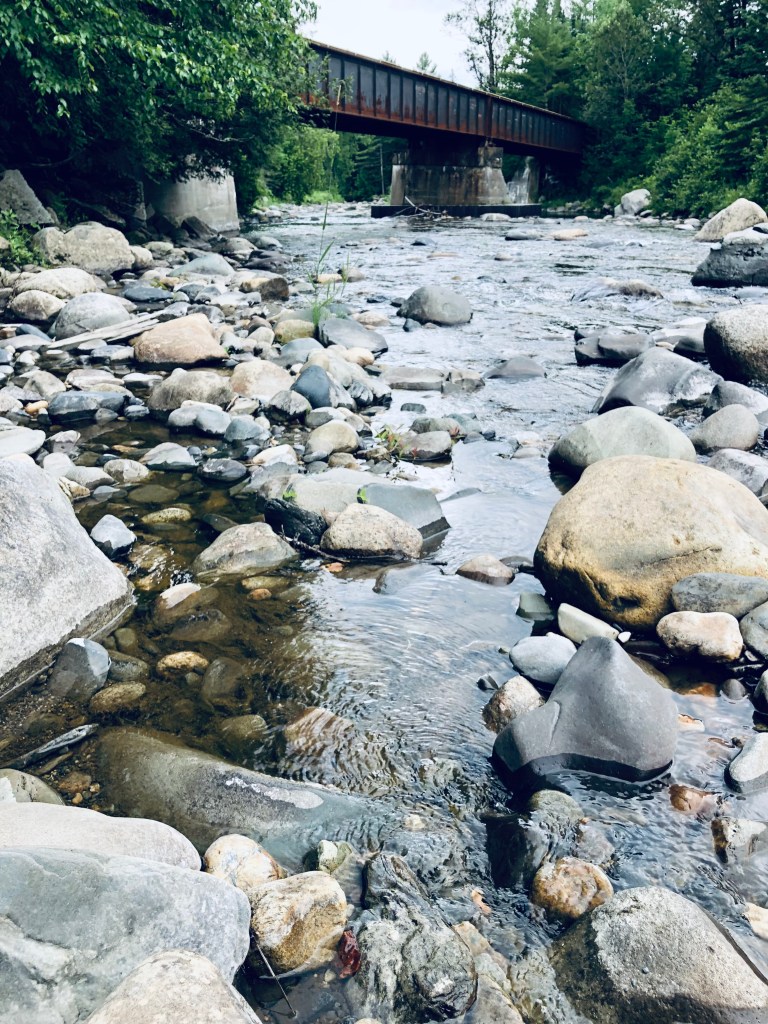
It’s another cold afternoon — a mostly sunny day in Northern Vermont — in a winter where cold has now dragged on well beyond its welcome. We’ve driven a little distance and taken a detour along a river whose middle has thawed. Only its shores are frozen.
A couple of decades now into parenting, I’ve observed children are formed by their parents’ lives — and not, too. She’s driving, and I seem to have taken up residence permanently in her passenger seat — a place I inhabit uneasily and definitely gracelessly. We drive and talk. Youth, I think, repeating the word soundlessly, like a mantra; I’m drawn to its utter ebullience and brashness, like the sunlight we all desperately need.
We remark on the price of gas. Our sheer luck at the happenstance of living in the Shire of Vermont right now. Of the war in cities and villages and homes on the other side of the globe.
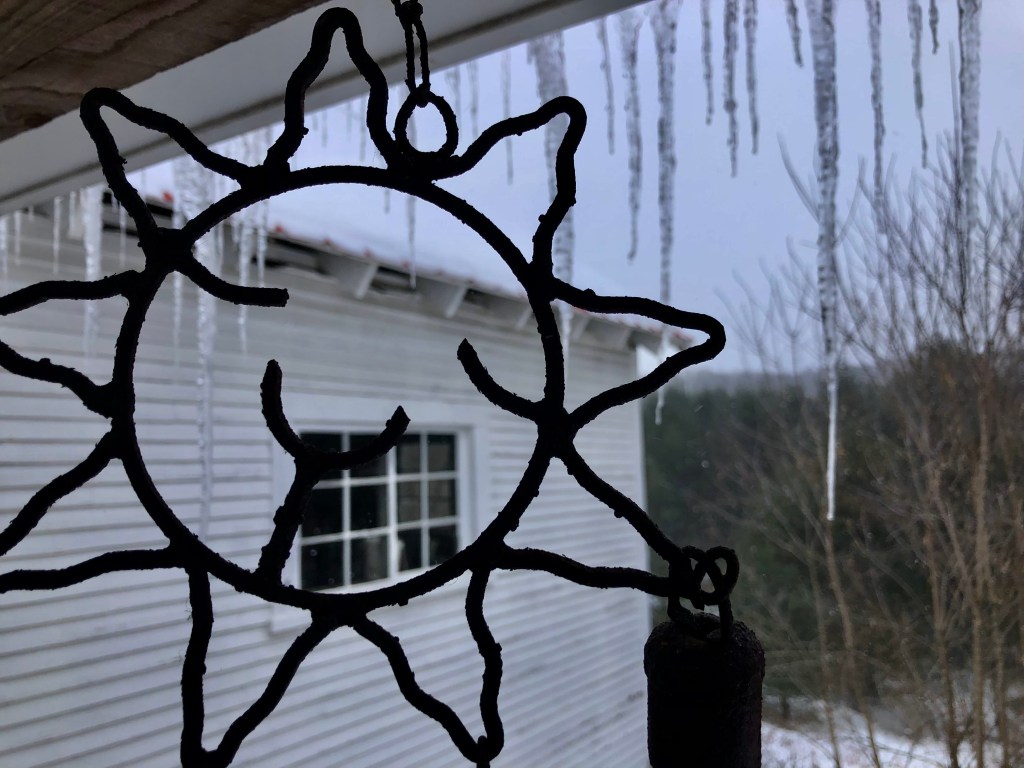
At our house, the icicles on our covered porch are exceptionally skinny and long this year. In the early morning, the ice begins falling in spires that break on the wooden porch. So many questions, and my answers are so poor. Keep asking.
In what could be called Yet Another Phase of Life, I meet my oldest daughter at her apartment, and we take the dog for a walk up a dirt road where I’ve never been. It’s rural Vermont, and the road bends away from the river valley and winds steeply up a hillside. It’s sunny and cold, and there’s absolutely zero traffic on the road. The weather had turned warm a few days ago, rutted up in a foretaste of mud season, and now is frozen in deep ruts.
The trees end at a stone wall and a sprawl of farm fields, with an incredible four-story 19th century barn. Whoever lives here appears to be hosting a kids’ sledding party. The homeowner appears on the road, with his black dog, who coincidentally shares the same name as my daughter’s dog. We speak pleasantly for a few moments, and it’s clear not many strangers wander up this road.
My daughter snaps a photo of a dripping icicle from one of the little outbuildings.
The kids’ party slowly heads back to SUVs and station wagons, the kids red-checked, in snowsuits, carrying small white paper bags. The adults wave and smile at us.
A little later, I drive home through that river valley I’ve driven countless times now, alone or with kids or sometimes with friends. The road switchbacks through the shadowy Woodbury gulf, and shortly after that, I’m home again, feeding the wood stove and cats, then on the couch with my laptop and work, listening to the litany of reporting from the Ukraine. I remember clearly when I was 23, too, living in Vermont, and it seemed utterly normal to have strangers ask, out of curiosity and nothing more, where do you live and what’s your story?
I sweep up the stove ashes and bring in more wood. The night promises more cold. How much I’d love to put my hands on sun-warmed soil and plant a garden of sunflowers.
My friend who has no cell phone (yes, indeed) phones me from someone else’s phone when she needs a ride, due to being “in a pickle.” I don’t get the message, as I’m on the phone with a hard-working journalist who’s graciously writing about my book.
Since it’s my lousy cell phone, I get the message about 20 minutes later, as messages are conveyed to my cell phone via carrier pigeon. I phone the stranger, who’s no help at all, but really darn nice.
I get in my car and go search for my friend, listening to a replay of Vermont Public Radio’s Brave Little State about the housing crisis. I pull into Montpelier and get out to look for my friend right around the time the podcast delves into interest rates and their role in this actual Real Life problem.
My friend is fine and home by then, and I sit on the steps of a closed restaurant and talk to her for a good long while. It’s dark, but not late, and the air is warm. I’m in this tiny little city that smells deliciously of something spicy, not sweet like cinnamon, but spicy like hot chili oil. I’m across from my beloved public library, closed up now, where I worked so many lovely long days, pre-pandemic, with never a thought that those days might cease for me. Since I have no real place to be, and my friend is ebullient to be home and safe, I tell her about the night so many years ago when I stood with my baby just down the street and contemplated renting a room in the inn and never going home. I’ve thought about that night and those crossroads in my life for years now, but when I tell my friend this story now, I imagine that long ago night lifting on little dove wings and fluttering over the roof tops.
I turn off my phone and drive home under the starlight.
We’re nearly at midwinter, the turning-around point of early February. The ice is hard; there’s snow; the light returns, an extra dipperful of it each day.
There’s that Currier & Ives vision of midwinter, nestled deep in fluffy snow that I’ve experienced in a few flashes. This year, unease eats us all around the edges, in strange kinds of ways. A shortage of kitty litter in the supermarket. What does that mean? Maybe nothing worth thinking about at all.
I buy a gallon of paint at the local hardware store. The young man who mixes it went to high school with my daughter. He puts the paint to shake, and I wait and wait in my winter coat and my knitted hat. I remember the first summer I canned so much from my garden and the endless jars I bought here — invested in, really — so many mason jars. High on a storage shelf above my head are those boxes of Ball jars, waiting for tomatoes and green beans and chutney.
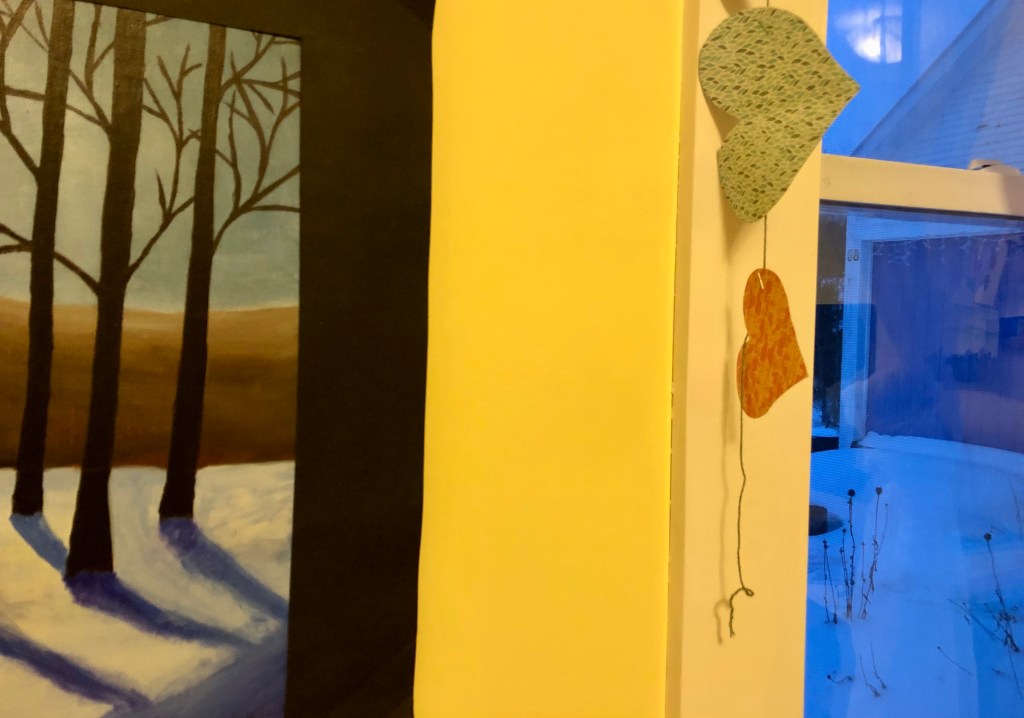
He reappears, his face mostly hidden behind his mask. With a key, he opens the can of newly mixed paint. For a moment, he stands there, studying it. Then he asks if that yellow is the right color. I tell him, Yes. He hammers back on the lid, then pushes the can towards me. Good luck, he says.
As I walk out, I wonder if he means good luck with the color, or the painting, or just generally. But what’s the point, really? We all could use a little good luck.
I was pruning the rose bushes along our house, pressed up against the clapboards, when I had the strangest feeling that I had stepped into a snapshot collage of my life: thorn, blood, house, half-hidden, wet moss under my knees, a cat bird screeching in the lilacs. This morning, I’m wearing a bulky sweater. Oh, Vermont July, how I love you.
Every year, my daughters and I end up in some lengthy discussion about the Fourth of July. This year, as if jointly agreeing to avoid words, we ate ice cream and lit sparklers after dark. The fireflies blinked, in their own particular journeys.


 Stony Soil Vermont