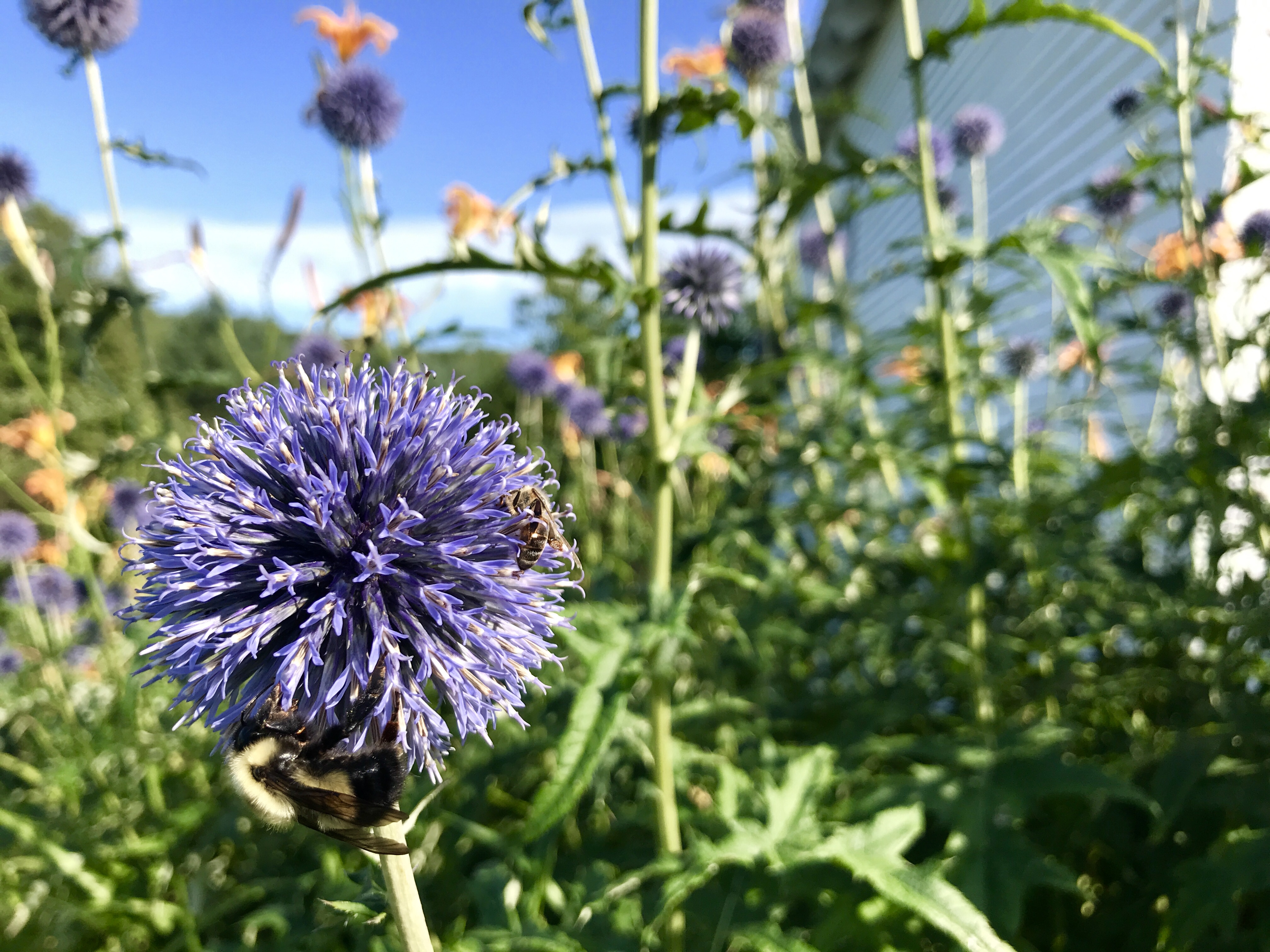
100 Daffodils.

In this balmy late autumn, I walk with new acquaintances in an oak forest where I’ve never wandered. Oaks are sparse in the woods where I generally walk, these lovely-leaved beauties, the ground beneath them strewn with acorns, some broken, their centers chewed out.

I’m with other women who are unwillingly on a journey similar to mine — cancer and chemo, the shock of our worlds slashed apart. Our conversation drifts to the kindness of friends and strangers, and the flip side of kindness — a kind of harshness: why can’t you get on with your life since the chemo is finished? (a raw impossibility) and didn’t you eat enough kale? For the record, when my daughters were young, I grew three kinds of kale in my garden, fifty plants to carry us through the winter, fenced from the foraging deer. All that kale, so carefully tended, and yet, here’s the luck of your draw: cancer.

It’s a rare kind of privilege to walk with these women, listening, offering snippets of my own story. On this cloudy afternoon, these woods are light-filled through the barren branches, the poplars and beeches still shimmering patches of gold. One woman ventures, “All nature has scars.”

Every year, I dread this season of dwindling light, the creeping-in edgy cold, the giant fist of winter readying. And yet every late autumn, the falling leaves enchant, the wood stove’s warmth soothes, the moon gleams its crescent cut-out in the starry sky.

Writing this book about cancer has pushed me to read and gather facts and history, the scientific low-down. And yet, simultaneously, I appreciate more and more the great mystery of this universe. A friend counsels me that I can hold two things in one hand: knowledge and uncertainty. But these, too, are beyond numbers; this world’s mysteries are multitudes. My sister once remarked that cancer is the great leveler: it’s humbling. On a recent chilly morning, I planted one hundred daffodil bulbs: a meager offering to this sweet place where I live. The story behind these spring beauties will surely sink down and vanish into the sandy soil.

Auto Mirror

In the rear-view mirror suddenly
I saw the bulk of the Beauvais Cathedral;
great things dwell in small ones
for a moment.

Adam Zagajewski, translated from the Polish by Czeslaw Milosz and Robert Hass
What we can’t know.

The cold hammers down around us in the way we’ve known Januarys before — nothing fierce, but sharp. January is a season that draws us up against our own mortality. Stumble and you’ll break a bone. Sleep outside, ill-prepared, seriously down on your luck, and you could perish.

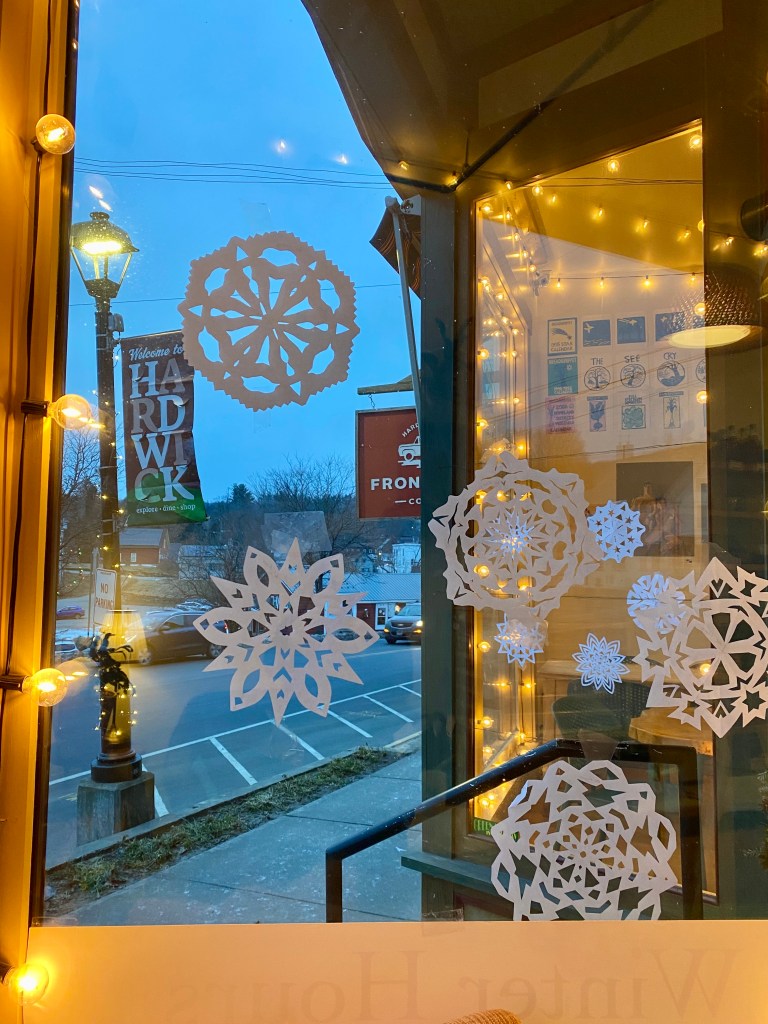
Wednesday morning on the early side, I’m drinking coffee and staring at the snowflakes that have appeared in the downtown again, a memory for an absent person. News has wound my way of the death of a person distant from me by numerous steps, the fate we’ll all meet, one way or another, the great leveler. In the afternoon, when I return from work, the window washers are carefully removing the lacy paper, setting the delicate flakes to one side, and then re-taping them on the windows. A gentle, wordless act of care. A piece of our human puzzle.

These winter days, I’m devouring Paul Lynch, about as good as anything can be.

“I believe it is worth writing to remind ourselves of what we can’t know. To remind ourselves that certainty is dangerous. That factual knowledge of the world casts only a small light. Fiction is necessary because it seems to me that only fiction can accommodate the total strangeness that is life. To remind us that truth is actually impossible.”

In my email inbox this morning, a lovely poem by Raphael Kosek, beginning:

My daughter is driving
across the continent, eating cheddar
in Wisconsin, waking to a cougar’s yellow
rasp, sleeping tentless
in a corn field….

Last night, with the power out, my younger daughter and I walked around town, the Main Street stores either marked closed with a cardboard lettered sign — gone home — or filled with folks simply hanging out, talking.

Later, we’re stuck in traffic, where the highway has washed down into the Lamoille River. We’re driving home from the one lighted town around here, my daughter eating fried rice with chopsticks, talking. We’ve nowhere in particular to go. I’ve let that constant press of time slip away. As we come into the town where we live, the darkness ubiquitous but for a gleaming slip of crescent moon, we’re still talking, just the two of us. She’s no longer the darling five-year-old I once tickled daily — daily tickle? she’d ask. How the world changes, and how it doesn’t. Short as time is, time is also long, too. We stand in the cold November night, beneath the starlight, listening.

IMG_6718

Very Far From Diaper Land

My daughters carry the kayaks through a cluster of serious party-goers — then we’re off, into the kind of pristine wildness so easy to find in Vermont.

At one end of the pond, we drift. The youngest jumps from her kayak and swims off. I leave my kayak on a rock and float on my back, staring up into the clouds. A loon calls.

It’s taken me just about forever to reach this place of parenting, a family life with a kind of togetherness where the girls load up the kayaks while I chat with a young mother about the fish hook she found on the beach.

This sentiment is pure August — like these mornings where the mist lies in the valley again, a harbinger of winter fooling no one.

We are everything, every experience we’ve ever had, and in some of us, a lot of it translates and makes patterns, poems. But, my God, we don’t even began to touch upon it. There’s an enormous amount, but we can touch such a little.

— Ruth Stone

IMG_6245.jpg


After Unraveling the Sweater, Not the Mistake

I’ve been knitting the same three balls of yarn over and over in different patterns for months now — perhaps a silly amount of time. I’ve knit half a vest, decided the shaping was off, abandoned that vest, begun a sweater whose gauge I never measured correctly, unraveled that and began again.

Sometimes at night, as I say good night to my daughters, I wonder about this day we’re closing our eyes to — and maybe this illuminates nothing more than my own crazy mind — but that day’s gone, over.

So many of my parenting days when the girls were young, I greeted the night with relief — the chance to close my eyes and be still. But there’s no re-dos on life, no taking apart and casting on again. That’s obvious maybe — that my life is not a ball of yarn to knit and knit — but those obvious things can be so difficult.

Hence, this early morning, gifted with a few more inches of wet white snow, I’m in my bare feet on the back porch, listening to the wind chimes, for the robins’ first clear notes of the long day ahead.

...It is no surprise 
that danger and suffering surround us.
What astonishes is the singing...

From Jack Gilbert’s “Horses at Midnight Without a Moon” — a short spring poem well worth the read…

img_5196.jpg

Joyful Interlude

A few years back, I told the man at the dump about an argument I’d had with my now ex. The old man always assessed what I had for garbage and recycling and then suggested what I should pay. Are you okay with that price? he’d always ask me. We had a sugaring and carpentry business then, and I often had strange assortments of things like moldy sap lines or boxes of broken syrup jars or a busted stroller.

The old man — who always spoke to my rowdy toddler daughter — told me to take her swimming for the day. That’s what you need to be doing today.

I think of him every time I go to the dump.

Before my second daughter was born, he suffered a terrible burn accident and died a prolonged and horrific death. I know this because I read his obituary in the newspaper one fall when I was crumpling up newsprint to build a fire in my wood stove. Those days when I pulled into the dump with my lively daughter and the million things I was doing then — syrup and mothering and trying to figure out my life — the day of his death seemed far away.

There’s a lesson in this I repeat to myself, that I must swallow down into the marrow of my bones. Seize joy — the unremarkable days of swimming that make up a life.

… We are not wise, and not very often kind. And much can never be redeemed. Still life has some possibility left… very likely you notice it in the instant when love begins…. whatever it is, don’t be afraid of its plenty. Joy is not made to be a crumb.

— Mary Oliver

IMG_0663.jpg