Old cheese, new peonies.

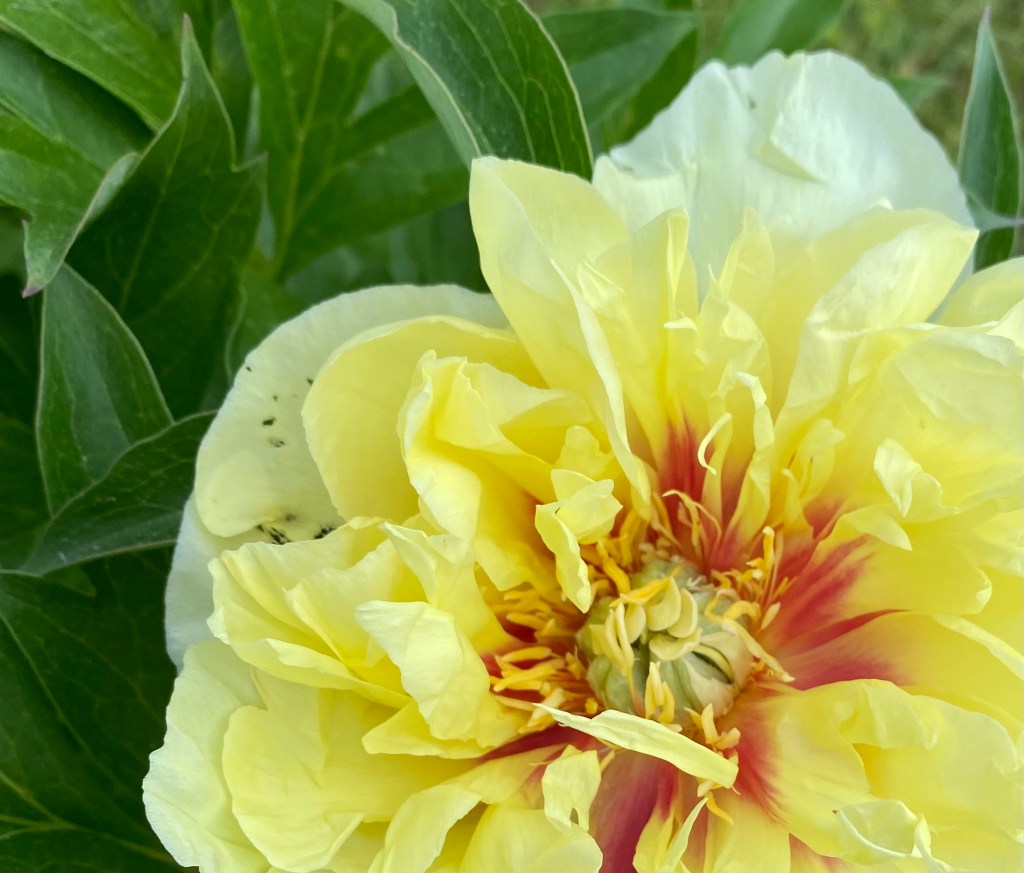
The girls come find me where I’m swimming, the water brackish, strewn with pollen. A blackbird keeps me company. The girls have snagged out-of-date cheese that’s perfectly fine and a tomato that’s sweetly ripe. At home, I dice last year’s garlic. I insist the girls admire the Bartzilla peony that’s blooming now, two blossoms and more fat buds of blossoms. The Bartzilla was a gift a number of autumns ago. My youngest planted the hairy root with me, skeptical. Now, for these few days, this peony’s a marvel.

All day, I’ve been thinking of this Mary Oliver poem. Well worth a share.

Peonies by Mary Oliver

This morning the green fists of the peonies are getting ready
to break my heart
as the sun rises, 
as the sun strokes them with his old, buttery fingers

and they open —
pools of lace, 
white and pink —
and all day the black ants climb over them, 

boring their deep and mysterious holes
into the curls, 
craving the sweet sap, 
taking it away

to their dark, underground cities —
and all day
under the shifty wind, 
as in a dance to the great wedding, 

the flowers bend their bright bodies, 
and tip their fragrance to the air, 
and rise, 
their red stems holding

all that dampness and recklessness 
gladly and lightly, 
and there it is again — 
beauty the brave, the exemplary, 

blazing open. 
Do you love this world? 
Do you cherish your humble and silky life? 
Do you adore the green grass, with its terror beneath? 

Do you also hurry, half-dressed and barefoot, into the garden, 
and softly, 
and exclaiming of their dearness, 
fill your arms with the white and pink flowers, 

with their honeyed heaviness, their lush trembling, 
their eagerness
to be wild and perfect for a moment, before they are
nothing, forever?
Playing cards, considering remains.

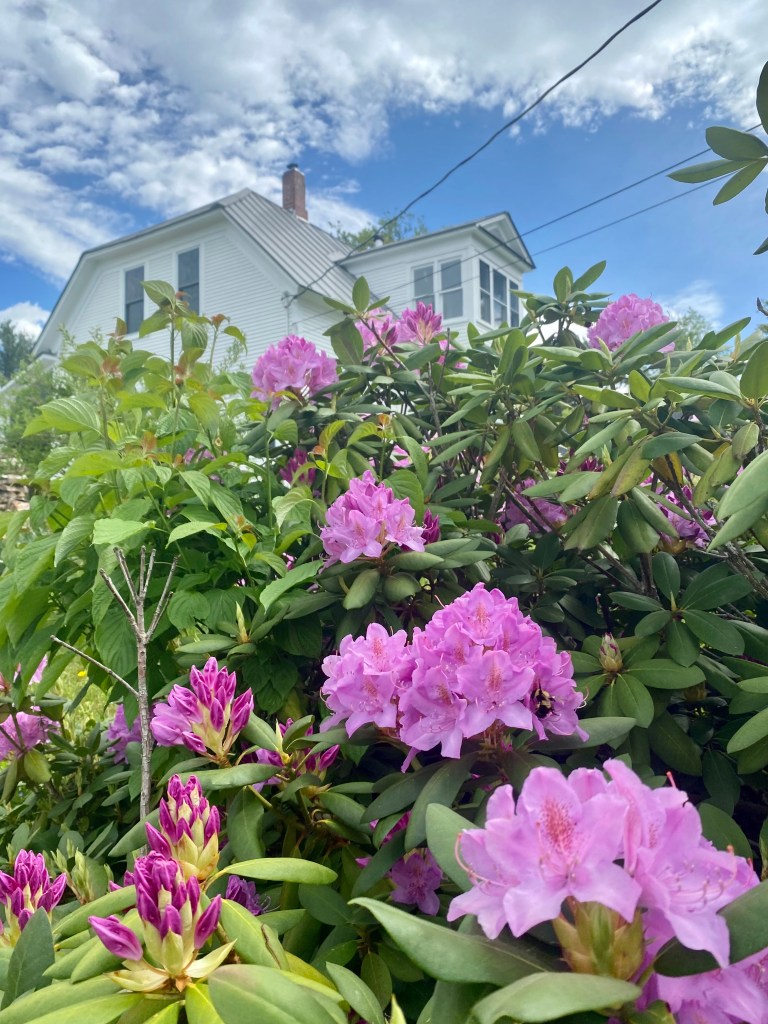
In the darkness, I slide the barn door shut. The world is redolent with cut grass, the wet earth where I watered grape vines. Embers flicker in the fire pit; low laughter moves through the night. June, oh loveliest June, endless varieties of leaf and blossom.

On a hike, we meet a stranger from Maine, and we swap stories about climate change and marriage. He sees my brother’s dog has no water, and shares what he’s carried for his dog. The afternoon gleams with storybook colors of emerald, cobalt, gold. We drive to the lake, to the general store, to a brewery where we sit outside. My brother drinks beer. My daughter and I sip lemon sodas from stemmed glasses, so sweetly yellow I imagine my hand cups sunlight.

I have my mother’s ashes in my possession. Our conversation bends back again and again to her ashes and her life, and the very different relationship that each of us had with her. Lacking a religious framework, I’m treading in open water. My mother, in fact, might have been fiercely opposed to the chain of circumstances that landed me keeper of her remains, or not. I am her second daughter, her match in stubbornness.

All day long, this tender beginning to June, we do the things we love to do. We drink coffee and eat buttered toast, play cards. The sunlight crosses over my house. The day is both chilly and hot. The days spin on, rich with the illusion that there is no finality. Mercy, I think, shutting the barn door to keep the raccoons from the recycling. Another day, the nightsongs of frogs serenading.

In the edge…

Midafternoon as a storm threatens in, I’m at a stretch of lakeshore where I’ve never swum, and I push in. I’m on the prowl for an eagle, which I never find, and the day has grown muggier than I imagined.

What a month of May this has been. My mother’s death ripples through the amazing forsythia and lilac season, through writing and the steady complexity of work I do for the local Selectboard. At a nearby farm, I buy hothouse basil and tomato starts. A woman I know slightly strikes up a conversation. In the past, our lives ran on weirdly similar tracks, involving divorce, sudden visits from the FBI, the miasma of disorientation. Now, we swap mother stories beneath an enormous lilac. I breathe in the blossoms’ scent.

A few years back, I volunteered in my youngest’s elementary school classroom to assist with a nature program that the kids loved. Naturalist and artist, the teacher kept using the phrase “in the edge.” She pointed out that life thrives at the crossing borders of field and forest, of riverbank, the edges of a homogenous world.

I’m in the edge these days. May’s heat notwithstanding, the water is bitterly cold. I swim out with my lousy swimming skills, my garden’s dirt washing away, the storm clouds hammering together over the glassine water, some of the day yet to come. On the shoreline again, sharp stones gouge my soles.

Stop all the clocks.

Santa Fe, many years ago

In this space, I’ve stepped between the mossy threads of my own life. For many years, my mother who lived far from me kept up with my life through my blog. I’d started writing stonysoilvermont the summer my then-husband and I split up. I was about to publish my first book. Although I’ve considered quitting, I’ve kept on, the disciplined scraps of this writing feeding into my creative life.

So it seems right to acknowledge my mother’s passing over into the next realm. A woman of nearly indomitable strength, she was ill for many years and surmounted multiple surgeries and illnesses. But none of us are mortal. My mother, who was a nurse for decades, knew this more keenly than most people. When I was a girl, she returned every morning at breakfast with stories from the hospital, some funny and some heart-wrenching — a child with leukemia, a cab driver shot point-blank in his head. One July morning, she carried home an orange kitten. We named him Oliver, and he lived a long full cat life.

Same, too, with my mother, a woman whose strength and passion shaped my own. In her later years, disease made her wander back and forth in time, into places where none of us could follow. My mother would have wanted us to grieve the end of her life, but not to fall dramatically on our knees. Raised a Lutheran, she was imminently practical. Nonetheless, I remember when I was 21, and my mother grieved her own mother. She stopped all the clocks.

Birthday Cake.

March 7 is my father’s 87th birthday. My daughter, the oldest grandchild, visited my parents a few days ago and asked what to do for my parents’ birthdays. Cake and flowers. And be sure to eat the whole cake.

At town meeting, on the fly, I had to add a few numbers, tally a total. Writing with my pencil, the 100 or so audience members looking at me, I thought of those childhood evenings when I handed my dad an algebra or calculus problem and asked for help. He always made me sharpen my pencil, align the numbers so the problem made sense, and exhibit some respect for mathematics, please. These three things have stuck with me my entire life.

Every year on my father’s birthday, I think of this Hayden Carruth poem. My father — a man who taught his kids about Arkhipov Day and Ancient Greek philosophy, and spent so many nights in the desert, playing cards with his kids at a picnic table lit by a battery lamp….

Birthday Cake

For breakfast I have eaten the last of your birthday cake that you
had left uneaten for five days
and would have left five more before throwing it away.
It is early March now. The winter of illness
is ending. Across the valley
patches of remaining snow make patterns among the hill farms,
among fields and knolls and woodlots,
like forms in a painting, as sure and significant as forms
in a painting. The cake was stale.
But I like stale cake, I even prefer it, which you don’t
understand, as I don’t understand how you can open
a new box of cereal when the old one is still unfinished.
So many differences. You a woman, I a man,
you still young at forty-two and I growing old at seventy.
Yet how much we love one another.
It seems a miracle. Not mystical, nothing occult,
just the ordinary improbability that occurs
over and over, the stupendousness
of life. Out on the highway on the pavement wet
with snow-melt, cars go whistling past. 
And our poetry, yours short-lined and sounding
beautifully vulgar and bluesy
in your woman’s bitterness, and mine almost 
anything, unpredictable, though people say
too ready a harkening back
to the useless expressiveness and ardor of another
era. But how lovely it was, that time
in my restless memory.
This is the season of mud and thrash, broken limbs and crushed briers
from the winter storms, wetness and rust,
the season of differences, articulable differences that signify
deeper and inarticulable and almost paleolithic
perplexities in our lives, and still
we love one another. We love this house
and this hillside by the highway in upstate New York.
I am too old to write love songs now. I no longer
assert that I love you, but that you love me,
confident in my amazement. The spring
will come soon. We will have more birthdays
with cakes and wine. This valley
will be full of flowers and birds.

Vermont’s fifth season: mud.

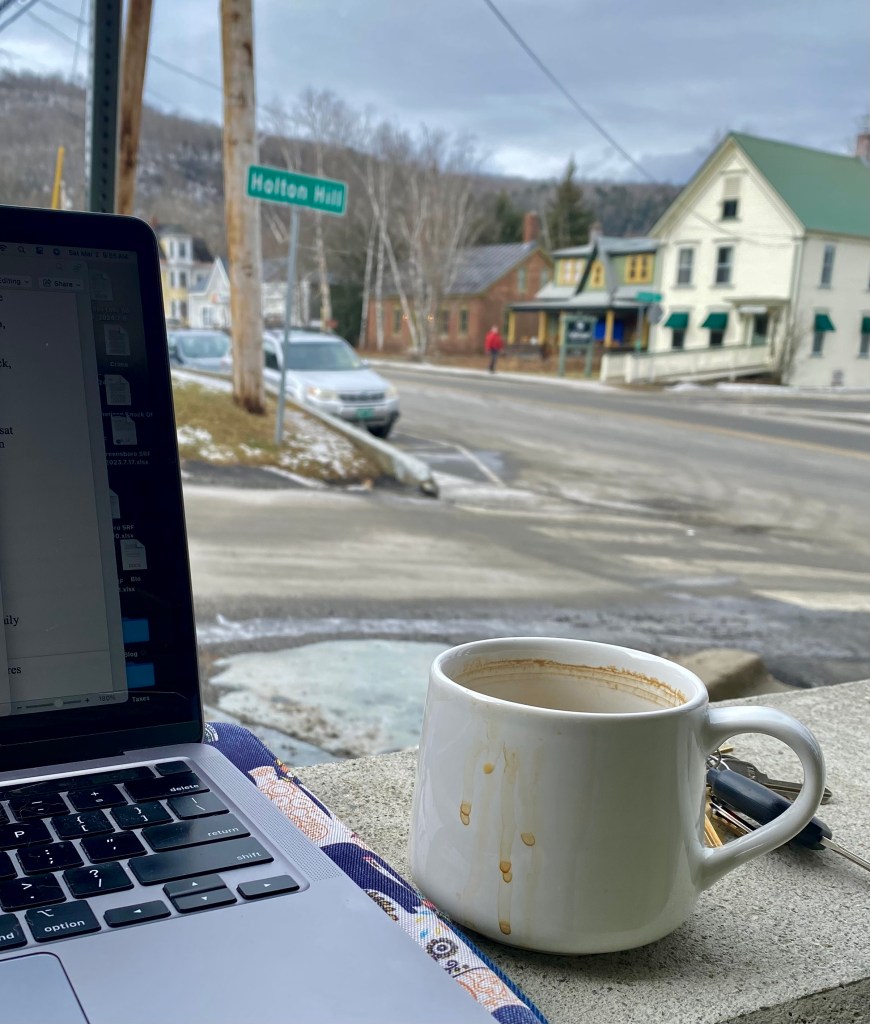
I carry my laptop out the backdoor of Hardwick’s coffee shop. A couple I know pulls up on their fat tire bikes and rave about the biking. There’s an adage in Vermont that the state’s fifth season is mud season. The first week of March is way early for the back roads to break up. Most towns post their roads around March 15, prohibiting heavy trucks, like log or delivery trucks, from destroying already soft roads. Now, towns have already posted these warnings, ribboned with orange survey tape, a sure sign that winter is on the wane.

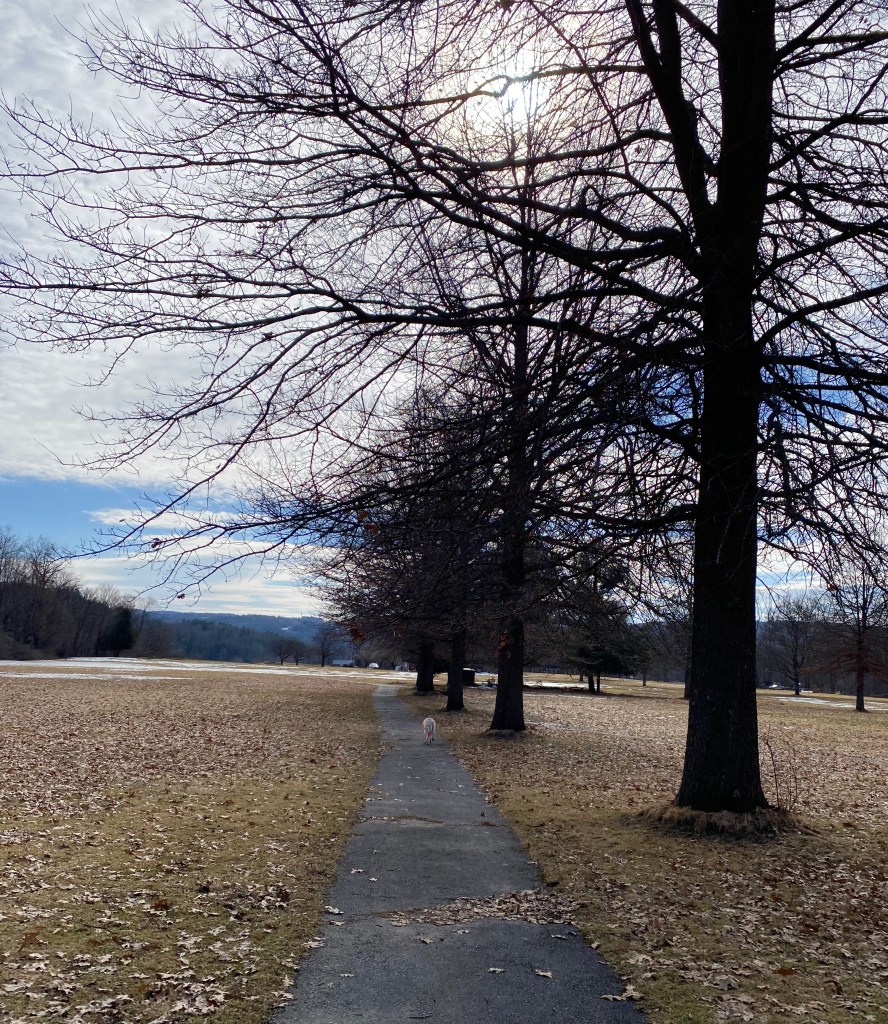
I meet a friend at a former golf course now owned by the city of Montpelier where people let their dogs run. The course is last year’s brown grass, but when I squint I can see emerging green beginning shimmer, pushing back the dull amber. How much the world leans into living.

My oldest daughter calls from New Mexico, on her journey to visit the grandparents. Through our phones, her face glows with desert light. I think of her driving around Santa Fe, this old adobe city and the stunning landscape an infinitely complex story that stretches so far back. Within that human history, my own family story lodges in with its numerous plot points. Ah, family… never a straight line.

T. S. Eliot wrote of that April is the cruellest month, breeding/Lilacs out of the dead land, mixing/Memory and desire, stirring/Dull roots with spring rain. Winter kept us warm… Mud season may be the least loved. But in my mind, it’s the sweetest. Sap runs. The softening ground sucks our boots into its stickiness. Tender green unfurls, strengthens. We move, onward.