“… hard wind and the rain that unsettled the creek…”

Evening, I linger on the porch swing, talking with my siblings as the long July day ebbs down to twilight. My neighbor texts me that a bear’s been seen in our neighborhood. As the gloaming, like a tide, washes in, I water the tomato plants. The white hydrangeas hover like magical pompoms in the dusk.

July, Vermont’s growing month. Walking with my neighbor, she points out the height of the wild grasses and flowers around her house. Already, this summer, taller than she’s ever seen. The heat and the rain have propelled immense growth. The box elders rub my house; I’ll need to ask another favor from someone with a saw.

I have not forgotten this winter when I drifted from one variation of cold to another, my body and mind fiercely bent to the intertwined goal of finishing cancer treatments and remaining alive. On the other side, what remains is what plagued me before, my own variation of hard wind and rain. And yet, a whole July hangs like a promise: sunshine all day, pink cottage roses, laughter with my neighbor about the burgeoning woodchucks.

In the late afternoon, I take a long walk in the town forest to the reservoir’s edge. Deer prints press into the mud. On this walk, I don’t see a soul. In the distance, children call to each other.

“Kitchen Sink”
Today she would change nothing,
not even the wallpaper peeling,
like dead bark. Nor, outside, the shadows
approaching the yard where ants
toil like women in their houses of sand.
Never mind that the sun will be setting.

When she was young she felt afraid
of hard wind and the rain that unsettled the creek.
But the earth never left her,
not once did the floods reach her feet.
The reward of a long life is faith
in what’s left. Dishes stacked on a strong table,
Jars of dried beans. Scraps of cloth,
And the ten thousand things of her own thoughts,
Incessant as creek water. She has been able
to lay up her treasures on earth,
as if heaven were here, worth believing.
In the water her hands reach
like roots grown accustomed to living,the roots of the cat-briar that hold to the hillside
and can never be torn free of this earth completely.

~ Kathryn Stripling Byer
“Quite Serious”

My neighbor runs out his back door, shouting and waving his arms. I’m working on my upstairs glassed-in porch. He cranks up the volume on VPR’s Morning Edition. I’m guessing he hopes the young woodchucks burrowing beneath his deck aren’t NPR fans.

Like my neighbor, I am a VPR fan. This morning, news of Iran dominates the air. As I labor to join noun to verb, I notice my heart beating at Steve Inskeep’s words. Eventually, I leave my cat sprawled on the windowsill and head downstairs to wash the dishes. I’ve listened to NPR my entire life. Heck, the radio was probably playing when my parents brought newborn me home from Presbyterian Hospital in Abuquerque. Little these days is good news.

This winter, I’ve written in this space about my obsessive struggle to remain among the living on this planet. Only now—two surgeries, six rounds of chemo, 11 hospitalizations later—do I realize the diciness of my determination to live. A few weeks ago, driving with my daughter, she showed me a lawn where she cried on a bench because I believed my mother would die. Every day now, as I begin by feeding my two cats and drinking coffee, I carry this winter, those months of spitting distance from my grave, within me. As at the beginning, my greatest worry was/is my daughters. So many months later, I understand how my life is connected intrinsically to so many others. That what lies before my eyes are the twig tips of stories.

In my younger, brasher years, I might have written about politics and conflict, but the Mideast is a place I’ve never been, with people I’ve never met, for whom I will never speak. Too, I’ve knocked around this planet long enough to know that violence changes the world, irredeemably. That the combination of deceit and anger and hubris wrecks destruction. And that cruelty wrought can never be undone. We hurtle onward. I keep listening.

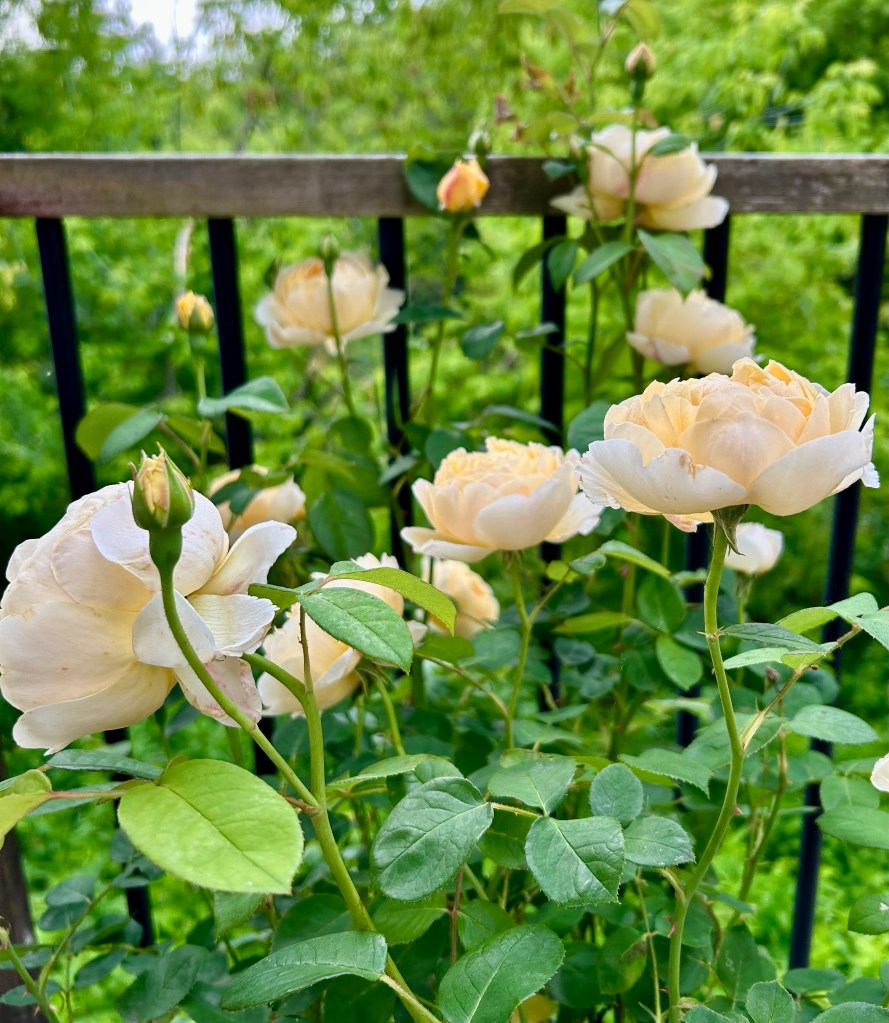
June, and pink roses bloom against my house, planted by someone I never knew, perhaps the woman known as Grandma Bea buried in the adjacent cemetery’s crest. My daughters climb a mountain with a view of Vermont’s shimmering Lake Champlain and the emerald patchwork of farms stitched together. They return with a gift for me, a thorny rosebush with fragrant blossoms that fill my cupped hand. In the evening, shortly before dark, I walk in my bare feet, the long grass already cool with dew. High heat is predicted, the planet is surely burning up, but this ruby-and-gold sunset drags in a coolness. Lush, so lush this month. The butternut tree I planted stretches towards the apple someone else carefully cultivated and noted in pencil on the barn’s bottom wall. A record someone held dear.

In 1956, Allen Ginsburg wrote: “America this is quite serious.”

“Everything blooming bows down in the rain…”

We make the trek again to Dartmouth for a surgical consult, the sign-off after surgery. I’ve met numerous members of this team, but not this kind NP, who’s read my history and says, What an ordeal. I’m not expecting these words, and I pause. Last November, when was I first admitted to Dartmouth, I had unplanned surgery. That snowy November night, the surgeon spent so much time with me. Then her Fellow returned and answered my endless questions. In May, I had surgery again. Two bookends – that November night and this sultry summer day. I’ll be treated here for years, but my hope – and none of know squat about the future – is that I’ll never need a surgeon again.

I thank her and the surgical team and student entourage who appeared in all those ER and hospital floor rooms where I stayed – me, the reluctant patient, who tried to negotiate some other outcome than surgery. To my surprise, she’s grateful for my words, too. We try our best but it’s hard to know how we come across to patients. The surgeons who operated on me are trauma surgeons. My surgery was routine, but routine surgeries go south. Mine did not.

Afterwards, my daughter and I stop at Dartmouth College’s Hood Museum. There’s a Georgia O’Keefe painting we want to see and two Monets. The current exhibit has mesmerizing photographs. This is a good day and a good visit. We eat sandwiches in King Arthur Flour’s patio, where so many families have pudgy babies tucked into a parent’s arm. We linger, talking about my mother who would have loved eating here.

So many of those drives on the interstate home, I slept, nodding in and out of conversation. My weak days are long passed, and we keep talking, the interstate edging near the Connecticut River and up on the ridge again. In June’s green, the drive no longer seems so desolate. Traffic here is always sparse. We pass a trailer of hay bales, a pickup with three wheelbarrows.

Enduring cancer turned my world (and my family’s world) inside out. In the first five-day continuous course of chemo, I forced myself to wash every morning. In those days, my hair had not yet fallen out. I was too weak to brush my hair, so I tied it at the nape of my neck. That month, my daughter cut what snarled hair remained. Those miserable uncertain November mornings, how grateful I was for hot water and soap, to have access to a brutal but hugely effective treatment, in a sterile hospital in one of the richest states in a phenomenally country. I made my choices, but I had choices.

In the inside-out world where I am now, I’m ticking through my list: profusely thank my oncologists and surgeons for saving my sometimes-surly life, tend my garden, figure out my youngest’s college bill, finish my book, accept the ravenous roaming woodchucks….. my domestic realm.

In our little end-of-the-road neighborhood, visitors come and go on my back deck, gardens on three sides, the wild pressing in on the fourth. My own nexus.

Everything blooming bows down in the rain:

white irises, red peonies; and the poppies

with their black and secret centers

lie shattered on the lawn.

~ Jane Kenyon

Do Two Things at Once.

Walking on a trail beside the Lamoille River, my daughter points out a snapping turtle, a giant creature, its head tucked in, watchful. Her partner reminds us that he grew up in a village where snappers took over the elementary school playground to plant their spring eggs. An inherent element of that school’s curriculum was try to get along with other beings.

The irises and rhododendron bloom profusely. Rain falls, chilly, for much of the day. In the late afternoon, the sun emerges. I cut back the hostas alongside my house to stave off the wet and rot. By late afternoon, I’m finished with my work and chores. I hang out on the porch, read, drink my cocktails of ice water and lemon. Listen to Nina Totenberg.

A month out from surgery, six weeks from chemo, I met a friend for coffee. We talk cancer and community, about the joys of traveling overseas and shifting perspective. Myself, I will be traveling near to home this summer, most of it by foot. Each day, I walk more and more, reclaiming my strength. As next year’s woodpile is transported into my barn (thank you, thank you, kind wood mover), I imagine planting a garden on that emptied place. As a younger woman, I believed vegetable gardening would change my world. I wasn’t wrong; Red Russian kale and bull’s blood beets fed my growing children for years. But blossoms and bushes and trees nourish the wild (and me, too).

I live on a hillside where hungry young woodchucks run rampart. Not so long ago, I considered the chucks my enemies. Now, having endured the scorched-earth transformation of chemo and cancer, I worry far less about these sleek-furred creatures. By summer’s end, I know the foxes thin this population. In the meantime, I slowly go about that repetitive work of weeding and mulching, and the visioning research of transforming lawn into wildflowers.

My coffee companion reminds me to take my time and take risks. Who wants to take risks after surviving cancer treatments? Answer: why not, why not? Dig more gardens. Contemplate the woodchucks. Plant coreopsis to replace the hollyhocks holes from the woodchucks’ foraging… Do two things at once: go with the flow and keep paddling.

White peonies blooming along the porch
send out light
while the rest of the yard grows dim.

Outrageous flowers as big as human
heads! They’re staggered
by their own luxuriance: I had
to prop them up with stakes and twine.

The moist air intensifies their scent,
and the moon moves around the barn
to find out what it’s coming from.

In the darkening June evening
I draw a blossom near, and bending close
search it as a woman searches
a loved one’s face.

~ Jane Kenyon, “Peonies at Dusk”

Under a Thousand Stars.

Walking home, I spy a smattering of white blossoms among a stand of pines, off the path. That short stretch is a strange area, more sand than soil, unusual on my Vermont hillside. Running theory is that someone stripped the top soil, years ago. Although I haven’t energy in excess, I’ve enough that I wander from the path. The blossoms are wild strawberries. Sweet mark of June.

For those not in New England, the common gripe is the weather. Every weekend, rain. Figures are tossed that there’s not been a fully sunny weekend since December; then I hear November. As for me, recovering, the days and weeks merge. Now, three weeks out from surgery, I’m easing back into work. The cats wake me at early light. In recovery, my old worries rekindle, but so does my drive and curiosity. I get up, eat cereal and maple syrup, brew coffee. I spread the manuscript of my fourth book over the kitchen table, cut, rearrange, stitch.

What’s changed, though, is a new slowness, a willingness to let the course of things unfold, to crouch beside those strawberry blossoms, wondering which birds will snag the tiny crimson berries. In a few weeks, I may wander here and sample this sweet delicacy. Half of this May, I lived in a hospital. Finally, I limped out the door with my brother. While he drove me home, I kept saying, “I’m out, I’m out,” and “The trees are leafing, the forsythia is blooming, the lilacs are opening.”

That surgery and that stay might likely have saved my life, again; and again, how immeasurably capable and kind was the hospital staff. Nonetheless, it’s June. The sky this morning is scrimmed over with smoke from wildfires. Under that dome, I have work to do. A friend will visit. I’ll move through this day, this Wednesday, happy.

I want to lie out

on my back under the thousand stars and think   

my way up among them, through them,   

and a little distance past them, and attain   

a moment of absolute ignorance,

if I can, if human mentality lets us.

I have always intended to live forever;

but not until now, to live now.

~ Galway Kinnell, “The Sekonk Woods”

“You got a God.”

Years ago, I ripped out a photo from the New Yorker of Marina Oswald taken the morning after her husband assassinated President Kennedy. She was hanging diapers on the clothesline, her face scrunched in misery. It was 1963, the realm of cloth diapers, and she had two babies. I tacked the photo on my wall.

No assassins in my household. Yet, as I described to a friend, I’m healing from chemo and surgery while the dailiness of life tugs me onward. In some ways, this is a relief; I’m utterly grateful to be in the world where I hand over my credit card for groceries, rise in the night when my daughter returns from work to ask about her hours. I order firewood, problem-solve our broken car scenarios. It’s triage and logistics, a math problem.

This May, a cold spring, snow yesterday all day in the New Hampshire White Mountains, I read through the mail. Make one phone call. A colleague stops by. My daughter makes grilled cheese, slices avocados, rims the edges of my plate with peanut butter cups. My brother texts, my sister calls, reminding me to eat, eat. In all this, I open the Grapes of Wrath, join hitchhiking Joad, and eventually sleep in the wood stove’s warmth. I dream of our lilacs who hold their buds closed against this cold, the Joad corn in the 1930’s, buried in feet of dust. Through my dream washes the rain against our windows, the purple and white violets studding our overgrown grass. Time and place and season sift like a jumbled dump cake.

When I wake, my cat Acer lies purring against my foot, contentedly grooming a dainty paw, supremely confident of an imminent dinner and another toasty night before the beloved hearth.

Memorial Day weekend, when we always invite friends and neighbors for an outdoor dinner. Not so, this year. The pieces in my life, my family’s lives, shift, rearrange, mend. Slow healing, slow domesticity.

From Steinbeck: “You got a God. Don’t make no difference if you don’ know what he looks like.”