The Present, the Forgotten.

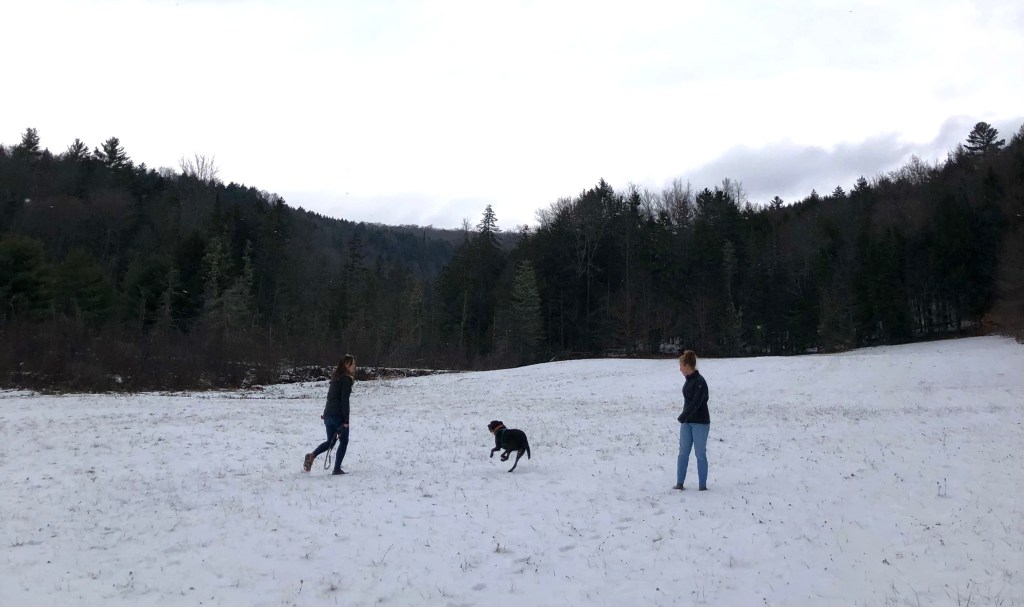
Midday or so, I jam on my boots and head out for a walk down to the lake, leaving behind my desk with piles of hard questions. I’ve forgotten my mittens, so I walk with my hands in my pockets while the wind tears over the lake. The summer people are all long gone, houses boarded up against the elements and thieves. Ahead of me on the road, a stranger walks with a little dog who leaps in snowbanks.

The sunlight is clear, sparkling on the snow, the lake white-capped and simultaneously blue and gray and the green that copper turns after rain.

Last winter, the town began plowing the sidewalk that cuts through the old school’s green. A woman had snowshoed a labyrinth in the snowy lawn for years. The sidewalk divides that space. She protested. The plowing continued. I see she’s marked that labyrinth behind the church. Ahead of me, the little brown dog stops in the road that no one else but us is traveling, its head cocked to one side, staring at me. A gust of wind blinds me with snow for a moment, and then drops just as quickly.

As I walk up to the little dog, I bend down and say hello. The man explains that the dog has rules about people walking behind them — not allowed — and then the three of us walk together, the dog now happily flipping itself into snowbanks. “It’s a bit of an inconvenience,” the stranger tells me, “especially when I have work to do.” At the main paved road, traffic is sparse. A lone Subaru passes with salt-streaked windows.

We part ways. I walk along the short stretch of pavement and turn at the old maple tree that I begged the Selectboard not to cut last year, arguing that the breaking branches were falling only on the grass. “Give it one more year,” I asked, secretly hoping the tree-cutting plans would drift into forgotten things.

At the door, I stamp snow off my boots: a walk with a handful of immutable things.
Winter Koan.

I stop in at the former Hardwick Gazette building, now turned into the Civic Standard, an organization trying to figure out itself. An acquaintance and I stand at the windows in the building’s rear, staring down at the Lamoille, where ice feathers only along the edges. The water is low enough that the rocks are mighty in the rushing current.

I drink coffee and sit crosslegged on the couch, and we talk for hours. I finally vaguely inquire if we haven’t had enough of our own words, and then we go on and on again. The building itself seems marooned in the 1970s, and even in 1972 the building likely felt stranded in 1957. An old printing press hulks beside us. One of us has an Hungarian immigrant family, and our conversation inevitably weaves in the first half of the 20th century.

December in Vermont is as good a time as any to ponder the Zen koan chop wood, carry water in the pieces of my life. Sunlight on the living room floor. Kim chi and brown rice. Reading Ruth Ozeki’s The Face on the rug.

Sunday afternoon, light snow sifts down, the sweetest gift, its fresh cold sweeping away our stale human layers of mind and emotion. I carry in an armful of wood to feed our little stove for the night. The snowflakes melt in my eyebrows. Finally, I think, finally, a scattering of snow. Then I quit thinking, close my eyes, and listen to the falling snow.

“The past is weird. I mean, does it really exist ? It feels like it exists, but where is it ? And if it did exists, but doesn’t now, then where did it go ?” 

— Ruth Ozeki

The Beginning of Genius.

An acquaintance comes into work today to update the town’s website. We talk back and forth, little details here and there, the mechanics of putting the website together and how the pieces of democracy work: minutes and transparency. The public can and does come to Selectboard meetings with requests to move roads and complaints about cowshit spilled over roads. Our conversation tips into philosophical territory. Nearing the end of a challenging week, I’m drinking my 46th cup of coffee that morning and espouse that we’re in end-stage capitalism. Sometimes we behave very badly. Sometimes, not so.

I am not at all a Facebook fan, not a FB reader, but all week I’ve been dipping into the stories people have posted about Ray McNeill. So many stories, some from people I once knew very well. I lived in Brattleboro when I turned 21, completely alone in an apartment over The Shin La, a Korean restaurant still in operation. One night, I closed Céline’s Death on the Installment Plan and went out in the rain. Even then, I was a loner. I didn’t go to public places alone. But that night, the rain fell so hard I ran into Three Dollar Deweys. My friend Debi was there. In those days, she lived with my ex-boyfriend. She came up to me and rubbed my long hair with bar towel. We played darts for hours. The bar lights shone out into the falling rain.

“The beginning of genius is being scared shitless.” 

— Louis-Ferdinand Céline

Twelfth Month.

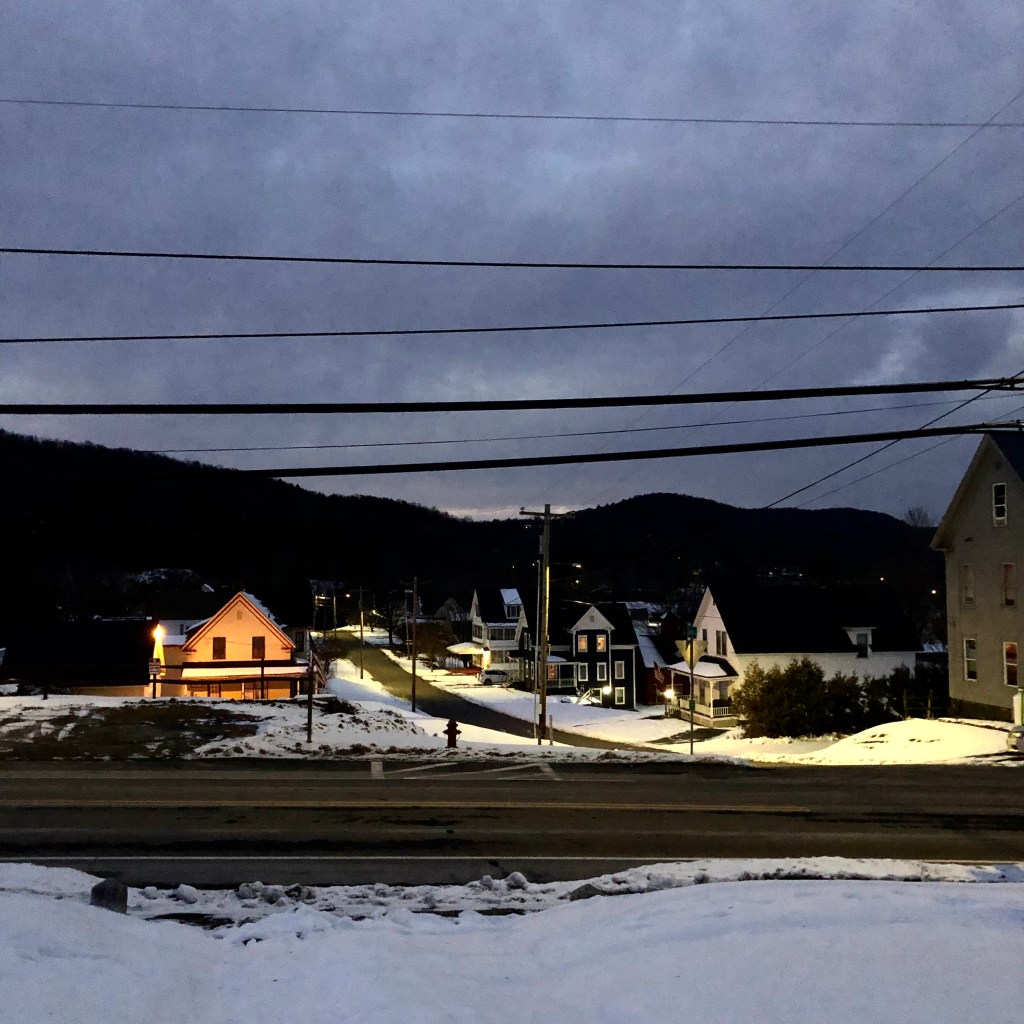
A woman steps out of Positive Pie on Main Street with a stack of pizza boxes and nearly bumps into me. Late afternoon, and a rainy twilight has gradually thickened all day. I’m walking home from a reading at the town Memorial building by an author who’s published a historical novel about Hardwick. Decades ago, when this town shifted from broke-back subsistence farming to the granite boom, the town fiercely debated the railroad construction (why let in the outside world?) and the economics of electricity and streetlights. Now, not so many years later, the tracks are torn up, the roads paved, the granite empire crumbled.

This afternoon, the streetlights are on early, the colored lights glowing at this junction of routes 14 and 15.

The woman with the pizzas asks me to open to her car door. I step off the sidewalk curb, breathing in the scent of garlic and bacon. Before she gets in the driver’s seat, she stands for a moment overlooking the colored lights and river. “December,” she remarks — that’s all — and then gets in and drives away.

In the brick courtyard, the kitchen staff is getting high, wearing t-shirts in the strangely balmy air. December: this descent into the amorphous darkness with no clear edges. Long after the stranger has disappeared, I stand beneath the building’s overhang while rain falls and light ripples across the wet world.

The Whole World.

In the beaver dam realm, we spy the quicksilver flash of wet fur, bright eyes. The ice there is thin, barely beginning its winter’s work. We cross the snow-shallow field, then head into the woods and cut down again where the swamp lies in the fold between two hillsides, ghostly in its black-water, dead tree beauty. Then up, up, up we trudge, the dogs eager. We find bootprints in the snow, a few drops of blood from a wounded prey, and then we’re back again to the dirt road. All day, the light seems like twilight, and then we pass through twilight and into the night, and still we’re awake, talking, circling back to the same old subjects. In the morning’s dark, I scrape ashes from the stove and carry out the hot bucket. My brother stands on the porch, watching his dog nose at my herb garden. The damp rushes at my face.

“Like Maine,” I say.

“Yeah,” my brother answers. “But it’s Vermont.”

Happy Thanksgiving, wherever you might be.

“Assurance”

You will never be alone, you hear so deep a sound when autumn comes. Yellow pulls across the hills and thrums, or in the silence after lightning before it says its names — and then the clouds’ wide-mouthed apologies. You were aimed from birth: you will never be alone. Rain will come, a gutter filled, an Amazon, long aisles — you never heard so deep a sound, moss on rock, and years. You turn your head — that’s what the silence meant: you’re not alone. The whole wide world pours down.

— William Stafford

Days of Little Light.

Night has fallen down all the way by the time I leave work. Just below freezing, the wind cuts up with a taste of wet — the feel of sugaring season but the light is all wrong. It’s a month before the solstice, and now I’ve given into the darkness utterly. The truth is, much as I rail against the scantness of light at this annual time, I relish it, too. This time of year entices us to go deep, soul-search, spread out the cards and see what’s there.

Dark to dark, our days go. My daughter phones on her way to work, two stray cats yowling in her car. She’s bathed these hungry creatures and found a home for them, a tiny bit of kindness in the midst of a complicated world. Ever in her blur, she hands off these cats to a new home, blessing them in her own way, and moves on into her day.

“What does it mean to grow rich?… Is it to retain a capacity for awe and astonishment in our lives, to continue to hunger after what is genuine and worthy? Is it to live at moral peace with the universe?” 

— Barry Lopez