The Beginning of Genius.

An acquaintance comes into work today to update the town’s website. We talk back and forth, little details here and there, the mechanics of putting the website together and how the pieces of democracy work: minutes and transparency. The public can and does come to Selectboard meetings with requests to move roads and complaints about cowshit spilled over roads. Our conversation tips into philosophical territory. Nearing the end of a challenging week, I’m drinking my 46th cup of coffee that morning and espouse that we’re in end-stage capitalism. Sometimes we behave very badly. Sometimes, not so.

I am not at all a Facebook fan, not a FB reader, but all week I’ve been dipping into the stories people have posted about Ray McNeill. So many stories, some from people I once knew very well. I lived in Brattleboro when I turned 21, completely alone in an apartment over The Shin La, a Korean restaurant still in operation. One night, I closed Céline’s Death on the Installment Plan and went out in the rain. Even then, I was a loner. I didn’t go to public places alone. But that night, the rain fell so hard I ran into Three Dollar Deweys. My friend Debi was there. In those days, she lived with my ex-boyfriend. She came up to me and rubbed my long hair with bar towel. We played darts for hours. The bar lights shone out into the falling rain.

“The beginning of genius is being scared shitless.” 

— Louis-Ferdinand Céline

Twelfth Month.

A woman steps out of Positive Pie on Main Street with a stack of pizza boxes and nearly bumps into me. Late afternoon, and a rainy twilight has gradually thickened all day. I’m walking home from a reading at the town Memorial building by an author who’s published a historical novel about Hardwick. Decades ago, when this town shifted from broke-back subsistence farming to the granite boom, the town fiercely debated the railroad construction (why let in the outside world?) and the economics of electricity and streetlights. Now, not so many years later, the tracks are torn up, the roads paved, the granite empire crumbled.

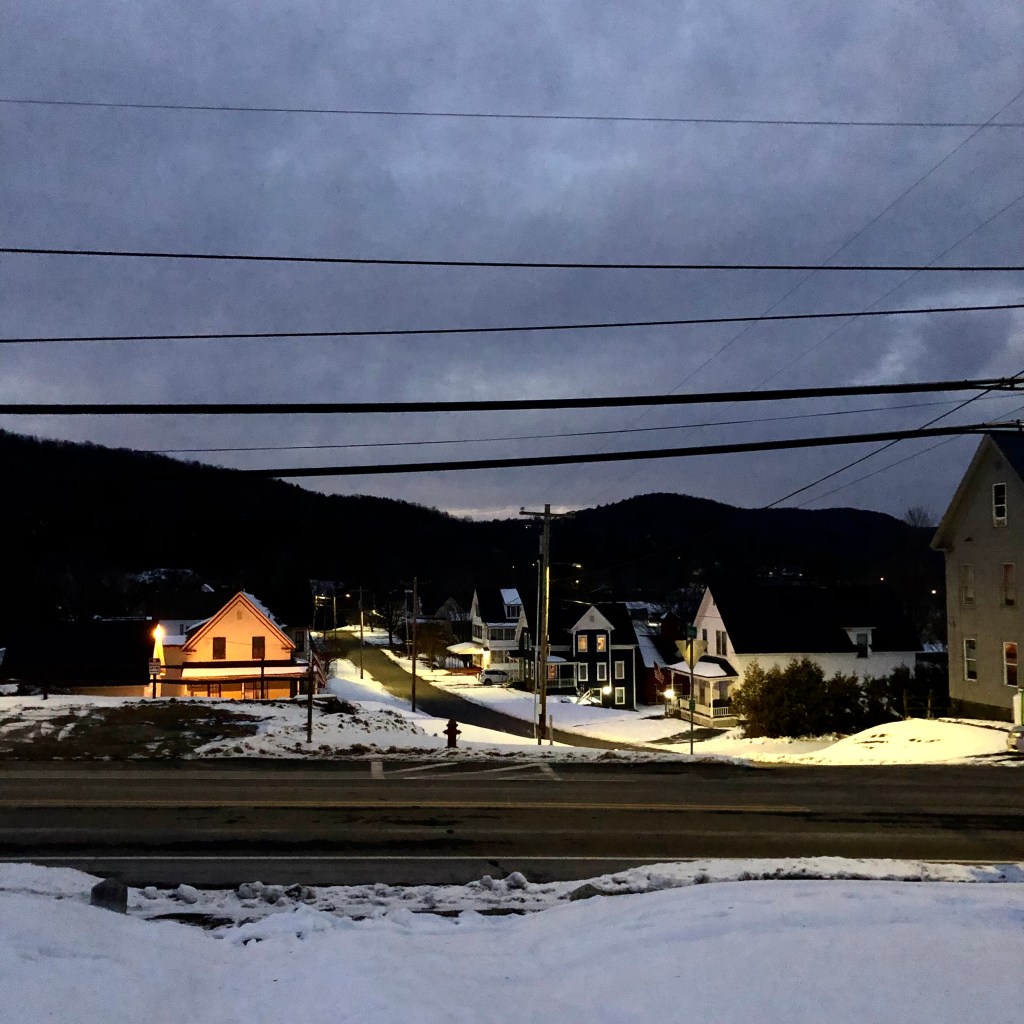
This afternoon, the streetlights are on early, the colored lights glowing at this junction of routes 14 and 15.

The woman with the pizzas asks me to open to her car door. I step off the sidewalk curb, breathing in the scent of garlic and bacon. Before she gets in the driver’s seat, she stands for a moment overlooking the colored lights and river. “December,” she remarks — that’s all — and then gets in and drives away.

In the brick courtyard, the kitchen staff is getting high, wearing t-shirts in the strangely balmy air. December: this descent into the amorphous darkness with no clear edges. Long after the stranger has disappeared, I stand beneath the building’s overhang while rain falls and light ripples across the wet world.

The Whole World.

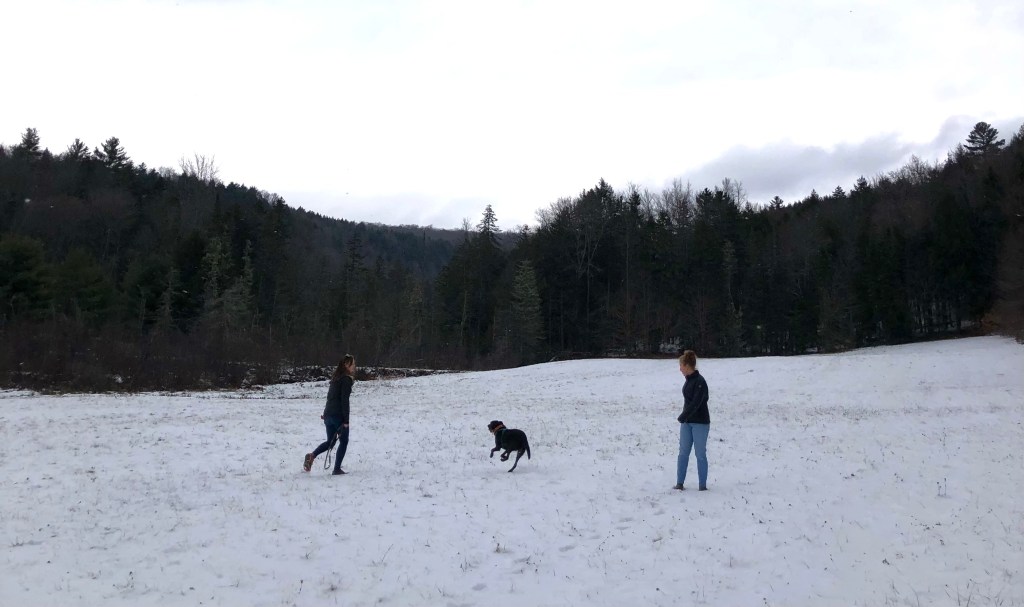
In the beaver dam realm, we spy the quicksilver flash of wet fur, bright eyes. The ice there is thin, barely beginning its winter’s work. We cross the snow-shallow field, then head into the woods and cut down again where the swamp lies in the fold between two hillsides, ghostly in its black-water, dead tree beauty. Then up, up, up we trudge, the dogs eager. We find bootprints in the snow, a few drops of blood from a wounded prey, and then we’re back again to the dirt road. All day, the light seems like twilight, and then we pass through twilight and into the night, and still we’re awake, talking, circling back to the same old subjects. In the morning’s dark, I scrape ashes from the stove and carry out the hot bucket. My brother stands on the porch, watching his dog nose at my herb garden. The damp rushes at my face.

“Like Maine,” I say.

“Yeah,” my brother answers. “But it’s Vermont.”

Happy Thanksgiving, wherever you might be.

“Assurance”

You will never be alone, you hear so deep a sound when autumn comes. Yellow pulls across the hills and thrums, or in the silence after lightning before it says its names — and then the clouds’ wide-mouthed apologies. You were aimed from birth: you will never be alone. Rain will come, a gutter filled, an Amazon, long aisles — you never heard so deep a sound, moss on rock, and years. You turn your head — that’s what the silence meant: you’re not alone. The whole wide world pours down.

— William Stafford

Days of Little Light.

Night has fallen down all the way by the time I leave work. Just below freezing, the wind cuts up with a taste of wet — the feel of sugaring season but the light is all wrong. It’s a month before the solstice, and now I’ve given into the darkness utterly. The truth is, much as I rail against the scantness of light at this annual time, I relish it, too. This time of year entices us to go deep, soul-search, spread out the cards and see what’s there.

Dark to dark, our days go. My daughter phones on her way to work, two stray cats yowling in her car. She’s bathed these hungry creatures and found a home for them, a tiny bit of kindness in the midst of a complicated world. Ever in her blur, she hands off these cats to a new home, blessing them in her own way, and moves on into her day.

“What does it mean to grow rich?… Is it to retain a capacity for awe and astonishment in our lives, to continue to hunger after what is genuine and worthy? Is it to live at moral peace with the universe?” 

— Barry Lopez

Snapshot. Vermont Thursday.

In Newport, at the Vermont/Canadian border, a woman in a bubble-gum pink blazer strikes up a conversation with me in a parking lot about the snow falling into Lake Memphremagog. Mid-morning, dense clouds, fat snowflakes disappearing into the gray lake. I’ve never been around the Canadian edges of this lake.

In Newport, I stopped first to visit my new acquaintance Lila Bennett to check out the work she and her colleagues are doing at the Journey to Recovery Community Center. The center is suffused with natural light, alive with plants and colors, and it’s immediately obvious that they’re engaged in that old-fashioned phrase, “the good fight,” work that saves and salvages lives. Lila shows me the stack of my books, too, that the center is giving away for free, to anyone who wants to read it. I thank her profusely.

I’m in Newport, too, to find my way into a state building, up through a reverse rabbit warren into a large and light-filled room where the state’s staff tells Selectboard members and volunteers from Vermont’s tiny Northeast Kingdom towns about the chunks of federal money in the state’s coffers and asks how to get that money to the needy and broken places in our rural communities.

The room is packed. I sit in the back beside a state senator who offers me advice while I knit a sweater cuff. My blue and orange balls of fingerling yarn roll beneath a stranger’s chair.

The snow falls all morning. A woman I knew 25 years ago comes up and reintroduces herself and launches into her enthusiasm for the rail trail. I chat with the Department of Libraries staff member who reads my blog.

Finished, I hurry down to the lake’s boardwalk before I leave, to breathe in some of that cold wet air. Years ago, my little girl lost a flipflop in this lake. I was talking to someone from the farmers market where I worked, and I turned around when my daughter cried out. She had stuck her foot through the railings and lost her shoe. My friend tried to save her shoe with a stick, but the pink- and purple-flowered flipflop bobbed away, headed northward.

I can’t see my future clearly…

The road becomes itself

single stone after single stone

made of limitless possibility,

endless awe.

— Jacqueline Suskin

First Snowfall, Again.

In a race with the season’s first impending snowstorm, I drive home from southern Vermont in those numberless hours of the night. I-91 northward to St. Johnsbury is bereft on traffic on an ordinary day. In the pocket of night, it’s me, a few rocketing cars from New York and Connecticut, interspersed long-haul truckers hurrying elsewhere.

I drink espresso and listen to This American Life, and when my attention wanes, Sam Birger and Fresh Air keep me company with Michael Imperioli. In the vessel of my Subaru, swathed with the blindness of night, my radio is oddly intimate.

Somewhere in that stretch, I do what I’ve cautioned my daughters never to do: I stop at a closed rest area and walk up and down the sidewalk vigorously. The night, with its promise of snow rushing in, bites coldly. Two trucks idle. The rest area is lit by lights tinged an orange-yellow, suffused with mist, as if we’re in a nether world, maybe the Underworld, maybe a halfway point between two realms. There’s such a strange, almost heady relief in being this unknown place, the allure of endless miles unfolding before me. My mind is filled with the night’s experiences — an enchanting home, the stories of strangers, a woman who poured out her heart about a funeral she attended that afternoon — the embrace of what’s resilient in our Vermont towns and what’s broken, cracked, fissured. I follow my advice to strangers and take my time, breathing in that damp and diesel-choked air, the freshness of wetlands at the far end of the lot, where the ground has not yet frozen. I wear my wool hat and a thin cotton dress. The night goes on and on.

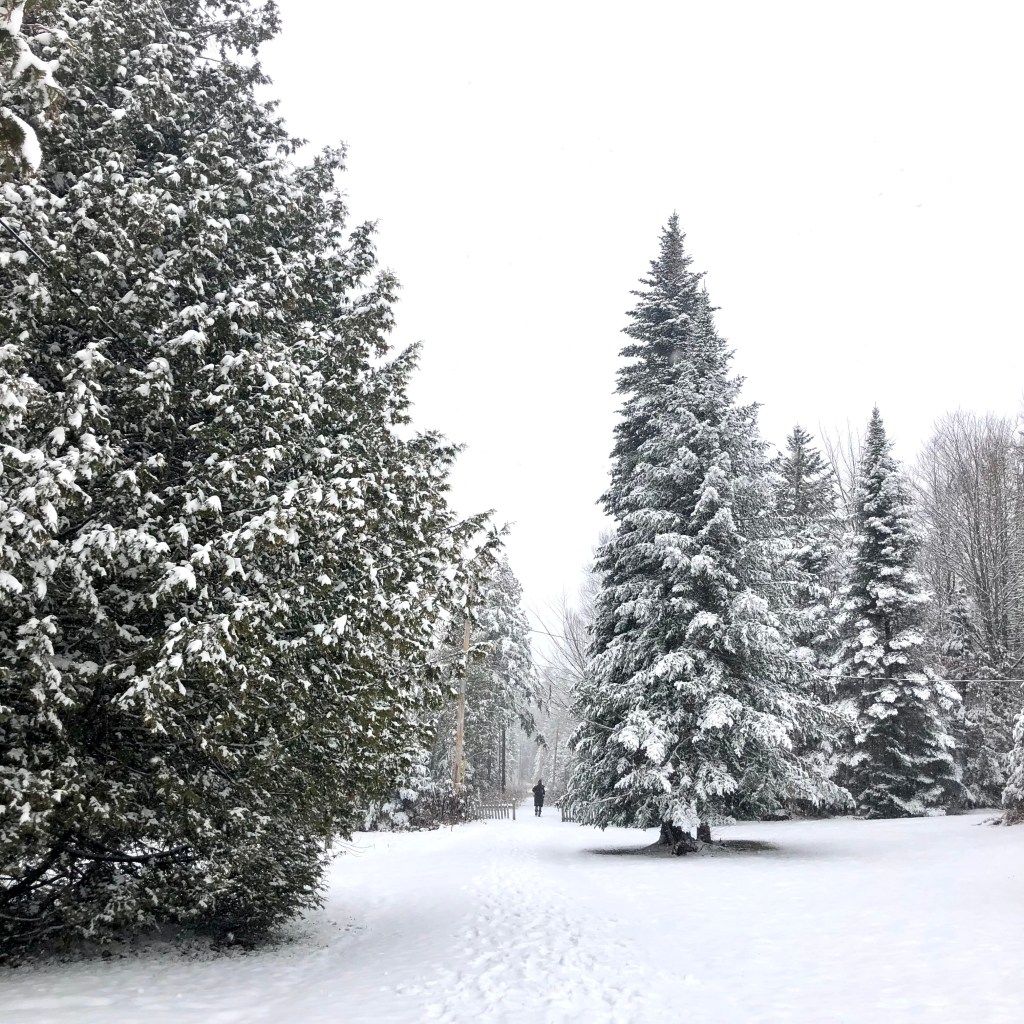
In the morning, snow falls steadily. My daughter and I drink coffee and eat Helga’s delicious blueberry torte and lemon mascarpone. A shift already, from gray November to winter’s enchanting light.