Interlude.

Checking out at the co-op, an acquaintance says she has a question for me. I follow her outside, and we stand in the falling snow, she with her bags full and me with the tomato and yogurt my youngest requested.

Through the snow, the mural across the street glows its brilliant rainbow of colors. Across Vermont, murals have appeared in the past few years, not just in the usual suspect cities — Burlington and Brattleboro — but in places where art seems least expected: a parking lot, or the roadside field in Jeffersonville where cement silos are beautifully painted with an old man sowing seeds, a red clover blossom. Half a decade ago, driving with four young teenagers, I pulled over and we walked around and into the empty cement tubes. Springtime, we splashed through standing water in the hayfield.

Now, snow swirls around us, my favorite kind of drifting snow, magical and full of possibilities. We talk for maybe ten minutes, while I hold that tomato and a paper bag of granola, shivering, while people trudge through the snow around us, buying baguettes and greens and bottles of wine. We’ll find no answers in our brief conversation that picks up those knots of privilege and power, of pretense and betrayal. This far along in our lives, there’s nothing textbook here. The questions shape our lives, the little world where we live.

I suggest a sliver of a solution, a tiny change, a minuscule movement, a small slice of good. By then, I’m shivering fiercely. The night’s falling down, and my small household will be hungry.

The painter’s vision is not a lens,

it trembles to caress the light.

— Robert Lowell, “Epilogue”

Order.

Dreaming, I untangle my knitting conundrums: rip out one half-finished cardigan and use the yarn for a cabled pullover. Nothing earth-alternating, planet-changing, simply my need for order and creation. Some small measure of satisfaction.

Which is why I understand the volunteer in the Giving Closet, the room in the old school building where I work these days. The Giving Closet holds the community’s castoffs and giveaways, an endless motion of clothes and toys and dishes and not enough artwork that swaps around from household to household.

Late afternoon, low clouds pressing around the wide windows as a storm moves in, I wander into her space and offer hot water for tea. She’s endeavored to straighten and tidy the concatenation of stuff that invariably slides into chaos. Two women are looking for scrubs, holding up shirts and asking each other, This? or This?

Through the windows, snow drifts down. The roads part and V around this old schoolhouse, empty. Across the way, the Ukrainian flag hangs down from the church’s sign.

….. and here’s a few lines from a recent review of Unstitched by Joanna Theiss.

While Unstitched is a valuable and important book for its discussion of opioid addiction, the writing is quietly beautiful, every word appreciative of the Vermont landscape and its seasons, on mothering girls while grieving with a mother who lost her own daughter, on the stark class divides that hinder our efforts to grow past this crisis, and the joy of community, no matter how much mending it requires.

These Days…

Days and nights on the cusp of sugaring season. It’s been years since I made a living sugaring, but I haven’t forgotten the years the kids and I inhabited the sugarhouse for a month and more. Walking at dusk, as the night bites my eyes and the tip of my nose, I remember what close friends the weather and I were in those weeks of sugar and ash. The children were always in sodden snowsuits, or their fingers shivered from lost mittens, or their faces were crimson with heat, cheeks sticky with a maple patina. We ate oatmeal and nachos, drank coffee with syrup, baked pizza in the arch when the fire burned to coals. We were always hungry.

One night, a daughter sleeping against me in bed, I read a Louise Glück poem in the New Yorker while knitting a yellow bunny for that sleeping child’s Easter gift. I gobbled that poem, ripped it from the magazine, thumbtacked it over my desk. Forget it’s still February; the poem must be read.

March

The light stays longer in the sky, but it’s a cold light,
it brings no relief from winter.

My neighbor stares out the window,
talking to her dog. He’s sniffing the garden,
trying to reach a decision about the dead flowers.

It’s a little early for all this.
Everything’s still very bare—
nevertheless, something’s different today from yesterday.

We can see the mountain: the peak’s glittering where the ice catches the light.
But on the sides the snow’s melted, exposing bare rock.

My neighbor’s calling the dog, making her unconvincing doglike sounds.
The dog’s polite; he raises his head when she calls,
but he doesn’t move. So she goes on calling,
her failed bark slowly deteriorating into a human voice.

All her life she dreamed of living by the sea
but fate didn’t put her there.
It laughed at her dreams;
it locked her up in the hills, where no one escapes.

The sun beats down on the earth, the earth flourishes.
And every winter, it’s as though the rock underneath the earth rises
higher and higher and the earth becomes rock, cold and rejecting.

She says hope killed her parents, it killed her grandparents.
It rose up each spring with the wheat
and died between the heat of summer and the raw cold.
In the end, they told her to live near the sea,
as though that would make a difference.

By late spring she’ll be garrulous, but now she’s down to two words,
never and only, to express this sense that life’s cheated her.

Never the cries of the gulls, only, in summer, the crickets, cicadas.
Only the smell of the field, when all she wanted
was the smell of the sea, of disappearance.

The sky above the fields has turned a sort of grayish pink
as the sun sinks. The clouds are silk yarn, magenta and crimson.

And everywhere the earth is rustling, not lying still.
And the dog senses this stirring; his ears twitch.

He walks back and forth, vaguely remembering
from other years this elation. The season of discoveries
is beginning. Always the same discoveries, but to the dog
intoxicating and new, not duplicitous.

I tell my neighbor we’ll be like this
when we lose our memories. I ask her if she’s ever seen the sea
and she says, once, in a movie.
It was a sad story, nothing worked out at all.

The lovers part. The sea hammers the shore, the mark each wave leaves
wiped out by the wave that follows.
Never accumulation, never one wave trying to build on another,
never the promise of shelter—

The sea doesn’t change as the earth changes;
it doesn’t lie.
You ask the sea, what can you promise me
and it speaks the truth; it says erasure.

Finally the dog goes in.
We watch the crescent moon,
very faint at first, then clearer and clearer
as the night grows dark.
Soon it will be the sky of early spring, stretching above the stubborn ferns and
violets.

Nothing can be forced to live.
The earth is like a drug now, like a voice from far away,
a lover or master. In the end, you do what the voice tells you.
It says forget, you forget.
It says begin again, you begin again.

— Louise Glück

February Light.

I am not a dog owner, but my oldest has a dog now she adores, so walking and hiking with her I’ve discovered the world of the dog walkers. Midday in full sunlight, I wander along the lake. Great puddles pool on the ice. White-throated sparrows sing late winter songs. I head through the woods from lake to library through a few inches of soft snow. I’m wearing shoes more than boots, and crumbles of icy slush soak through my socks. At the library I sit on the steps and empty my socks of ice bits and shreds of cedar greens sprinkled in the woods from the last windstorm.

A little white dog runs up to visit, curious. As I bang out my shoes to the dog’s fascination, the dog’s owner and I chat about the birds and the sunlight, and then she leaves her dog with me and heads into the library. The little creature and I ruminate about the neighbors’ cat sitting in the window. Beyond the paved driveway, mud oozes in the sunlight. Sure sign of spring.

Last, The Writing Life column in Hippocampus ran my essay this month. The essay includes:

Without wealth — as most of us are — a creative life is a dicey proposition…

Falling.

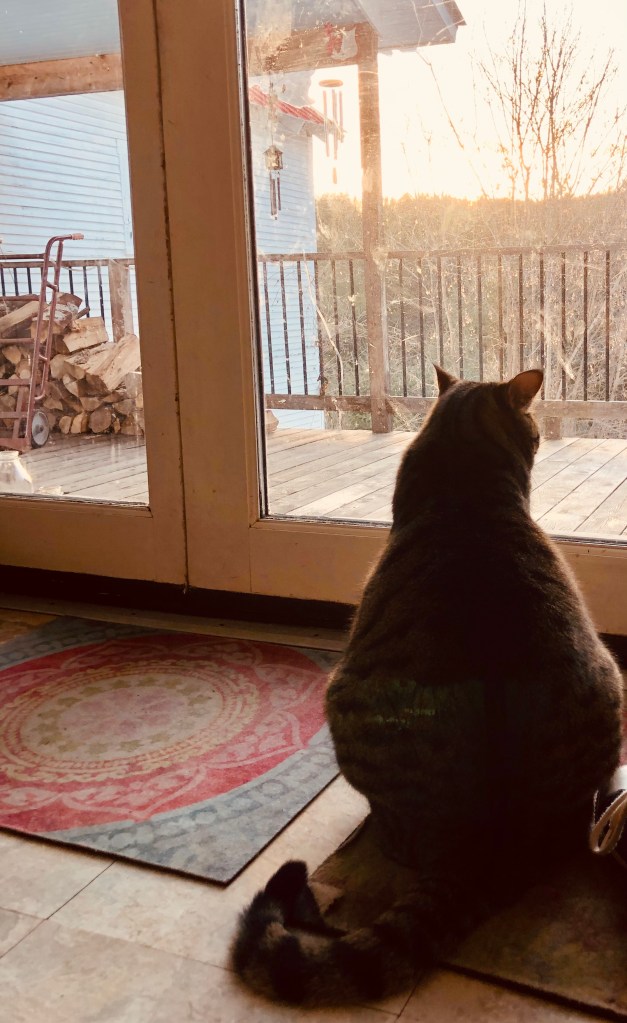
The outside light flicks on early this morning, and my little cat Acer stares wide-eyed at a skunk making its snuffling and curious away around a flowerpot I left on the back step. Well before dawn, the cats are already fed, the kitchen warm, redolent with coffee, and here’s this wild creature, not in the least troubled by the two of us.

The skunk waddles on its way. Shortly afterwards, snow and chunks of ice rush down the house roof and crash on the porch, softened in the rising temperature. My cat runs. I wonder about the porch railing which snapped in prior years, but nothing appears broken. The design is poor — steep roof and wide porch and slender railings — and I let myself wonder just for a moment if this is some kind of hidden cosmic twist, a long-buried plan from when my former husband built this porch. I cut off that sentiment. This far along in life, I’m well-acquainted with the steepness of roofs and the precariousness of ice and snow and dynamic temperature. Gravity is not ruled by human desire.

At the other end of the day, I’m carrying in a few armloads of wood from the barn when another ice chunk falls, shaking the porch where I had tread a moment before. Through the glass door, my teen raises her hands — what’s happening? — Acer at her feet.

The cold’s drilling back in for the night. In the valley below, the village twinkles in the darkness. The wind whirls around the scent of woodsmoke. I step back, finally wary. The roof has cleared.

When you’re young, you are certain of your capacity to imagine a way out of the previous generation’s problems. There is a different way to grow old, paths that don’t involve conforming and selling out….

— Hua Hsu, Stay True

History, Yellow Wallpaper, Gas Station.

On my way home, I stop to fuel my Subaru. A light snow falls, icy around the edges, barely sharp enough to tease my cheeks as I stand looking up. It’s after dark, and the people are coming and going in the convenience store with cups of coffee and bottles of wine and white paper cartons of fried food. The river curves behind the store and the attached garage, silently bending through town, water running beneath the frozen surface.

The evening before, my daughter asked me about The Yellow Wallpaper, the novella she’s reading for class. I remembered the free copy I picked up in high school, dirty and water-stained — a copy I probably snagged from my high school floor. This is the season of freeze and thaw, freeze and thaw, the long slow slog towards spring. In the late afternoons, skiing, the sunlight pushes through the forest. Some days, cold. Some days, warm. So it goes.

Life is a verb, not a noun.

— Charlotte Perkins Gilman