Worms for the Body, Philosophy for the Soul.

A little light rain falls as I pull a few weeds from the Sweet William in my garden. I planted these flowers when I moved here, putting my shovel into this terrain, vying for flowers and vegetables versus lawn. At the moment, the flowers flourish. I’m thinking a little about a writers roundtable I participated in the morning before, how I urged writers to remember that cause and effect drive the world we live in. All the pretty and noble thoughts we have about ourselves are only illusions. Character lies in our actions, for good or ill, whether we chose to see this or not.

On this Father’s Day, I remember those conversations my siblings and I had with my father at our kitchen table, so many decades ago. This sense of the world comes from the Aristotle he had us read. It’s a lesson that I’ve been hammering out, over and over and over in my life, through garden (what truer way to learn cause and effect), through writing and childrearing, through work, divorce, friendship.

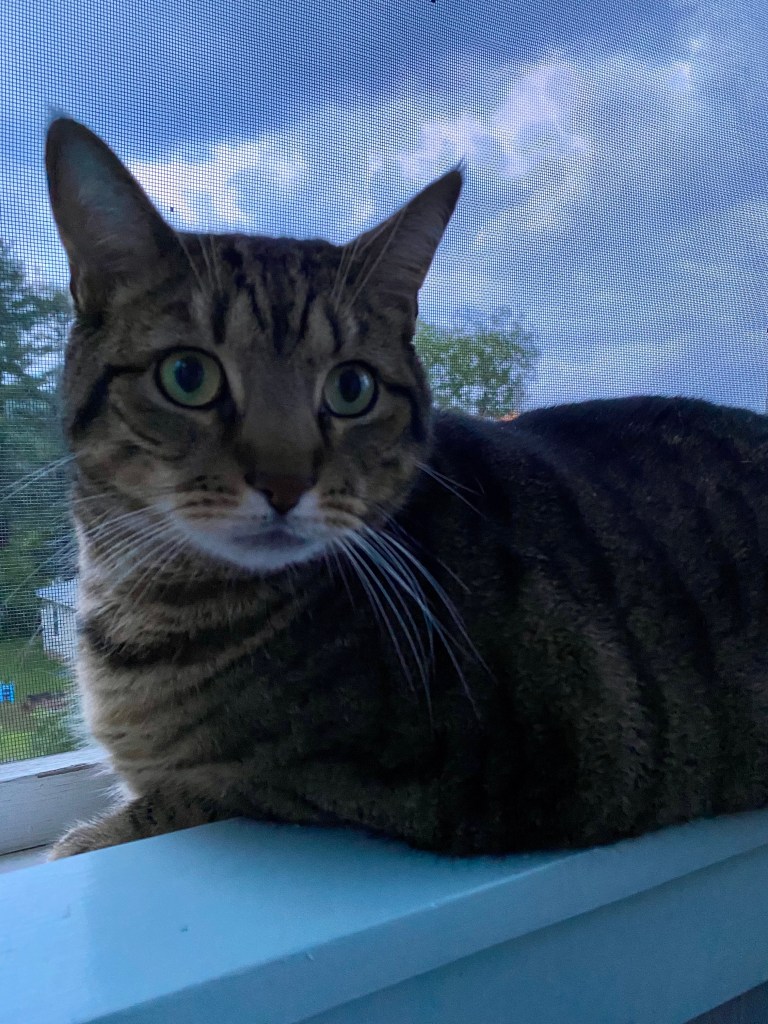
On my deck, the robins’ nest has open-beaked fledglings, tufted and mewling. All day, the parents fly in and out, worms draping from their beaks, feeding their young, this great Herculean parenting endeavor. My cat Acer lies on a kitchen chair, staring through the glass door, mesmerized. The robins, in their robin way, have taken a chance nesting just above my door. Will this pan out? Will the young survive?

Wendell Berry wrote that “Parenthood is not exact science.” Nor, by any means, is bird or human life. My father gave his three children worms and philosophy. He taught us to love bread for the body, wine for the soul.
Robin Survival?

This is now the sixth year we’ve lived in this house. I count these years by June 15th, the date I signed for the house, two days before my oldest graduated from high school, the date the sellers took us out to lunch and I stared through the diner window, wondering if buying this house was a good idea.

On this sixth year, a robin family has joined us, building what appears to be a well-made nest, strands of straw hanging from roof rafter. The nest is beneath the porch roof, covered from the weather. The nest is so close to our house that the mother robin flies away whenever we open the back door. My daughters and I wonder, Why not choose a rafter in the barn? A good old-fashioned tree limb?

The robins’ destiny is, of course, neither here nor there. We didn’t make the nest, and whether this family survives is largely beyond my purview. Certainly, my curious housecats will not harm these young ones. Yet I’m curious as my cats, wondering what drove this family to our porch.

June. We are surrounded by a hungry world that eats wee robins. I’m rooting for these young ones, hoping they’ll pull through. Come what may.

18th Birthday.

Here’s the thing: 18 years is a whole lot of parenting. 18 years is hardly a heartbeat.

My youngest was born by caesarian at 8:13 a.m. Leaving the hospital a few days later, corn nubs had emerged through the soil. As we drove by farm fields, I admired the new corn, marveling at its beauty. I had seen corn growing my whole life. And yet….

Perhaps that and yet sums up parenting. As a little girl, my youngest wore a green fairy tutu from her grandmother for about two years straight. These days, we are past the days of tiny teacups and Go, Dog, Go. Our family dynamics are now getting down to the hard questions: what does it mean to be a woman? what shall I do with my life? and how many times does sunscreen really need to be applied on a senior skip day at the beach? The questions go on….

blessing the boats

                                    (at St. Mary’s)

may the tide

that is entering even now

the lip of our understanding

carry you out

beyond the face of fear

may you kiss

the wind then turn from it

certain that it will

love your back     may you

open your eyes to water

water waving forever

and may you in your innocence

sail through this to that

— Lucille Clifton

‘In sorrow, pretend to be fearless.’

In Praise of Coldness

“If you wish to move your reader,”
Chekhov said, “you must write more coldly.”

Herakleitos recommended, “A dry soul is best.”

And so at the center of many great works
is found a preserving dispassion,
like the vanishing point of quattrocentro perspective,
or tiny packets of desiccant enclosed
in a box of new shoes or seeds.

But still the vanishing point
is not the painting,
the silica is not the blossoming plant.

Chekhov, dying, read the timetables of trains.
To what more earthly thing could he have been faithful?—
Scent of rocking distances,
smoke of blue trees out the window,
hampers of bread, pickled cabbage, boiled meat.

Scent of a knowable journey.

Neither a person entirely broken
nor one entirely whole can speak.

In sorrow, pretend to be fearless. In happiness, tremble.

— Jane Hirshfield

Birds are a Kind of Souls.

I’m sitting at the kitchen table talking with my daughter about past, present, future — one or all of those mixed in together; it’s late adolescent talk; the future hovers around us all the time, all day long — when I see a robin swoop up to our porch beam, its beak full of limp weed.

For the first time in the half dozen years we’ve lived here, robins are building a nest a few feet from our kitchen door.

In our other house, robins crafted fat nests in our sugarhouse and under our balcony. We witnessed baby beak feedings and collected blue ragged shells. Twice, a hawk ate fledglings — the course of nature, but sorrowful.

Rain has fallen all day. There’s an underlying promise of deepening green with the rain, but the hours have been cheerless and cold, filled not with any bad news but the accrual of petty things that drag at all our lives.

A robin stands on the porch railing, eyeing us through the glass door. Its mate flies in quickly, busy busy in the nest. Time is of the essence in bird movement. The robins are a little story come to stay with us for a short while.

Build and thrive, I think. Thrive.

“I was convinced that birds were kinds of souls. Not the souls of people but of previous birds whose mystery and beauty were so necessary on earth that God would not allow them to be anything in their second life but birds again.” 

— Howard Norman

Apple Blossom Petals Like Snow.

When my youngest was born, nearly 18 years ago, my brother had a new cell phone that had a camera. I didn’t own a cell phone then and didn’t predict I ever would. Who wanted to carry a phone around with them?

Turns out, my brother had forgotten his phone, anyway.

I could rhapsodize about how many phones and how many laptops have now passed through our house, the zillions of digital images and words, but really…

This is the most amazing blossom season. In the late afternoons, I read beneath an apple tree while petals fall, the pollinators hum, the spring crickets creak on. The first crop of dandelions has already morphed into gossamer globes of seed. How fast this passes. Sometimes, waking in the night, I get up and read. I am now beyond those baby waking nights, no longer so hungry to rest. Jays bicker over something I’ll never know. The day slips along.

The sea is calm tonight.

The tide is full, the moon lies fair…

— Matthew Arnold