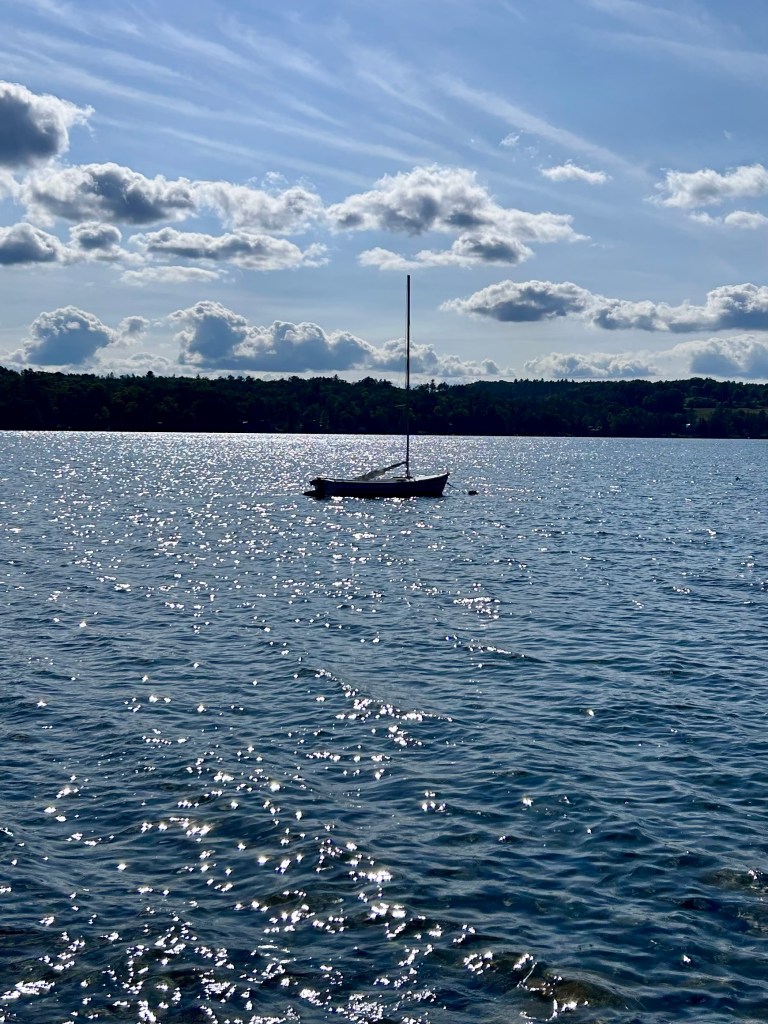
Solitary Sailboat.

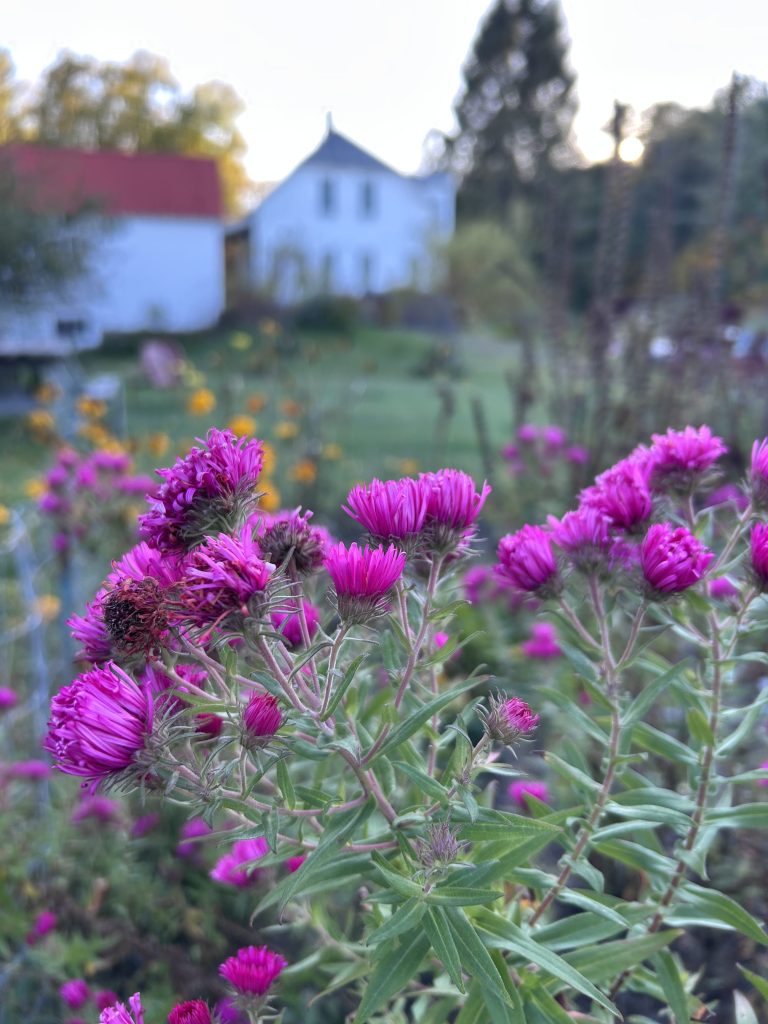
I make a difficult phone call to a family member. Late afternoon, the perennial sunflowers stretch above my head in my garden. I’ve walked barefoot from my house through the grass that’s already cooling in the shadows to my garden, the soil warm from the day’s sun and so dry it’s verging near dusty. Afterwards, there’s a second call, then a third. I find two zucchinis that need picking, an onion I’d forgotten beneath the tansy. I gather these.

I’ve had this worldview of cause and effect: make a decision, or not a decision, and the consequences creep up or roar upon you. No stasis in this world. A selfish view. Meanwhile, of course, the transient world churns along, F. Scott Fitzgerald’s ceaseless waves, the pollinators feasting lustily on these sunflowers whose petals are already beginning their autumn wilt-and-drop.

September: a month jammed with color and sadness, the fleetingness of this life. Two years ago, disease was rampaging in my blood. I did not yet know this, while already my ailing body was sailing me into faraway seas. That journey was me in a solitary life raft, cold winter starlight drenching my eyes. Swimmers tossed over the edge of that rickety inflatable boat the things that kept me alive: medicines of all kinds, tiny bowls of hot soup, books and money, the hands that propped me up and guided me on walks, the company of voices. Meals and kindness that sustained my daughters, and so sustained me.

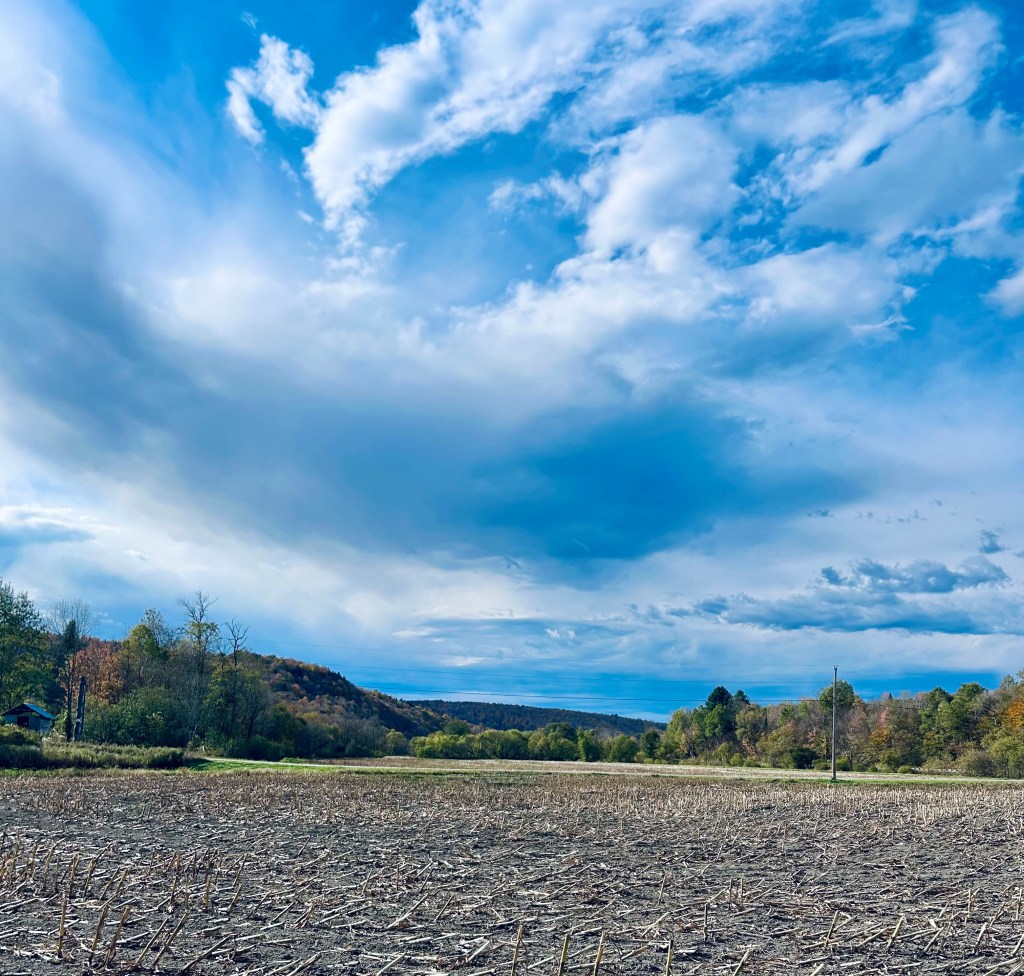
Overhead, the bluest of a Vermont sky. I answer my phone again. What luck, immensity of good fortune, to be enmeshed in wildly unknown world, relishing fatty marrow.

Into My Own

One of my wishes is that those dark trees,
So old and firm they scarcely show the breeze,
Were not, as ’twere, the merest mask of gloom,
But stretched away unto the edge of doom.

I should not be withheld but that some day
Into their vastness I should steal away,
Fearless of ever finding open land,
Or highway where the slow wheel pours the sand.

I do not see why I should e’er turn back,
Or those should not set forth upon my track
To overtake me, who should miss me here
And long to know if still I held them dear.

They would not find me changed from him they knew—
Only more sure of all I thought was true. ~ Robert Frost

Wild and Human Worlds, Intersection.

In New Hampshire for a book reading, visiting bro — all the New Hampshire things: granite boulders and thickety woods, the clear Saco River where we alternate post-hike lying in the pebbly river and warming on the water-polished rocks, so much talk and laughter, all the things.

A fellow hiker stops us on the trail and points at two black bear cubs in a tree, the great mama below, brown-nosed like a creature in a child’s picture book, but of course not at all like a child’s tale. Wordlessly, we admire the animals, one cub climbing a branch, round in limb, enchanting. Then slowly we make our way off the trail and through the forest, a great half-circle, to leave these creatures to their own wild way.

In my own corner of Vermont, I’ve spied so many bears this summer. Always, this flash of awe, this sense of luck to know this sliver of wild, immediately followed by caution: keep our human realm away from these creatures in their own bear domesticity.

It is a mystery to me where each word begins and ends, let alone each phrase. ~ Jean Said Makdisi

Small Celebrations.

Each morning presents a new skein of yarn, knotted and jumbled as if carelessly carried in the bottom of my backpack, beneath leaking and softening apples, a sandwich wrapped in wax paper whose crumbs have escaped, the shuffling of notebooks, pricks of pens.

A friend asks me to xc ski this weekend. I pause and then warn her of possible abject failure. Can I balance? Can I even snap boots into bindings? Talking, I think of my ski boots in the upstairs closet. A year ago, a knitting companion asked to borrow needles: an inconceivability. A year ago, I couldn’t walk up my house’s wooden staircase, let alone swing open the closet door and shuffle through needles. I might as well have considered mining for gold with a plastic spoon. Pulling together boots, skis, poles: that alone would mark a kind of success. I am a lousy skier, but the glide of ski over fresh snow has given me so much pleasure. I imagine again stopping at the trails on my way home from work, how the cold winter twilight gleams on snow.

A theme that emerges in my writing over and over is order versus chaos. How laboriously I endeavor to keep the chaos from my life, from vacuuming the ashes and bark shreds around my woodstove to ordering my work life. Be productive. Get my work done…

When I first emerged from surgery and chemo this summer, I flung myself into living with buoyancy and joy. Now, I am in the longer stretch — grateful to be here, but mindful of sinkholes. A longstanding quarrel in town rises up again and grabs at me. I remind myself, this was not my doing and not my requirement to undo. What I do, instead: I force myself up from the couch, lace up my boots, and walk. In town, I fill my backpack with library books, zip my coat against my throat as the gloaming sprinkles down. I take the longer walk home through the neighborhood built near the coal-dark Buffalo Mountain, these houses built for Hardwick’s granite workers, a hundred years and more ago, once filled with hardscrabble people from other places, seeking not a fortune but a livelihood. The kind of work where a slip or accident had horrible consequences. I pass a house with a family of small children, strung with glowing lights, sleds jammed in snowbanks. The empty house where the old woman with the two barking dogs disappeared in my illness, and another empty, for sale. On my road, I’ve strung red globes in an apple tree, bits of brightness, small celebrations, better than order.

The oncologist… “knows not to describe everything all at once.” — Marion Coutts, The Iceberg

The Illusion of the Ordinary.

A year ago, I entered the local ER with acute pain. I’d been there before with my kids for stitches and an allergic reaction, things that could be patched up and remedied. A year ago, an MD told me that a scan revealed metastatic cancer. It was the eve of a contentious election, the nation cracking apart. In my life, however, I suddenly had no time for beliefs or opinions. To survive, I had to lean on facts.

For years, I’d been running not so much as a lone wolf but a mangy coyote, hustling my single mama gig, utterly determined to nourish and protect. But there was no way I was going to weasel through this cancer alone. Almost immediately, I was forced to size up strangers — a surgeon, an oncologist, nurses — and do what I had never done before. I had to trust these strangers with my life. Divorce had school me to be wary; now, disease was forcing me to revise my life, rapidly, on the (incredibly painful) go.

A year later, I’m alive. Some was my stubbornness, the trait that enraged my mother — and yet she herself had taught me stubbornness. Back me into a corner, and, damn, will I fight. But that’s a scrap. The more profound reason I’m alive is that I had access to first world health care. I benefited from medicines and decades of trial-and-error, thanks to researchers and so many suffering patients before me. I had access to that small rural hospital who took me in, over and over, this winter, and to Dartmouth-Hitchcock, such a remarkable cancer center surrounded by New Hampshire woods. We drove down the interstate in multiple snowstorms, and always I was gladdened to see the crimson EMERGENGY sign that never turned off. Entering, I knew I would be treated with compassion, with unflagging skill.

I could not have been treated at Dartmouth without my daughters’ immediate willingness to relinquish nearly a year of their young lives to ferry me through the sheer wretchedness of chemo and the brutal complications, and to keep enduring when I finally broke. They had the patience to stay with me while I put myself together.

I was determined to endure all the chemo to gain the best chance of a cure — and I did, running and then limping and eventually crawling — but I received so much kindness from family, from friends old and new, from many of you here, and from strangers. People brought soup and pot roast, drove me to appointments and blood draws, took me outside on walks, carried in firewood and brewed tea, and insisted that I did not look so terrible at all when I couldn’t even sit up. My post office box filled with lovely cards that I taped on the wall over my bed. A friend texted me photographs nearly every day of the beautiful Vermont winter that I was missing; another dear friend texted me a poem she read every night. Boxes of books and cookies and stollen — such treasures. The end of the chemo was followed by a painful surgery. By then, I had no income, and a check from a friend carried me into the summer and recovery. All these well wishes — all this meant so much to me. Gratitude beyond gratitude.

On the day before this year anniversary, I walked down a dirt road as the darkness fell down. In the gloaming, I could see across the valley a tiny white square I knew was my house where my cats were hungry for dinner. The neighbors’ house glowed orange and yellow with their Halloween lights. An utterly ordinary November day.

What remains with me is a body weakened and damaged, but alive, and the steely secret that the ordinary is luminescent with the extraordinary. Here I was — this small woman stripped down to a t-shirt in a billowy warm November afternoon walking along an empty road. Overhead, a line of cacophonous geese arrowed through the sky. The road dipped down in a wet area, and the mud stunk of rank water and rotting leaves. Ahead of me, mist hovered. What luck! I thought. I strode into the mist. In the spring, Daphne plants grow in these roadside woods where someone too broke or too lazy keeps dumping household trash. By the time I was back at my car, I was in the solid dark, the stars and moon swallowed by clouds. Oh, this messy, unclear, uncertain, marvelous world. What luck.

Something Else.

About a year ago, a friend and I hung out laughing in her car beside Lake Champlain. Early November, by 6 p.m. it was dark as a buttoned-up pocket. The lake lapped against the shore. We joked about the pan I held of the worst cornbread I’d ever baked and the potluck we skipped, the polite and surely erudite chat we’d missed. Ah, whatever…. Twenty plus years ago, we were young mothers, driving around in my old car or her old car, our toddlers in carseats. The kids sometimes bickered if nap time neared, sometimes spun tales about Mopsy bunny driving a dump trunk or wondered aloud if maybe the mothers would relent for creemees.

My friend’s kids and my kids — they’re all grownup now. Are their stories more fun now than the cups of sand and lake water they used to serve us on the beach? Those countless gritty root beer floats.

So a year ago… a kind of throwback, this time without the kids. She ran a stop sign. I insisted we walk out to the ferry launch, and the bitter wind was dreadful. We stopped and bought Thai noodles and kale, and my friend ate like a normal person, while I stared at her and wondered what on earth was wrong with me. I was convinced I had mold poisoning from a work exposure, and we kept laughing and laughing. Then she said, “What if it’s Lyme disease? What if it’s something else?”

It was something else, of course. A few days later, I was hospitalized, turning dreadfully towards septic. That winter, as I endured chemo, as things went from really bad to worse, I sometimes thought back to those hours of silliness, how rapidly my life altered. As a young mother in those years, I did not yet know this. I did not yet comprehend that the world does not go on and on and on.

Knowing this now, in my soul and body, does it make the laughter sweeter?

Yes, indeed.

But just when the worst bears down
you find a pretty bubble in your soup at noon,
and outside at work a bird says, “Hi!”
Slowly the sun creeps along the floor;
it is coming your way. It touches your shoe. ~ William Stafford

Such a World.

Late afternoon, walking with a friend on the town forest trails and talking all-things-grownup-and-fascinating, her little girl runs ahead of us, stops suddenly, raises her arms in a Y over her head, and exclaims to the woods, “I love this place!”

Relish this.

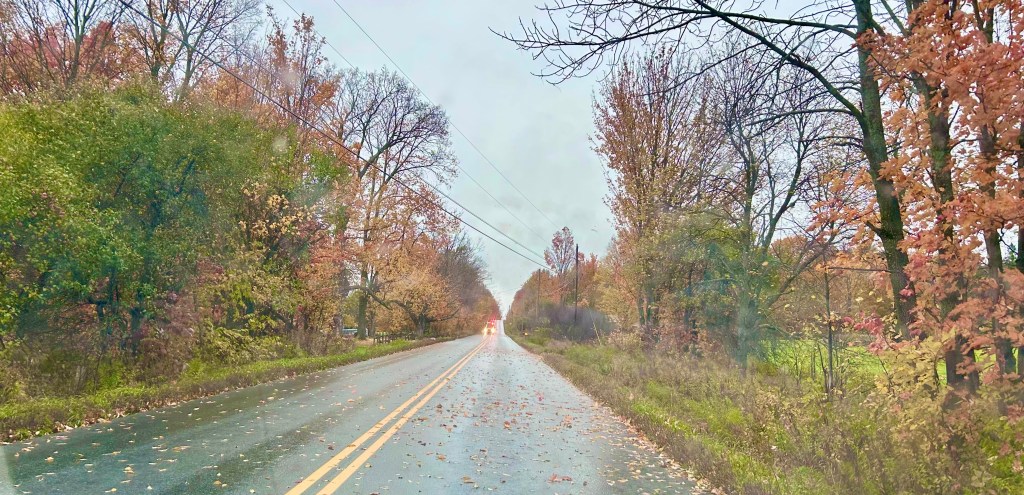
Slowly, the rain is returning, the streams beginning to flow again. Puddles muck the trails in a few low places. Meanwhile, people ask, “How’s your water holding up?” Word travels of dried up wells. This morning, I stand on my porch in the dark, listening to rainfall patter through the leaves that linger on the trees around my house. The crests of the apple trees hang onto their crowns of gold. We’re at that dipping point, the swing of seasons, the earth yet warm, redolent with this summer’s abundance.

Such a moon —

the thief

pauses to sing. — Yosa Buson