The Illusion of the Ordinary.

A year ago, I entered the local ER with acute pain. I’d been there before with my kids for stitches and an allergic reaction, things that could be patched up and remedied. A year ago, an MD told me that a scan revealed metastatic cancer. It was the eve of a contentious election, the nation cracking apart. In my life, however, I suddenly had no time for beliefs or opinions. To survive, I had to lean on facts.

For years, I’d been running not so much as a lone wolf but a mangy coyote, hustling my single mama gig, utterly determined to nourish and protect. But there was no way I was going to weasel through this cancer alone. Almost immediately, I was forced to size up strangers — a surgeon, an oncologist, nurses — and do what I had never done before. I had to trust these strangers with my life. Divorce had school me to be wary; now, disease was forcing me to revise my life, rapidly, on the (incredibly painful) go.

A year later, I’m alive. Some was my stubbornness, the trait that enraged my mother — and yet she herself had taught me stubbornness. Back me into a corner, and, damn, will I fight. But that’s a scrap. The more profound reason I’m alive is that I had access to first world health care. I benefited from medicines and decades of trial-and-error, thanks to researchers and so many suffering patients before me. I had access to that small rural hospital who took me in, over and over, this winter, and to Dartmouth-Hitchcock, such a remarkable cancer center surrounded by New Hampshire woods. We drove down the interstate in multiple snowstorms, and always I was gladdened to see the crimson EMERGENGY sign that never turned off. Entering, I knew I would be treated with compassion, with unflagging skill.

I could not have been treated at Dartmouth without my daughters’ immediate willingness to relinquish nearly a year of their young lives to ferry me through the sheer wretchedness of chemo and the brutal complications, and to keep enduring when I finally broke. They had the patience to stay with me while I put myself together.

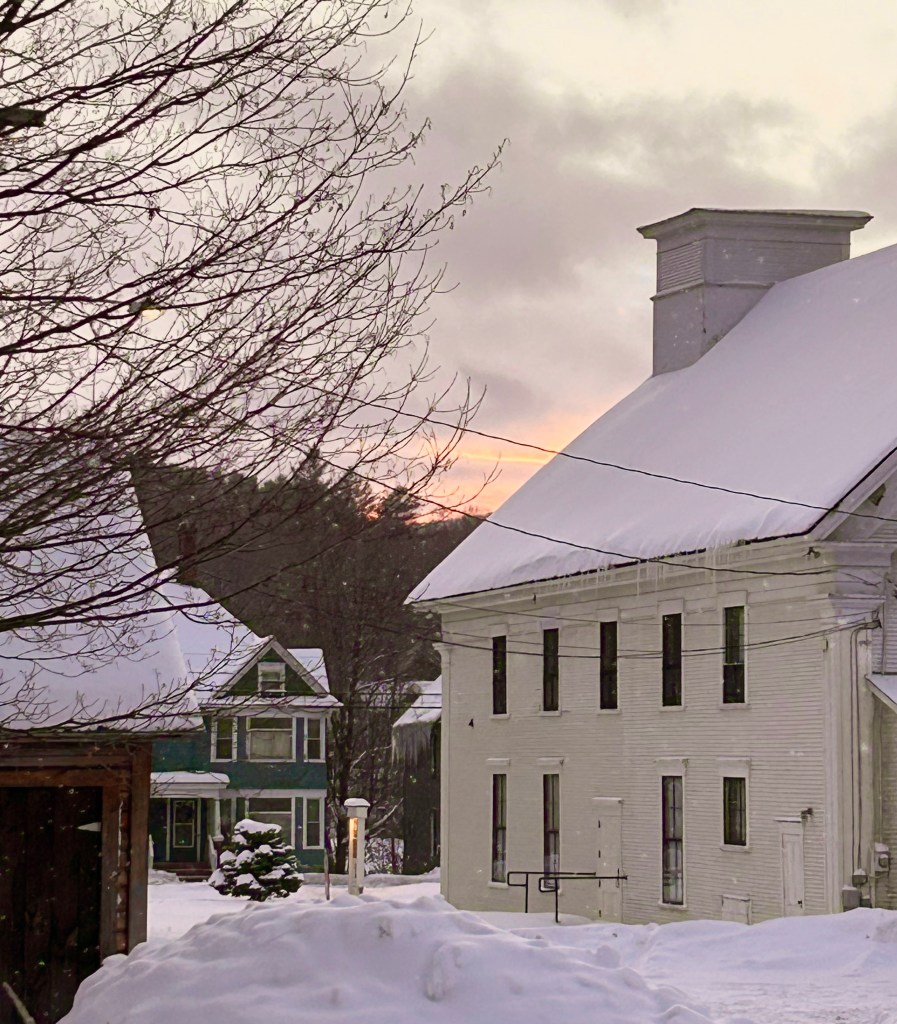
I was determined to endure all the chemo to gain the best chance of a cure — and I did, running and then limping and eventually crawling — but I received so much kindness from family, from friends old and new, from many of you here, and from strangers. People brought soup and pot roast, drove me to appointments and blood draws, took me outside on walks, carried in firewood and brewed tea, and insisted that I did not look so terrible at all when I couldn’t even sit up. My post office box filled with lovely cards that I taped on the wall over my bed. A friend texted me photographs nearly every day of the beautiful Vermont winter that I was missing; another dear friend texted me a poem she read every night. Boxes of books and cookies and stollen — such treasures. The end of the chemo was followed by a painful surgery. By then, I had no income, and a check from a friend carried me into the summer and recovery. All these well wishes — all this meant so much to me. Gratitude beyond gratitude.

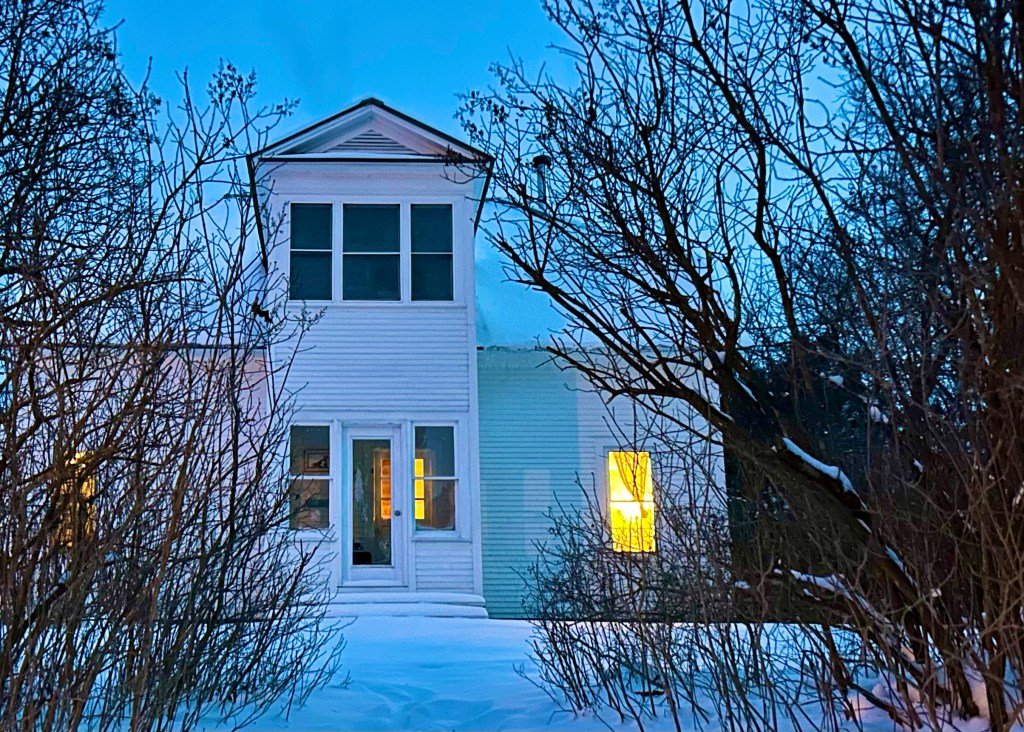
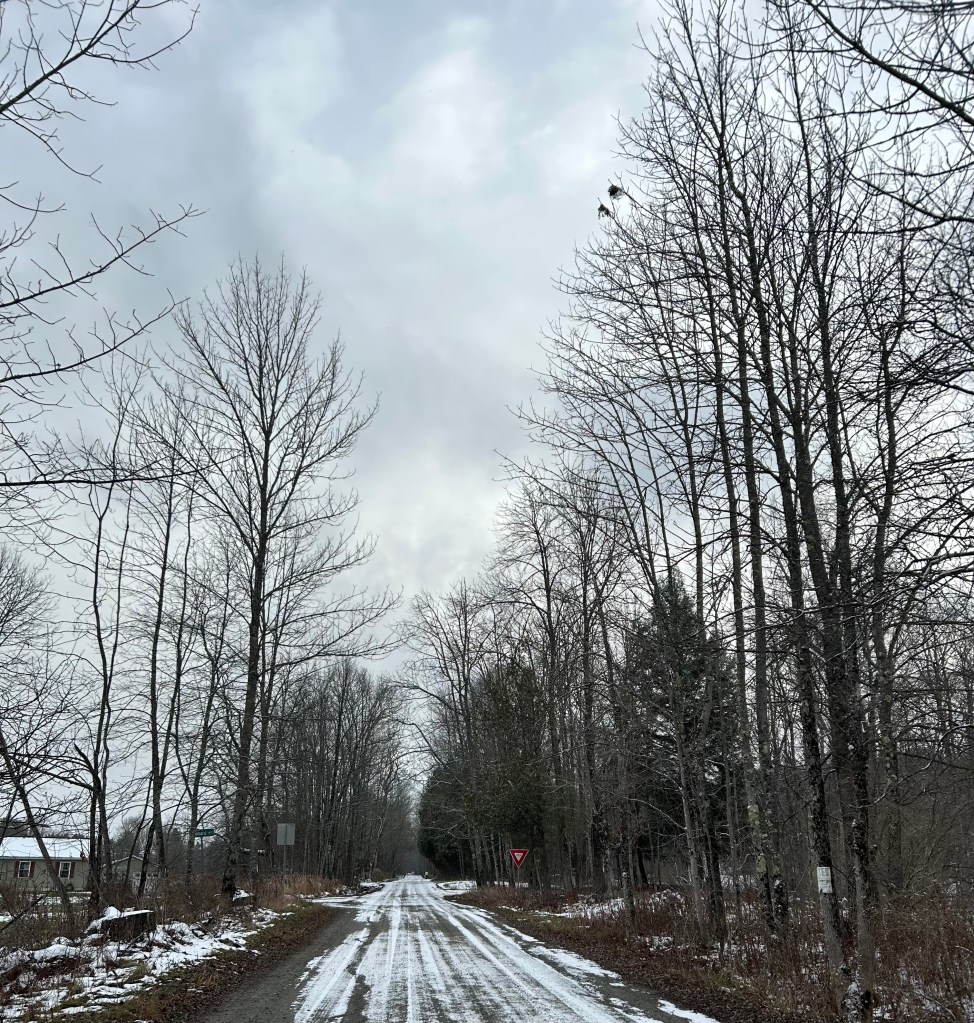
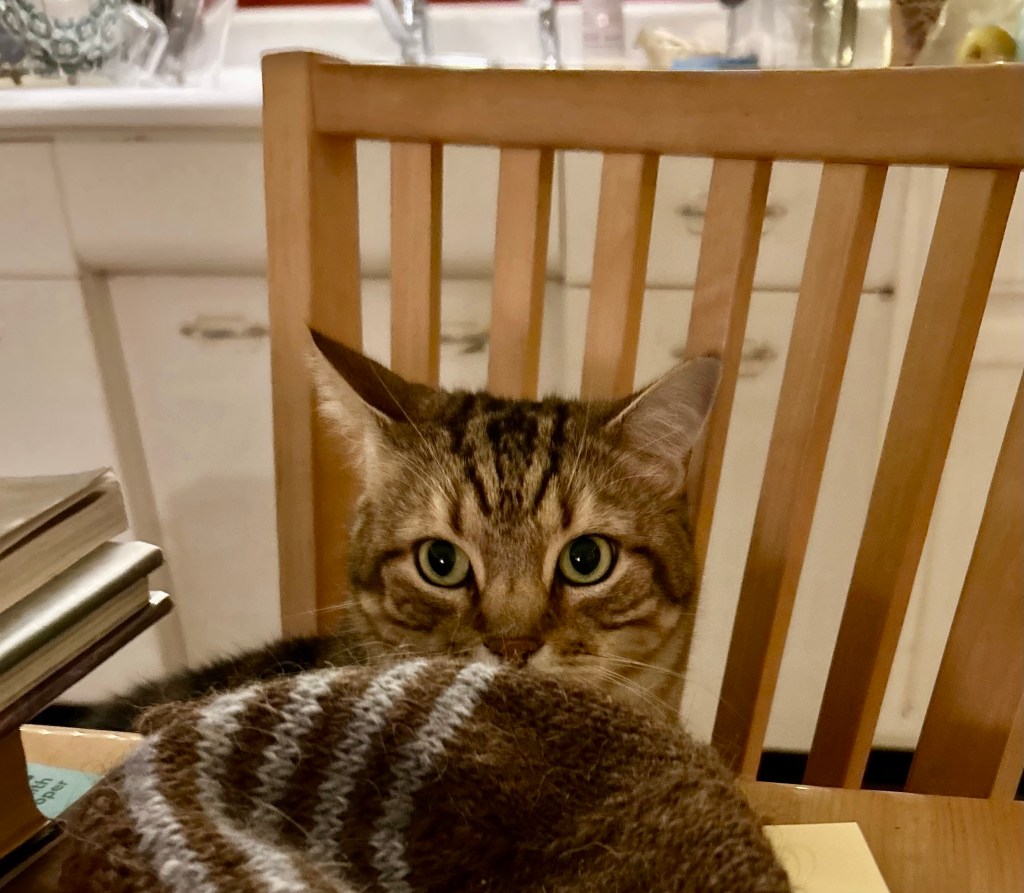
On the day before this year anniversary, I walked down a dirt road as the darkness fell down. In the gloaming, I could see across the valley a tiny white square I knew was my house where my cats were hungry for dinner. The neighbors’ house glowed orange and yellow with their Halloween lights. An utterly ordinary November day.

What remains with me is a body weakened and damaged, but alive, and the steely secret that the ordinary is luminescent with the extraordinary. Here I was — this small woman stripped down to a t-shirt in a billowy warm November afternoon walking along an empty road. Overhead, a line of cacophonous geese arrowed through the sky. The road dipped down in a wet area, and the mud stunk of rank water and rotting leaves. Ahead of me, mist hovered. What luck! I thought. I strode into the mist. In the spring, Daphne plants grow in these roadside woods where someone too broke or too lazy keeps dumping household trash. By the time I was back at my car, I was in the solid dark, the stars and moon swallowed by clouds. Oh, this messy, unclear, uncertain, marvelous world. What luck.

Something Else.

About a year ago, a friend and I hung out laughing in her car beside Lake Champlain. Early November, by 6 p.m. it was dark as a buttoned-up pocket. The lake lapped against the shore. We joked about the pan I held of the worst cornbread I’d ever baked and the potluck we skipped, the polite and surely erudite chat we’d missed. Ah, whatever…. Twenty plus years ago, we were young mothers, driving around in my old car or her old car, our toddlers in carseats. The kids sometimes bickered if nap time neared, sometimes spun tales about Mopsy bunny driving a dump trunk or wondered aloud if maybe the mothers would relent for creemees.

My friend’s kids and my kids — they’re all grownup now. Are their stories more fun now than the cups of sand and lake water they used to serve us on the beach? Those countless gritty root beer floats.

So a year ago… a kind of throwback, this time without the kids. She ran a stop sign. I insisted we walk out to the ferry launch, and the bitter wind was dreadful. We stopped and bought Thai noodles and kale, and my friend ate like a normal person, while I stared at her and wondered what on earth was wrong with me. I was convinced I had mold poisoning from a work exposure, and we kept laughing and laughing. Then she said, “What if it’s Lyme disease? What if it’s something else?”

It was something else, of course. A few days later, I was hospitalized, turning dreadfully towards septic. That winter, as I endured chemo, as things went from really bad to worse, I sometimes thought back to those hours of silliness, how rapidly my life altered. As a young mother in those years, I did not yet know this. I did not yet comprehend that the world does not go on and on and on.

Knowing this now, in my soul and body, does it make the laughter sweeter?

Yes, indeed.

But just when the worst bears down
you find a pretty bubble in your soup at noon,
and outside at work a bird says, “Hi!”
Slowly the sun creeps along the floor;
it is coming your way. It touches your shoe. ~ William Stafford

Pie.

I write an email to friends: Come eat pie and keep me company

In northern Vermont, in the grips of drought, wells and springs dry up. Towns send pleas to be mindful about water usage. Dry, dry, in need of rain, nonetheless the sunny days unfold, day after day after day, and we revel in these, the longest span of perfectly perfect wonderful weather unmatched in anyone’s memory. Soon enough, the weather will shift.

Less and less I write on the back deck, that glass table I bought in the pandemic with stimulus money. Never much of desk user, I write at the kitchen table my brother made for me, or the couch beside the wood stove and my heat-glutted cats. In one evening, I sprawl on the couch and read Meredith Winn’s Uncertain Behavior, her story of bone cancer, passing parents, creativity.

In four-week bursts, I zoom into a writing circle through Dartmouth Hitchcock, all of us linked in some way through cancer, survivors or caregivers. At 5 p.m., I’m spent for the day, hardly a creative whisper stirring in my mind, and yet I manage to rise, so often astounded at the profound and beautiful and fearful words of my compatriots. These folks pull out the better side of me.

Some take stock of their lives (and how can you not, with the leer of death toothy around us), an apt exercise, as this autumn-gorgeous tapestry threads through with lifeless brown, the shadow of winter rising. But joy, too, and all the parts of our lives: raising kids and aging parents and chimney sweeping and sowing garlic for next summer’s table. I search for my leaf rake and check my email…. it’s apple pie season.

The thief left it behind:
the moon
at my window. ~Ryokan

Crazy-Making.

Yesterday, my oldest and I made that drive again down I-91 that flanks that Connecticut River. My knitting in my lap, I counted exits, St. Johnsbury first exit, then the second, the third that heads east to New Hampshire’s White Mountains, the fourth Barnet, which I took when I stayed at Karmê Chöling. We talked about fall colors and a meatball recipe and family, of course, all the way down to exit 13, the Norwich and Hanover exit, where we stopped for coffee and scones, as if a good luck charm. Coffee and sweets, not a dash to ER. We watched the time, careful not to be late for what I hoped would be a mere routine check-in.

All summer this day has hovered in my mind — what will this day reveal? — but this past week this coming journey was as near to me as something I held in my hand as I went about my days, doing what needs to be done. The day before, talking with friends, the fear of this day erupts and I hear myself on the verge of screeching, nearly crying. All summer, I’ve relished my good life, learning to walk again and eat again, to read on my back porch in that hand-me-down butterfly chair. To marvel that I am not in pain. That I might sleep and reasonably expect I might wake in the morning exactly as I want, in the pre-dawn darkness drink milky coffee and write. That I will witness the unexpected autumn buds on a yellow rose bush open, these final velvety blossoms of the season.

At Dartmouth, we wait again in 3K, in the cancer center. I am no longer one of the pallid-gray-faced chemo patients, hobbling, enduring. How desperately I never want to return here. My oncologist gently reminds me that he’d assured me I’d pull through this winter, even as I was admitted again and again and again, a dozen times. Add to that, more ER visits.

Later, a friend asks about the scan’s sign-off, but the only rules that matter are what the hidden mysteries of my blood and flesh reveal. The markers are that the lymphoma has not returned. I know that the reaper’s scythe heads towards me as that inarguable blade poises over each of us. But not this day for me. Not yet.

Driving home, people crowd the interstate bridges with RESIST signs. As our car sails beneath the metal and steel, we wave. I’d told the oncologist that my wellness plan was four-fold: eat real food, walk, do my work, and try not to go crazy.

He said, This is crazy-making. Just do your best.

There is only one heart in my body, have mercy
on me…

Thank You for letting me live for a little as one of the
sane; thank You for letting me know what this is
like. Thank You for letting me look at your frightening
blue sky without fear, and your terrible world without
terror, and your loveless psychotic and hopelessly
lost
with this love

~ Franz Wright

Inoculation, Fallacy, and the Sacred.

A few years back, I did a joint reading with a woman who claimed she had discovered an inoculation for kids to prevent drug and alcohol addiction. She’s way more famous than me – and has made far more money – but the premise seemed prideful to me. There’s no shot against addiction, no simple fix.

For no particular reason, I was thinking of this on a recent walk. As part of my healing, I’m determined to walk every day, through rain, shine, or wildfire smoke from Canada. Sometimes with friends, sometimes alone. Late afternoon, I was on the wooded trails behind the local high school. Hermit thrush sang their endearing notes. I spent my childhood in the New Hampshire woods. As an adult, I backpacked. My former husband and I sugared for two decades and knew our maple acres in every variation of weather.

Not so many weeks ago, exhausted from chemo and surgery, I walked crooked over. Now, my boots confident on the path, I remembered those winter visits to the ER, more out of my mind than not with pain. A frequent visitor, I requested IV Zofran, Dilaudid, fluids, in that order. The scent of saline washing through the IV tubing became synonymous for me with the near promise of breathing easily again, the temporary ability to inhabit my body.

Dilaudid promises to make whole what’s broken. How well I know this enchantment. For anyone who judges this, I reply, you endure chemotherapy, you endure the way the lymphoma choked my innards, more brutal than childbirth labor. The narcotics pulled me back from pain into the world. There was that subzero night when we drove to the ER, and my daughter and her partner kept leaning against the ER’s wall heater, while the nurses buried me under heated blankets. And the balmy midnight I sat outside the ER entrance, high as hell again, listening to the heat shield rattle on my Subaru as my sister drove around the hospital. Those nights, the dilaudid nights, are all done. May they be finished, forever, for me.

These mornings, I take vitamins, mundane, boring. There’s that trite phrase that we’re all on a journey, but so much of our lives we simply click along. The lymphoma broke that clicking-along for me, the regularity of waking up and going about the day. Now, on these daily walks, I hold to this sacredness, this euphoria.

“One morning in April, I woke up a little sick. I lay there looking at shadows on the white plaster ceiling. I remembered a long time ago, when I lay in bed beside my mother, watching lights from the street move across the ceiling and down the walls. I felt the sharp nostalgia of train whistles, piano music down a city street, burning leaves. A mild degree of junk sickness always brought me the magic of childhood. It never fails, I thought, just like a shot; I wonder if all junkies score for this wonderful stuff.”

~ William S. Burroughs, Junky

Seeking the Something New.

A friend arrives with a box of seedlings, including tithonia, AKA Mexican sunflowers, a tall, brilliantly orange, hopeful plant. A few mornings later, more friends appear with seedlings and a pitchfork. Lucky, lucky me.

I am a gardener who allows the Johnny-jump-ups and forget-me-nots to spread where they like, pulling back a few and nestling in basil, scallions, poppies. Why unroot a flower? Eventually, I weed diligently, ruthlessly. The garden mirrors my approach to novel writing. My friends leave with their boxes filled with forget-me-nots as a gentle rain falls on the tender seedlings.

Every day is a further day from surgery and chemo, the days and night accumulating like pages read in a book. I put away the narcotics, the Tylenol, the ibuprofen. Mornings, I drink a single cup of café au lait. I sauté mushrooms, bake a quiche. I ask for a ride to drop off my car at the garage, worrying about walking up my hill, but picking it up is mostly downhill. I walk.

For a little bit yet, I’m a person of interest in this small town. The postmistress asks me, no, really, how are you? For months, the PO staff has stuffed my box with cards and books and sheaves of medical bills from two hospitals. I’m there to pick up a book of essays (a gift which quickens my heartbeat). I tell her I’m in remission, that word still awkward as it emerges from my throat. I want to add that remission does not mean cured, does not mean that this strange and uninvited cancer beast has left my body – and certainly not my soul. I don’t know this woman at all well, but she looks steadily at me, as if she understands what I’m thinking.

Here’s the thing: how afraid I was of cancer eight months ago; honestly, I’m still fearful of it. Yet, cancer rooted in me, infested my family, my friends, a great wide circle of people around me, including my readers here. This is not unique. In its myriad forms, cancer spreads widely. I lived for years with the putrifying secrets of addiction. I refuse to repeat that with cancer.

Last November, I thought I wouldn’t live to see spring. I did. If jaywalking doesn’t do me in, cancer certainly might. Or I might die as a scrawny old woman from a stroke or heart attack. In this rainy late spring/early summer, I’m grateful for the possibly random dice throw, for plants and gardeners, for an infinitude of people. Among these are the people who’ve shared their stories with me, of decades-ago cancer diagnoses, almost always offered sotte voce, as if not to tempt the fates. Their stories ring clearly: I endured, I transformed, I thrived. This possibility can be mine (maybe yours, too).

From Suleika Jaoad’s The Book of Alchemy:

But there are also moments when our internal compasses tell us it’s time to change course–to leave something behind and build something new…. Rebuilding is not easy…. But to me, rebuilding unfolds alongside becoming. It is crucial, if we want to keep evolving and flourishing, to get rid of things that are no longer serving us and make space for something new to grow.