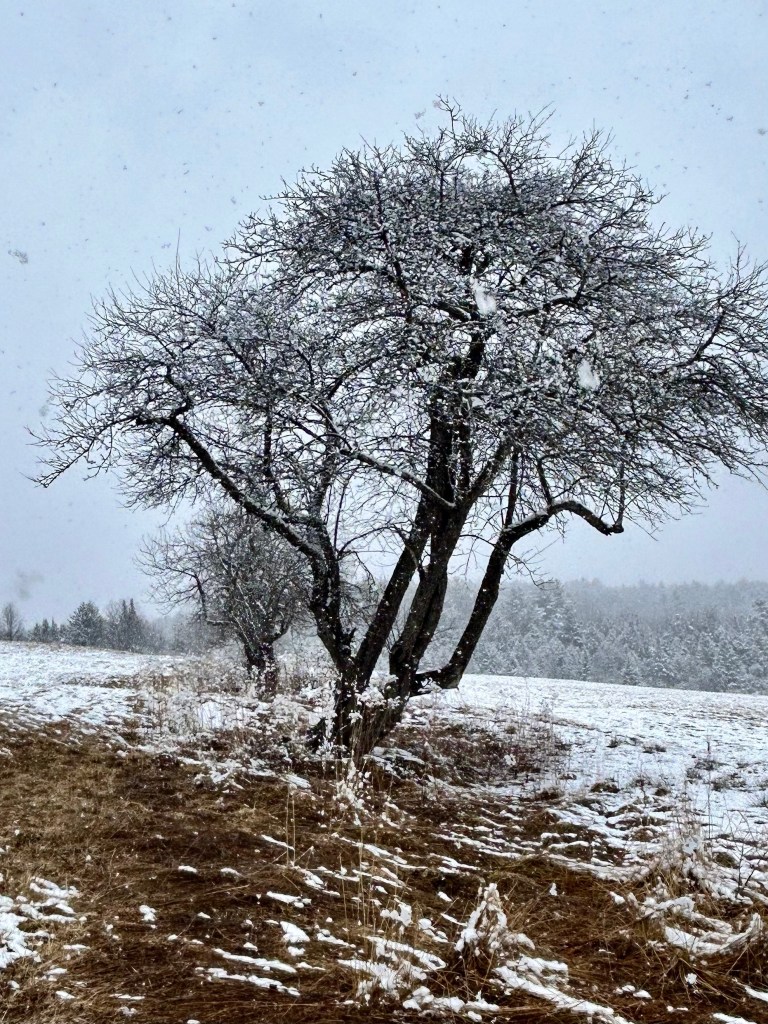
Dividing line: rivers running north and south.

Lost, I spend a crazy amount of time on back roads, driving from here to there, searching for a house where I’ve never been. A porcupine ambles along a dirt road. I slow, the car windows rolled down, the sunroof open and dust drifting in. The quilled creature disappears into the roadside weeds. I follow the paved state highway north, a two-line twisting road that cuts through farm fields jeweled with blooming dandelions.

I find them, finally, this kind couple, and apologize for my lateness. Turns out, they’ve worried about me. We stand outside in the sunlight, with their little dog and their grown daughter who stops by, this witty and laughing family who has endured tragedy. We’re on a rise of land that overlooks a pond. We are at the dividing place, I learn, where water flows both south and north. As we talk on this old homestead, I sense the world’s expanse, how brooks and streams and thin rivers join immense lakes, powerful rivers, the mighty beast of the Atlantic Ocean. Around us rises the history of this homestead, how the house and family has grown and contracted and changed over the decades. Spread overhead, the gleaming night sky, the pinprick constellations.

Black flies chew my hairline. Post-chemo, my lost straight hair returned as ringlets. On my way again, I retrace my way through swamps dense with marsh marigold. On this sunny day, the trees push out new leaves, further, further, in these few hours. I return to a former school house, where the town is voting again that day on a failed school budget. People come and go, cheery with the spring weather. I stay late for a hearing and drive home under a blood-red sunset, the breeze through my car windows sweet with plowed earth and manure.

How furiously I labor to remain in this world. To savor the inevitability of lostness, the chance crossing of a porcupine on its solitary animal journey, the stunning May blossoms. Many months ago, I asked my brilliant oncologist what I did to invite lymphoma into my body. Vehemently, he replied that I’d done nothing, absolutely nothing, to cause this brutal disease.

This physician saved my ragged life, but do our philosophical planes align? Two years ago, as the cancer sunk its silent teeth into my flesh, those intertwined demons of fatigue and despair shook me, too. Always now, skimming beneath my days and nights, flickers that fear: relapse. I’d spent so much time, that winter of illness, in the Dartmouth ED that the nurses and MDs became familiar. They knew my daughters and I by name. The general surgery team appeared repeatedly in that huddle around my bed, and I began to understand the hues of that word restraint as they considered their surgeon thoughts. There was that dreadful evening when I informed the oncologist that I could endure no more, and he gently replied that I could. He would get me through. So I endured. Many years ago, when I was so young, 21 and naive and freshly falling in love, I whined to a professor that I could not finish my thesis; I’d done enough. He kindly informed me that someday I would write a book and I would fear I would never reach the end. All this, in fact, transpired.

Restraint and effusive joy. Sooty despair, the pleasure of a purring cat. As the night settled down through twilight, I drank tea on my back step, leaning against my house. A fox trotted across the violet-strewn grass, quickly, on its way. So much for monotone winter. Wild spring.

Dandelion 

The first of a year’s abundance of dandelions 

is this single kernel of bright yellow 

dropped on our path by the sun, sensing 

that we might need some marker to help us 

find our way through life, to find a path 

over the snow-flattened grass that was 

blade by blade unbending into green, 

on a morning early in April, this happening 

just at the moment I thought we were lost 

and I’d stopped to look around, hoping 

to see something I recognized. And there 

it was, a commonplace dandelion, right 

at my feet, the first to bloom, especially 

yellow, as if pleased to have been the one, 

chosen from all the others, to show us the way.

~ Ted Kooser
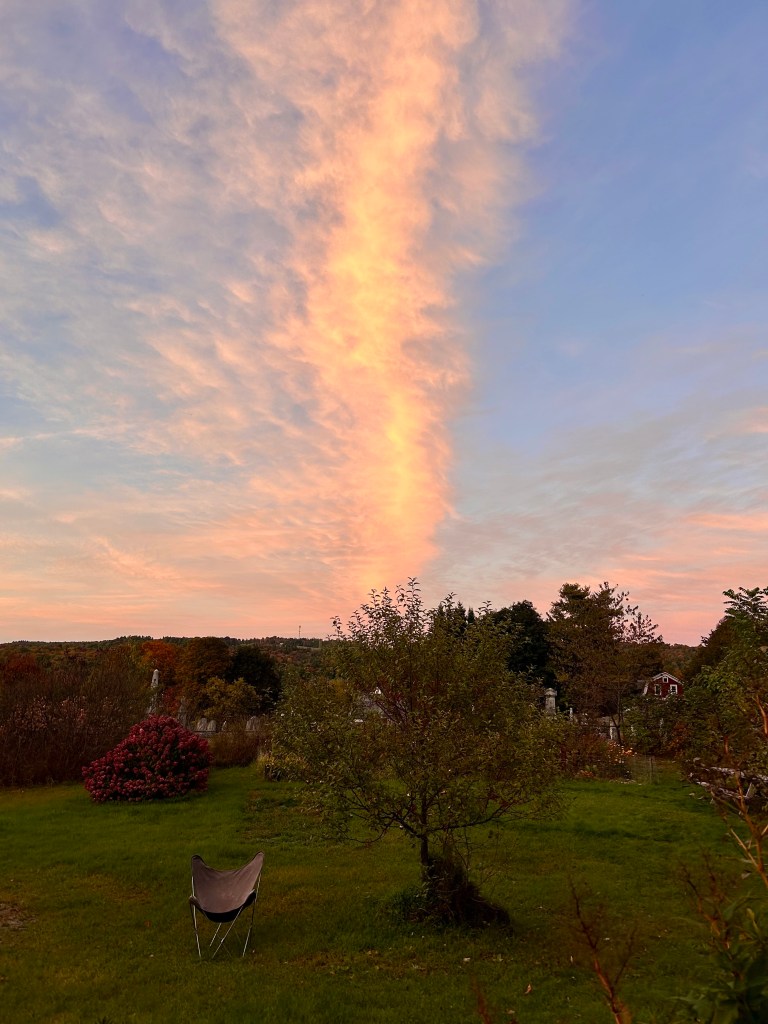
“… spring’s thousand tender greens…”

Two sleek loons swim and dive in the lake while I stand on the shore, listening the conversation about mean water level and stones and a grandfather who bought this property, back in the years when no phones reached here, and travel to the lakeshore was by foot or by hoof or a wooden-spoked wheel.

Chilly, I pull my sweatshirt hood over my head. A story about this summer cottage is that it was a farmhouse. Not so long ago, the landscape was cleared around this lake, and farms stretched down to the water. In the winter, ice was sawed into great chunks and shipped via train, cushioned in sawdust, to faraway homes.

In my own home, the carpenter has finished. I keep on with my paintbrush, call a daughter for reinforcements. A year ago, just out of surgery, I could stand only as a wilting flower stem, crooked over in pain. Sequestered in a hospital, I longed for cold rain on my face. Now, on this breezy afternoon, the wet wind burrows behind my neck. Later, at home, I feed my woodstove. There’s nothing permanent, but for now, this.

… I longed for spring’s thousand tender greens,

and the white-throated sparrow’s call

that borders on rudeness….

Jane Kenyon

Risking Delight with the Lion

Precisely a year ago, to the day, Isele Magazine published my essay “Red Devil, Survivor Herself.” I had written all through the godawful cancer treatments, AKA chemotherapy, and publishing this essay marked my tenacious determination to remain among the living—and to remain a fierce writer, too.

Over the summer and autumn, “Red Devil” morphed into a manuscript-in-process. Recently, three more chapters were picked up. The kind folks at Isele Magazine published “Risking Delight with the Lion.” The following two will be published in different journals later this spring.

Here’s the opening of “Risking Delight.”

In my winter of chemotherapy, I woke at night, quivering. Where was I? What was happening? Gasping, I reminded myself that I was in bed, I was okay, that whatever demons had sought me in sleep had been banished by my waking. I didn’t blink my eyes open into peace. My breathing never eased into contentment.

Cancer-and-chemotherapy is a path of suffering, an involuntary hairshirt. The first morning I met my oncologist Dr. Valera in that Dartmouth-Hitchcock hospital room, I was surfacing, bleary and exhausted after an emergency admission and an exploratory surgery that verged on plunging me into a sedated coma. My daughters had been summoned through a snowstorm. What remained of my vitality was vanishing. Me or the lymphoma would triumph. There was no middle ground. Yet, that first morning, Valera assured me, “I can cure you.” Not cocky, not boastful, merely stripped down to facts: the lay of my body and disease, his skill and treatment course.

I clutched his words desperately, but I never repeated aloud, “This physician makes a claim that I will live.”

What was the levy I would pay for remission?…

Last… with the 2050: Vermonters Take a Swipe at the Future project, I’ll be reading at the Tenney Memorial Library in Newbury, Vermont, this Saturday, 4 p.m. Come!

Gravy

In the town where I work, the summer folks haven’t yet returned. By chance, on a rural road around the lake, I meet a builder. “Hey!” he calls to me, and I can hear the surprise in his voice. You’re alive? I am, indeed, yes.

Around us, a sugar snow melts. Sunlight falls through the trees that are a month out, at least, from this year’s first nubs of leaves. Behind him, the silent snow-covered lake. We kick around, as Vermonters do, what it’s like to live in our Green Mountain state right now, how hot passions run, how immediately aid is given to a neighbor in need. What it’s like to live in the crumbling of the American Empire, a madman at the helm. In a copse of cedars, blackbirds chorus.

Precisely one year ago, I could not walk outside my house alone. Ravaged by cancer and chemo and hunger, I was so weak I trembled, on the verge of falling. A rattle of bones, scraps of flesh.

On this clearing day, on my way home, I stop by the co-op and buy two pears. I lay these on the seat of my car and dart across Main Street to the post office. Without realizing it, I’m running. As I leap onto the sidewalk, I marvel at the pleasure of movement, the sun in my short hair, my cheeks wind-burnt from a recent long walk along a muddy backroad. I took the time to stand before a tree of chittering goldfinches.

All this week I’ve been reading Robert Frost, perhaps my mother’s favorite poet. A poet who wrote of stone walls and apple picking and the ineffable darkness of human life. But here’s a poem to celebrate today, this day, no matter where or who you are, by Ray Carver who knew the great symphony of life, too.

Gravy

No other word will do. For that’s what it was. Gravy.
Gravy these past ten years.
Alive, sober, working, loving and
being loved by a good woman. Eleven years
ago he was told he had six months to live
at the rate he was going. And he was going
nowhere but down. So he changed his ways
somehow. He quit drinking! And the rest?
After that it was all gravy, every minute
of it, up to and including when he was told about,
well, some things that were breaking down and
building up inside his head. “Don’t weep for me,”
he said to his friends. “I’m a lucky man.
I’ve had ten years longer than I or anyone
expected. Pure gravy. And don’t forget it.”

Under the kitchen vinyl.

While the radio carries in terrible news, the carpenter tears off the vinyl on my kitchen floor. I run my hands over the worn maple boards that are revealed to the daylight again. In one corner, a rotten board where perhaps the sink leaked. The carpenter cut out those pieces, and I look down at the basement’s graveled floor. In another corner, there’s a blackened place where perhaps a woodstove once charred the flooring. He and I stand there, considering, wondering about who once lived in this house. I wonder about their patterns of heat and sustenance, these people who passed from this world, decades ago.

When the carpenter leaves, I vacuum, then sit on the cold floor while the cats sniff curiously. I rub my hands over these boards bruised from living and speculate that I can sand and polish this small space, quicken it again.

I began this project with a desire to take down a wall, open a room, and chase away the dismal memories of illness, to acknowledge that, indeed, this is the house where cancer devoured my body, tore at my flesh and mind. I survived. To continue surviving, I must revise my life, change my patterns of living.

I know a few of the names of the people who lived in this house on a village hillside. Now, barefoot on these cold hard-worn floorboards, I sense the mysterious stream of connection that runs between the dead and myself and those who will someday live here, when I have moved on myself, to other earthly or unearthly places. Who laid this floor I’ll never know, but I’ll put my hands and my muscle to it, lend my energy towards restorative beauty, towards the scantness I can do.

I am beginning to understand that healing is not about returning to what was, but about accepting the change and adapting to the brokenness. This is happening all around us, for people, for the land. People have done damage to the earth and to each other that can’t be undone. We can lament what was, but that won’t help us take care of what we still have. In fact, it might just hold us back. Nature herself keeps giving and never giving up. ~ Helen Whybrow. The Salt Stones

Shift in POV.

(photo G Stanciu)

My daughter sends word and photos of walking on Lake Champlain, frozen hard. I send word back, Be mindful! For those of us who love to swim and lounge on lakes and ponds, walking on the ice in the dead of winter is exhilarating, a flip in view in these cold months.

11 degrees this morning when I rise in the dark and shovel ashes from the woodstove while the cats mewl a protest for breakfast. I’m still thinking of those photos, and how it feels to have the cold air descend on your cheeks and walk that border between hypothermic water and all that sky. In a troubled winter I worked in a nearby town, I’d walk on the lake’s ice at noon and lie down and stare up at the sky. There were a few ice fishing shanties, never a sign of anyone, just me and the crows, all ice and the limitless sky and whatever the heavens had to offer. Sometimes spitting snow, sometimes endless blue, sunlight without warmth.

Heart of February. The skiing is excellent. A friend who I’ve known forever picks me up, and we walk along an ice-and-sand-strewn road. Below, the valley where the Black River and Route 14 is hidden in the folds of mountains. We look across and muse at the snow we can see on the mountains’ forest floor, how the bare trees reach up towards the sky.

Full moon:
my ramshackle hut
        is what it is. — Issa