Go for a walk around the block?

March 7, my father’s 88th birthday today in what is doubtlessly sunny New Mexico. So much for my plans, months ago, to visit him on this day.

Here’s the thing about living such a long life — I could pick countless numbers of things to write about, but what I woke up thinking about this morning was how my dad would often say, “Let’s go for a walk around the block.” At any time of day, we’d set off. Sometimes just up the street and actually around the block, or other afternoons on hours-long rambles through the woods behind our neighborhood. We walked in sunny days, through sleet, through knee-deep snow, in the sweet spring rain. It’s a habit all three of his children have continued our whole lives, and his four grandchildren, too.

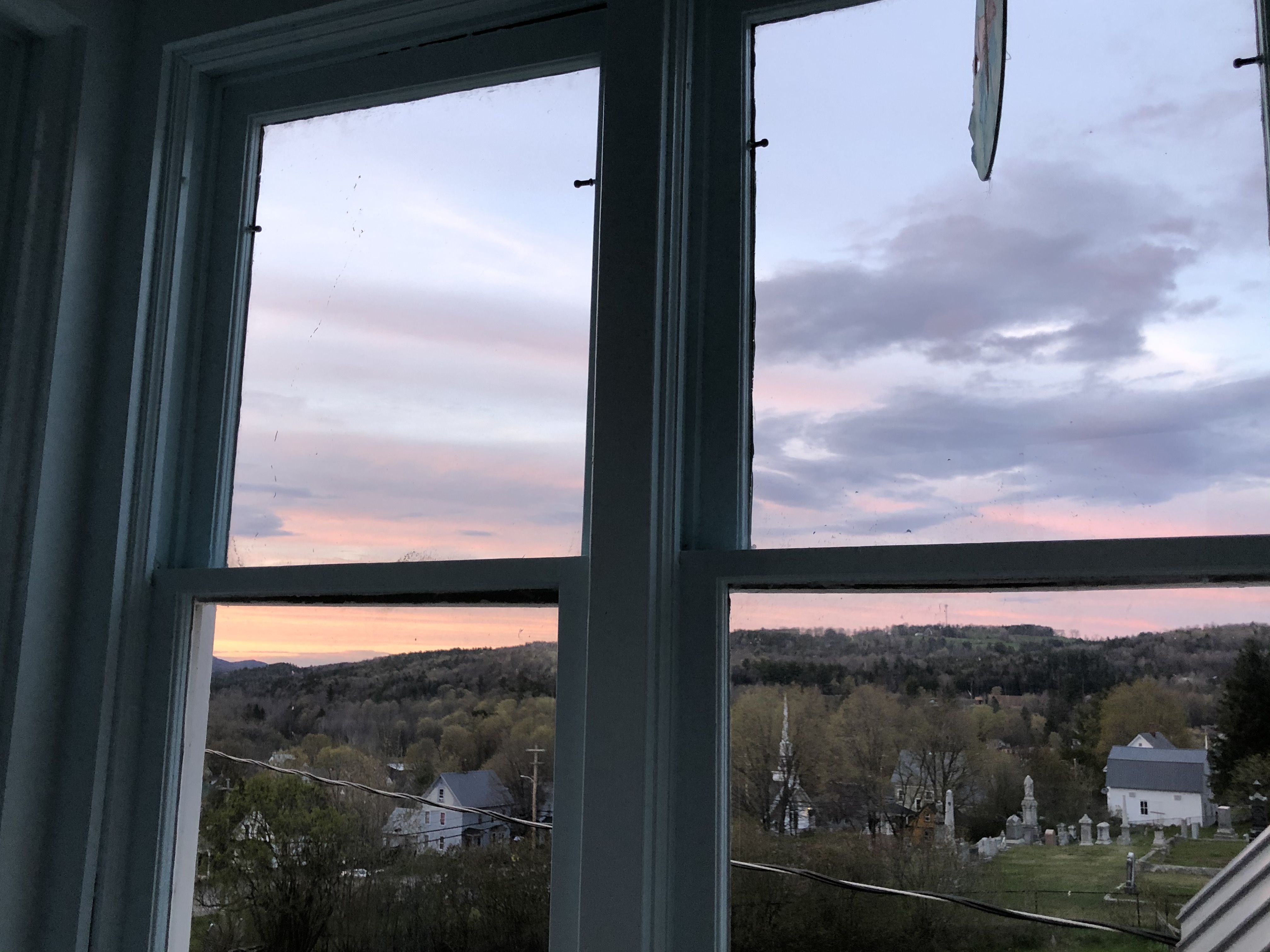
Sunny, here, in northern Vermont, too, a day of such optimism that the blue sky choruses the inevitable promise of spring. And for my father, one of our favorite poems from the unmatchable Hayden Carruth.

Birthday Cake

For breakfast I have eaten the last of your birthday cake that you
had left uneaten for five days
and would have left five more before throwing it away.
It is early March now. The winter of illness
is ending. Across the valley
patches of remaining snow make patterns among the hill farms,
among fields and knolls and woodlots,
like forms in a painting, as sure and significant as forms
in a painting. The cake was stale.
But I like stale cake, I even prefer it, which you don’t
understand, as I don’t understand how you can open
a new box of cereal when the old one is still unfinished.
So many differences. You a woman, I a man,
you still young at forty-two and I growing old at seventy.
Yet how much we love one another.
It seems a miracle. Not mystical, nothing occult,
just the ordinary improbability that occurs
over and over, the stupendousness
of life. Out on the highway on the pavement wet
with snow-melt, cars go whistling past. 
And our poetry, yours short-lined and sounding
beautifully vulgar and bluesy
in your woman’s bitterness, and mine almost 
anything, unpredictable, though people say
too ready a harkening back
to the useless expressiveness and ardor of another
era. But how lovely it was, that time
in my restless memory.
This is the season of mud and thrash, broken limbs and crushed briers
from the winter storms, wetness and rust,
the season of differences, articulable differences that signify
deeper and inarticulable and almost paleolithic
perplexities in our lives, and still
we love one another. We love this house
and this hillside by the highway in upstate New York.
I am too old to write love songs now. I no longer
assert that I love you, but that you love me,
confident in my amazement. The spring
will come soon. We will have more birthdays
with cakes and wine. This valley
will be full of flowers and birds.

Chemo ride…

… took a bitch turn. Dreaded day 5 passed (thank goodness for the amazing anti-nausea meds), but with the last bag of this poison/healing fluid, a fist immediately grabbed my chest and squeezed my breath. My cheeks coursed with blood.Terror, say the word, terror. So much back and forth, oxygen and treatments and more liquids through this purple spaghetti plastic that drip, drip, drips near my heart. I shook fiercely – rigors – the nurses said. I was stuck on the word as my molars hammered, rigors!, where is this hard ride taking me? The fluid was stopped with a promise not to start again until I knew.

In and out of a fog, a dream of a herringbone jacket with a pleated flair my youngest wore as a two-year-old. In the evening, a nurse sits with me. As the drip-drops begin again, she talks, right beside me, watching me, close eye, about this disease, about infection and rest, about what I will need to do and avoid – do not knick your fingers with a knife, no dirt, no cat litter, no flowers, no illness. I ease from tension and realize, yes, yes, I am still breathing, I am still taking in this toxin that quite possibly will save my life. I glance up at the round analog clock on the wall that reminds me and my brother of school days. These are the moments Burlington’s Phoenix Books is hosting the Almanac intro in an online event. In my haze, I imagine the Almanac editors and reading and answering questions, this book filled with farm dirt and blooming flowers, hay chaff and sneezing, insects and sheep, and stories – so many stories – of people working on this northern place on the globe. In my half-dream, exchanging novels to read with this steady stranger, I feel my place in the world opening up, both descending into the long trek of illness and healing and, miraculously, an upward course, too, as this illness strips me down. Your bone marrow, the stranger says, marrow, a word I love and have been content to let lie, bone marrow doing its bone marrow thing. All this is changing, too, from nature, from medicine, from my fierce intent to reclaim my body.

All of you who have traveled or will travel this journey, bone marrow and rigors and fear, how simultaneously far and yet close this feels, all of us.

….. Everyday, a dear friend texts me a poem read in her clear strong voice. Here’s Rilke’s “Let Darkness Be a Bell Tower”

Quiet friend who has come so far,

feel how your breathing makes more space around you.
Let this darkness be a bell tower
and you the bell. As you ring,

what batters you becomes your strength.
Move back and forth into the change.
What is it like, such intensity of pain?
If the drink is bitter, turn yourself to wine.

In this uncontainable night,
be the mystery at the crossroads of your senses,
the meaning discovered there.

And if the world has ceased to hear you,
say to the silent earth: I flow.
To the rushing water, speak: I am.

Sonnets to Orpheus II, 29

Conversation in the Moonlight.

At the open hatch of my car, I’m writing a mental grocery list, when something — what it is I don’t immediately know — happens. I’m fucked, I think. I’ve broken my hand.

A pneumatic hatch strut has broken, and is pinned between the hatch and taillight, the plastic light smashed. I turn my hand around and around. My hand suddenly seems very small, utterly familiar, a thing easily ruined.

People walk around me, going in and out of the co-op. Weirdly, I remember a car crash from my twenties when a Subaru Justy ran into my gold Rabbit. My Rabbit was knocked off the road. I got out and ran. The Justy had spun around and around and came to a stop, the wrong way in the middle of the road. No one was around. The Justy’s driver was crying, her window rolled down, saying, “I’ve killed you.” I begged her to get out of the car, leaning towards the Justy in the falling snow but not touching it, saying, “But I’m alive. I’m here.”

In a twist of great good fortune, my hand isn’t broken, only bruised. I go in the co-op and buy scallions and yogurt. The hatch and the strut are an irritation, another thing to sort out and solve, a fixable occurrence.

Later that week, after the dinner guests have left and it’s just me and my daughters and their friends, the five of us pull our chairs around the fire. The neighbors have taken their little kids into bed. The band in the village has quit by then, too, and the frogs are signing again, snippets of frog melodies.

In the darkness, we talk about relationships and marriage, what holds people together, what makes people endure. What makes people split. I toss another chunk of wood on the fire. A glistening half moon hangs over my house. Listening, I turn my hands around and around. So often, my hands are full and busy. Now, the moonlight falls in my open palms.

We keep talking and talking and talking. The moonlight is endless.

Travels

Saturday, my daughter and I drive through Montpelier, Vermont’s capitol city. I’m in the passenger seat, as I always seem to be these days, while she negotiates intersects. Who has right-of-way? When can you turn right on red?

Eventually, she parks, and we walk around town.

At a take-out window, I order her a milkshake. Since she can’t walk down the street and drink a milkshake with a mask, we sit on the state house lawn, while she drinks the milkshake. I lie back beneath the immense maple tree and remember nursing her here, sixteen summers ago.

Eventually, she looks at me, and says, There’s so many people.

It’s true; people are walking back and forth to the farmers’ market. College students are playing frisbee. Families are everywhere. But it’s also Vermont and not particularly populous.

At just a few weeks shy of sixteen, my daughter straddles that terrain between girl and woman, beautiful and strong and curious.

Looking at her, I marvel that over a year of her life has been spent in such isolation, our world shuttered up.

On our walk back to our car, we stop beneath the crab apple blossoms and breathe in. Spring.

Yes
William Stafford
 
It could happen any time, tornado,
earthquake, Armageddon. It could happen.
Or sunshine, love, salvation.
It could, you know. That’s why we wake
and look out––no guarantees
in this life.
But some bonuses, like morning,
like right now, like noon,
like evening.

Our Perpetual Holiday

To practice night driving, my daughter and I set off after dinner, delivering a book and knitting needles to a friend. We’re laughing on the way there, and my daughter remarks, Why is it so dark?

I answer that I’m going to let that question lie.

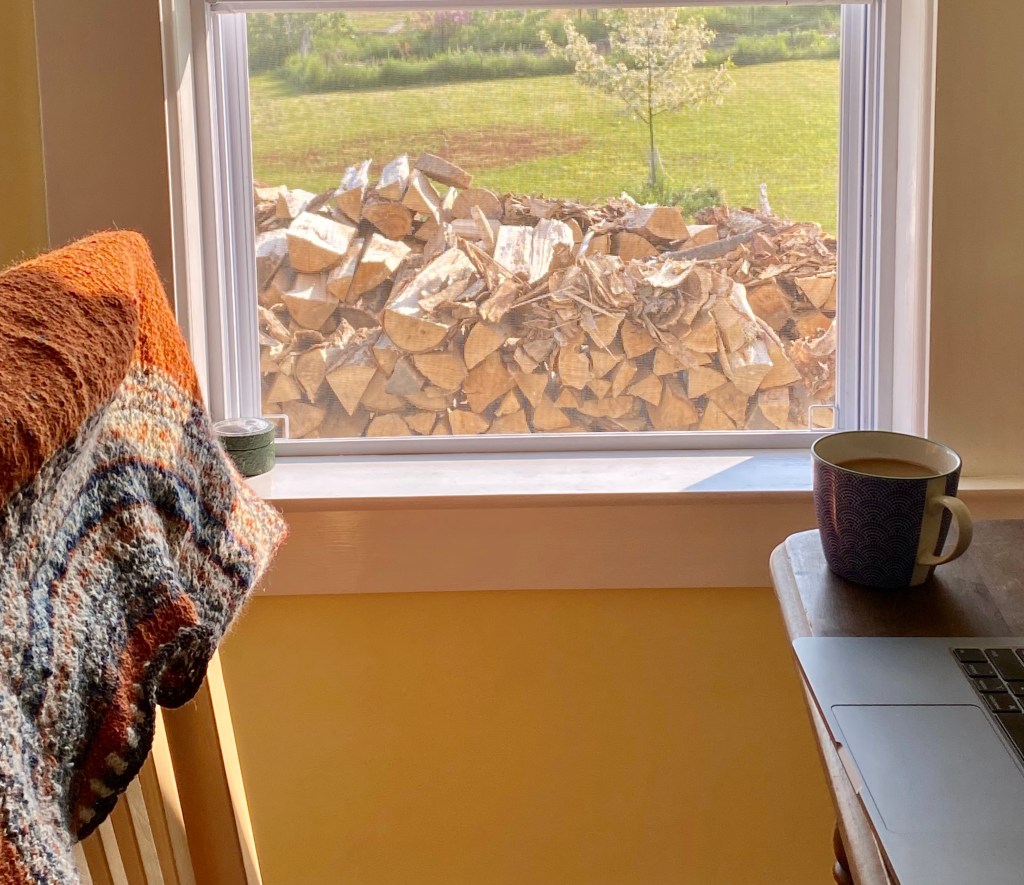
At our friends’ house, we can see through the windows where the family is around the wood stove, talking, the walls painted yellow. I have a sudden flash of envy at the intactness of mother, father, two children, and then that passes quickly, too. At our house, warm and well-lit, with interior walls painted limoncello, we’re as intact as any family, too.

With my friend’s book in my lap, my daughter drives up the back roads, over ice and sand, through all that darkness. We reach the crest of hillside. There, as she drives and talks, I see across the valley to where a barn is lit in a long string of lights on the opposite hillside. Sporadic houses glow in the cold night, and not much more.

She drives down, then along the S curves along the river where I remember a terrible accident years ago. We stop and fill the gas tank. Beneath the bright gas station lights, it’s just us. I walk around the car, washing windows. In the driver’s seat, she watches me, and then I step back and bow. She shakes her head at me, amused.

Middle of February. Cold. A little chit in our collage.