In this early July heat, there’s one clear path of wisdom: subsist on watermelon. So I’m opening my car door in the co-op parking lot when I glance over my shoulder and a friend from long ago is sitting in his pickup beside me, eating a sandwich. I set the melon on my driver’s seat and lean against my car, and we catch up, mostly about kids. I know, in the randomness of what my memory snaps tight, that he’s just about my age, 58, and between us we know plenty—about broken marriages and houses we’ve sold and a terrible tragedy in the town that now lies hovering beneath the surface. He is the kind of father who showed up at school board meetings in dirty t-shirts and wondered, existentially, what was transpiring.
He tells me that he’d just heard that I had (I suppose, technically, do not curse myself, yet still have) cancer. In the fierce sunlight, I cross my arms along his open truck window and tell him what that was like, news of metastatic cancer in the ER, my 19-year-old running out, her sister immediately following, and me in my sweater I’d knit and worn so hard it was felted, in my jeans, with these two strangers, an MD and an RN, and sorrow. Around me, the void. I had been naive for all of my life thus far: the Reaper always surrounds us, escorting us in and out of this world.
It’s July, and I’m well at the moment—so well—full of sass and merriment. The sorrow that wreaths me is not at all my unique terrain. In this parking lot, me still holding a tomato I’d bought, too, and he with that sandwich of shredded lettuce and mayonnaise, we linger, talking, about the ineffable joy of parenting little girls into grown women and its counterpart: grief.
On this eve of this American holiday, maybe lay down the slogans and dictums, speak up or be kind, the opinions and beliefs we hold so dearly. Maybe widen the frame.
He wishes me luck with my new book, and I wish him luck haying. My little town has temporary stoplights as a crew labors to guard against the next flood. Waiting, the scorching air blows into my car, and I blink. What luck. Another day of human life. And watermelon, too.
“Sometimes life is merely a matter of coffee and whatever intimacy a cup of coffee affords.” ― Richard Brautigan
My twenties were years of road tripping, Vermont to Washington state, lots of New Mexico, sleeping in the back of our black diesel VW Rabbit, 55 mpg, our Rand McNally shedding pages. Thirties were babies and learning to garden, raising high the roof beams, forties the scrambling decade of parenting alone and keeping kids shod and fed. Fifties, kids are paddling their own lives, and yet we’re tight, tight; cancer survivorship schooled us rapidly in what’s dear and what’s so easily lost.
Among these decades, my own unbroken thread of writing. Road trip with a self-made atlas.
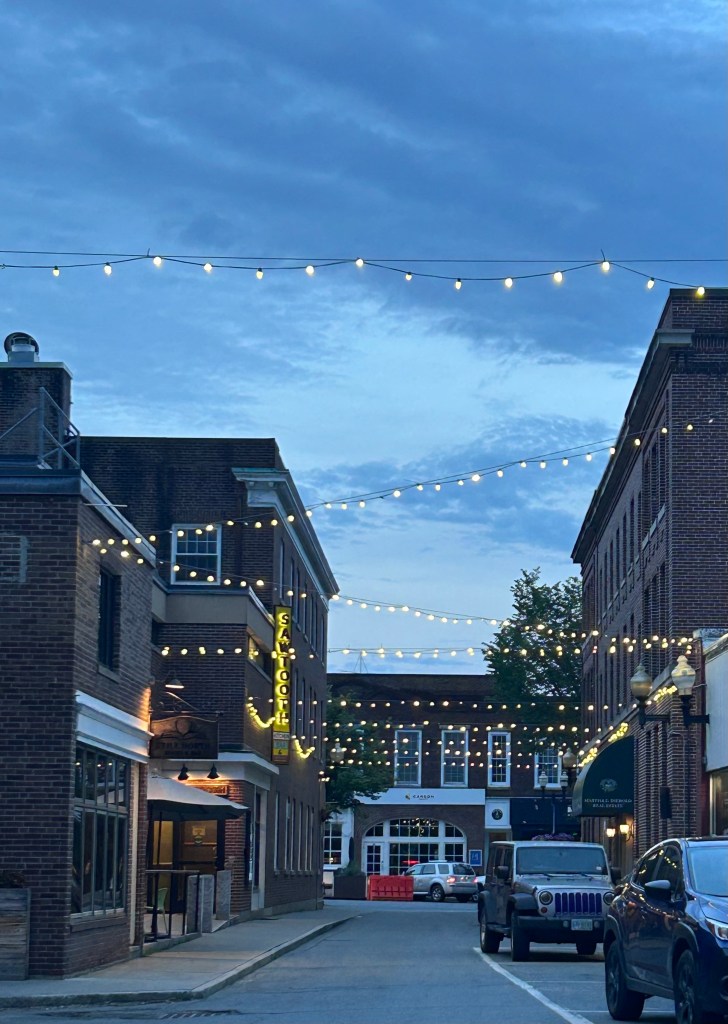
A beloved friend hops into my car. We lived on the same dirt road for years. I would phone and say, It’s sleeting. Come walk with me. She was always game. This late afternoon, I drive south, that too familiar journey of Route 15 and I-91, heading towards Dartmouth-Hitchcock, but I park in pretty Hanover, NH, where I’ve been invited to read from Call It Madness — a title that reflects my own life — madness, madness, everywhere — both the crazy-making of divorce and cancer but also my own fierceness for my dear ones, for literature and the roses blooming around my house and the precipice I tread between ebullience and the frigid teeth of despair.
The loveliest of evenings at Still North Books. My reading companion, Shasta Grant, is true and gifted, the bookstore staff warm, the audience curious and kind. My friend and I are the last to leave, save for the cheery folks folding the chairs and emptying our water cups. I drive north into the night. The sun dwindles into gold and pink. We talk about cars and money, kids of course, drinking and books and death.
She gives me her apple. I eat and drive. Thirty years into our friendship, as the darkness folds around us, I think, What a long way we have come. In my driveway, we linger, the car’s engine clicking as it cools, the fireflies flickering. How happy I am to begin my own hand-crafted book tour for Call It Madness. In my youth, those decades when I leaned so hard into my life I hardly brushed my hair, I believed my life would flatten, temper into quietness. Oh friends, the world’s depths are revealed as bottomless crevasses and immense peaks, largely unknowable. What’s knowable is the stickiness of that apple’s juice on my fingers, the darting fireflies, the answer I gave to a stranger’s question at the end of the Still North Books reading: “My real flaw was cowardice.” I’ve long ago abandoned the flimsiness of that forgiveness concept, for myself or others. Life propels onward, word by word, sunset to sunrise, companionship in all weather.
A few things…. I’ll be on Bon Mot on Central Vermont Radio, Sunday, June 21, 5 p.m. Call It Madness book launch Tuesday, June 30, 7 p.m., at the Jeudevine Memorial Library in Hardwick, Vermont, sponsored of course by the hometown and most stellar Galaxy Bookshop.
Survive, professor! That’s all you really have to do. Keep the grass from creeping into eh carrots, deal with the woodchuck stealing the apples, patch up the pipes! — Makenna Goodman
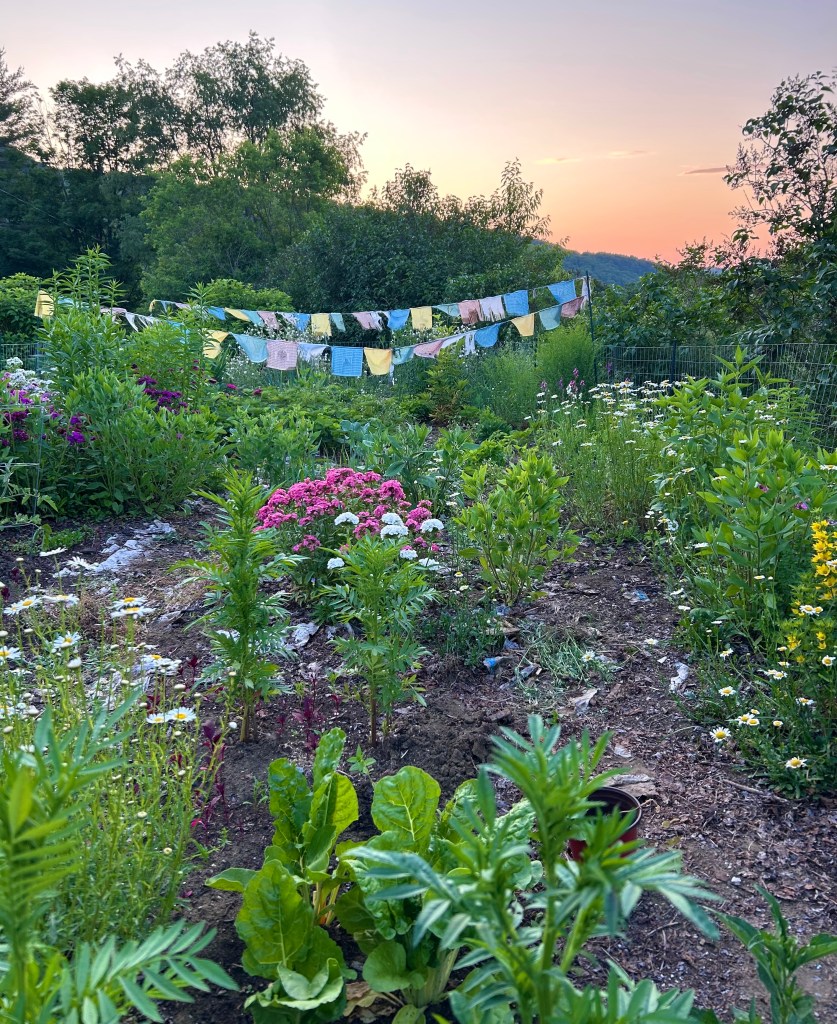
For readers who haven’t lived in northern Vermont, here’s a keyhole view of June: heat and humidity move in, and the earth thrusts out into leaf and bloom. Overnight, the loosestrife blooms yellow, the chard gains an inch in leaf. The lilacs fade. The Siberian irises spread purple.
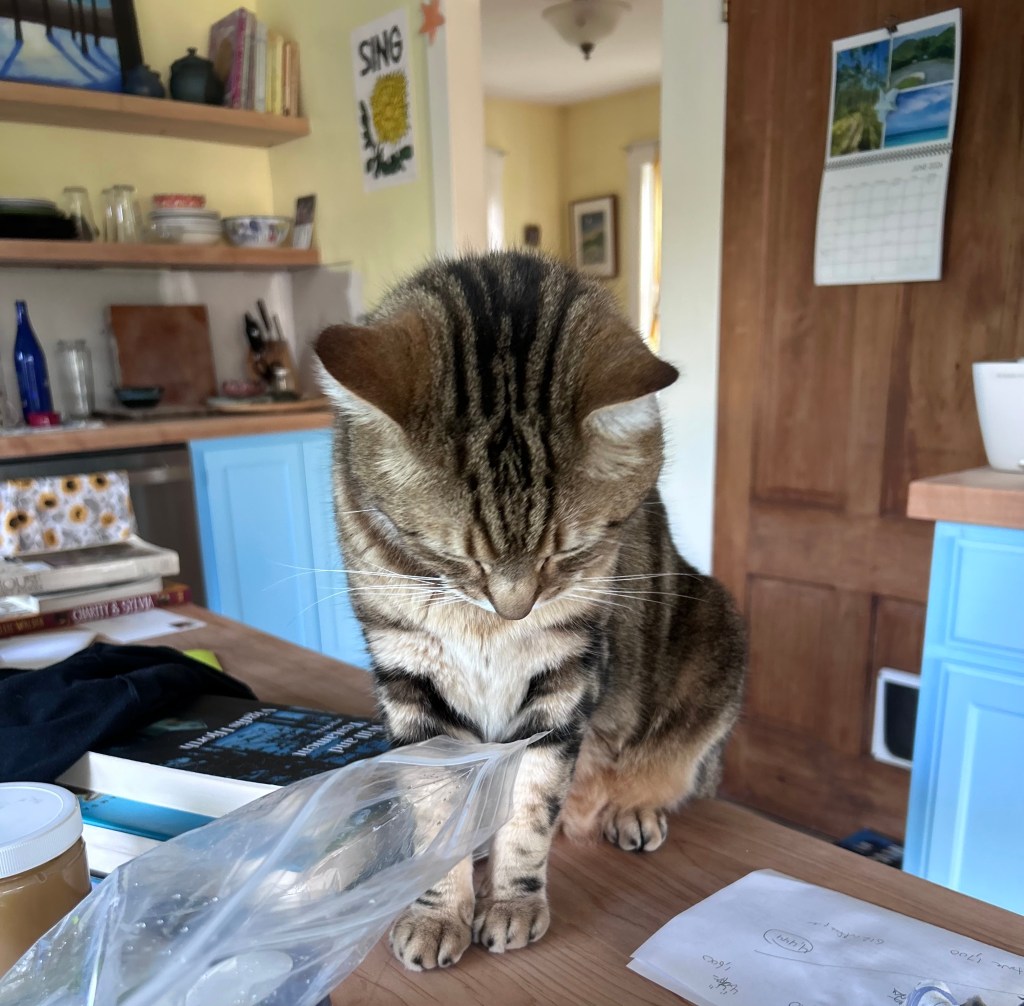
In the heat, listening to terrible news of the American Empire’s spread, I finish stacking next winter’s firewood. Sweaty and dirty, the cats and I admire my work, contemplating the frosty fall evenings. The cats, perhaps, are merely curious about my labor, or the next meal’s arrival, or perhaps a cat calculus I don’t imagine.
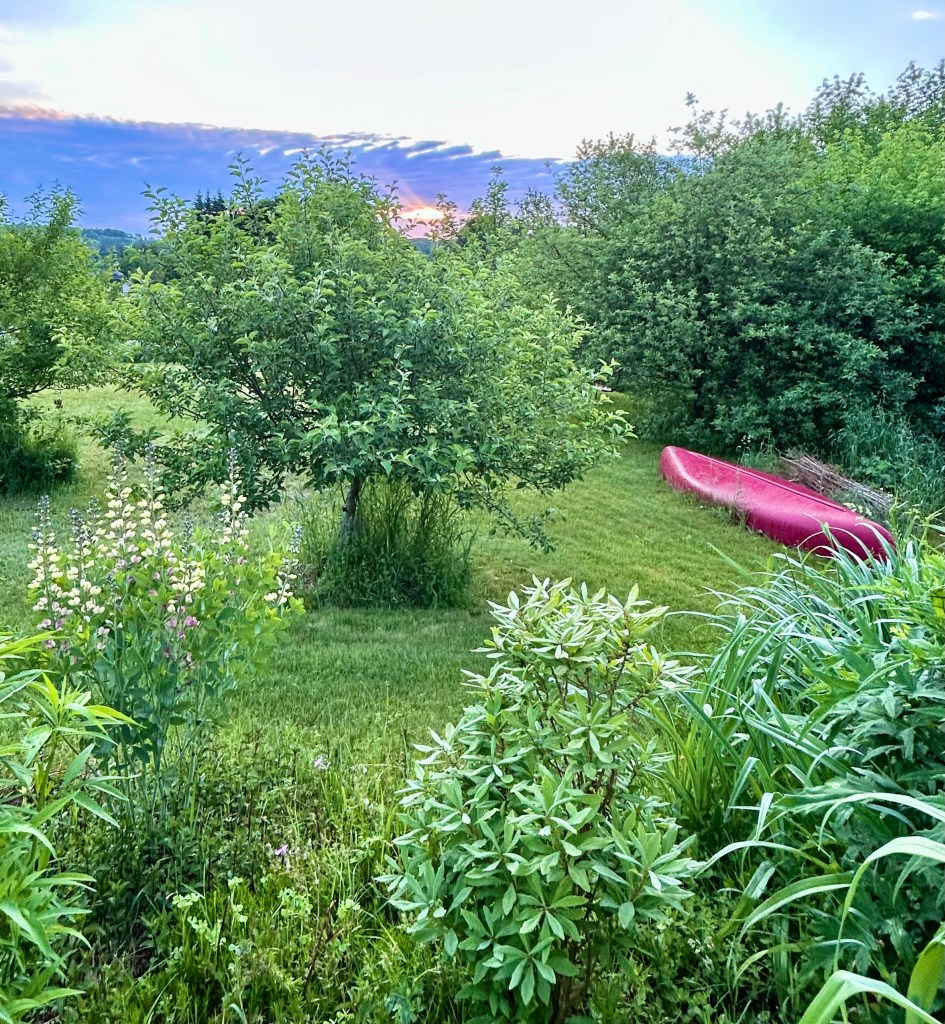
June, the songbirds serenade exquisitely. I mow the grass around the woodpile, the pink roses beginning to bloom, the brushy compass flowers that are now knee-high. Will the ancient mock orange leaf and bloom? Will the woodchuck devour the sunflower seedlings? Will I unclench my knotted heart and let myself fall in love, tumble into the next phase of whatever I may have in this lifetime?
Rain falls and the heat breaks as I finish mowing. I wander around, drinking a glass of water, the rain running through salt and chaff on my cheeks and biceps. 21 years ago, a friend labored to bring her baby into the world. I sat in her kitchen while our six-year-olds played under her front yard maples. Her mother-in-law made chicken soup that I ate while I nursed my own wee infant.
The world isn’t filled with ten thousand things. In the June afternoon’s rain, a rainbow elusive, math welds no teeth. A hopping robin in search of sustenance, unfolding hydrangea leaves, the bounce of a child’s basketball, the scent of sap bleeding from winter’s firewood.
For local folks…. I’ll be reading at Still North Books in Hanover, NH, Wednesday, June 17, 7 p.m. Yes — a lovely bookstore — and yes, a non-cancer visit to this lovely village.
Is not all the summer akin to a paradise? — Henry David Thoreau
Freakishly, by chance, I discover my mother’s given first name is different from the name she used. I’d never heard a whisper of this secret. As a writer, the discovery is material manna. As a daughter… well, strange news, indeed.
In the inexplicable alignment of fate, I’m a month away from publication of my third book, Call It Madness, a novel about young woman Avah who unexpectedly realizes her mother lied two decades ago when she claimed Avah’s great-grandfather died, his beloved house sold. Now, I unearth this secret my mother kept so well. I carry my mother’s name that was at once her name and not her name.
Where is the dusky line between fiction and life? Impossible, this seems, impossible, that I’ve written about my life in reverse. Kierkegaard wrote, “It is really true what philosophy tells us, that life must be understood backwards. But with this, one forgets the second proposition, that it must be lived forwards. A proposition which, the more it is subjected to careful thought, the more it ends up concluding precisely that life at any given moment cannot really ever be fully understood; exactly because there is no single moment where time stops completely…”
How meagerly we know this world, the littleness of the stuff that structures our own stories. Stacking firewood on Sunday afternoon, I listen to a NYT story written by a sighted man about traveling with the unsighted. The upshot? How we understand the world in pieces. The whole is an impossibility for any one of us.
And yet, fiction aims to manifest a perfect miniature world, a shimmering sphere, a handful of secrets and mysteries revealed one-by-one, like a matryoshka doll. At its center, is there a grain of rice or a chip of coal? A folded fortune like a slip of paper in a sweet cookie, a koan to clench in a fist and ponder. A way to reflect the whole of life, this impossible life.
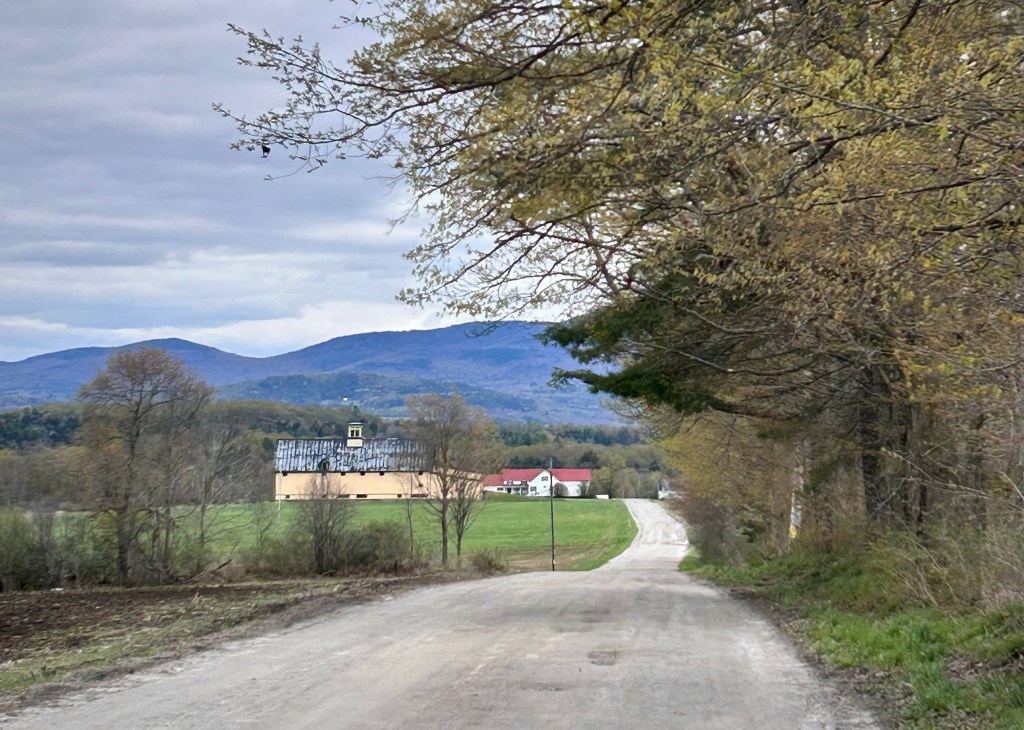
Lost, I spend a crazy amount of time on back roads, driving from here to there, searching for a house where I’ve never been. A porcupine ambles along a dirt road. I slow, the car windows rolled down, the sunroof open and dust drifting in. The quilled creature disappears into the roadside weeds. I follow the paved state highway north, a two-line twisting road that cuts through farm fields jeweled with blooming dandelions.
I find them, finally, this kind couple, and apologize for my lateness. Turns out, they’ve worried about me. We stand outside in the sunlight, with their little dog and their grown daughter who stops by, this witty and laughing family who has endured tragedy. We’re on a rise of land that overlooks a pond. We are at the dividing place, I learn, where water flows both south and north. As we talk on this old homestead, I sense the world’s expanse, how brooks and streams and thin rivers join immense lakes, powerful rivers, the mighty beast of the Atlantic Ocean. Around us rises the history of this homestead, how the house and family has grown and contracted and changed over the decades. Spread overhead, the gleaming night sky, the pinprick constellations.
Black flies chew my hairline. Post-chemo, my lost straight hair returned as ringlets. On my way again, I retrace my way through swamps dense with marsh marigold. On this sunny day, the trees push out new leaves, further, further, in these few hours. I return to a former school house, where the town is voting again that day on a failed school budget. People come and go, cheery with the spring weather. I stay late for a hearing and drive home under a blood-red sunset, the breeze through my car windows sweet with plowed earth and manure.
How furiously I labor to remain in this world. To savor the inevitability of lostness, the chance crossing of a porcupine on its solitary animal journey, the stunning May blossoms. Many months ago, I asked my brilliant oncologist what I did to invite lymphoma into my body. Vehemently, he replied that I’d done nothing, absolutely nothing, to cause this brutal disease.
This physician saved my ragged life, but do our philosophical planes align? Two years ago, as the cancer sunk its silent teeth into my flesh, those intertwined demons of fatigue and despair shook me, too. Always now, skimming beneath my days and nights, flickers that fear: relapse. I’d spent so much time, that winter of illness, in the Dartmouth ED that the nurses and MDs became familiar. They knew my daughters and I by name. The general surgery team appeared repeatedly in that huddle around my bed, and I began to understand the hues of that word restraint as they considered their surgeon thoughts. There was that dreadful evening when I informed the oncologist that I could endure no more, and he gently replied that I could. He would get me through. So I endured. Many years ago, when I was so young, 21 and naive and freshly falling in love, I whined to a professor that I could not finish my thesis; I’d done enough. He kindly informed me that someday I would write a book and I would fear I would never reach the end. All this, in fact, transpired.
Restraint and effusive joy. Sooty despair, the pleasure of a purring cat. As the night settled down through twilight, I drank tea on my back step, leaning against my house. A fox trotted across the violet-strewn grass, quickly, on its way. So much for monotone winter. Wild spring.
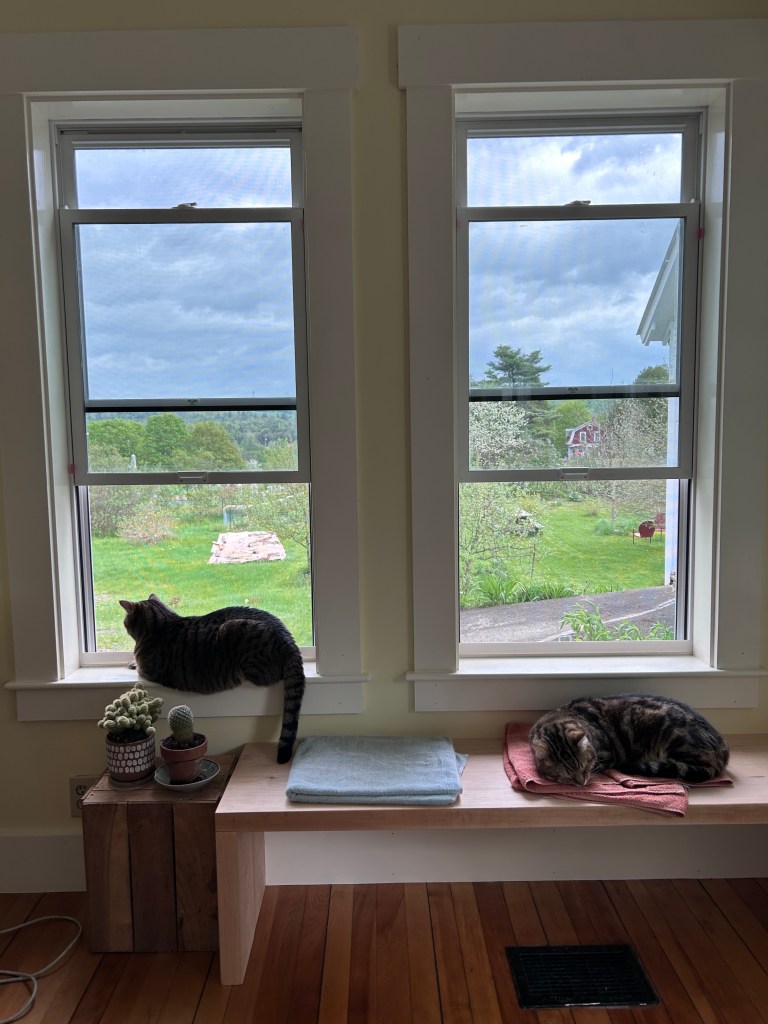
On this Mother’s Day, I pull on my coat and wander into the early spring garden with hot coffee. Blue dawn, the birds are at their singing nesting work already. My cats, satiated with breakfast, sleep on windowsills, dreaming perhaps of red-breasted robins prying worms from the rain-soft earth.
My mother died two springs ago. She’d lived a long life, crammed full, from joyous passion to bitter despair. In the same year, I suddenly stared at my own mortality. In those first days of the cancer realization, I railed that I wasn’t done, that to die while my youngest was yet a teenager, was out of the natural order. Or what I wanted to believe was the natural order. A belief which had, of course, no bearing on any natural law, whatsoever.
Severe illness returned me to childhood again. Too weak to boil water for oatmeal or tea, with hours upon days upon weeks upon months, lying in bed or on the couch, watching sunlight and shadows move across the maple floors in my house, the hospital tiles. There was an old tradition of slipping a knife beneath a laboring woman’s mattress to cut the labor pains. In those months I fought to remain alive, I slowly realized my mother and father had each slipped me a knife: my father gave me that writing and fortitude, my mother a wily stubbornness that was sometimes silly and often tenaciously sharp. Invaluable.
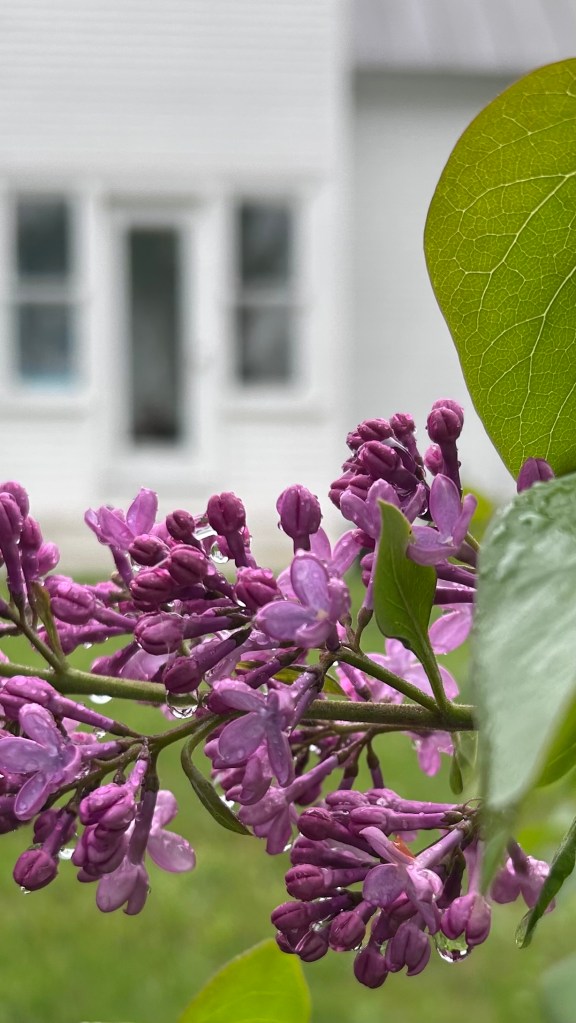
Yet here I am, lucky enough to have another act of my life unfolding. The daffodils I planted last October are blooming, brilliant yellow against the row of lilacs that are just beginning to bud. In my kitchen, I washed last night’s dishes, discovered a white quartz left as a gift on the table.
The First Green of Spring
Our walking in the swamp picking cowslip, marsh marigold, this sweet first green of spring. Now sautéed in a pan melting to a deeper green than ever they were alive, this green, this life,
harbinger of things to come. Now we sit at the table munching on this message from the dawn which says we and the world are alive again today, and this is the world’s birthday. And
even though we know we are growing old, we are dying, we will never be young again, we also know we’re still right here now, today, and, my oh my! don’t these greens taste good.