Where I Am.

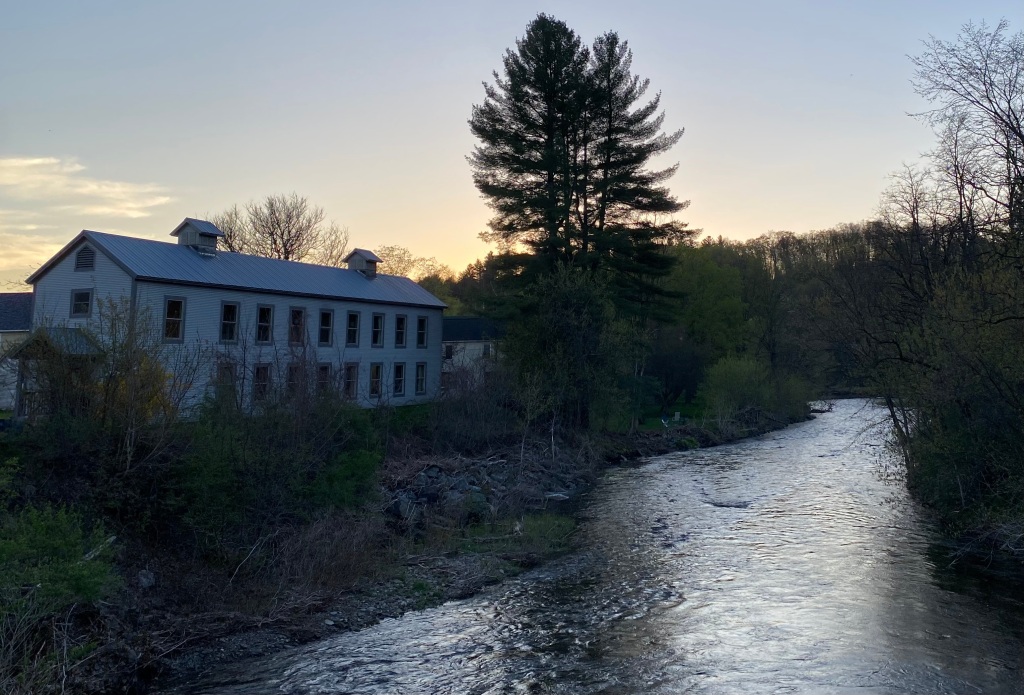
For a week, I’m lucky to be staying at the Vermont Studio Center for the Arts, tucked in Johnson, Vermont, with writers and visual artists. A word, first: like anyone in this culture driven to create art, I’ve been swimming upstream (clumsily) for what seems like most of my life. But this magical place offers notsomuch an antidote but an alternative possibility.

In one way, I feel like I’m a college student at tiny rural Marlboro College again, eating communal meals with the same cohort, attending presentations, talking and so much talking. How’s your book going? What are you doing with copper? So many interesting people writing and sculpting and painting. But, like everyone else here, I’m far beyond college age, using my studio hours fiercely.

In my studio building, a former resident wrote in a communal notebook about arriving worn down from the grind of capitalism, and how rejuvenated she left after her stay here. I’ve long realized that our capitalist model often draws out the mean and petty strands of us, like a competitive gardening streak that weirdly surfaced in a long-ago baby group I attended. Which serves, of course, exactly no one at all. For this bit of time and space, I’m savoring this dear space, where my back is watched, and I can do my work.

… Last, thank you all for your notes and emails since my mother’s death. My father recently uploaded his memoir, 87 years of his indisputably distinct life.

Song against Reductionism.

A pretty wet snow covers our muddy world — temporarily, for sure, a grace of sugar snow in a long mud season. Early March, and I’m already hanging the laundry out to dry, the pale green nubs of perennial bulbs pushing up through matted debris of last year’s leaves, broken twigs.

On a warm afternoon, I put the snow shovel away — my usual blind enthusiasm about spring! I’m the woman who rails against reduction, that the world can be defined as this or that. This world is nothing but gray, an unending smear of thaw and freeze. And yet, I’m wrong about that, too. Daily, the bird chorus gains, the winged creatures flocking in the box elders in the ravine behind my house, feasting at the feeder in the mock orange.

A poem from the late David Budbill:

“What Issa Heard”

Two hundred years ago Issa heard the morning birds

singing sutras to this suffering world.

I heard them too, this morning, which must mean,

since we will always have a suffering world,

we must also always have a song.

Small Things.

With a teenage daughter and another grown daughter, I’ve long ago sunk ruggedly into a mantra of and life goes on that has ferried me through plenty of turbulent waters into smoother waters, always determined to seek calmness to keep my head together and keep working. Life and work have so long been synonymous for me, with brief forays into the pleasantness of family, of friends, of just life itself.

But I woke this morning thinking how impossible that mantra really is. Life is “going on” for so many people in such harder ways, so far away from me.

This week, I’ve been with my own family, sorting out the challenges of aging. Meanwhile, ordinariness reigns around me, with people coming and going to work, maybe buying bread and sausages for dinner, a bouquet of sunflowers for the table. How dear family life is, mine, yours, the families in bombed apartments in Ukraine.

In the end, of course, how much do our small thoughts and complicated opinions matter, anyway? Here I am, a small woman in a small Vermont village. In the face of bleak nihilism and despair, I return to the things that have made the truest sense to me — the sky that exquisitely changes from sunup to sundown, the liturgy of human language, laughter. There’s no answers here, only a reminder to myself that the wind brushes over my cheeks, and the wisdom that turns the globe is wider than my own imagination.

Demian. Hermann Hesse.

This afternoon, I tore through my bookshelves searching for a paperback copy of Hermann Hesse’s Demian, a book I first read in high school. The book above — brand-new, Harley Rustad’s Lost in the Valley of Death — reminds me of Demian. Like so many other people, in some ways reading Hesse as a young woman shaped my life, every one of my years off the well-trod path. Demian has reappeared at certain keys points in my life, always rising with a strangely mysterious power. At the end of a very long winter, that book returns to me like a breath of spring air.

Fittingly, perhaps, I’m unable to find my copy. Maybe that hardly matters. For the first time in months, I take a long hatless walk, listening to the singing birds, remembering the unstoppable power of spring, and that the world wraps around us in ways we understand, and in ways we’ll never comprehend.

On this sunny Sunday in Vermont, here’s a few lines from the incomparable W. H. Auden on the nature of war. For more about this poem, the New York Times has an essay today.

About suffering they were never wrong,

The Old Masters: how well they understood

Its human position; how it takes place

While someone else is eating or opening a window or just

walking dully along…

Rain

Rain fell yesterday morning. I stood in my dusty garden, thinking, Bring it on.

Halfway through the morning, the light held the thin green translucence, like we moved in a piece of sea glass that was alive.

All afternoon in my library, people wandered by, singly and in pairs — nothing more. Most had tidied up, wearing sundresses and ironed shirts — all with masks — as if swinging by the library was an outing. Which, perhaps, it likely was. We spoke with the same underlying uncertainy and loneliness, and a tender care with each other.

At the very end, I loaded up two bags for a 10-year-old hungry for books — my good deed for the day.

IMG_7989.jpg

Reading

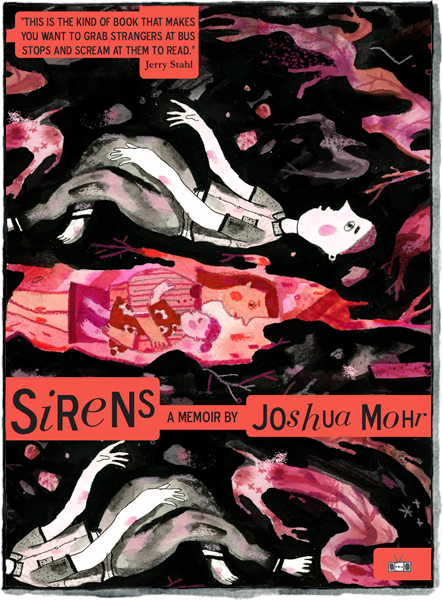
By lucky chance, I start reading Joshua Mohr’s Sirens — memoir of writing, drug use, broken spiritual and physical hearts — and I can’t stop. The slender book reminds me of when I was twenty, reading Death on the Installment Plan in bed in a second-floor Brattleboro apartment, savory from the downstairs Korean restaurant. Like Celine, Mohr’s writing is full of life as that Brattleboro Main Street, or as desolate as a snowy midnight.

Check out Two Dollar Radio’s Santa Fucked Up sale.

Our lives are always in flux, so many contradictions comprising our identities…. We are never one thing. I was never only the heart defect, only the author or junkie or husband or father or professor or drunk. I wear all these like layers of skin. Like stars creating a constellation.

— Joshua Mohr, Sirens

TDR_BookCover_sirens-by-joshua-mohr_2048x2048.png