Journey of many layers.

One of the best journeys of my life was when I was 19 and had long hair I rarely brushed. My then-boyfriend and I were hitchhiking (don’t hitchhike any more, folks) at the Greenfield, MA, I-91 exit, heading north, home to Brattleboro. A man driving an old convertible Cadillac, a great white Moby Dick beast, picked us up. In my memory, he’s smoking a cigar and grinning. While he and the BF sat in the front, shooting the shit, I sprawled in a backseat so enormous it could host a family. I surely wore no seatbelt. My god, on that July evening, I felt like I was flying.

This week, a grad school friend of mine invited me to spend a morning as a visiting writer with his students. All the layers of this trip—the journey south, the first solo I’ve taken since the cancer (my girls urging me to drive carefully, have fun), the stop in Brattleboro where I’d lived in my twenties and was happy, the visit with my dear friend and his wife who I immediately feel is a kindred soul, in their inviting house with a backyard vernal pool and singing peepers, a night of rainstorms, the morning’s magnolia blossoms gleaming pearly—all these layers folded into these writing students who arrived with questions and notebooks, hungry. In this breaking world, what a joy to swim for a bit with others in the passionate stream of loving literature, in all its myriad forms.

On my way home, I stop at a café near Dartmouth-Hitchcock Medical Center. By then, early afternoon, I’m worn down. The café was a favorite of my daughters, in all those months I was treated. Last June, when I was finally well enough to join them, no longer sequestered in a hospital room, they bought me a plain croissant, and I ate a few bites of its inner softness. This afternoon, on the sunny patio, I devour pickled vegetables, soaked in vinegar—something I could not eat last year. Delicious.

April, mud season, it’s just me and a young woman with an infant cradled on her chest. I read for a bit, and then as I’m gathering my things, a car pulls up with two young women. They run to the woman and the baby, laughing and shouting, gleeful.

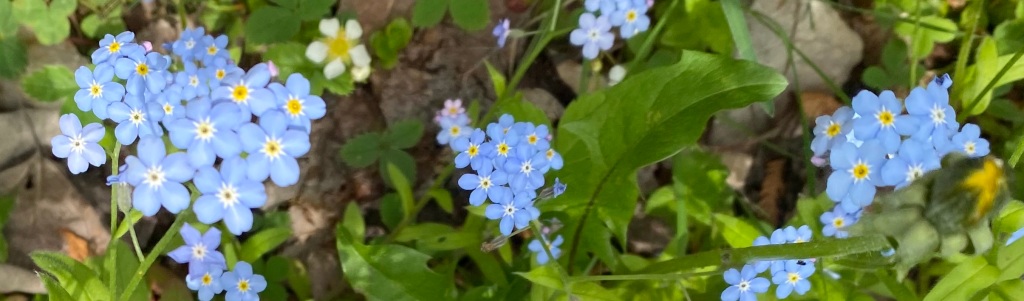
Midafternoon, I have a ways to drive yet, along the wide river and over the mountains. I take a small walk first through the pine forest behind the café. Warm sunlight filters through the canopy. No ephemerals emerge yet, but soon, soon, as the trout lily leaves spread over the earth. My mother would have noticed the young mother, her sleeping babe, the joyous friends meeting this new life. Such satisfaction she would have taken. One more element folded into this journey. Then I head north.

…. And for folks around me, Helen Whybrow will read from her fantastic The Salt Stones and Jody Gladding from her translation of Jean Giono’s The Serpent of Stars at Greensboro’s Highland Center for the Arts, Saturday, followed an artists’ reception for a stunning group exhibition celebrating Vermont’s pastoral life. I was lucky to write about this for Seven Days.

I am beginning to understand that healing is not about returning to what was, but about accepting the change and adapting to the brokenness. This is happening all around us, for people, for the land. People have done damage to the earth and to each other that can’t be undone. We can lament what was, but that won’t help us take care of what we still have. In fact, it might just hold us back. ~ Helen Whybrow
The die is cast?

Writing notes for a reading for Call It Madness, I scrawl in my notebook that this novel is jammed with secrets. Avah Lavoie, protagonist, stashes secrets of theft of longing, and she’s surrounded by secret-keepers, too. Early in the novel, I offer readers two clues. These questions underpin my life, too. No surprise.

The first that’s slipped into the narrative is the story of beavers in New England, how these creatures and their laborious dams once flooded New England, rendering that birch bark canoe a viable form of transportation. When the craze for beaver hats set in, the beavers were trapped nearly to extinction, drying up the land. The story of the past shapes the terrain where we live and how we see the world.

The second is Caesar’s line Alea iacta est — the die is cast. The machination of fate. It’s a question that’s arced through my life since I was a teenager, immersed in Russian novels. Now, from my Vermont house, in the tender dawn, pearly crescent moon hanging low in the horizon, the stars snuffing out as light grows, the robins striking up their day’s singing, this line returns to me. Is fate sealed for this country where, by circumstance, I live, a madman as a leader, intent to wreck destruction and pain, war crimes? Around me, the questions reverberates through everyone: how to live?

Sunday morning, the earth after this fierce winter softening, the daffodils pushing up through black earth, the delicate snowdrops pearly, persistent, the strength of these slender stalks a strain of secret, too.

“If, then, I were asked for the most important advice I could give, that which I considered to be the most useful to the men of our century, I should simply say: in the name of God, stop a moment, cease your work, look around you.” — Leo Tolstoy

Holy Nightsky.

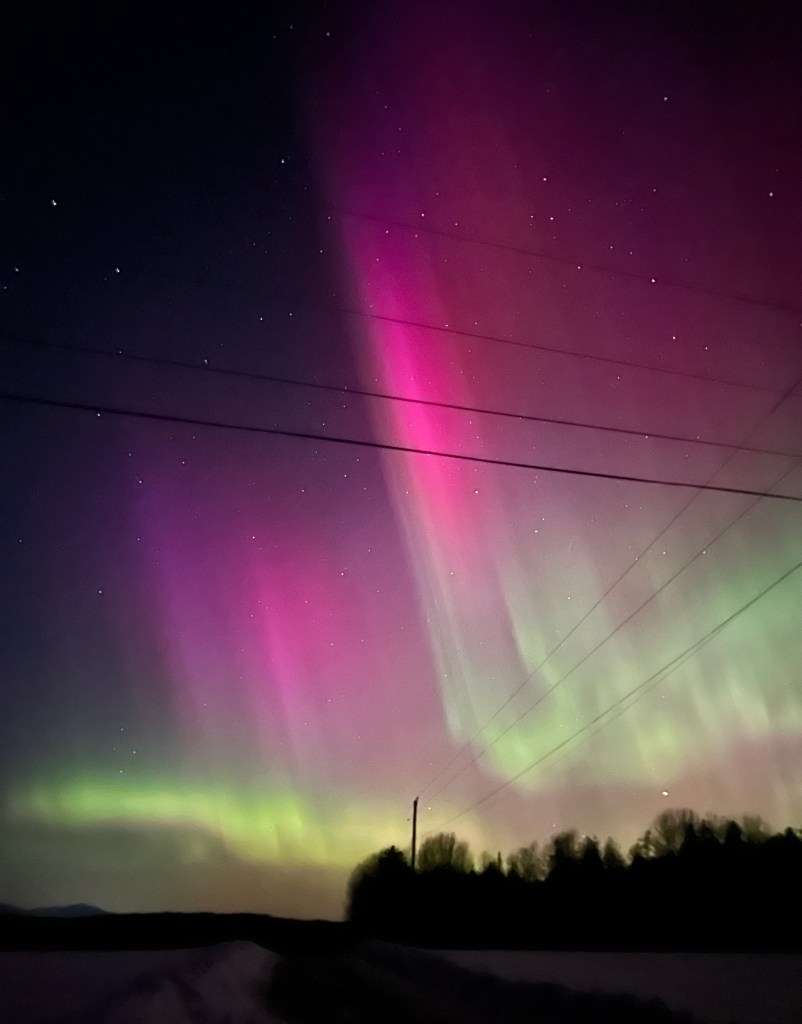
10 degrees on a starry night, my daughter phones me while I’m cramming more wood in the stove. She’s on a dark-soaked back road, the northern lights resplendent, and urges me to go in search. Up Bridgeman Hill, she tells me, with the ridgeline view.

So, bundled in coat and hat, I drive through the little village and up the hill where the town lights cannot touch. In my headlights, wind scatters snow gathered from the wide hayfields, winter dormant. I pull over at the hill’s crest where two farms join. I get out of my car and walk down the road. The limitless sky gleams ruby and emerald, an immense shaft of white light luminescent. In the east, the black spreads profoundly, the stars so radiant I imagine I could reach out and grasp these gems.

John Donne wrote that illness is a “holy room.” My oncologist taught me that we are all the ailing; if not now, to come. Mortality’s cut makes zero discrimination. A cancer diagnosis gained me admission to inner chambers. Unwanted—let me reiterate again, I did not request admission. But I hung up my coat in the anteroom and set my hiking boots against the wall, and I walked barefoot and thirsty into the nexus, me and that fiercely multiplying lymphoma. The lymphoma and me — one of us was not going to survive this go-round.

In the night’s darkness, the rushing wind tore at my cheeks and hurled ice in my eyes. In the distance, a cow barn glowed with light, a scatter of houses in the valley. Around me, that immense and mysterious beauty over small human beings, at whatever mundane chore or decency or devilment we conjure, be it the evening milking or washing supper dishes or plotting a wrong against another.

The sharp-clawed cold shoves me back towards my car, back towards the village and my hot woodstove, my little house in the great holy room of this planet, this universe, this precise moment.

“It seemed like I was doing something ludicrous, trying to build a permanent work of literature out of broken little whimpering bits about the most ephemeral experiences when I was still mostly broken and half-ephemeral myself.”
― Anne Boyer

To Know the Dark.

This is the season of scant light, the day’s heart sooty at best.

Oh, the darkness, keeper of so many secrets. My garden’s soil where rough-edged chard and calendula seeds germinate, where tree roots clench and foxes den. In the summer, the night sounds sing of lust and procreation, hunger and scavenging. The night is the realm of star and moonlight, of the mysteries of creation and romance. And more—in all those hospital nights I endured this past winter, I often woke drenched in nightmares, disoriented. Gasping, I whispered that I was still here, still part of this world. A hospital at night is a ship full of humans, listing its way through uncharted territory.

This morning, crossing over gradually into the days of longer light, into this winter that has barely begun to breathe its life, I carry my glowing ash bucket outside and stand in the cold. Below me, the village lights sprinkle through the valley. My neighbors, early risers, too, have not yet snapped on their kitchen lamp. The wind stirs, and I shiver, barefoot in my Danskos, my hearth divided between stove and bucket, inside and outside, a small thing to consider. I keep standing, keep shivering, my blood running hot.

To go in the dark with a light is to know the light.
To know the dark, go dark. Go without sight,
and find that the dark, too, blooms and sings,
and is traveled by dark feet and dark wings. ~ Wendell Berry (of course)

Picking at the salty remains of roast beef…

Shortly before the November election, I’d heard word of a friend’s illness, and I determined to fly West and see this couple. At that time, I thought I was poisoned by mold and struggling myself, but I really wanted to visit. I decided to hold off buying the ticket for a few days until just after the election, because, well, what if? What if the grid crashed or something? I’ve lost money on airline tickets before.

What happened, instead, is I ended up in the ER the night before the election and discovered the mold was a red herring. I had cancer — although I hold, yet, that the mold was an element of a complicated equation that may, or may not, have added to turning on that cancer gene. By then, flying was impossible for me. Now, news comes to me of her final passage from this life. My friend has lived a long, loving — a good, very good — life, and yet…

All afternoon, another friend and I text back and forth. Remember the nights we ate in their dining room where the walls were painted light blue above a cream headboard? On the wall thermometer, we watched the January temps dip to 20, 21, 25 below zero, laughing at what would be a cold drive home. We never wanted to leave early. Instead, we kept drinking wine, eating chocolate cake, picking at the salty remains of roast beef.

Sorrowful, indeed. We are all now far enough along in life to know that no one dodges the Reaper, that the cut of illness or injury might fall swiftly at any moment. That, in the end, we leave as we entered. While my daughter drove me home the other twilight, I watched the stars ignite in the burnished blue along the horizon, one by one, these ancient untouchable illuminations. She followed the highway home; my eyes fastened on those seed pearls, the slender thread that thickened just the merest width as the night flushed in.

Here’s a line from Niall Williams that, by stroke of coincidence, I read today.

“… you could stop at, not all, but most of the moments of your life, stop for one heartbeat and, no matter what the state of your head or heart, say This is happiness, because of the simple truth that you were alive to say it.”

Some news…

… in a year unlike any other year in my life (youngest off to college with the first year’s bill figured out, grating loneliness and joyous solitude, so much writing and small publications, a radiant writing residency, new friendships, and my mother’s death — say this again, my mother’s death) Regal House Publishing, an Indie press in Raleigh, picked up my second novel, Call It Madness, pub date summer 2026.

Chapter One

            I didn’t know what made my parents drive from Bellingham to faraway Vermont the summer I turned four. I had never met my great-grandfather Opa until that afternoon my mother rolled our station wagon down Breadseed Lane. Earlier that day, a stranger had helped my parents change a flat tire on the New York turnpike, but the spare was a misfit. For hours, our car had been thumping while I stared through the backseat windows at the trees and fields passing by, pondering the puzzle of that strange word breadseed. Could seeds blossom into loaves? We hadn’t stopped for lunch, and I was hungry. Was this Opa character cooking us dinner? Turned out, he was not.