Disease as Teacher.

About a year ago, a friend asked to borrow knitting needles, a request I almost certainly ignored as I could hardly walk up the stairs in my house, and forget the effort of opening the closet door and searching through my needles. A year ago, my family moved my bed downstairs, and I wondered, Well, is that? Am I now confined to one floor like an old woman? I was not, thankfully.

Half a year out from chemo and surgery, my family moved my bed back upstairs. The first morning I wake, I stand at the window looking down at the mock orange planted decades ago. In June, this giant bush is covered with small white blossoms, but in November, the bush is mostly sticks, save for a few withered leaves.

Standing there staring down, I felt suffused with profound grief. Almost immediately, I chastised myself. Why grieve when I survived a terrible illness? When this might have easily gone otherwise? And yet, grief.

Nearing the holidays, I think often of my mother who died not so long ago. She and I had years ago separated our lives for reasons both silly and profound. Only at the end of her life did I begin to have empathy for her and see her not merely as my mother but a woman in her own right. So that morning, thinking of her, my grief is for her absence, for what might have been between her and my daughters and myself. So many years I invited her to holiday meals, and all those years, she refused to join us. How I would love to invite her this year. Surviving cancer (thus far) broke me in so many ways, shoved me right up against the fragility of the world, revealed my own meager strength, but it also allowed me to grieve the loss upon loss that is not endemic to me but woven integrally through our mortal lives. Cancer empowered me to hold that grief without rage, to acknowledge simply what is.

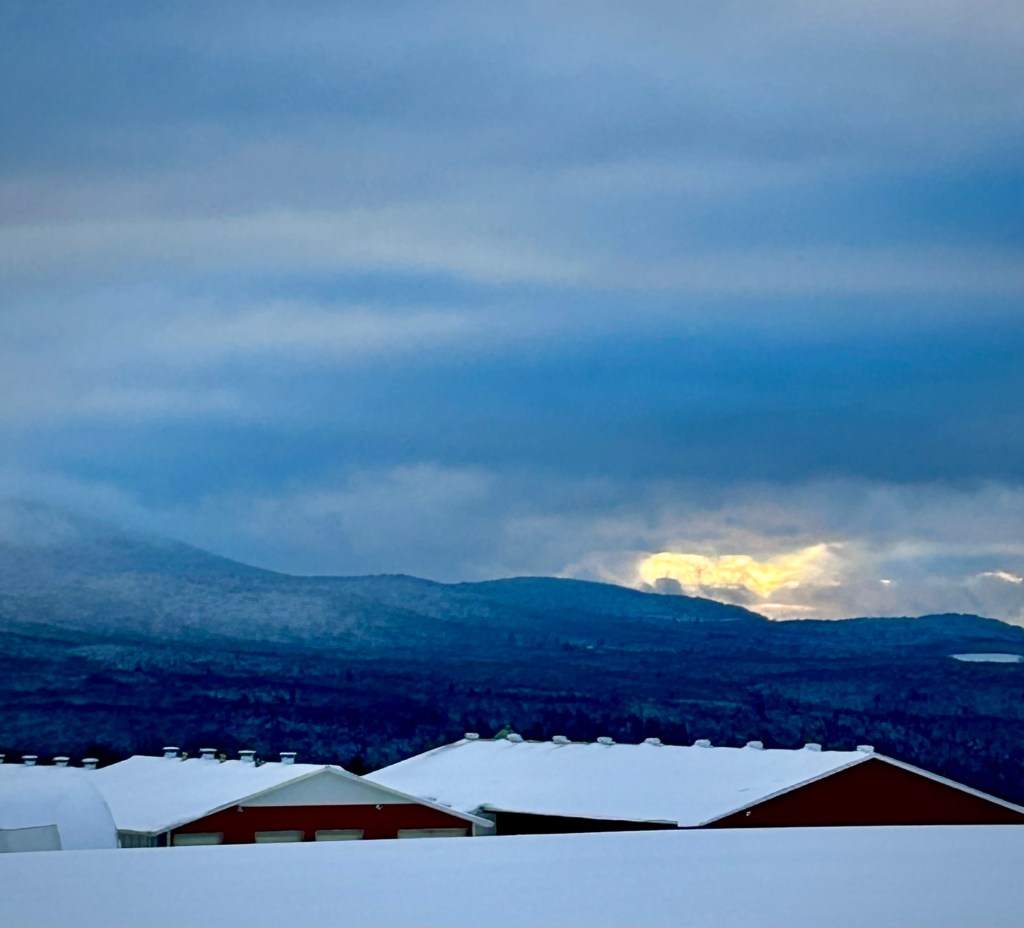
But sadness, of course, is one variation of the complex symphony of our lives. Yesterday, walking along a hillside dirt road in the November sunlight, hat pulled off my head and in my hand, eyes on the spine of the Green Mountains in the distance freshly covered with snow, pure joy suffused me at simply being in the world. Six months ago, my companion had walked with me from my house to Main Street. It wasn’t at all certain to me that I could manage that short walk there and back. Now, the two of us moved quickly through the world, talking poetry and plans. How remarkable is that?

What if we embraced the messy, evolving, surprising, out-of-control happening that is life and reckoned with its proximity and relationship to death? What if, instead of being afraid of even talking about death, we saw our lives in some ways as preparation for it? What if we were taught to ponder it and reflect on it and talk about it and enter it and rehearse it and try it on? What if our lives were precious only up to a point? What if we held them loosely and understood that there were no guarantees? So that when you got sick you weren’t a stage but in a process? And cancer, just like having your heart broken, or getting a new job, or going to school, were a teacher? — Eve Ensler

The Survivable.

It’s dark as the inside of my fist at five o’clock. I’m driving into spitting snow, my brand-new studded snow tires grinding. My companion and I are talking about all kinds of things — how language shapes our worldview and the personalities of tuxedo cats and dentists. I’m driving more by faith than anything else, not particularly fast, headlight beams filled with snow. As if cued, a deer waits in the forested roadside. I slow, then stop, people and deer staring at each other. Then the deer vanishes into the woods.

On this backroad, I’ve passed no other vehicle save a UPS truck, so I wait for a moment for the deer to return, for a companion to leap across the road.

My passenger says, apropros of some conversational thread, that I’ve shed bad karma in my months of cancer treatment, of struggling to survive. My devotion has always been my pencil or keyboard, not the meditation cushion. And yet…

I roll my car forward through the swirling snow. I’ve long adhered to that ancient Aristotelian notion that action defines character. When I realized I had cancer, a year ago, I was rapidly veering towards sepsis. I could not indulge any opinion. To survive, I had to strip away illusion. What were the facts? What was the wisest way forward? None of this was simple.

Cancer narrowed my world. Through weakness and the possibility of a fatal infection, I was confined to my few downstairs rooms, to Emergency Rooms, and hospital rooms. But unexpectedly, cancer widened my life, too, gave me the gift of friendships forged in rough experiences, reinforced for me that this world is propelled by cause-and-effect, that actions have consequences, and that I often grasp only the slenderest knowledge.

New England November drives us into the season of early darkness, blackness so profound our eyes struggle to navigate. When I left Dartmouth-Hitchcock after that last long stay, I felt old, aged in bone and flesh, and concurrently, miraculously restored to my twenties, those years when my lust for living and creating was ravenous and I did not yet comprehend the immutability of time. At the end of this evening drive, I stand for a few moments in this velvety and freezing darkness, snow hissing on the hot car hood, a slender strand of white lights twinkling in my kitchen window. I clench my mittens in my cold hands. Around me, beguiling night.

“When you survive something that was thought to be unsurvivable, the obvious is gained. You have your life—you have time. But it’s only when you get there that you realize your survival has come at a cost.”
― Suleika Jaouad

And last… my story “Tiny Towns” appears in the new collection: 2050: Vermonters Take a Swipe at the Future. Reading tonight in St. Johnsbury….

The Illusion of the Ordinary.

A year ago, I entered the local ER with acute pain. I’d been there before with my kids for stitches and an allergic reaction, things that could be patched up and remedied. A year ago, an MD told me that a scan revealed metastatic cancer. It was the eve of a contentious election, the nation cracking apart. In my life, however, I suddenly had no time for beliefs or opinions. To survive, I had to lean on facts.

For years, I’d been running not so much as a lone wolf but a mangy coyote, hustling my single mama gig, utterly determined to nourish and protect. But there was no way I was going to weasel through this cancer alone. Almost immediately, I was forced to size up strangers — a surgeon, an oncologist, nurses — and do what I had never done before. I had to trust these strangers with my life. Divorce had school me to be wary; now, disease was forcing me to revise my life, rapidly, on the (incredibly painful) go.

A year later, I’m alive. Some was my stubbornness, the trait that enraged my mother — and yet she herself had taught me stubbornness. Back me into a corner, and, damn, will I fight. But that’s a scrap. The more profound reason I’m alive is that I had access to first world health care. I benefited from medicines and decades of trial-and-error, thanks to researchers and so many suffering patients before me. I had access to that small rural hospital who took me in, over and over, this winter, and to Dartmouth-Hitchcock, such a remarkable cancer center surrounded by New Hampshire woods. We drove down the interstate in multiple snowstorms, and always I was gladdened to see the crimson EMERGENGY sign that never turned off. Entering, I knew I would be treated with compassion, with unflagging skill.

I could not have been treated at Dartmouth without my daughters’ immediate willingness to relinquish nearly a year of their young lives to ferry me through the sheer wretchedness of chemo and the brutal complications, and to keep enduring when I finally broke. They had the patience to stay with me while I put myself together.

I was determined to endure all the chemo to gain the best chance of a cure — and I did, running and then limping and eventually crawling — but I received so much kindness from family, from friends old and new, from many of you here, and from strangers. People brought soup and pot roast, drove me to appointments and blood draws, took me outside on walks, carried in firewood and brewed tea, and insisted that I did not look so terrible at all when I couldn’t even sit up. My post office box filled with lovely cards that I taped on the wall over my bed. A friend texted me photographs nearly every day of the beautiful Vermont winter that I was missing; another dear friend texted me a poem she read every night. Boxes of books and cookies and stollen — such treasures. The end of the chemo was followed by a painful surgery. By then, I had no income, and a check from a friend carried me into the summer and recovery. All these well wishes — all this meant so much to me. Gratitude beyond gratitude.

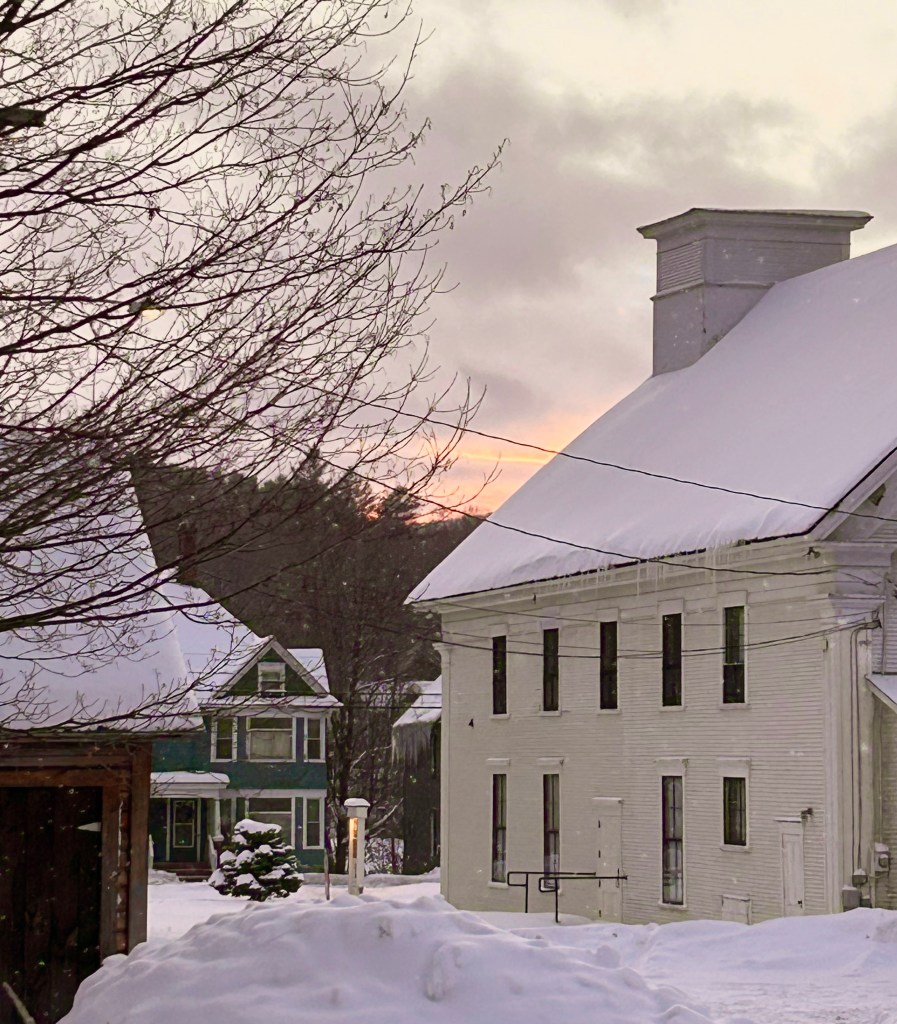
On the day before this year anniversary, I walked down a dirt road as the darkness fell down. In the gloaming, I could see across the valley a tiny white square I knew was my house where my cats were hungry for dinner. The neighbors’ house glowed orange and yellow with their Halloween lights. An utterly ordinary November day.

What remains with me is a body weakened and damaged, but alive, and the steely secret that the ordinary is luminescent with the extraordinary. Here I was — this small woman stripped down to a t-shirt in a billowy warm November afternoon walking along an empty road. Overhead, a line of cacophonous geese arrowed through the sky. The road dipped down in a wet area, and the mud stunk of rank water and rotting leaves. Ahead of me, mist hovered. What luck! I thought. I strode into the mist. In the spring, Daphne plants grow in these roadside woods where someone too broke or too lazy keeps dumping household trash. By the time I was back at my car, I was in the solid dark, the stars and moon swallowed by clouds. Oh, this messy, unclear, uncertain, marvelous world. What luck.

Something Else.

About a year ago, a friend and I hung out laughing in her car beside Lake Champlain. Early November, by 6 p.m. it was dark as a buttoned-up pocket. The lake lapped against the shore. We joked about the pan I held of the worst cornbread I’d ever baked and the potluck we skipped, the polite and surely erudite chat we’d missed. Ah, whatever…. Twenty plus years ago, we were young mothers, driving around in my old car or her old car, our toddlers in carseats. The kids sometimes bickered if nap time neared, sometimes spun tales about Mopsy bunny driving a dump trunk or wondered aloud if maybe the mothers would relent for creemees.

My friend’s kids and my kids — they’re all grownup now. Are their stories more fun now than the cups of sand and lake water they used to serve us on the beach? Those countless gritty root beer floats.

So a year ago… a kind of throwback, this time without the kids. She ran a stop sign. I insisted we walk out to the ferry launch, and the bitter wind was dreadful. We stopped and bought Thai noodles and kale, and my friend ate like a normal person, while I stared at her and wondered what on earth was wrong with me. I was convinced I had mold poisoning from a work exposure, and we kept laughing and laughing. Then she said, “What if it’s Lyme disease? What if it’s something else?”

It was something else, of course. A few days later, I was hospitalized, turning dreadfully towards septic. That winter, as I endured chemo, as things went from really bad to worse, I sometimes thought back to those hours of silliness, how rapidly my life altered. As a young mother in those years, I did not yet know this. I did not yet comprehend that the world does not go on and on and on.

Knowing this now, in my soul and body, does it make the laughter sweeter?

Yes, indeed.

But just when the worst bears down
you find a pretty bubble in your soup at noon,
and outside at work a bird says, “Hi!”
Slowly the sun creeps along the floor;
it is coming your way. It touches your shoe. ~ William Stafford

100 Daffodils.

In this balmy late autumn, I walk with new acquaintances in an oak forest where I’ve never wandered. Oaks are sparse in the woods where I generally walk, these lovely-leaved beauties, the ground beneath them strewn with acorns, some broken, their centers chewed out.

I’m with other women who are unwillingly on a journey similar to mine — cancer and chemo, the shock of our worlds slashed apart. Our conversation drifts to the kindness of friends and strangers, and the flip side of kindness — a kind of harshness: why can’t you get on with your life since the chemo is finished? (a raw impossibility) and didn’t you eat enough kale? For the record, when my daughters were young, I grew three kinds of kale in my garden, fifty plants to carry us through the winter, fenced from the foraging deer. All that kale, so carefully tended, and yet, here’s the luck of your draw: cancer.

It’s a rare kind of privilege to walk with these women, listening, offering snippets of my own story. On this cloudy afternoon, these woods are light-filled through the barren branches, the poplars and beeches still shimmering patches of gold. One woman ventures, “All nature has scars.”

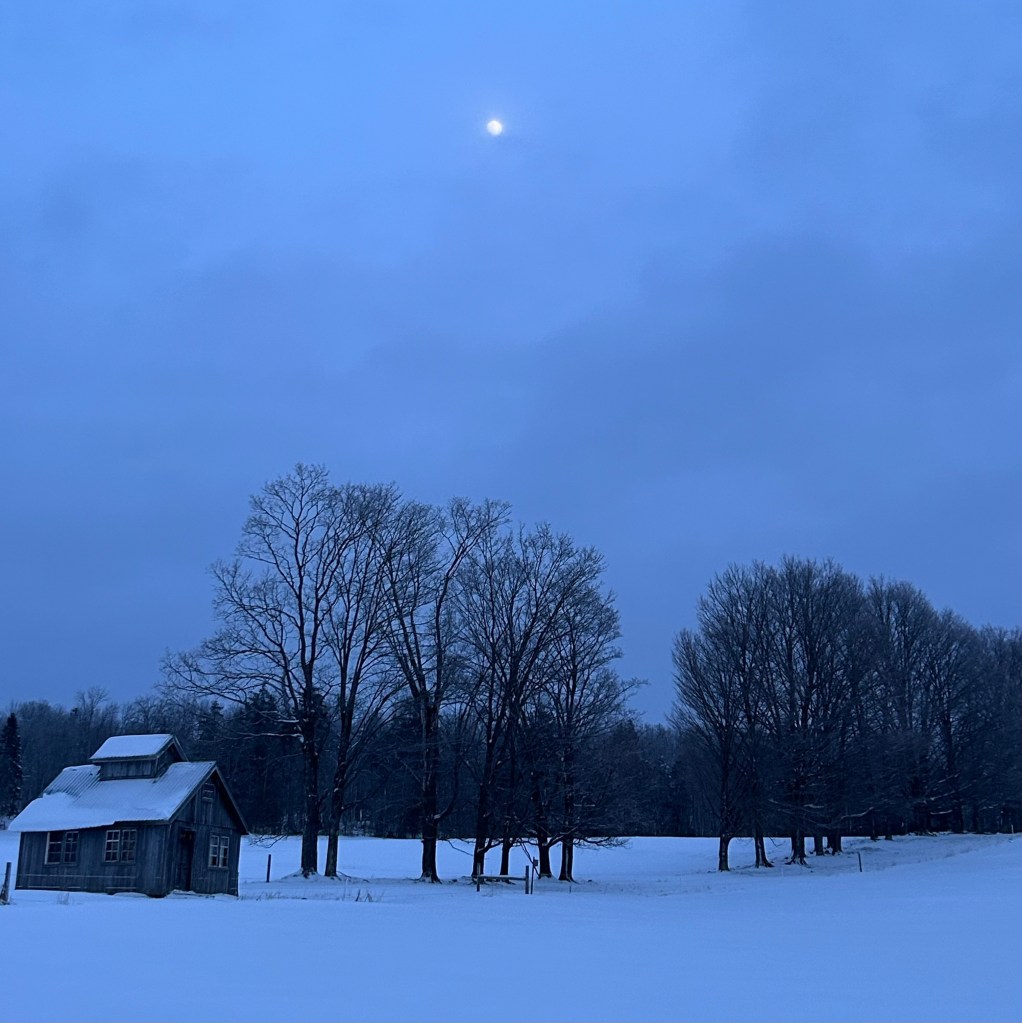
Every year, I dread this season of dwindling light, the creeping-in edgy cold, the giant fist of winter readying. And yet every late autumn, the falling leaves enchant, the wood stove’s warmth soothes, the moon gleams its crescent cut-out in the starry sky.

Writing this book about cancer has pushed me to read and gather facts and history, the scientific low-down. And yet, simultaneously, I appreciate more and more the great mystery of this universe. A friend counsels me that I can hold two things in one hand: knowledge and uncertainty. But these, too, are beyond numbers; this world’s mysteries are multitudes. My sister once remarked that cancer is the great leveler: it’s humbling. On a recent chilly morning, I planted one hundred daffodil bulbs: a meager offering to this sweet place where I live. The story behind these spring beauties will surely sink down and vanish into the sandy soil.

Auto Mirror

In the rear-view mirror suddenly
I saw the bulk of the Beauvais Cathedral;
great things dwell in small ones
for a moment.

Adam Zagajewski, translated from the Polish by Czeslaw Milosz and Robert Hass

Gifts at the Back Door.

I arrive home in the dark and find one of my red deck chairs at my kitchen door, a white container set on its seat. It’s not late but dark already. On my way home from work, I’d walked along the river and walked further than usual. When I’d returned to my car, darkness had fallen.

I’ve been living in or nearby this village for thirty years. I’ve seen a share of miserable things — from addiction and homicides to petty cattiness — and its goodness, too. How, in times of trouble, folks appear with aid. No questions, often very few words. My god, the grace of this.

Scorched earth is how I consider myself these days, not so many days post-chemo, post-surgery, leering up on a year’s anniversary since I learned I had cancer. See how I write this? Past tense. And yet, transmogrified is a word I used with a friend. How this disease has transmogrified my being.

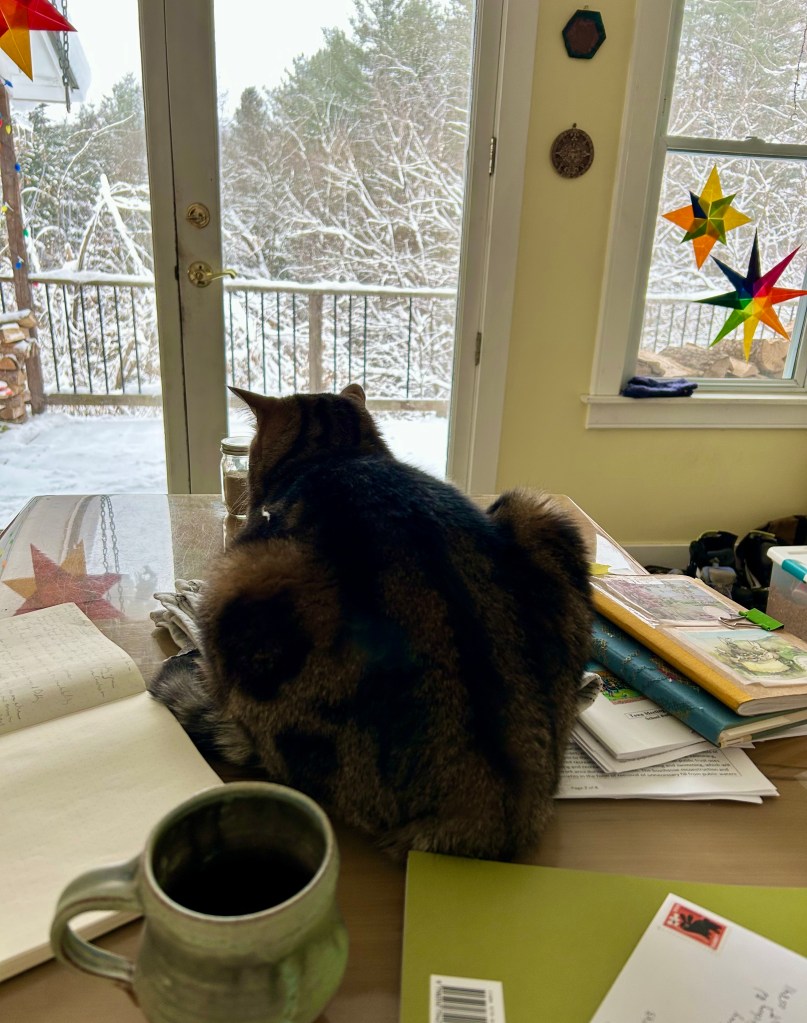
In the dark, I unlock my door, set down my backpack, a pile of library books, a bag of apples. My cats mewl for their cat supper. The container has soup, barley and beef and spinach. The woodstove has gone cold, my jacket drips rain on the floor and my cats’ dense fur, darkness presses against the windows. And yet, serendipitous soup. I take a spoon from the drawer. As for figuring out the rest of my life, or this week, or even this evening — I let that go.

From my library book stash, Sally Mann:

“As for me, I see both beauty and the dark side of the things; the loveliness of cornfields and full sails, but the ruin as the well…. The Japanese have a phrase for this dual perception: mono no aware. It means “beauty tinged with sadness,” for there cannot be any real beauty without the indolic whiff of decay. For me, living is the same thing as dying, and loving is the same thing as losing, and this does not make me a madwoman; I believe it can make me better at living, and better at loving, and, just possibly, better at seeing.”