Hell-bent robins.

I arrive home from the local arts center, get out of my car, and a robin nearly flies into my head. Winged creatures are swooping from the apple trees to the hedge of lilacs that is just beginning to bud. My god, what a lovely day.

In my bag, I have an empty pint jar of water I’ve been drinking, and a ball of purple linen I’m knitting into a summer shift, and the books of the two authors whose reading I just attended — Helen Whybrow of The Salt Stones and Jody Gladding’s translation of Jean Giono’s The Serpent of Stars. I have a new book, too, a collection of stories by a Turkish author I’ve never read. Sitting with my book world friend, her publisher friend hands me a book, too. The afternoon and evening has gone this joyous way, like that hell-bent robin — strangers and friends and people I haven’t seen in ages — exuberant about literature and art and the unstoppable profusion of spring.

I like this art center so much I imagine curling up on a cushiony bench and sleeping beside the wide windows, the starlight on my face. An acquaintance I met at a Vermont Studio Center residency works here, too, and we plot some amusing possibilities. We’re beside the table heaped in lush mounds of delicacies, and I graze on stuffed mushrooms and empanadas and fresh tomatoes. I wrap lemon squares in napkins and hold these in my hands away from my books and knitting.

Outside on the stone patio, the wind is lifting over the meadow, the sun sinking and the cold creeping in. All around me looms that chilly darkness, the nearness of sunset, the hole in the night where dawn seems impossible. So much of my life I’ve teased and poked at this, and, conversely, pushed the vast cold away — through distraction and once-upon-a-time through drinking and work. Now, as the twilight drains away and night stakes in for its duration, I wander among the yet leafless apple trees, the garden with its green garlic nubs, drinking tea and listening to the birds settle down to sleep. My god, the myriad lessons of cancer. Note this, too: clench joy and fear in the same fist. See what happens.

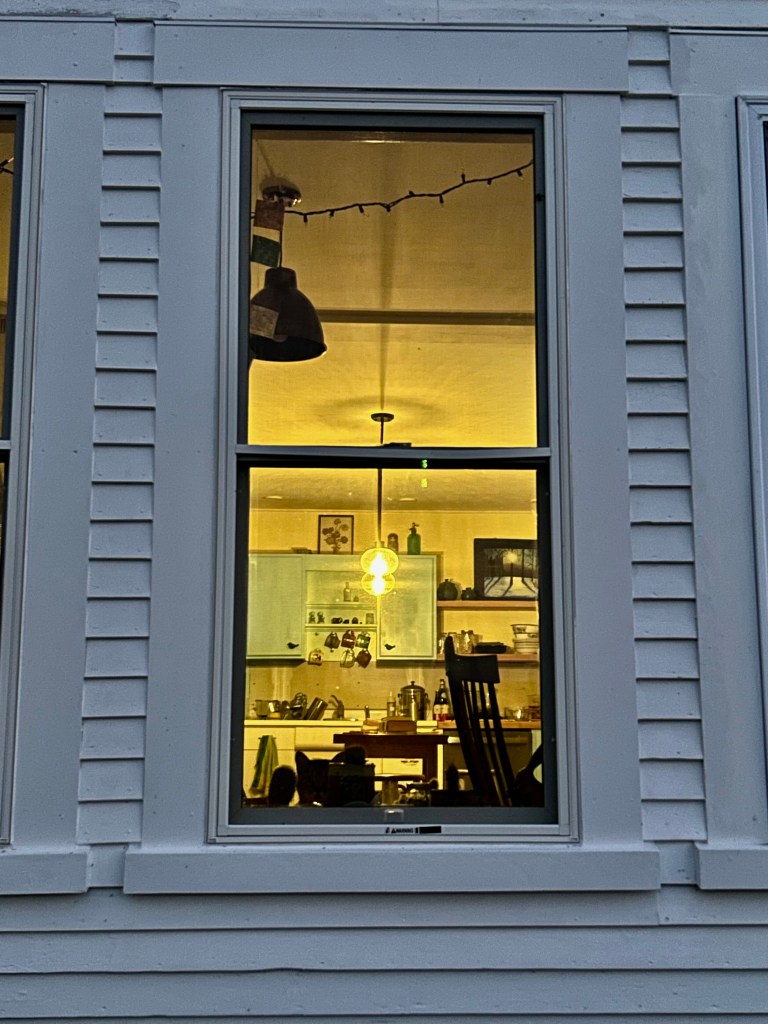
Kitchen renovation paint considerations….

Journey of many layers.

One of the best journeys of my life was when I was 19 and had long hair I rarely brushed. My then-boyfriend and I were hitchhiking (don’t hitchhike any more, folks) at the Greenfield, MA, I-91 exit, heading north, home to Brattleboro. A man driving an old convertible Cadillac, a great white Moby Dick beast, picked us up. In my memory, he’s smoking a cigar and grinning. While he and the BF sat in the front, shooting the shit, I sprawled in a backseat so enormous it could host a family. I surely wore no seatbelt. My god, on that July evening, I felt like I was flying.

This week, a grad school friend of mine invited me to spend a morning as a visiting writer with his students. All the layers of this trip—the journey south, the first solo I’ve taken since the cancer (my girls urging me to drive carefully, have fun), the stop in Brattleboro where I’d lived in my twenties and was happy, the visit with my dear friend and his wife who I immediately feel is a kindred soul, in their inviting house with a backyard vernal pool and singing peepers, a night of rainstorms, the morning’s magnolia blossoms gleaming pearly—all these layers folded into these writing students who arrived with questions and notebooks, hungry. In this breaking world, what a joy to swim for a bit with others in the passionate stream of loving literature, in all its myriad forms.

On my way home, I stop at a café near Dartmouth-Hitchcock Medical Center. By then, early afternoon, I’m worn down. The café was a favorite of my daughters, in all those months I was treated. Last June, when I was finally well enough to join them, no longer sequestered in a hospital room, they bought me a plain croissant, and I ate a few bites of its inner softness. This afternoon, on the sunny patio, I devour pickled vegetables, soaked in vinegar—something I could not eat last year. Delicious.

April, mud season, it’s just me and a young woman with an infant cradled on her chest. I read for a bit, and then as I’m gathering my things, a car pulls up with two young women. They run to the woman and the baby, laughing and shouting, gleeful.

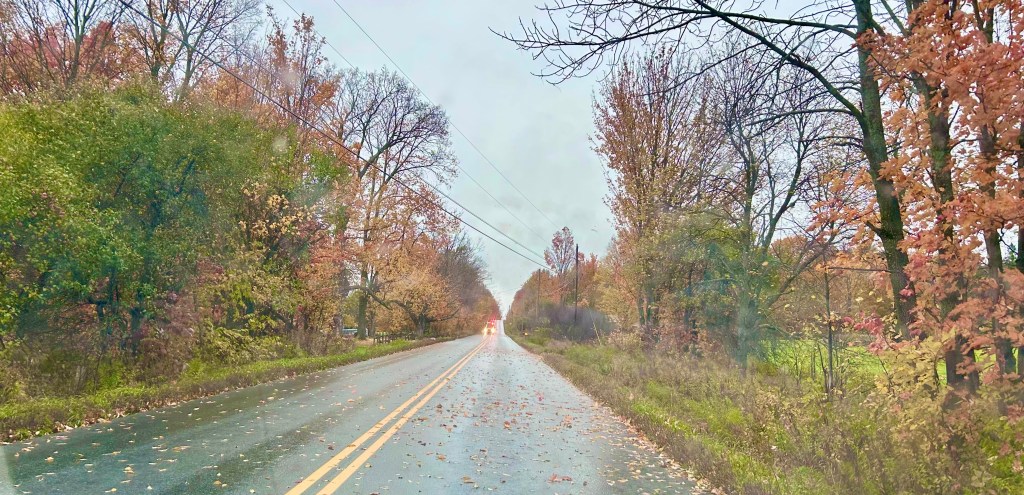
Midafternoon, I have a ways to drive yet, along the wide river and over the mountains. I take a small walk first through the pine forest behind the café. Warm sunlight filters through the canopy. No ephemerals emerge yet, but soon, soon, as the trout lily leaves spread over the earth. My mother would have noticed the young mother, her sleeping babe, the joyous friends meeting this new life. Such satisfaction she would have taken. One more element folded into this journey. Then I head north.

…. And for folks around me, Helen Whybrow will read from her fantastic The Salt Stones and Jody Gladding from her translation of Jean Giono’s The Serpent of Stars at Greensboro’s Highland Center for the Arts, Saturday, followed an artists’ reception for a stunning group exhibition celebrating Vermont’s pastoral life. I was lucky to write about this for Seven Days.

I am beginning to understand that healing is not about returning to what was, but about accepting the change and adapting to the brokenness. This is happening all around us, for people, for the land. People have done damage to the earth and to each other that can’t be undone. We can lament what was, but that won’t help us take care of what we still have. In fact, it might just hold us back. ~ Helen Whybrow

The full extremes.

The days are hurrying right up to that mark of a year of healing from chemo. After that final treatment, I lived into a little lull where I allowed myself to believe that all would be okay again, but the need for surgery roared up, too. Much as I fought against this — and, honestly, my fighting was from fear of a horrible outcome and, perhaps even more, if I’m dead honest, was my terror of YET MORE PAIN — but as I said, much as I fought against this, I eventually ended up back at Dartmouth in a hospital bed, my daughters beside me wondering when the heck this was going to end. That huddle of surgeons appeared. It was, after all, a teaching hospital.

I said no. The surgeon said, I put you on Tuesday’s schedule. Doubtlessly, he was satisfied to finally, after those months, to get to work repairing me. I stared out the window and knew there was no way I would ever make it home. So I said yes.

But a year… a year ago, I was somewhat seeing a man who was more interested in me than I was in him. I was interested in admiring the daffodils and learning to walk again. I was interested in never returning to the hospital again. I had other things on my mind, too. I was rewriting a book, and, since I had lived, I had to start earning a living again.

It’s been a remarkable year, suffused with radiant joy, with gratefulness to walk and eat and read and write and sleep—without pain. And a year filled, too, with the darkest thoughts I’ve ever experienced, as if the cancer had broken every inhibition, allowed me to feel and fear all the rottenness I’ve kept away for so long. This is not something I’ve written about here, but I keep bearing in mind my oncologist’s prescription: Go and live your life, Brett. A year later, the word that surfaces is fragility. I live in a world that bandies resilience—resilience of soul, resilience of Flood Ready Vermont!, resilience of community and systems. A year later, I know intimately the thinness of energy and health, the scantness of my days, your days, our days. All of it, I know; live all of it, such largess.

“The society to which we belong seems to be dying or is already dead. I don’t mean to sound dramatic, but clearly the dark side is rising. Things could not have been more odd and frightening in the Middle Ages. But the tradition of artists will continue no matter what form the society takes. And this is another reason to write: people need us, to mirror for them and for each other without distortion-not to look around and say, ‘Look at yourselves, you idiots!,’ but to say, ‘This is who we are.” — Anne Lamott

Thawing earth, tempered heart.

My neighbor and I kvetch about what the spring thaw reveals: dogshit and stove ashes running into pools of black ink. The mud is a housekeeper’s bane and a gardener’s promise. In the rain, we swap stories of illness and books and parenting. These days, I keep T. S. Eliot’s words in my pocket.

April is the cruellest month, breeding

Lilacs out of the dead land, mixing

Memory and desire, stirring

Dull roots with spring rain.

Inexorably (and grateful, so grateful to be here, writing), my days unfold towards that first-year mark of emerging from chemo, from the brutality of drugs that both scorched and healed my body. In rickety last summer, I started yoga classes, at first hardly able to climb the stairs to the third floor with its windows that overlook Main Street and the Village Diner and the blinking yellow light intersection. In this mindful class, those ER visits appear again, drift through my thinking, vanish. In my fifties, now, like anyone, I’ve lived through the gamut. The most fearful times of my life, I was often quiet, utterly focused, like the terrifying afternoon when my youngest baby had an allergic reaction and a stranger rushed us to the ER.

Enduring the chemo was like that, too, so many months of cowering beneath a rushing train, nearly always on some variation of the pain scale, intent on the single goal of survival. I longed for the everyday world. In this were small bright gifts. My daughter’s friend would sometimes raid my post office box and bring me books and letters and medical bills, news of the outside world, literary fodder.

Disease is a strict teacher, with lessons of endurance and patience, of non-negotiable acceptance. My world constricted so often, breathing through pain to survive a little more, a little longer. One afternoon in April, my daughters walked me outside the hospital. We sat on a bench beneath a profusely blossoming apple tree. Through the white-petaled flowers with their ruby hearts, the blue sky. We sat and talked. For ten minutes? Half an hour? What does it matter? The limitless spring sky, the infinite mystery.

April this year, not otherwise
   Than April of a year ago,
Is full of whispers, full of sighs,
   Of dazzling mud and dingy snow;
   Hepaticas that pleased you so
Are here again, and butterflies. ~ Edna St. Vincent Millay

Life can only be understood backwards…

Kierkegaard wrote that famous line, “Life can only be understood backwards; but it must be lived forwards.” This is the story of my life, and probably of yours, too. I’m a few weeks shy of a year away from the last chemo session. During those hours of infusion, I dozed, watching cardinals and house wrens through the cancer center window. That night, I slept profoundly, believing done, done, not yet realizing an excruciating surgery would lear up unavoidably a month later, that I would phone my siblings and beg for their arrival, that I needed fresh horses, the calvary’s arrival, that the end to these months of cancer treatment seemed impossible.

A year later, I’m still here, living forward, still waking before dawn to reckon what kind of light might kindle the day. A year ago, I could hardly lift my laptop. Now, I text a friend to borrow a belt sander. I am determined to lean my shoulders and back into revitalizing this old wooden floor that had been hidden for years beneath vinyl.

Cancer reshaped me in multiple ways, diluted my rage, cushioned my prickliness, whetted my fierceness to entertain no truck with catty foolishness. Disease fed my solitude and forced me to reach out and grasp hands. And now a sander.

A friend recorded Vermont’s poet laureate Bianca Stone speaking about Robert Frost. The recording is up for a few weeks on the local radio station, WGDR, on the March 22 Bon Mot show; it will feed your heart.

And one of my favorite Frost poems:

Into My Own

One of my wishes is that those dark trees,
So old and firm they scarcely show the breeze,
Were not, as ’twere, the merest mask of gloom,
But stretched away unto the edge of doom. 

I should not be withheld but that some day
Into their vastness I should steal away,
Fearless of ever finding open land,
Or highway where the slow wheel pours the sand.

I do not see why I should e’er turn back,
Or those should not set forth upon my track
To overtake me, who should miss me here
And long to know if still I held them dear.

They would not find me changed from him they knew—
Only more sure of all I thought was true.

Under the kitchen vinyl.

While the radio carries in terrible news, the carpenter tears off the vinyl on my kitchen floor. I run my hands over the worn maple boards that are revealed to the daylight again. In one corner, a rotten board where perhaps the sink leaked. The carpenter cut out those pieces, and I look down at the basement’s graveled floor. In another corner, there’s a blackened place where perhaps a woodstove once charred the flooring. He and I stand there, considering, wondering about who once lived in this house. I wonder about their patterns of heat and sustenance, these people who passed from this world, decades ago.

When the carpenter leaves, I vacuum, then sit on the cold floor while the cats sniff curiously. I rub my hands over these boards bruised from living and speculate that I can sand and polish this small space, quicken it again.

I began this project with a desire to take down a wall, open a room, and chase away the dismal memories of illness, to acknowledge that, indeed, this is the house where cancer devoured my body, tore at my flesh and mind. I survived. To continue surviving, I must revise my life, change my patterns of living.

I know a few of the names of the people who lived in this house on a village hillside. Now, barefoot on these cold hard-worn floorboards, I sense the mysterious stream of connection that runs between the dead and myself and those who will someday live here, when I have moved on myself, to other earthly or unearthly places. Who laid this floor I’ll never know, but I’ll put my hands and my muscle to it, lend my energy towards restorative beauty, towards the scantness I can do.

I am beginning to understand that healing is not about returning to what was, but about accepting the change and adapting to the brokenness. This is happening all around us, for people, for the land. People have done damage to the earth and to each other that can’t be undone. We can lament what was, but that won’t help us take care of what we still have. In fact, it might just hold us back. Nature herself keeps giving and never giving up. ~ Helen Whybrow. The Salt Stones