Snow, Saturday, Living in History

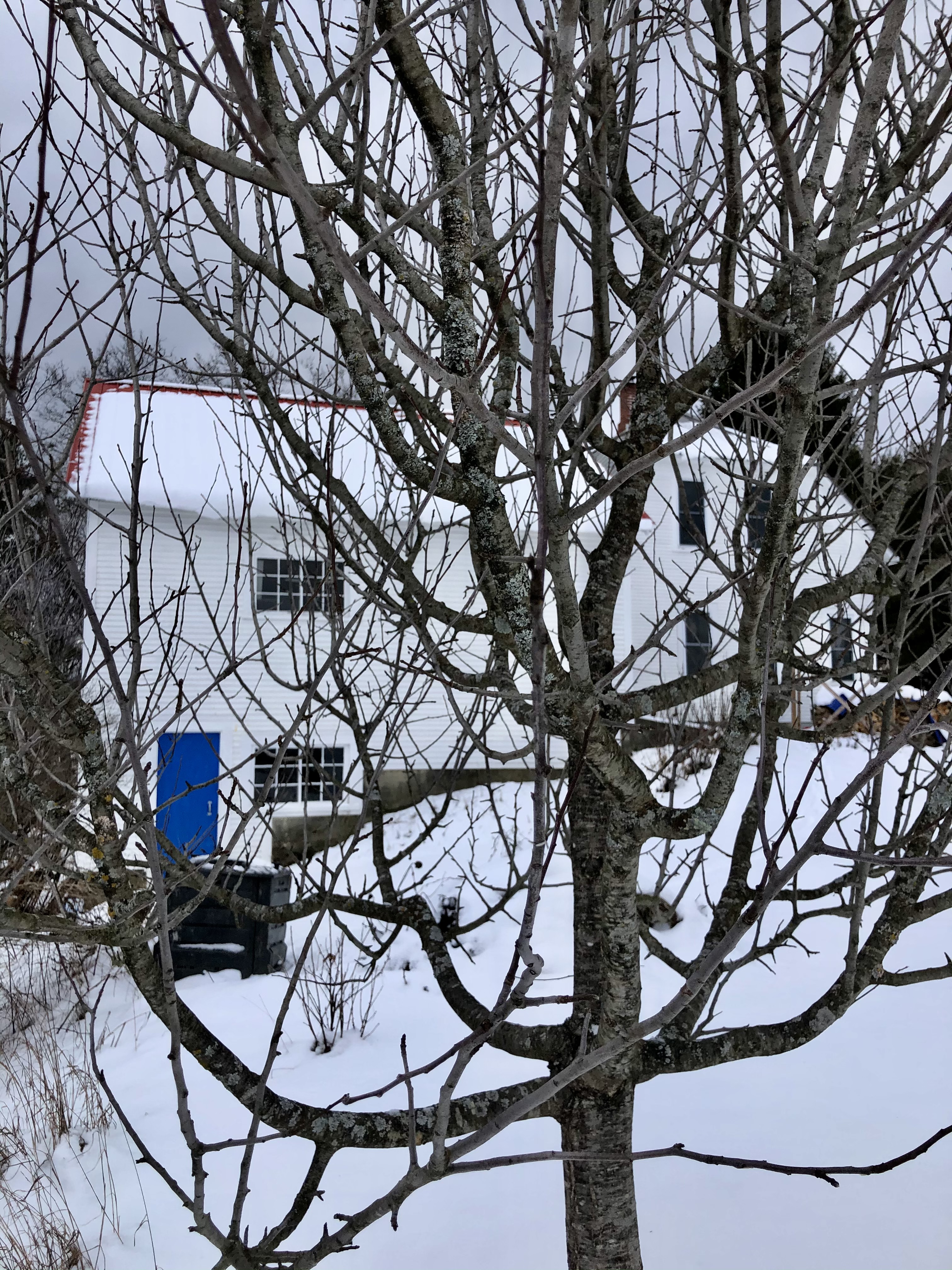
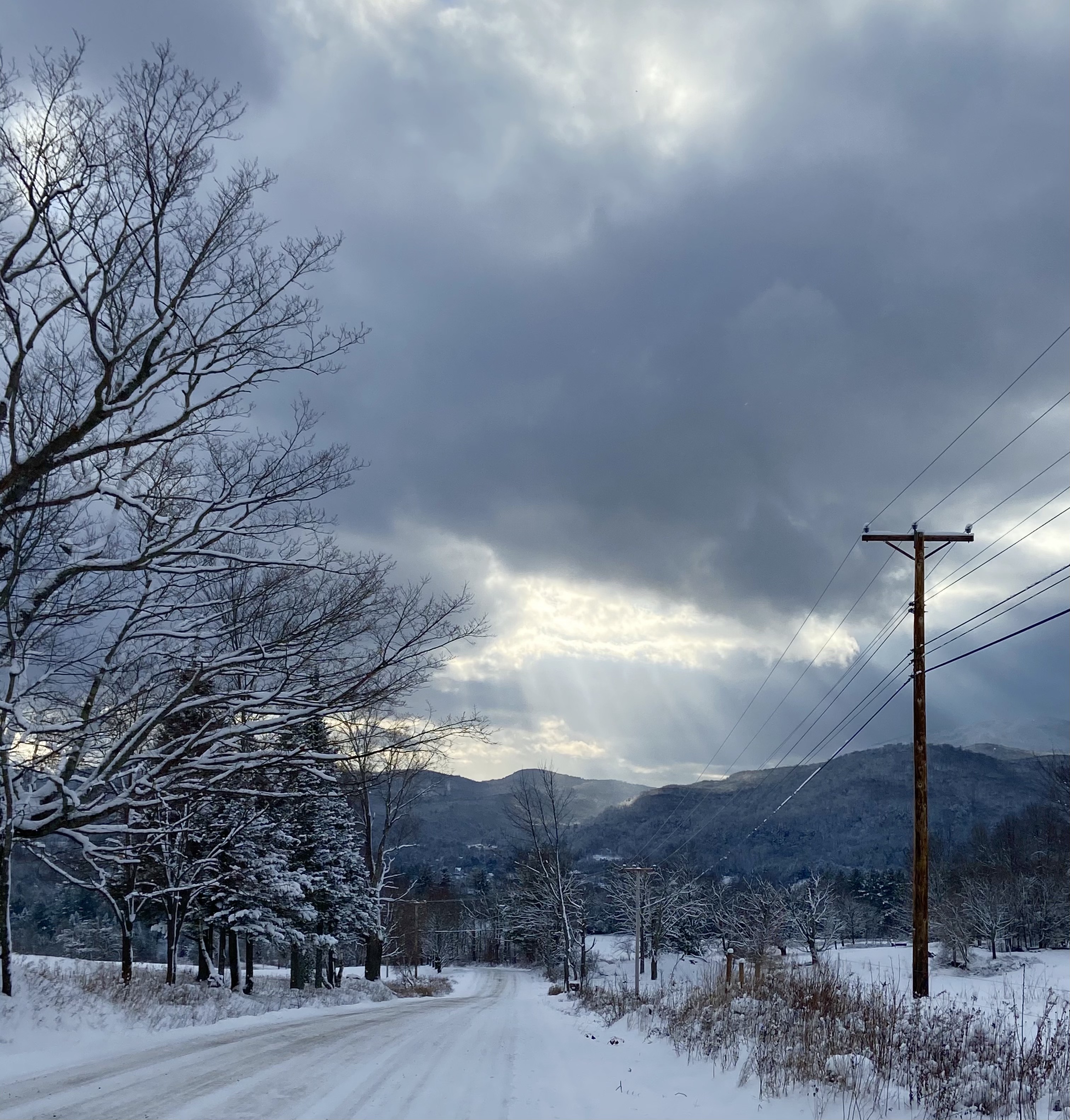
Saturday morning, we wake to a snowfall — gorgeous fat flakes swirling down — the kind of sparkling snow that miraculously turns the world brand-new and utterly beautiful.

In early afternoon when I return from work, the girls have shoveled the paths and driveway and deck. Inside, they’re drinking tea in front of the wood stove and putting together a puzzle my sister sent from Virginia, a pretty blue puzzle with birds.

I stand at the glass door drinking coffee, thinking where I stood that morning, on the shores of Caspian Lake, its center obscured by drapes of falling snow. Bundled in hats and masks and scarves, I stood talking with another woman about the small town planning process. Then our conversation wandered into the oddities of human life, how determined we all are at times — and I’ll put myself firmly there — to keep our attention focused on our own little stamp of land and home, be it a postage-stamp-sized piece or hundreds of acres. Meanwhile, the snow, the rising and setting sun, the wandering woodland creatures, continue on.

Saturday afternoon, I claim my own place near the fire and read The New Yorker‘s recent “The Plague Year” by Lawrence Wright, reading aloud pieces to my daughters, saying, This is the history you’re living through. This is your story, too…. It’s a lesson for me, too, when I dream of living elsewhere, where sleet doesn’t fall, where the cost of living isn’t crazy-high, where the sun shines even in the heart of winter — a reminder for me to embrace my own accidental luck to live here.

Nations and states that have done relatively well during this crisis have been led by strong, compassionate, decisive leaders who speak candidly with their constituents. In Vermont, Governor Phil Scott, a Republican, closed the state early, and reopened cautiously, keeping the number of cases and the death toll low. “This should be the model for the country,” Fauci told state leaders, in September. If the national fatality rate were the same as Vermont’s, some two hundred and fifty thousand Americans would still be alive. 

— Lawrence Wright
More found stuff…

Things May Start….

So long, 2020.

2020 might not have been the brightest year on record, but then, say, 1944 might not have been all that rosy, either.

2020 became the year when our house finally became a home. Three years ago, I sold our former house and moved with my daughters. We moved, I realized only later, only out of desperation, to leave a bad scenario for what I hope would be a better life.

2020 showed me that this story — while uniquely ours — is also the human story, of movement and longing, of fear and hope. We’ve now claimed ownership of this house — us three females and our two house cats — through countless meals and nights and early mornings, through arguing about things petty and not-so-petty. We claimed ownership all those spring days when I leaned against the kitchen counter, listening to the governor and wondering what the heck was happening; through my daughter setting up high school in front of the wood stove, through the slow dawning when I realized my employment was no longer viable, and I would need to adapt.

I did. We did.

During this hard year, the ancient moon rose and set over our metal roof, over our neighbor boys’ sandbox, the road sloping down our hill and out into the world, our village, our sweet state of Vermont, the veritable globe.

I’m reading Lauren Redniss’ Oak Flat: A Fight for Sacred Land in the American Midwest — a book both terrible and beautiful. Redniss writes:

If you go back to the beginning,
everything was dark.
You start from nothing.
Things start to come to light.

Hello, 2021.

Little Bright Bits

A friend and I have a habit of emailing back and forth requesting send me something good. We’ve been doing this so long now that I can’t remember when we started, although I’m nearly 100% certain this began in a long Vermont winter.

Generally, we offer little bright bits — a book to share or a decent recipe. Yesterday, she emails about the rising full moon. Drivers along the County Road pulled over and took photos.

Little bits that are maybe not slight at all.

After dinner, my daughters and I bundled up against the sharp cold and went walking in the silvery moonlight. We hadn’t dressed warmly enough and shivered by the time we returned. Chattering, my girls were exuberant that winter had finally arrived in all its radiant beauty.

That gleaming round moon, the sparkling snow, a warm house: solid strands of our web.

  Barn’s burnt down 

     Now I can see 

     the moon! 

— Mizuta Masahide

Photo by Molly S./Hardwick, Vermont

Ships Passing in the Night

Way back in the last century, when I first moved to Vermont as a young woman, my then-boyfriend and I drove in the middle of one night to Boston. We passed through tiny Massachusetts town after town, shuttered up and dark for the night. As our old Toyota hurried through, I wondered who lived there. At two in the morning, hardly anyone but a parent with a crying baby is awake.

Walking downtown last night, while my daughters wash our dinner dishes, I marvel how the pandemic seems to have placed us in a very long 2 a.m. In the dark, I pass a single masked person. Treading carefully on the ice, we each half-raise a hand, a human version of ships passing in the night.

This morning, my neighbors’ lights are off. Last year, with their youngest, their house lights glowed at all hours. Now, at 6 a.m., the house remains shrouded in the darkness of sleep. And so it goes, I remind myself, night always yields to dawn.

Winter passes and one remembers one’s perseverance.

— Yoko Ono

Holy/Unholy

A warm Christmas Day rain washes away every bit of snow in our patch of northern Vermont, save for a few ice-hardened and blackened plowed-up ridges. As the dawn drips in with its gray, the landscape appears unfamiliar to me in December — an experience that, again, sums up 2020.

Friends of ours had Christmas dinner on the in-laws’ porch, with the in-laws inside and themselves on the covered porch, eating Christmas dinner 2020-style. Strange and weird, but what wouldn’t I have given that for hilarity.

Talking with my brother on Christmas morning, he mentions he may grout a floor that afternoon. My youngest, afterward, tells me how fun that sounded and then wonders if she would see her uncle before she’s all grown up, headed out into the world on her own, not so far away.

And so it goes in this landscape of unfamiliarity: suspended in a warp of uncertainty. In the midst of all this, there’s me with my lists, my agendas, my determination to craft plans for happiness.

In this gray and blue and brown landscape — not the traditional Vermont snowy Christmas — there’s nothing to do but let all that fly away in the rising and balmy breeze. The heart of the Christmas story, after all, is the unexpected gift in the barn’s manger, the promise of joy where we least expect its appearance.

Photo by Gabriela S.

Instead of Lunch…

On the solstice Monday, I’m standing along a dirt road, bent down, petting a dog.

The recent cold snap has broken, and the midday is nearly balmy. Some winters in Vermont are like this: cold and thaw ricochet back and forth. Each thaw reminds us that we’ll endure the bitter cold. Beneath my boots, mud may not be far away. But I know — and not just by the low declination of light — that plenty of winter remains.

The conversation I’m having bends around again to the observation I’ve gnawed over and over: how human irrationality winds all through these bucolic Vermont villages. Likely, it’s the human condition.

Irrationality or not, for these moments, I’m standing in shallow snow, on a hillside with a view of the valley below and the not-so-far blue mountains in the distance. The little dog’s ears are velvety to my bare fingers. And, for these few midday moments, I soak in these landscape of brown dirt road, pristine snow, pale blue sky, conversation. Spring is an infinity away, but spring always arrives. I’ve been here before.

Photo by Gabriela S.