Non-Academic Grit

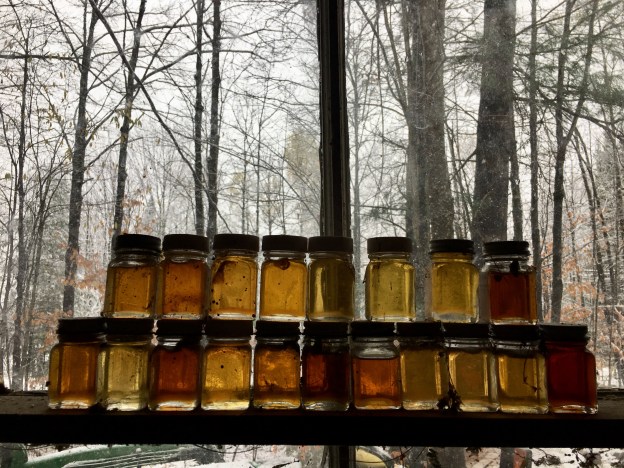
In my twenties, I made a decision which changed the course of my adult life: I left the academic world and threw in my (considerably small) fortune in agriculture. My former husband and I sugared for nearly twenty years, on a small family-scale, and, while he was a carpenter and I worked various jobs (census taker, book seller), the bulk of income I brought in was through the Stowe Farmers Market. I made more money at that farmers market than I ever have anywhere else.

Yesterday, my teenager daughter skipped high school and stayed home to help load some of the heaviest things from the sugarhouse into a buyer’s truck. Are you kidding me? she asked. I’m not going school and missing out. The buyer was a New Hampshire family with their 26-year-old son and sleepy dog, and they arrived in a wet snow with such good cheer and humor in our unheated sugarhouse that they convinced another gentleman who arrived to write me a check for a sap tank.

The man and his son and my daughter with her honed tractor skills (“I’ve been driving this tractor since I was 10,” she explained) loaded up the heavy stuff while his wife and I talked about novels and farmers markets and, oddly, sex.

Afterwards, eating apples with my teenager, I raved about how terrific sugarmakers are, with their can-do because must-do attitude. She answered me, “You sugarmakers are all nuts, mom.”

I didn’t bother to point out that she’s one of us, too, with her graceful physical strength, her gritty determination to accomplish what needs to be done, and – even more so – her sizing up of priorities: why sit in a classroom doing hated trigonometry when you might put your hands and back to work and accomplish something useful?

Before she left, the woman told me they had taken a ten-year hiatus from sugaring and then commenced again. You will, too, she assured me.

My daughter eyed me. No, she said.

One of the things I loved best about sugaring was leaving the house’s confines at the end of the winter and moving, essentially, down to the sugarhouse and outside. Yesterday, my feet freezing on the cold cement floor, smelling the pervasive scent of fresh snow and remembering the blackbirds who nested in the white pines and sang every April, seeing the chalk drawings my daughters made on the rough-board sugarhouse walls and the huge rope swing hung outside the door, I assured my daughter, I’d do it differently, the second time… even better…. How could we not make sweet syrup?

She looked at me and shook her head.

And yet, I can trust she’ll lend her hands, again.

Here’s a few lines from the Van Gogh letters I’ve been reading.

You will no doubt tell me, the moment may well arrive when one regrets becoming a painter. And what could I then reply on my own behalf? They who have such regrets are those who neglect solid study in the beginning and race hurry-scurry to be top of the heap. Well, the men of the day are men of just one day, but whoever has enough faith and love to take pleasure in precisely what others find dull, namely the study of anatomy, perspective & proportion, will stay the course and mature slowly but surely.

The Letters of Vincent Van Gogh
FullSizeRender.jpg

Photo by Molly S.


Early Evenings

Just when it seems like the gray may finally be settling in for months, it’s tamarack season. On my way to pay the yearly property taxes today, I realized those trees were rich gold. Then that amber, too, will pass, and I’ll forget about that autumn splendor, until next year. I’m not a fan of that phrase “it’s all good,” because nothing is all good, but this autumn has been radiantly gorgeous.

Someone remarked me the other day that there’s so little time in our lives, but late fall holds a profusion of time. Night closes in early these afternoons, and our after dinner strolls along the road have ceased for now. The children sprawl before the wood stove. Our house smells of slightly overripe apples, and around us glow the last vestiges of this fall.

The fishermen know that the sea is dangerous and the storm terrible, but they have never found these dangers sufficient reason for remaining ashore.

– Vincent Van Gogh

fullsizerender

Woodbury Village, Vermont


October Snow…

…. is not my favorite. Too wet, too scant, and the hydrangea suffers.

With enthusiasm, though, the children have dug into paper crafts and apple pie baking. My contribution to the household is vacuuming the ratty living room rug, spreading out my papers, and working in front of the wood stove. My brother sends a request for a knitted winter hat.

Our house, tall and narrow, reminds me of a clipper ship sailing through uncharted waters, resilient through gusty wind, its largely inaccessible cupola a crow’s nest. Overnight, while we were sleeping, the seasons turned. We are now gliding into the outer edges of the snowy season, and the children seek mittens. I’ll search for sage beneath that white for sausage and potato pie.

It is not down on any map; true places never are.

– Herman Melville, Moby-Dick; or The Whale

fullsizerender

West Woodbury, Vermont

Mother’s Work

Maybe I’m just incredibly narrowly read, but it seems far too infrequent that I read a male writer exclaiming, “Thank god. The kids played Monopoly all afternoon and left me alone at my desk. For two whole hours.” Perhaps what I need isn’t so much a room of mine own (which I now have, after many years) but a nanny of my own.

Rain is rumored, but long in arriving. We’re now settled into a summer routine of kids swimming at the lake while I spread out my laptop and a bag of work on a stained towel. By the dinner, it’s been a full day of work sandwiched with swimming and snacks. This is the high point of the summer – the crickets at full throttle, the lakes endless, the garden escaping its fence and long past the dire point of must-weeding. What will grow, will indeed grow. Blackberry tart rears its maplely head this evening.

Here’s a brief bit of beach reading from Mary Norris’s Between You and Me, one more womanly skill among many mothering others:

Used well, the semicolon makes a powerful impression; misused, it betrays your ignorance.

IMG_2068

Slow Learner

At breakfast at the hotel, my ten-year-old is mesmerized by fruit loops. I’ve never tried those, she says, looking at the rainbow bits yearningly.

Go for it, I tell her.

Nearing the end of the milky bowl, she lays down her spoon and comments that Cheerios are better. Those colored rings have failed to hold up to their promised joy. It’s a loss she takes easily, mere observation. When her older sister was that age, I would have leapt forward to fill that moment: disappointed with a cereal? Try this. Or this. This time around, I let it lie. It’s the slightest sadness, and I just let it be. Second time around, I let her keep that sadness for herself.

That evening, she floats on her back in the hotel’s pool, then raises her dripping face and smiles radiantly, sparkling clean, thoroughly happy with buoyancy. I can’t help but stretch for her chlorine-scented hand, and then we flip over and float again, together.

Bring on winter, bring on

disease, & rot & fracture,
because the more broken

we become, the more music
we can spin out of our bones.

– Stephen Cramer, Bone Music

FullSizeRender.jpg

Woodbury, Vermont/April/Photo by Molly S.

Roadside Schooling

The kids and I stood at an exit off I-91 today looking for an old maple tree. The tree wasn’t hard to find, right near a park-and-ride, the fieldstone remains of a former barn or house nearby. My younger daughter noted the upper, dying branches of the tree had been wired together, and remarked that, rather than taking a chainsaw to the trunk, someone had taken the time to care for this tree. This ancient beauty may yet linger for years.

The evening before, we had listened to a poet read about this former Vermont farm, in his collection Vermont Exit Ramps II. At the terribly sad ending of this story about Romaine Tenney, I watched in the dim theatre as my older daughter’s mouth visibly opened in shock.

On our drive home, I realized how carefully she had listened to the poem, as she gave me solid directions. While the midmorning commuter traffic rolled in and out of the lot, we studied the mountains and the bend of the land, living in the facets of the past’s stone and trees traces, the sunny and breezy present, and the poem, binding the two.

Hello black fly. Thanks for the welcome.
Now I know what Romaine Tenney cursed
and loved here on Tenney Hill Road: the sting
inside blossoming, the black bother
at the center of the eye bent on spring beauty….

– Neil Shepard, “Romaine Tenney”

IMG_2245.JPG

Brattleboro, Vermont/Photo by Molly S.