Neighbors

While my 12-year-old was turning cartwheels on the grass, I leaped over the fence last night into the cemetery and stepped between two enormous, fragrant hydrangeas, their blooms just beginning to brown and fade. My daughter followed me over the fence and turned a few cartwheels down the slope.

Spread over one of the highest points in the village, the cemetery’s view gazes down at the few streets of houses, the brook and river concealed in the foliage, and the rise of Buffalo Mountain across the way. From here, the village is small, cradled in the green-turning-to-gold-and-red forest which far outsizes the town.

All summer, we’ve begun to know the village’s patterns – how the traffic rises in the morning, ebbs off in the day, then rises again. How on warm evenings, certain porches fill with talking people or other folks simply sitting, watching the evening go down, phones glowing in their hands. Across the cemetery is a house often lit with the white twinkling lights like ours, and whoever lives there burns a campfire behind a fence of lilacs.

Late nights and early mornings, the darkness lies thickly through the slumbering town.

My daughter leaped back over the fence and stretched out her hand to hold the bouquet of blossoms I’d snatched, so I could jump over, too.

The home is the center of life. It is a refuge from the grind of work, the pressure of school, and the menace of the streets. We say that at home, we can “be ourselves.” Everywhere else, we are someone else. At home, we remove our masks.

– Matthew Desmond, Evicted: Poverty and Profit in the American City

FullSizeRender.jpg

front door

School Rules

My teenager, tackling chemistry, doesn’t follow my advice to get some assistance with all those equations. Instead, she cheerfully informs me her teacher did some of her homework. I just asked, she said, and he just went ahead and did them. To say the least, I’m stunned by her happy willingness to make do and glide through a class. The truth is, she cares little (well, possibly nothing) for chemistry, and while I may not either, my own student approach was decidedly more rule-bound – or dull.

Here it is again – this really interesting thing about parenting – seeing my daughter’s skill, from a fairly young age, at navigating the world with a deftness I lack. I’d describe it as Hemingway’s “shock-proof bullshit detector,” an uncanny way of slipping around what appears unimportant to her, with a self-regulating impunity. Nonetheless, I’m pleased to see her immersed in biology….

There’s another trouble with meaning. We’ve been taught to believe it comes near the end. As if the job of all those sentences were to ferry us along to the place where meaning is enacted… Why not begin where you already are?

– Verlyn Klinkenborg, Several Short Sentences About Writing

Sunday

Growing up in southern New Hampshire, the summer sky often skimmed over with smeary white humidity, and I spent a lot of my childhood summers reading library books on the cool front porch behind the trumpet vine. Our box fan in a green metal cage was missing a screw and rattled until my mother jammed it somewhat quiet with a folded-over piece of cardboard.

These days, it’s often just the 12-year-old and me. Yesterday, I found her, hidden on the back porch, reading. While the summer to me seems to be soaring by in a few heartbeats, for a child I often forget a day is yet a day.

Good book? I asked.

Her eyes came to me slowly, returning from this fictional land with people I’ve never met. She nodded. Yeah.

Walked and walked
Here still to go—
Summer fields

– Buson

FullSizeRender.jpg

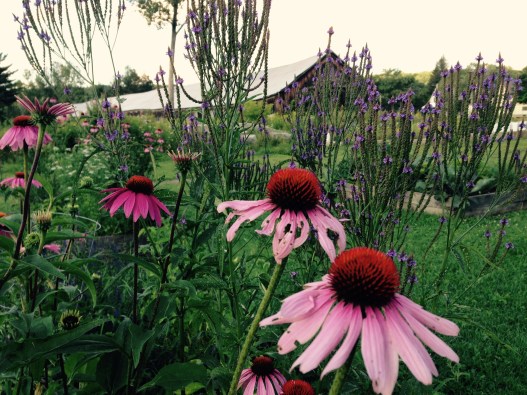
Hardwick, Vermont, community garden

Spring Notes

Emptying boxes of recycling at the transfer station, I found a drawing of my daughter’s making, from a few years ago. In a shallow sea of mud, surrounded by the mighty clangor of trash-moving activity, seagulls pinwheeling overhead, I studied her bright creation, laid it carefully on the passenger seat, and returned it to our living room wall.

Flowers? More, please.

Nothing is so beautiful as spring –
When weeds, in wheels, shoot long and lovely and lush….

What is all this juice and all this joy?

– Gerard Manley Hopkins

FullSizeRender

Dirty Shoes

We’ve officially entered into the season of increasing darkness – not merely politically but because of the planet’s tilt. My teenager, home early from school, slouches at the kitchen table and moans about the gray. I advise her to head out for a run in the rain. She’ll return, pink-cheeked, and far more cheery, her running shoes smeared with greasy mud on their soles.

Post-election, all these words have surfaced again, the same ones Vermonters use over and over – community, persistence, hope – words that are distressingly meaningless without tangible action. How do our footprints mark our paths? For my daughter who will mature to adulthood under a new administration, I’m going to keep advising her to muddy your feet, girl. In my garden, the johnny-ups are yet blooming amongst the weeds.

I’ve been reading Scholastique Mukasonga’s Cockroaches, her memoir of growing up in Rwanda, and that’s all I’m going to write about this slim, powerful book.

The ultimate measure of a man is not where he stands in moments of comfort and convenience, but where he stands at times of challenge and controversy.

– Martin Luther King, Jr.

fullsizerender

November color


The Town at Night

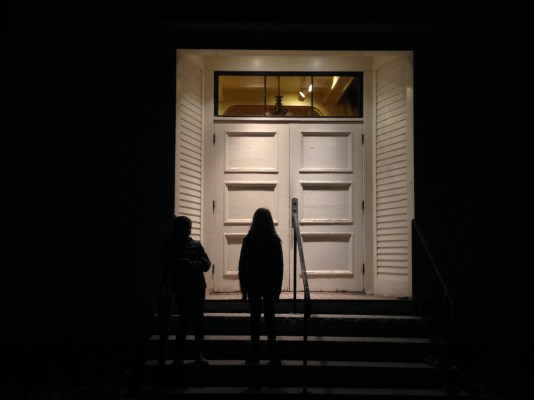
Driving through Hardwick, Vermont, last night, beneath a crescent moon, the 11-year-olds in the backseat playing a word game and clapping, the 17-year-old  dreaming thoughtfully at the wheel, I marveled at how good Hardwick looks in the dark, the handful of streets lit up, the Town House’s double doors open for a musical, foyer chandelier shining welcomingly.

Run-down Hardwick, with its perpetually empty storefronts, the town of two auto parts stores, five gas stations with cheap greasy food, one food co-0p with pricy produce, and one thrift store. Reservoir of cheap beer and highly-taxed cigarettes and way too many scratch-off tickets. A town of more well-heeled days, called theirs now by those who have moved in with plenty of money or education or both, while those who have lived here for generations frequently are scant on both.

I left the Town House before the finale, standing outside in the cold. Freakishly, a structural fire burned behind the Town House, bright flames turning billowing smoke and steam bright red, split through with blue police lights. The cold gnawed at my feet. Overhead, clusters of stars and that curl of moon pushed through the streetlights and hazy atmosphere. From the closed doors, I heard a girl’s clear song, her voice graceful as a heron in flight, slowly winging its way through the sky.

Oh, there’s nothing wrong with the children. Only the governesses.

The Sound of Music, 1965

img_2723

Hardwick, Vermont