“… the now of us…

The incomparable Mary Elder Jacobsen reads her poetry at Elmore State Park. A sultry August morning, I come alone, friends off doing one summer thing or another. Mary reads in the beach house with the doors and windows open, a breeze carrying in the lake’s lapping and children’s laughter.

Afterwards, because I’m there, I hike the mountain. My family and I have hiked this mountain many times, but I haven’t been here in a few years. Last summer, I was walking—short stretches at first, then longer—gaining strength from the trifecta of cancer and chemo and surgery, gaining strength week by week. This summer, I’ve pulled out my hiking boots, pushing. How far will my strength return?

The rocky outcropping is familiar, a bit more brushy, but the cement footings of a vanished cabin are as I remember, with purple asters and wild roses. A sweltering, sweaty day that recalls my New Hampshire childhood, the countless hikes with my dad. A couple arrives, and we talk about the lake below, the view of the forest and hayfield landscape. We share apples, handfuls of crackers, stories.

The story I don’t share is the January evening I parked at the lake’s edge and walked out on the ice beneath the piercing stars. I was on my way from a late meeting to pick up my daughter at a friend’s house, and I’d allotted myself exactly ten minutes. The cold came at me like arrows. Across the lake, the ice cracked like a shot in the fierce temperature. And the constellations? Ancient and present and promising a future…. Now, years later, in moist August scented with those roses…. This day bears no thinking of time. August, in her tumbling abundance.

That January night, my daughter was waiting for me, wanting home. We’d been gone for hours and hours, since early morning, and the wood stove had gone cold, our house inhospitable. Rushing — I was always rushing in those days — I kindled the fire, boiled boxed macaroni and cheese, carried in more wood. We ate in front of the crackling wood stove, sharing our days. All the seasons of a life. Now, this August afternoon, damselflies flicker.

Hours later, I swim in my favorite pond. A friend and I swap stories and books, crackers, tomatoes, cheese. A stranger swims, too, and the stories widen. In a pouring rainstorm, I drive home, then stand under my covered porch and lean against my dear house, drenched from swimming and rain. The earth drinks deeply.

Because, whatever Science says about some equal future moon, 
I know the rare particulars of this vast and intimate brilliance— 
the now of us—won’t ever, in our lifetime, come my way again. ~ Mary Elder Jacobsen

Our World for this Moment.

In the Heidi book that I read over and over as a girl, Heidi’s invalid friend Clara visits the Swiss Mountains and becomes healed. These days, hiking in the New Mexico mountains, I keep thinking of this child’s book. In the high desert country, hiking through an aspen forest, I forget I’m in recovery, forget that scar on my abdomen, forget everything but the breeze against my cheeks, the desert sand and stone beneath my soles.

This is a family trip to see my aging father, with all the sweet and bittersweetness of family. Here’s hoping all of you are enjoying July wherever you might be. For me, too, these trips make the journey home happy.

“If you take a flower in your hand and really look at it, it’s your world for a moment.”
― Georgia O’Keefe

Mad World, Abundant Wildflowers.

For no particular reason, I walk on the path along the river which leads to the road where I once lived. In the meadows and beside the trail, the wildflowers blossom abundantly: yellow toadflax and pink asters, bluets and Black-eyed Susans, cinquefoil.

I dawdle at the dirt road. At a turnout, long ago I had a carpool meeting spot. Over the years, my daughters and I passed hours there. In the afternoons, I lingered with my friend, the girls lingered with their friends. The girls played in a brook. The fields have been used for hay, vegetables, seeds, THC. In the past few years, the flooding river dumped sand in these acres. Burdock and thistle claim this terrain now. These fields are for sale again.

A few pickups zoom by. When my ex and I were splitting up, we’d meet here, too. I’d run down the mountain road and leave the girls at home, baking cookies or riding bikes. In my then-husband’s truck, we’d argue about our lives. That autumn as an early dusk washed in, I leaned my head against the truck window and watched two coyotes running across the field. He kept talking and talking and I kept thinking about our daughters who would be hungry for dinner. Someone else lives in that house now. Our lives have long ago moved on.

A friend pulls up, and I get in her car. We talk about kids and aging parents, about money and oranges. The world around us is falling apart. What we see now might be just the cracks of a shifting society. Yet, our lives spin on. My friend and I keep talking and talking. Children grow up. The fields’ bounty changes. I no longer live a few stones’ throws down an empty road from this friend, but how I love her.

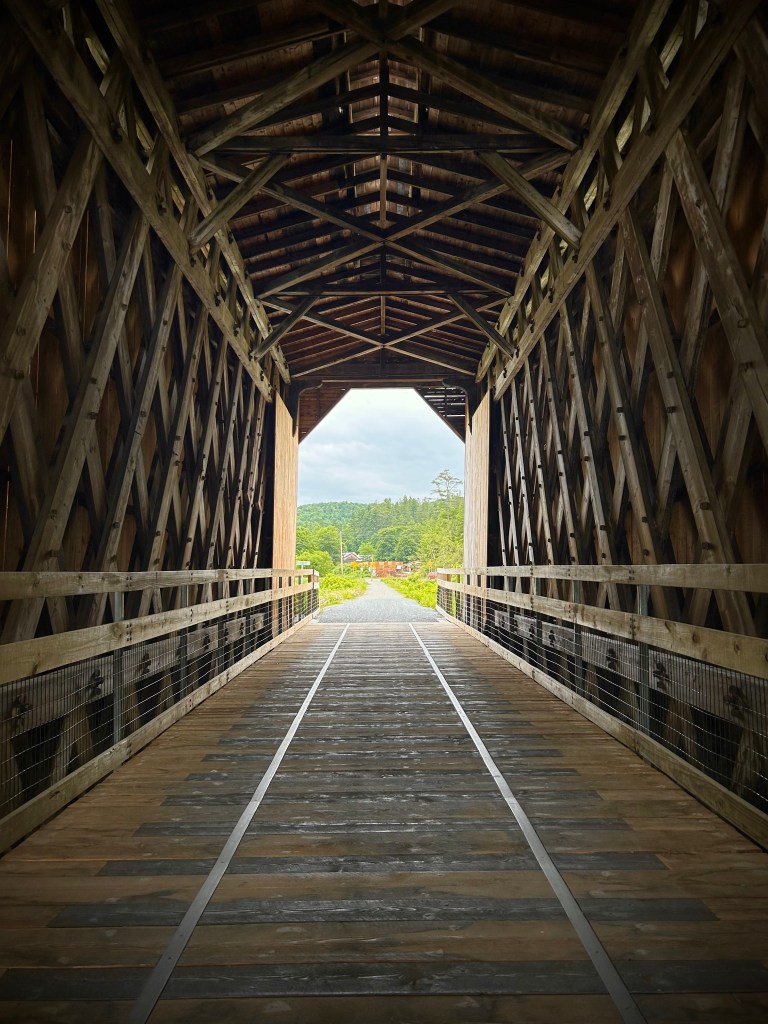
I walk back slowly on that trail, under the cool shading trees. Chicory, knapweed, Canada lily. In the covered railroad bridge, I pause in its interior dimness, light at either end. There’s no one around at all. I soak it in.

The heart’s actions
are neither the sentence nor its reprieve. 

Salt hay and thistles, above the cold granite. 
One bird singing back to another because it can’t not.

~ Jane Hirshfield

Myself, the Householder.

Furious, long before four this morning I’m at my desk with coffee and manuscript and my needy cat who must have his nose rubbed. A few months ago I asked a neighbor to knock off his cash carpentry payments to my ex-husband, a father who’s never made a child support payment. The neighbor brusquely told me I didn’t understand the complexity of the situation and walked out.

Now, he’s sent word that I made him and his wife feel unsafe. Oh Lord…. me and my 4’9″ stature and my insistence that I do know the complexity of my story and my uncomfortable female rage. I’ve doubtlessly repeated this, but his is a Kafka-esque flip of the word unsafe. And since when are other people’s children negligible?

I’ve been here before — like too many others, as this is hardly my unique problem — and I do what seems sensible to me. I tell no one where I’m headed and hike through the forest and up along a ridgeline. The hike cools my head. I discover white trilliums and wash my face in a low-running stream. The woods are hurting for rain, thirsty, thirsty.

I left with a question — what will I do? — and returned with my answer. Out of chaos, always, springs the pulsing might of creativity. At home, I hole up with Joanna Biggs’ A Life of One’s Own: Nine Women Writers Begin Again, and Biggs points me to Toni Morrison. In the evening, I pull a few weeds from the lily-of-the-valley that guard my house’s foundation. Such a delicate, pure, tiny flower.

 Q. You don’t feel that these girls (of teenage mothers) will never know whether they could have been teachers, or whatever?

A: They can be teachers. They can be brain surgeons. We have to help them become brain surgeons. That’s my job. I want to take them all in my arms and say, “Your baby is beautiful and so are you and, honey, you can do it. And when you want to be a brain surgeon, call me — I will take care of your baby.” That’s the attitude you have to have about human life.

— Toni Morrison, Time Magazine

Which Way?

Midday, I walk along Caspian Lake’s edge. By now, the summer people have long since gone elsewhere, back to their own tangled lives. In no mood to see anyone and chat, I take the woods path. I know my way well enough now — all these little wanders — that I know where to turn and hide when I hear voices through the woods. The day is clear, the water so transparent I can almost imagine swimming across its blue surface.

I’m so caught up in my mind’s little narrative that when I cross out of the trees and into a meadow I nearly step into a woman walking her dog. We nod and exchange little greetings about nice day and who knew November could be so pleasant? Her golden retriever rubs my knee. I crouch down and let her dog touch the palm of my hands with her nose. There’s nothing more between the stranger and me but this: the dog, the wet nose, the creature hungry to know me.

November is the beaver moon, sunlight falling through bare branches, and the question of winter: which way will this go?

Upon a withered branch
A crow has stopped this
Autumn evening

— Bashō

Brief Interlude.

17 years ago, I was at the end of my second pregnancy. The apple blossoms hadn’t bloomed yet. The month of May had been especially rainy and cold.

My second child was born via caesarian. The morning she was born, I walked down to our sugarhouse and closed the front doors we had left open the night before. My oldest daughter who was six was eating breakfast at the house with her father. She was wild with excitement. Baby sister? Baby brother? What was going to happen?

Rain had fallen the night before, and the path to the sugarhouse was slick. I was huge, an unwieldy ball of a woman who was so ready to finish this pregnancy and meet this baby. I had waited years to have this second child. It was early in the morning, and friends were already on their way to meet us at the hospital. I lingered in the open front doors, breathing in the scent of mud and that particular sweetness of new leaves. We’re always leaving and arriving, aren’t we, in this transient life. This year, the lilacs have already faded, the earliest I remember.

I stood there just a few moments before I locked the door and took the longer path back to the house. My six-year-old was in the driveway looking for me. Ready.