Living in the Edge.

As part of my heal-from-cancer and keep-the-cancer-from-returning approach, I borrow my daughter’s yoga map on Thursday mornings and walk through the cemetery and along Little League field to the village. The studio is above the town’s coffee shop. The windows frame the town’s main intersection of routes 14 and 15, the Lamoille River, flanked by July’s burgeoning green.

As I lie on the polished maple floor, the sound of the traffic comes and goes. This calmness reminds me of those years I lived in Brattleboro, pre-internet, when the main source of my twenties’ activities was walking to the public library or a favorite bar, hiking, or hanging out with my roommates in the house we rented, running our mouths about the state of the world. There was a lot of laughter, a whole lot of discussion about morals and relativity.

This particular Thursday is the anniversary of the floods in 2023 and 2024, exactly a year apart. The class leader repeats a theme of in the edge, that fertile and sticky place between terrains. I think of this summer’s profuse wildflowers – trefoil and asters and Canada lilies – that spread between the river and the fields. Afterwards, I spread out my notebooks and papers and laptop in the coffee shop, plunge into a hard piece of work. I’ve no illusions that yoga will set me floating down any peaceful river. The edge, that complicated habitat, has long been my domain. Friends appear and tell me they’ve sold their house, are pulling up stakes and heading overseas. Around me, people come and go, talking and eating, figuring out or not figuring out parts of their lives.

Later, at home, the catbirds screech. A robin perches on the porch railing and studies me. The woodchucks scurry under the steps from den to woodpile, or have they slowed to a who-gives-a-damn saunter?

Winter, the edge terrain is a cold beast. July, I’m all in…

“Not so much a game
as a sphere,
a mystery.
Held up to light,
a small hole
into another dimension.” ~ Ruth Stone

A sense of urgency…

My youngest and I are watching a track-and-field race in the Olympics when a commentator remarks that a runner needs to up her sense of urgency to medal. In the humid night, the fan whirring through the crickets’ amped-up August songs, I keep riffing on the sense of urgency… My god, what does that actually mean?

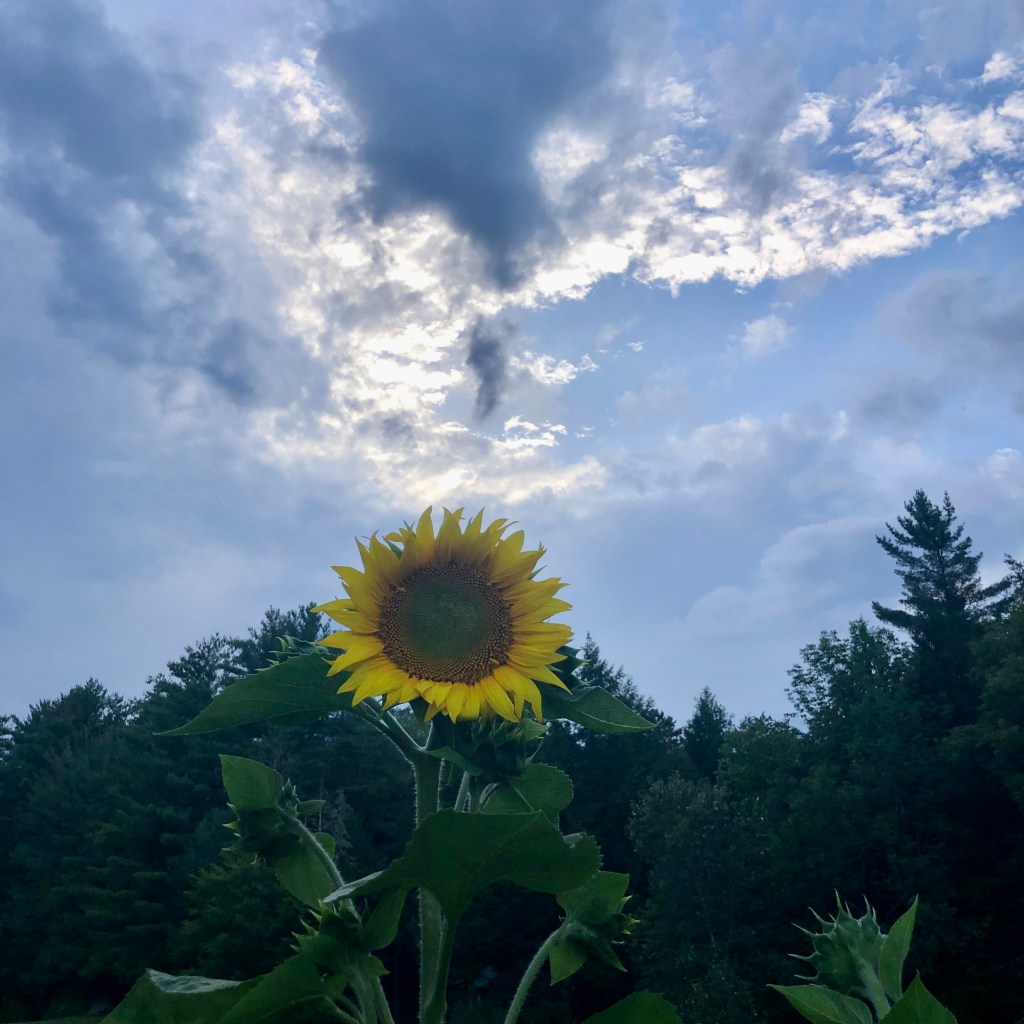
Early August, and I always remember Hayden Carruth’s poem “August 1,” its line: The world is a/complex fatigue. Which perhaps sums up these days, so humid the yellow coreopsis flowers gleam, the cats sprawl on the kitchen floor, hungry for coolness. This summer has been fat with growth, the butternut and walnut trees I planted seven years ago spreading into their own canopy, already offering shade for me to lie beneath, as I read in the late afternoons.

Someday, perhaps, I’ll look back at this year as it’s own of kind of waiting — which way will this world tip? Even as I’m busy, busy with my urgency of work and gardening, my perpetual lists, of finish these three projects and then paint the back of the house, the outside world burrows in. Some of this is our own story, as my daughter heads back to college soon, but some are my own observations — the two battered cars crammed along the riverbank from the last flood, the perpetual national dialogue — and my wondering, which way might this go?

Urgency, raw want. At the farmers market, I see my daughters’ father across the field, appeared again from wherever he’s hidden. I hold a hot cardboard box of dumplings while the market crowd swirls around me. I turn to talk with a friend and when I look back again, he’s disappeared. Meanwhile, dumplings and curry in my hands: the urgency of eating, the words and life we’ll share over this savory meal, this evening, these moments.

August First

Late night on the porch, thinking

of old poems. Another day’s

work, another evening’s,

done. A large moth, probably

Catocala, batters the screen,

but lazily, its strength spent,

its wings tattered. It perches

trembling on the sill. The sky

is hot dark summer, neither

moon nor stars, air unstirring,

darkness complete; and the brook

sounds low, a discourse fumbling

among obstinate stones. I

remember a poem I wrote 

years ago when my wife and

I had been married twenty-

two days, an exuberant

poem of love, death, the white

snow, personal purity. now

I look without seeing at

a geranium on the sill;

and, still full of day and evening,

of what to do for money,

I wonder what became of

purity. The world is a 

complex fatigue. The moth tries

once more, wavering desperately

up the screen, beating, insane,

behind the geranium. It is an

immense geranium,

the biggest I’ve ever seen,

with a stem like a small tree

branching, so that the two thick arms

rise against the blackness of

this summer sky, and hold up

ten blossom clusters, bright bursts

of color. What is it — coral,

mallow? Isn’t there a color

called “geranium”? No matter.

They are clusters of richness

held against the night in quiet

exultation, five on each branch,

upraised. I bought it myself

and gave it to my young wife

years ago, in a plastic cup

with a 19cent seedling

from the supermarket, now

so thick, leathery-stemmed,

and bountiful with blossom.

The moth rests again, clinging.

The brook talks. The night listens.

August: Complex Fatigue

On this August evening, a sparrow flies out of the wild raspberries along my walk and startles me just the slightest. Stunned a little from its flight through the leaves and small prickles, the sparrow fumbles from foot to foot on the path and then rises up on its wings and disappears. The swifts are out, too.

A downpour has fallen and the humidity has thickened right up again. I walk through the village, and folks are hanging out on porches. A three-quarters moon hangs over the empty high school soccer field, stunning. I’d write that it’s otherworldly in its beauty — but in this slow, sticky night it’s hard to imagine a sweeter world, even this one chockfull with chaos.

In the heat, tempers are either short or silly. Tomorrow is Vermont’s primary, so much fervor, and I wonder what all that might come to. In the evening, I talk to my cat, a tête-à-tête about why he cowers at the slightest noise, as if the house might be under attack by coyotes. You’re a housecat, I remind him, one of the most pampered creatures on the planet. He looks at me, poor ignorant thing that I am, and wisely keeps his ears pressed down and low like a spooked owl.

August. Time to share again one of the loveliest poems.

The world is a 

complex fatigue. The moth tries

once more, wavering desperately

up the screen, beating, insane,

behind the geranium. It is an

immense geranium,

the biggest I’ve ever seen,

with a stem like a small tree

branching, so that the two thick arms

rise against the blackness of

this summer sky, and hold up

ten blossom clusters, bright bursts

of color.

Hayden Carruth, “August First”

August Love

August is national picnicking month, I hear on the radio, in my crazy too-many hours of driving yesterday. I also catch an interview with a female comic whose voice reminds me I swear of all those August afternoons of picking blackberries. It’s not blackberry season yet, but soon will be. August often means the dirt roads have turned dusty.

First, I picked alone, then newly pregnant, then had a baby on my back, then all those years with a fat-wheeled hand-me-down stroller. Later, the children walked or biked. Our baby, on the back of her father’s bicycle, held out a hand and said blacks, blacks, hungry for the berries.

What to do with blackberries? Last August, the girls baked a tart with fresh peaches and blueberries, served it with maple-sweetened whipped cream.

That’s how good was this woman’s voice.

Home too late to swim, my daughter and I walk through the cemetery and down to the community gardens. Only the mist is out and a few women walking dogs.

August 1. We go to bed ridiculously early, because we get up ridiculously early. This morning, I open the windows to let in the gray dawn and its cut-grass scents. As a child, we camped nomadically, crawling out of the tent in the morning and discovering cold dew and trails of mist from the night. In the eternity of childhood, we were hungry for breakfast and whatever the day might bring.

Here’s Hayden Carruth’s August First poem, too good not to read again.

IMG_6183


Birthday Blessings

This afternoon, I stepped out of my library with a child to look at the sky. He was glad he had returned a stack of library books, a kind of clearing of his child conscience. In my clogs, I leaned against the building, a squall fattening in this valley, tucked up against Woodbury Mountain. What a winter this has been. Snowbanks dominate Hardwick like a pop-up mountain range.

Later, a friend and I leafed through a Vermont guide to wildflowers. Remember spring beauties? Remember trilliums?

Early March is my father’s birthday and, two days later, my mother’s. In their  80s now — old but not very old, not even close to very old — my parents who lived through WWII, the Vietnam War, Nixon’s resignation, and the eternity of the Reagan-Bush regime, through having careers and raising children, teaching and writing books and caring for the infirm and the dying, through decades of friends, through all the everydayness of living — and now through the particularly heartless regime of Trump — here’s Hayden Carruth’s birthday poem for love of a woman and love of living.

“Birthday Cake”

by Hayden Carruth

For breakfast I have eaten the last of your birthday cake that you
had left uneaten for five days
and would have left five more before throwing it away.
It is early March now. The winter of illness
is ending. Across the valley
patches of remaining snow make patterns among the hill farms,
among fields and knolls and woodlots,
like forms in a painting, as sure and significant as forms
in a painting. The cake was stale.
But I like stale cake, I even prefer it, which you don’t
understand, as I don’t understand how you can open
a new box of cereal when the old one is still unfinished.
So many differences. You a woman, I a man,
you still young at forty-two and I growing old at seventy.
Yet how much we love one another.
It seems a miracle. Not mystical, nothing occult,
just the ordinary improbability that occurs
over and over, the stupendousness
of life. Out on the highway on the pavement wet
with snow-melt, cars go whistling past.
And our poetry, yours short-lined and sounding
beautifully vulgar and bluesy
in your woman’s bitterness, and mine almost
anything, unpredictable, though people say
too ready a harkening back
to the useless expressiveness and ardor of another
era. But how lovely it was, that time
in my restless memory.
This is the season of mud and thrash, broken limbs and crushed briers
from the winter storms, wetness and rust,
the season of differences, articulable differences that signify
deeper and inarticulable and almost paleolithic
perplexities in our lives, and still
we love one another. We love this house
and this hillside by the highway in upstate New York.
I am too old to write love songs now. I no longer
assert that I love you, but that you love me,
confident in my amazement. The spring
will come soon. We will have more birthdays
with cakes and wine. This valley
will be full of flowers and birds.
IMG_4848.jpg

Reprieve

At the hardware store in town, the woman ringing up my chicken feed asks if I’m going out partying for New Year’s Eve.

Are you kidding me? I blurt out. Then I apologize and ask about her plans. I like these hardware store folks, with their humor, their can-do willingness to solve my piddling problems — a clogged bathtub drain, a stuck lamp switch.

The cold’s broken for December’s last day. Before dusk, I follow the raccoon tracks from my compost down the snow-crusty hillside, wondering where this creature lives.

Another of my daughter’s homemade calendars folded up and put away, the day-to-day record of our lives — work schedules and friends and dentist appointments — the stuff of our lives.

For this year? Stay solvent. Paint the kitchen gold, my bedroom turquoise. Swim in the Atlantic with my kids. Follow wild tracks and fill the creative well.

Why speak of the use
of poetry? Poetry
is what uses us.

— Hayden Carruth


IMG_4331