Travels.

Driving down the heart of Vermont today, I hear an ecologist on public radio explaining how trapping beavers altered our landscape. Something that seems so simple and petty — a craze for beaver hats — changed the flow of water, the flora and fauna, and human transportation, too. As a kid, we made tiny birch bark canoes in grade school. Birch bark canoes were once a kind of Volkswagen for people who lived in Vermont. Serious water flowed over this landscape then.

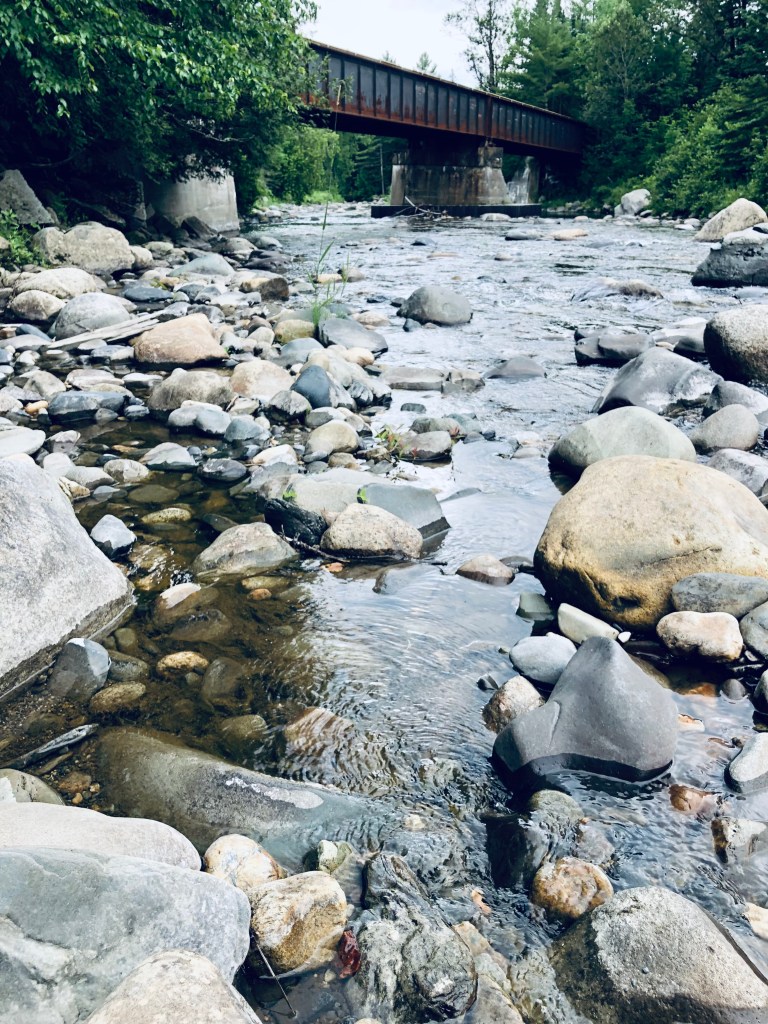
I drive along the Connecticut River. Eventually, I just pull over and admire where I am. So much green. Such an infinity of shades, and all that water, flowing steadily to the sea.

Our world smells of lilac these sweet days.

I’m parked near an abandoned brick mill, in a town that has seen more vibrant days. The temperature may hit 90 this weekend — in May! in Vermont! — and no one in a rational frame of mind can claim this is right.

But yet….. here I am by the side of this great river, the mountains rising on the other side, the leaves leafing out in summer beauty. I’m in a shifting place in my own tiny life, my youngest nearly grown. Which way this will go, I have no idea, but I’m here, breathing in the humid lilac air, for this moment at least in no rush at all.

Lilacs in dooryards

Holding quiet conversations with an early moon;

Lilacs watching a deserted house

Settling sideways into the grass of an old road;

Lilacs, wind-beaten, staggering under a lopsided shock of bloom

Above a cellar dug into a hill.

You are everywhere

~ Amy Lowell

Stranger Aid.

Retreat Meadows, Brattleboro, Vermont

A stranger in the post office asks me if I can free her mail from her box. It’s a narrow box, nearly at the bottom of the wall. I crouch down, extracting envelope by envelope, taking care not to tear the paper. It’s clear she hasn’t collected her mail in some time. She waits patiently while I tug with some effort. While I hand up envelopes and fliers and magazines, I talk and talk, rambling on about the mail and whatever inane thing drifts into my mind. Around us, people open their boxes, collect their stuff, and disappear. I keep at my project, now kneeling. Finished, I shut her box door.

She thanks me, and we go our separate ways. Walking home, I keep thinking about that simple thing, how easy it is to give to a stranger. There’s likely an obvious lesson here. But one thing is clear, I got as much from the mail extraction as this woman.

… A cold and soggy April. Miniature daffodils push up through black soil. I keep feeding my wood stove.

Appetite.

Before it’s warm enough, I open the open to our glassed in porch. This porch (nor its upstairs counterpart) isn’t heated. In Vermont’s long winters, we simply close the door and leave the space be. I think of this as a standard New England practice. I store empty canning jars, summer flip-flops, things like old blankets I don’t really want any longer, but nor do I want to cast away.

All day long, doves and cardinals, juncos and chickadees and sparrows, dip and fly around our house. The crocuses struggle upward. I should be cleaning our house, I think, taking a broom to the cobwebby corners before the spring sets in mightily and I’m in the garden as much as possible, happy as I could ever be, the warming soil between my toes.

Now, snow falls intermittently. The robins dig into the earth hungrily.

Consider the tulip,

how it rises every spring

out of the same soil,

which is, of course,

not at all the same soil,

but new.

~ Rosemerry Wahtola Trommer

Ordinary Mystery.

The moon shines brilliantly tonight as I walk down the street to the co-op for cheese and cauliflower. Lady Moon: round as a dime and luminescent like no earthly thing.

In the best of times, January can rage like a shrieking stranger, a visitor who’s arrived with too many needs.

This year, time has slowed to incomprehensible. We wake; we do our things. Work and email. I paint a room. I endeavor to write another book. I keep Unstitched moving along.

The ordinary happens: snow falls. All day and into the night. When I wake in the morning, there’s inches and inches of fresh, sparkling snow. It’s not a blizzard, not feet upon feet. I have little trouble finding my Subaru in the morning. But the snow sugars our world for this day in utter beauty.

The rest of everything is still there — the pandemic, the crumbling American Empire, the chaos of human relationships in my house and all around — but walking home, the cold is so sharp that the snow squeaks beneath my boots. For a moment, I’m a child again, mystified that fluffy snow can yield a squeak. But there you go. A mystery incarnate.

Here’s an interesting essay emailed in by a reader about growing saffron in Vermont — yes, saffron & Vermont.

A Little Meal

A 13-year-old or so boy is fishing at the edge of the pond when my friend and I walk down in the evening to swim. He nicely shuffles to one side, and then we’re off.

The evening sky this summer has been especially enchanting — muted in color, pale peach sky with gentle blue.When we’re finished swimming and laughing, we stand for a moment on the weedy shore, and I point out a luna moth dipping and rising — part of the evening charm, like an Impressionist painting. Suddenly, a bird pursues the moth, then swallows it. A ragged wing falls.

And so much for the make-believe world.

Poem for America.

I was pruning the rose bushes along our house, pressed up against the clapboards, when I had the strangest feeling that I had stepped into a snapshot collage of my life: thorn, blood, house, half-hidden, wet moss under my knees, a cat bird screeching in the lilacs. This morning, I’m wearing a bulky sweater. Oh, Vermont July, how I love you.

Every year, my daughters and I end up in some lengthy discussion about the Fourth of July. This year, as if jointly agreeing to avoid words, we ate ice cream and lit sparklers after dark. The fireflies blinked, in their own particular journeys.

Here’s a poem in its entirety from Tony Hoagland’s Twenty Poems That Could Save America:

Even if the geraniums are artificial

Just the same,

In the rear of the Italian café

Under the nimbus of electric light

They are red; no less red

For how they were made. Above

The mirror and the napkins

In the little white pots . . .

. . . In the semi-clean café

Where they have good

Lasagna . . . The red is a wonderful joy

Really, and so are the people

Who like and ignore it. In this place

They also have good bread.”

“The Geraniums” by Genevieve Taggard

Hardwick, Vermont