Hopeful Strings

In the night, the cold moves in. The evening before, returning after work in Vermont’s “big city” of Burlington, the frogs chirped, and the air, drenched with a heavy rain, was suffused with the hummus-y scent of soil and leaves beginning to turn and rot.

This morning, the crescent moon shimmers.

Against the noise of the news these past few weeks, as I’m feeding the cats, I think of Leslie Schwartz, in Los Angeles County Jail, tenderly nourishing tiny sprouts from apple seeds, the slenderest of life, nonetheless growing within concrete.

So I fell in love with the apple sprouts the way one might a newborn.

— Leslie Schwartz, The Lost Chapters: Reclaiming My Life, One Book at a Time

IMG_3533


Vermont Dawn

It’s autumn here. Better — Vermont autumn — a landscape hordes of people drive and fly hundreds, thousands, of miles to see.

Because the world is dying down, my prolific garden beginning to crumple, autumn always seems to me the season of memory.

A memory of pulling beets and carrots in an enormous garden while my friend’s husband lay in the house, dying of skin cancer. More happily: a memory of my older daughter’s first Halloween costume, a piece of a sheet I cobbled into a baby ghost costume.

Tricia Tierney directed me to Leslie Schwartz’s The Lost Chapters: Reclaiming My Life One Book at a Time. Late nights, I lay awake reading, thinking how glad I am not to be jail. Early one cold morning, I pull on my down jacket, a beautiful turquoise hand-me-down, now worn thin and stained at the cuffs, and follow the path behind my house, disappearing into the darkness and walking all through the sunrise, the ebony sky streaked through with endless ribbons of luminescent pink.

Schwartz writes, “Writing is survival.” Surely creative work of any kind carries us along. Like the Vermont landscape I live in, creativity has its cycles, too, my garden’s sunflowers shedding their golden petals, bending down for winter’s dormancy.

IMG_3553

Fat Garden

A monarch butterfly followed me to the post office. Since the store closed last year, the village is quiet — only a garage and the post office remain open, and the post office keeps merely afternoon hours. Save for the elementary school, the town feels emptied out.

With no one around, I walked with the butterfly along the dirt road, until the winged beauty turned and fluttered over the weeds along the stream.

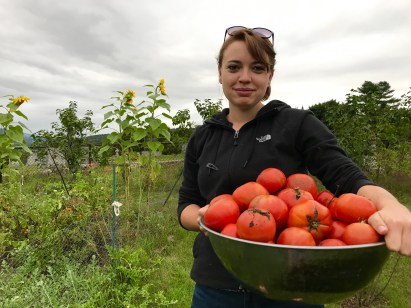
September: with the weather still warm, the frogs sang last night. Just before dusk, the girls and I picked a mountain — and then a mountain more — of tomatoes from the garden. More to put up. The younger daughter keeps track, satisfied, with our harvest.

IMG_3348

Gold, On a Rainy September Morning

Good lord, what a mystery this single sunflower holds — and how my creative attempts pale in comparison. This photo is a mere image — the beauty itself fell from a 10′ stalk, pecked where head joined stalk by birds. I picked it up from the grass and carried it into the house into both hands.

I first planted sunflowers many years ago, when I was a very young woman, after I admired a single enormous sunflower in a woman’s garden. The face of the sunflower was so heavy it hung down. I stood beneath this great bloom of pure gold, staring up. That sunflower’s size and beauty was improbable. How, from a single seed, from soil and water and light, did such a beauty emerge?

And yet, evidence to the contrary.

What a forest of sunflowers this year. Weeding in the garden, I hear the leaves rustling in the wind, like a canopy in a forest.

I don’t think there is any other solution than constantly coming to terms with the past, and learning from it.

—  Simon Wiesenthal, The Sunflower: On the Possibilities and Limits of Forgiveness

IMG_3315

To water or not to water?

The Vermont gardener question.

With my sandy soil, I’m watering — a showery hymn to growth.

One of the hottest and driest places I’ve ever been is Utah’s Hovenweep. A few years ago, my daughters and I spent one eternally long August afternoon beneath an aluminum picnic shelter, watching the sky. Thunderheads moved majestically slowly, then veered away, taking their rain — if they ever shed it — elsewhere.

Here in Vermont, we’re hardly parched. And yet, water, water…..

The work of the world is common as mud.
Botched, it smears the hands, crumbles to dust…
Hopi vases that held corn, are put in museums
but you know they were made to be used.
The pitcher cries for water to carry
and a person for work that is real.

— Marge Piercy, “To Be of Use

IMG_2281.jpg

Lady Lupine

Here’s a line from a children’s picture book — my younger daughter’s favorite — You must do something to make the world more beautiful.

Last evening, I overhead the girls planning to spread lupine seeds gleaned from the flowers blooming before our house. Maybe that thousand and one readings of Miss Rumphius sowed deep, or maybe spreading these blossoms is just instinctual, part of being alive.

IMG_5432

Photo by Molly S.