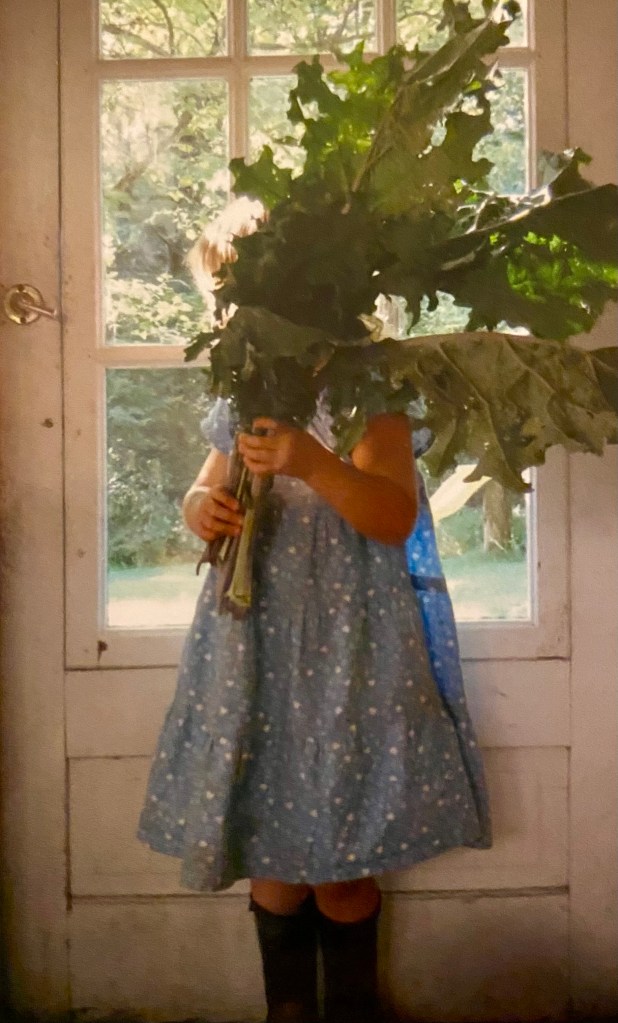
Hand-me-down mud boots.

These few days I’ve spent in New Mexico, my mother is a constant presence and absence. She’s powerfully here, in her sunny kitchen or in the stacks of empty flower pots in the garage. Yet, she’s vanished, too. All night, the desert breathes into this house, sage-sweet wind and coyotes barking and the robin songs here, too, like in my Vermont world. These days, the skies have been layered with lightening and sooty storms, golden sun, the blowing gritty sand that scours my skin to softness.

The world far beyond my small family’s sorrows teeters towards deceit and collapse. There’s no inoculation against any spiritual ailment, really. Measles, sure, but never the terrifying largeness of grief or rage, or losing safety or love. Which leads me back to the photo above, my little daughter as she was at our kitchen door, in her hand-me-down mud boots and a handmade cotton dress, carrying stalks of garden-cut kale. A reminder never to sentimentalize or diminish the rugged and real lives we live.

A Pretty Song

From the complications of loving you
I think there is no end or return.
No answer, no coming out of it.

Which is the only way to love, isn’t it?
This isn’t a playground, this is
earth, our heaven, for a while.

Therefore I have given precedence
to all my sudden, sullen, dark moods
that hold you in the center of my world.

And I say to my body: grow thinner still.
And I say to my fingers, type me a pretty song.
And I say to my heart: rave on.

— Mary Oliver

Growth.

In these days of long light, my daughter and I are drinking tea and talking on our glassed-in porch when she spies a fox walking along the lilacs that fence us from the road. The red fox, a real beauty, turns and looks at us.

June has been a season of the wild pushing in — the prolific groundhogs (and my thoughts will come to naught about this, but I’m wishing for a more even ratio of groundhog to fox, for my garden’s sake), the multiplicity of birds, raccoon and possum, the circling turkey vultures. This year, too, my garden grows half-wild, the amaranth reseeding around the Brussels sprouts, coreopsis sailing over the fence. One morning, I straighten and pause, brushing dirt from my fingers, when I spy a fox staring at me through the layers of hydrangea and pin cherry trees. For a time without borders, we hold each other’s gaze. What passes between us is a wordless language, with no clear question or agreement. Maybe simply curiosity.

There’s plenty of the human chatter around me these days, much of it rippling up in chaotic waves. But then, this, too. Last night, poetry at a rural arts center, with all the best things of Vermont June: wildflowers and the pleasure of company, the beauty of words stitched finely together.

…. Last, never least, here’s some words about the unsurpassable Vermont novelist Jeffrey Lent, in need of a little lift…

Child

How you’ve grown, child

of mine—pearl from my oyster,

you sparkle like snow. 

Mary Elder Jacobsen

“Everything blooming bows down in the rain…”

In the sultry dawn, I’m wandering barefoot in the garden, snatching the lingering strawberries before birds have nabbed the remainder. By late afternoon, thunderstorms have settled in. I’ve left a wooden chair on the porch, a throw rug over the railings, both sodden now. Book in my hand, I lean against our house’s dusty and pollen-layer clapboards, reading in the coolness that’s washed in. Our porch looks out over a bed of bleeding hearts, false Solomon’s seal, hostas. Beyond that, the cemetery, the river valley below. Behind our house, the wild presses in. Ferns tall as my shoulders, goldenseal, the groundhogs, thrush, chittering sparrows, the cut of ravine and the great life there.

Equinox; the lushness burgeons. Bring it on. The rain blows through the bedroom screens whose windows we left open all day. The box elder shoves between the porch railings. The grapes rise hungrily against the barn. All night our rooms are filled with moonbeams, the blowing dew, the mixture of milk trucks rattling down the road and the calling frogs.

Everything blooming bows down in the rain:

white irises, red peonies; and the poppies

with their black and secret centers

lie shattered on the lawn.

~Jane Kenyon

Seven years ago…

Seven years ago, my daughters and I moved from a rural hillside down to a village, about five miles away. I’d closed midweek, with plans to rally help for a Sunday move. The evening that I closed, two friends who had followed the jagged path of my divorce loaded up my car and their cars, and we carried in the first load of my family’s belongings.

It was heavenly June, warm without undue heat. I had no furniture. A friend had brought dinner, and we sat on the back deck, eating and talking. I wondered, which way would my story go? Last night, I remembered this first meal here, when a neighbor stopped by with cake and rhubarb sauce: how complicated life is and, sometimes, how very simple.

Now, in this beginning to a lush summer, I water my seedlings in these early mornings, listening to the birds and spring crickets, the drenching dew over my bare toes. The spinach is already wilting. The tithonia drooped dramatically, beginning for extra water. The blueberries have hard knots nestled among their leaves.

So much of life seems impossible — birth a baby, endure a divorce, survive a death, write a book, write another, pack up a house and move (bring the beloved tricycle, too) — and yet we do these things. We all do these things.

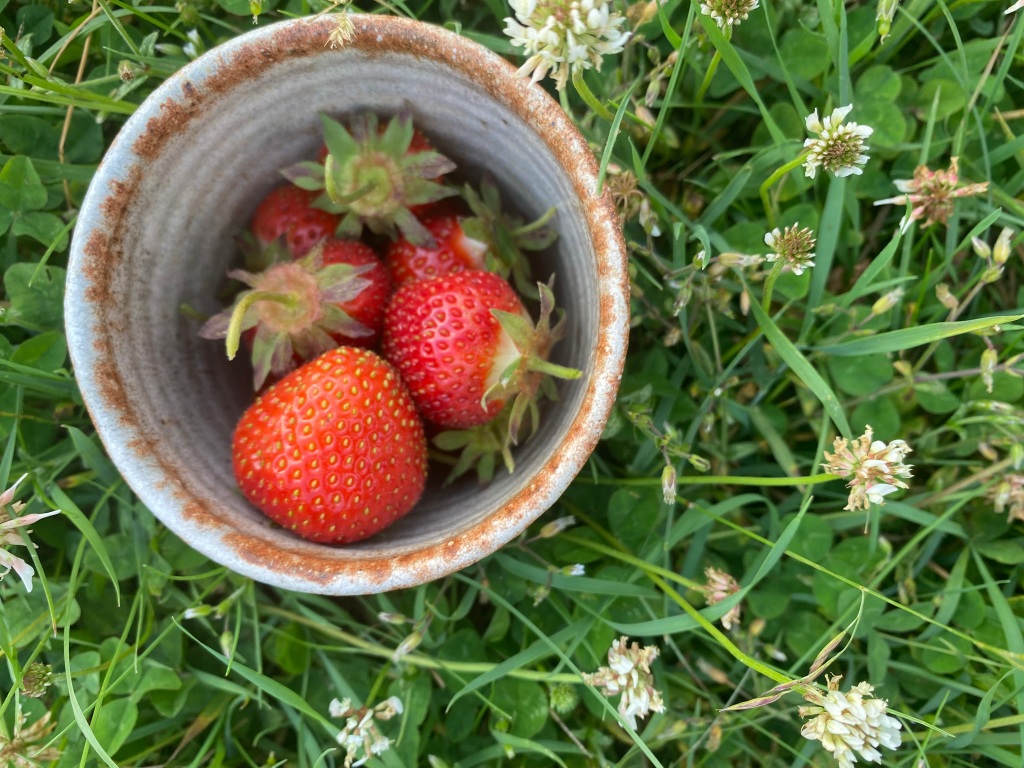
Seven years ago, would I have seen myself watering the sprouting green beans and listening to a woman on my neighbors’ porch sing the blues, the sky streaked with turquoise and crimson? I gathered a bowl of strawberries from plants I’ve let run rampart all through my garden beds. Messy, weedy. My youngest was given these plants when she weeded as an odd job in middle school. This year, the plants have given us so much sweetness.

Record temps are moving into Vermont, the world shifting rapidly. Around the globe and in my town, people are on the move. Which way will this story go? For a moment, I gather berries in the dewy morning. So much more day to come. But a steady start, my soles on the damp soil.

Don’t confuse hunger with greed.

At breakfast, I mention to my daughter that June 6, today, is D-Day. I’ll write what perhaps she would not want me to write: that she’s standing at the counter making avocado toast and drinking yesterday’s cold coffee. She pours sriracha over the cut avocado. She’s 19, and, lord, a sheer miracle of youth, this gorgeous young woman.

I say, The soldiers were your age. Younger.

We stand staring at each other in our small kitchen of June sunlight. On our table lies a pile of unopened mail, our tabby cat Acer grooming his whiskers, car keys and lip balm, a hunting knife that could extract a man’s heart.

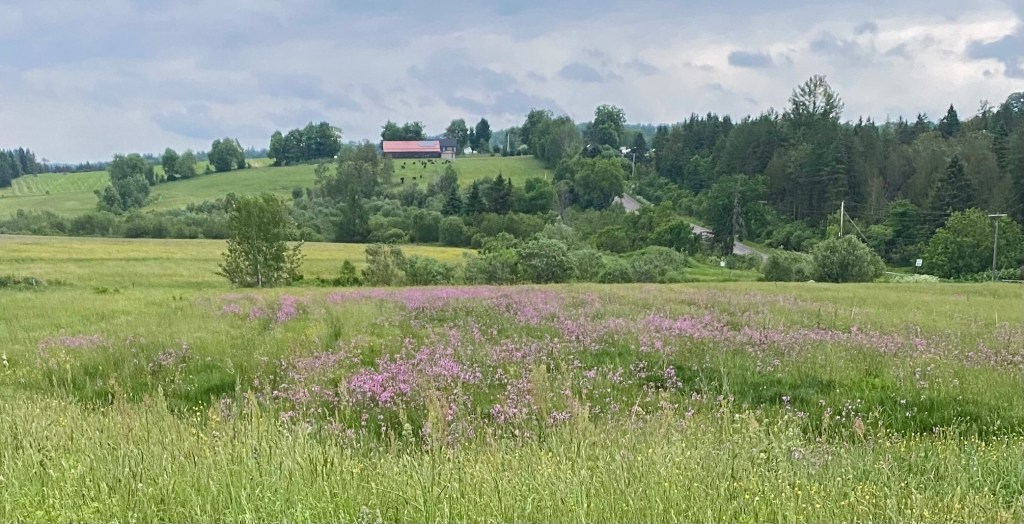
In the evening, I’m at the local arts center to see Nora Jacobson‘s documentary about poet Ruth Stone. The evening is still light when I drive home. I take the long way and pull over beside a field to admire the ragged robin, its pink spreading where the dandelions have gone to seed and green. In my Subaru, it’s me and that box of my mother’s ashes. I once knew a woman who kept her stepfather’s ashes for three years in a Datsun. Impossible, I thought. Now, I think, Sure, possible.

A day of such historical might, such profound sorrow. Yet, our own domestic dramas, the kitchen table stories: how real and meaningful these are, too. As a woman, as a writer, I’ve been thinking for weeks about Ruth Stone’s admonition: “Don’t confuse hunger with greed;/And don’t wait until you are dead.” In my garden, I grab a branch of lilac – the goregous white double blossoms, withering with rot – and breathe in the sweet fragrance.

There is only the wearing away,

The changing of means.

From Ruth Stone’s “Speculation”

Sips of May.

As the spring dusk settles down, I’m wandering around the edges of my garden. The lilacs have just begun opening, a tiny four-petaled blossom here, another there, the remainder of that lavender flower still knotted, not yet relaxed into the wide open spring season.

I’m in my ragged jeans, dirt under my nails, when my neighbor pulls into her driveway and gets out of her Prius. She’s wearing what she calls her rag-bag dress, and the two of us make a kind of pair. I’ve known her since our oldest kids were babes in arms, not yet eating smashed carrots.

It’s been a year for each of us — and I mean that: a year. We both have college-aged kids in and out of our houses. Under the fragrance of pear blossoms, we immediately head into that long-running conversation we have about her work and my work, about writing and art, about aging parents. The half moon rises over my apple tree.

May, in all her radiant beauty. Here I am, with a hundred chores in one day — a hot water heater repair, more writing, plant arugula and Brussel sprouts, my constant fiddling with the wood pile, the daughter chat. How this Vermont world loves to green. Yes, and again, more, yes, yes.