Your own darkness.

An old friend from years ago sends me a message. She’s persistent, wearing down through my imposed or self-imposed hermitage, whatever this thing is I’m doing, and I drive myself out on muddy roads. She has such a lovely little girl, I’m smitten immediately. I sit down on the floor and chat up the child, and eventually remember my good friend and how much I enjoy her world. She’s funny, with boundless good will and cleverness, in a life that’s had her share of lemons.

End of March, nearly Easter, my perennials spike up further every day. How the earth desires green. I’m far enough along now in my own life that I know the cupboard of my mortal life will always hold certain grooves and scars, its beaten shape, the way the material in my life has shaped me. Aren’t we all that way, though? Maybe this is why spring is the dearest of seasons, that from mud and ice emerge tender shoots, the improbable made manifest every year.

Beginning

The moon drops one or two feathers into the field.   
The dark wheat listens.
Be still.
Now.
There they are, the moon’s young, trying
Their wings.
Between trees, a slender woman lifts up the lovely shadow
Of her face, and now she steps into the air, now she is gone
Wholly, into the air.
I stand alone by an elder tree, I do not dare breathe
Or move.
I listen.
The wheat leans back toward its own darkness,
And I lean toward mine.

— James Wright

“Writing is about breaking down…”

A book of Knausgaard’s essays makes its way into my house. On a snowy day, the cats and I finish putting together my taxes, then read. The snow piles and drifts. The next day, the snow melts and melts, running in sun-sparkling rivulets. Readers either love Knausgaard or despise him, like readers understand Halldór Laxness, or don’t, much in the same way that I have never understood Jane Austen. When I began reading Knausgaard’s Struggle books, a neighbor read at my breakneck pace, loving his words. She and I have long since traveled our own different lives. But reading these essays reminds me of her, how profoundly she believed in beauty as a force. Whichever way she’s traveled, I wonder how that’s worked out for her.

Writing is about breaking down what you can do and what you’ve learned, something that would be inconceivable to a craftsman, a cabinetmaker, for instance, who can’t possibly start from scratch every time.

— Karl Ove Knausgaard

Are you for real?!

The other night, I’m leaving a meeting in the high school library devoted, more or less, to hashing out what community means (nothing to be solved in a few hours). In the parking lot, a woman says Goodbye, Brett — and quicksilver, I shout, Are you for real?!

As the other folks empty out of the school into the spitting snow, she and I talk beneath the ghostly streetlamp. Very quickly, it’s clear to me how utterly wrong I am about this woman. What I believed was true was not. I once ate chocolate covered strawberries in her house with my youngest daughter. The woman packed up a bowl of these delicacies for one sister to give to another.

In ten minutes, we are speaking animatedly of matters of our hearts. We’re both shivering by then in the damp snow. We hug and head to our homes.

I don’t know what’s happening in the rest of the country, and I surely can’t speak for anyone else, but how glad I am that I called out in anger. And how much more grateful I am that she took the time to listen to me, to lend me her shoulder, and I could do the same for her. Indeed: real.

A community… is the knowledge that people have of each other, their concern for each other, their trust in each other, the freedom with which they come and go among themselves.

— Wendell Berry

Pocket Treasures.

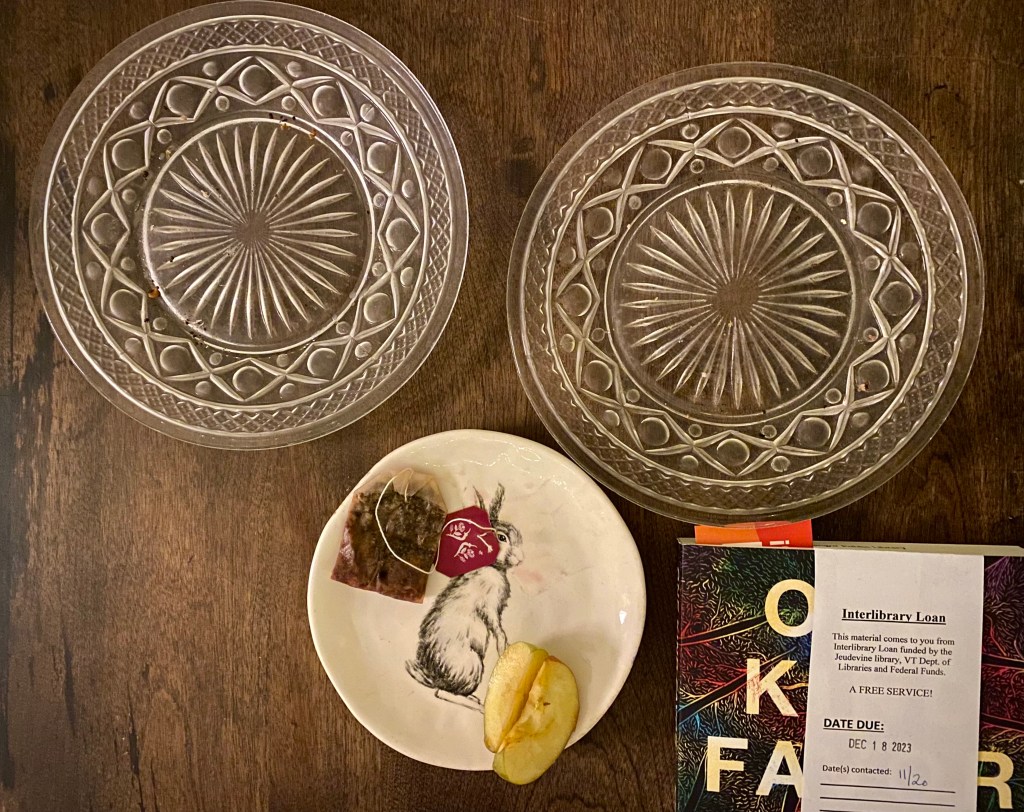
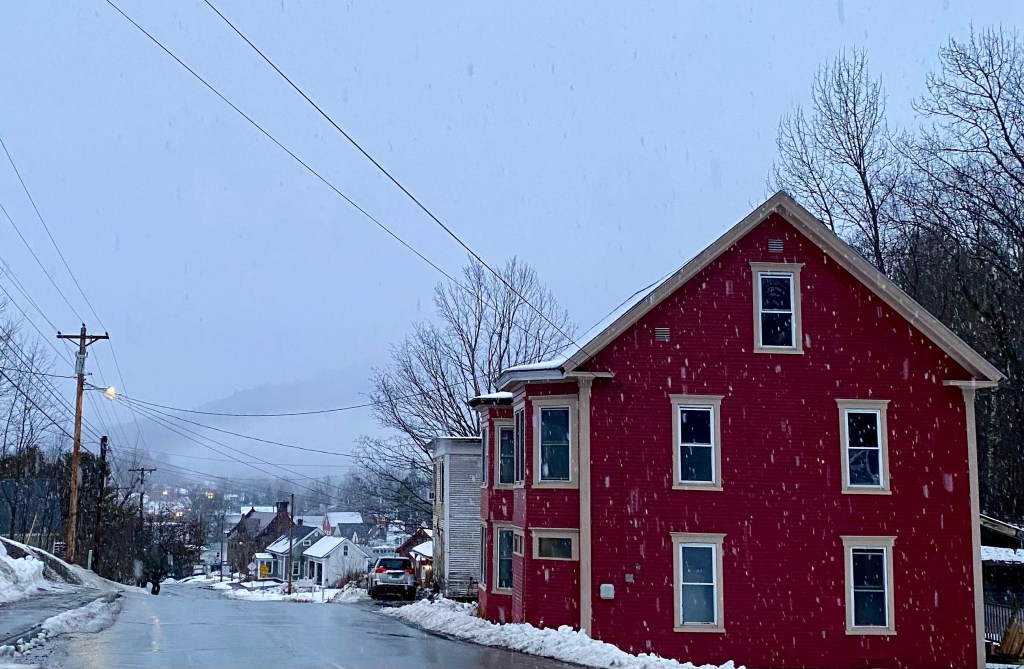
On this Sunday afternoon, my guest departs in the falling snow. When I head out for a walk, the cold has sunk in, deep enough that tendrils of snow cling to the grass and trees branches. The snow bends down last summer’s sunflowers in the garden. I leave my woodbox full, the cats sleeping, plates on the table. I intend only to return a handful of library books, but I head up the hill and around the high school and into the woods where the snow lies deeply and slows me down.

It’s December. Snow circles down, lovely and miraculous, this silent transformation.

Here’s a few lines for winter:

“Treasure what you find
already in your pocket, friend.”
― Ted Kooser

How to Reconcile Contradictions?

The November days end in early darkness. Late afternoon, I close my laptop, comfort the cats with a handful of kibble, and pull on my jacket. The village lights glow: the few restaurants, a garage, a laundromat, the library. When I’ve reach the high school, the darkness spreads ubiquitously through the town forest that spreads up the hillside. Nearly all my life I’ve lived in New England, and yet the profoundness of this late autumn darkness always amazes me.

Later, I’m in the neighbors’ house who need some aid. As we stand talking in the well-lit rooms, I feel the house around us, the century-old vessel of wood and nails, a metal roof. Around us, the wind stirs through the evergreens. I walk back in the dark, my head bent against the cold channeling through the valley. All night, wind howls, the inexorable thrust of our world into winter.

While I read on the floor beside the wood stove, the cats keep me company, thinking their feline thoughts. Eventually, I turn off the lamp, and we three beings watch the fire’s flames through the stove’s glass door. Encompassing us, this profound darkness I will never comprehend. In it, our hearts beat on.

Here’s a few lines from David Truer’s “The Americas They Left Me” I read last night, in The Best American Essays, 2023.

This country is a terrible country, and this country is not…. There is a great ugliness on the land and also a great beauty. This country would and will do its worst at the same time it embodies the most nurturing habits our civilization has to offer. There is no reconciling these contradictions; they cannot be reduced or done away with. I must, we must, find a way to contain both.

“Our stories from around here…”

I convince a friend to pull on her raincoat and meet me along the rail trail. The story this summer and fall has been rain, rain, more rain; the river runs high. Grabbing alders, we stumble along the edges, marvel that the two cars rammed deep into a bank have finally been removed. What remains is a sandy patch.

This amble is not conducive to talking: we toss bits of our lives between us as we struggle through the mud. Eventually, we make our way back to the trail. The bridge there is intact from July’s flood, but where the river rewrote its course the bridge hangs over the river, the bank jagged black earth. The rain falls hard now, streaming down my cheeks.

Vermonter Kenneth Cadow’s novel Gather (just named a finalist for the National Book Award) is fresh in my mind, a contemporary version of Huck Finn. Walking back in the rain that’s determined not to let up, my friend and I talk about growing up in New England: how powerful the autumn is, redolent with the scent of rotting leaves, the earth shaking off her pretty leaves, exposing the bones of mountains, rocks, the hungry rivers. Another friend sent word recently of this particular date’s power for him: the date his world shifted, spun from destruction to creation.

Walk finished, I’m grateful, ever so grateful, to return to my hot hearth, my wool sweater steaming, redolent of the sheep and grass that gave me these materials to knit….. and so it goes….

From Gather:

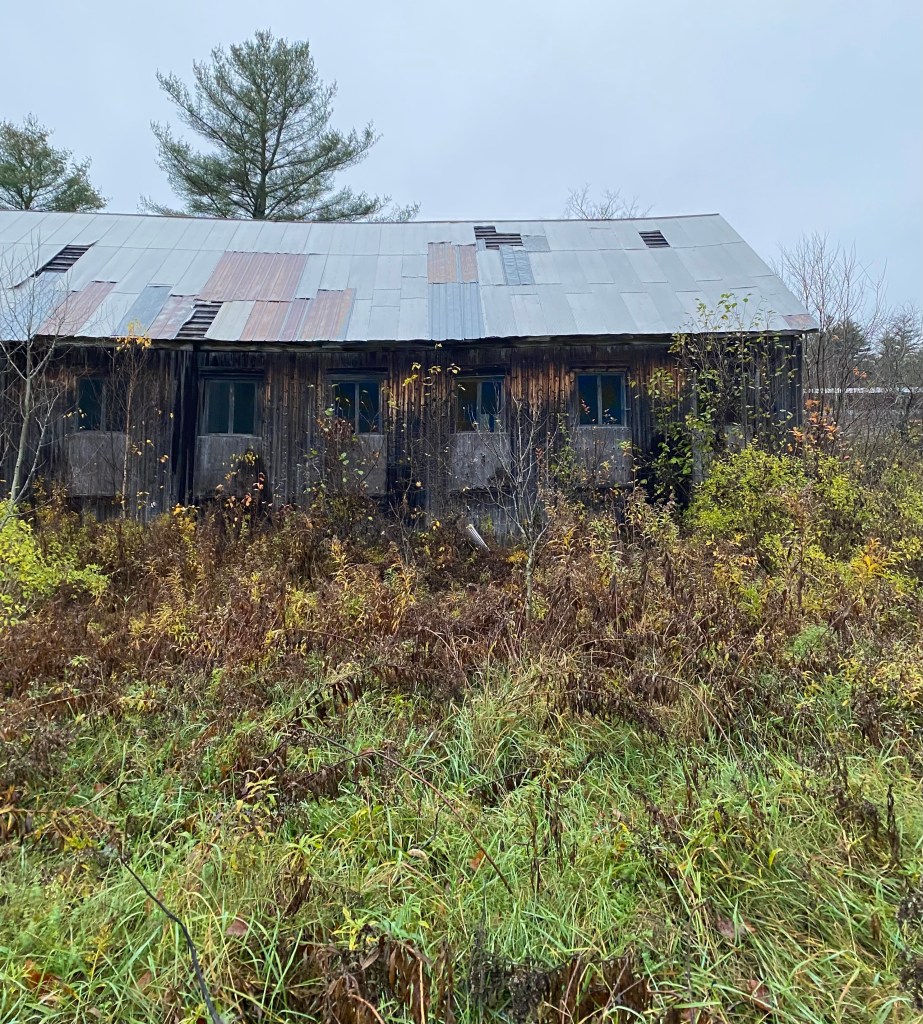
But I feel like you need to understand this. Our stories from around here come out like the way we keep our work shed: you go in there, see what you have lying around, some of it being old as hell, some of it being stuff you might even have had the money to buy for yourself. You move something, you find something else. You brush it off a little, then you use it or set it back down. But you need it all to piece together how things come to be the way they are now, how you come to be who you are.