Wonder…

About a decade ago, when I was first navigating single parenting (so many unfun challenges!), I held to the notion that every time a door slammed in my face, I’d scramble through a window. In my novel that will be published next year, a character says Really? We’re taking life advice from The Sound of Music? But it’s a darn useful approach. Small and scrappy, I’ve been tumbling through windows for years, although admittedly wounding myself on broken glass sometimes.

These balmy autumn days, raking leaves over garden beds, I’ve had a whole sun-rich summer of remission, of cancer survivor, of figuring out how to walk and eat, work and sleep again, these simple things that often eluded me all winter. A summer of learning to live within the bounds of this alive-but-more-broken body. By chance, I meet an old friend who comments about my short hair, and I spill a snippet of my lymphoma which she had not heard. Our lives, connected through kids now grown up, have taken different paths. I’m on the edge of saying that I don’t know how I survived last winter, but I hold back.

Last night, I stepped out of our warm house where the cats are again sprawled in their favorite place before a toasty wood stove and walked out to the nighttime garden to look at the half moon, hung in the sky among the constellations like a profound mystery, cream tinged with autumn’s gold, loveliness incarnate. The cold held me. One of my earliest small-child memories is looking through my father’s telescope at the pocked moon, wondering, wondering…

Mid-October, and the crickets are still singing. The elements for my survival include so many of you here, who sent me letters and cookies, books and cards; access to medical care (a great privilege); friends and colleagues and my dear family… and my own scrappiness, my fierce desire not to slip away from this world and this patch of acreage, the half-moon sailing silently over my frost-gnawed garden.

“You own everything that happened to you. Tell your stories.” ~ Anne Lamott

Autumn’s Radiance, Fine Medicine.

Before dawn, rain patters, a splatter through the open windows. The singing frogs are still at this hour. The rain moves through lightly. All summer: drought, drought, not likely to be relieved any time soon. In the town forest, beneath the soaring pines, the scent of the hot soil reminds me of the desert, a strange thing in northern Vermont. In the garden, the peppers, the sneezeweed, the Love Lies Bleeding relish the dry weather. By September, the garden will do whatever it’s going to do this year. Early autumn, colors burst. The hydrangea, so pink the large blossoms appear overly dyed, the coreopsis and compass flowers great bursts of little-kid-yellow, swaying with feasting bees.

Autumn, and I’m reliving last year’s descent into illness. A year ago, I was in a clinic’s office, asking what was wrong with me. I was sent away, and I went back to my toiling work, my sleepless nights. A month later, I returned again, thinner and weaker. Again, I was sent away. Shortly afterwards, I was in the ER and dosed with opioids. A scan revealed “unexpected severe neoplastic disease,” nothing that I’d conjured.

This fall, my novel heading towards an ARC for next summer’s publication, I reread my journal and the hospital notes and began writing a book about cancer. I’ve relied on my memory, that fickle creature, so rereading the notes from two hospitals is a vocabulary builder (so many medical words brand-new to me) and illuminating. This and then this happened. Our bodies and the world are known through numbers, like this drought, the inches of rain we need and the inches of rain to cure, a climatology record. Likewise, the hospital notes are records of lesions in centimeters and pulse in numbers and drugs in millimeters — my story’s elements. But, so, too, are the pears on our trees, plumper and sweeter than I’ve tasted in the eight years I’ve lived here. I pluck a weighty fruit from its branch, stand in the dusky-night yard, and watch the nearly full moon rise.

This week, driving to a friend’s house, I spy #10 Pond shimmering through the trees. The sheer unbidden beauty of the pond pulls me to a stop. I get out and stand on the dusty roadside, the crickets sizzling. A day like any other random day, a slip of a few afternoon hours. But here I am, still stitched into this evolving story.

“When I realized the storm
was inevitable, I made it
my medicine.” ~ Andrea Gibson

Do Two Things at Once.

Walking on a trail beside the Lamoille River, my daughter points out a snapping turtle, a giant creature, its head tucked in, watchful. Her partner reminds us that he grew up in a village where snappers took over the elementary school playground to plant their spring eggs. An inherent element of that school’s curriculum was try to get along with other beings.

The irises and rhododendron bloom profusely. Rain falls, chilly, for much of the day. In the late afternoon, the sun emerges. I cut back the hostas alongside my house to stave off the wet and rot. By late afternoon, I’m finished with my work and chores. I hang out on the porch, read, drink my cocktails of ice water and lemon. Listen to Nina Totenberg.

A month out from surgery, six weeks from chemo, I met a friend for coffee. We talk cancer and community, about the joys of traveling overseas and shifting perspective. Myself, I will be traveling near to home this summer, most of it by foot. Each day, I walk more and more, reclaiming my strength. As next year’s woodpile is transported into my barn (thank you, thank you, kind wood mover), I imagine planting a garden on that emptied place. As a younger woman, I believed vegetable gardening would change my world. I wasn’t wrong; Red Russian kale and bull’s blood beets fed my growing children for years. But blossoms and bushes and trees nourish the wild (and me, too).

I live on a hillside where hungry young woodchucks run rampart. Not so long ago, I considered the chucks my enemies. Now, having endured the scorched-earth transformation of chemo and cancer, I worry far less about these sleek-furred creatures. By summer’s end, I know the foxes thin this population. In the meantime, I slowly go about that repetitive work of weeding and mulching, and the visioning research of transforming lawn into wildflowers.

My coffee companion reminds me to take my time and take risks. Who wants to take risks after surviving cancer treatments? Answer: why not, why not? Dig more gardens. Contemplate the woodchucks. Plant coreopsis to replace the hollyhocks holes from the woodchucks’ foraging… Do two things at once: go with the flow and keep paddling.

White peonies blooming along the porch
send out light
while the rest of the yard grows dim.

Outrageous flowers as big as human
heads! They’re staggered
by their own luxuriance: I had
to prop them up with stakes and twine.

The moist air intensifies their scent,
and the moon moves around the barn
to find out what it’s coming from.

In the darkening June evening
I draw a blossom near, and bending close
search it as a woman searches
a loved one’s face.

~ Jane Kenyon, “Peonies at Dusk”

Wood.

The wood man delivers cord wood not long after dawn. I’m in the kitchen with a manuscript spread over the table when I hear his truck beeping as he backs around the car my daughter left in the driveway’s middle late last night, returning from work. I lay clean spoons over my pages to keep them steady from my cat, who cares nothing about words or order.

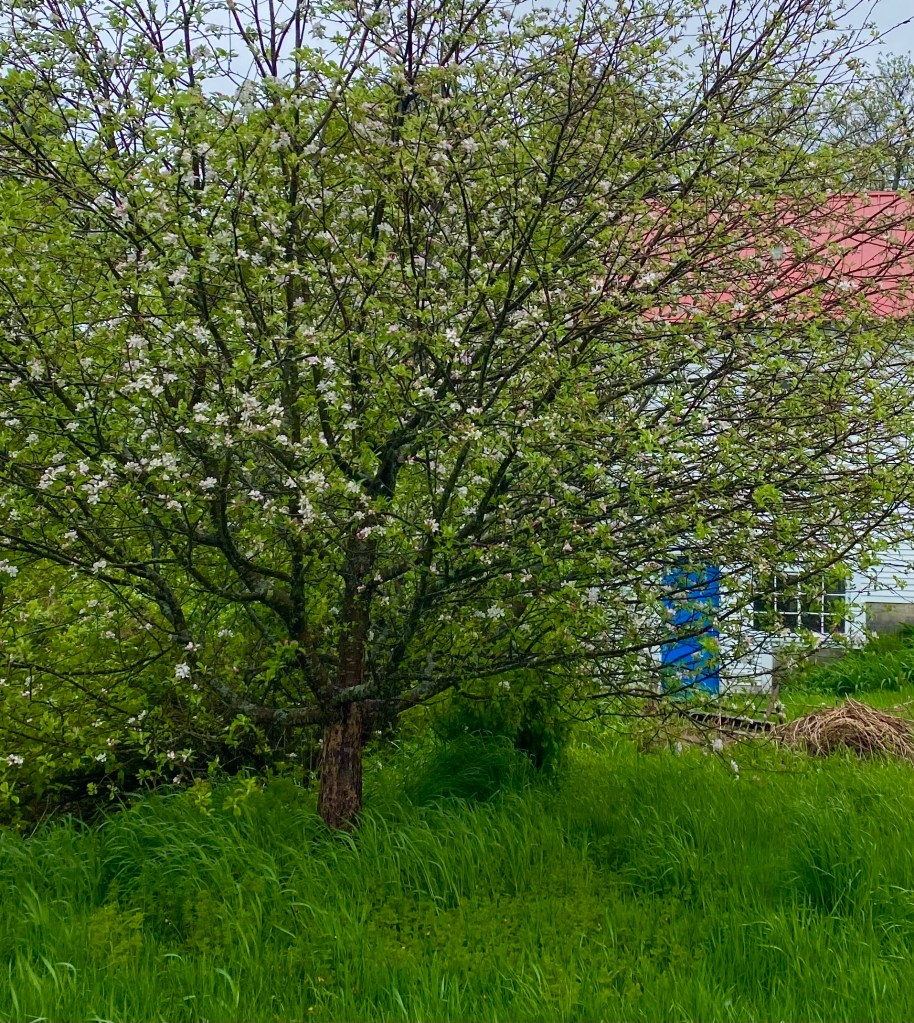
The morning’s chilly, sunlight snagged in the crabapple blossoms, downy white.

I hand him a check, and we talk for a bit about maple sugaring and sap sugar content, about his mighty 17,000 taps, and burning wood. Can’t people remember to order their own firewood every year, anyway? He dumps the load and drives off into the rising day. Freshly split, the wood’s redolent with sweet sap, that forest scent.

Two weeks and one day out from surgery, each day I’m pulling along further. After a winter of chemo, I now have a gnash in my middle, a non-bikini scar, that renders all the more real this cancer. Nonetheless, I ordered a small $16 tree, a witch hazel. One daughter digs a hole, the other plants the tree. Healing, I’m required to restrain myself from stacking that wood, digging holes, tugging out last year’s Brussels sprout stalks that lingered all winter, blackening and rotting. My daughter rips up a stalk and shakes the soil loose. The plant’s tendril-like roots spread skyward.

Amazing, I say, what comes from a tiny seed, isn’t it?

She shakes it again, then tosses the stalk in the garden cart and moves on to the next plant.

“Tree”

It is foolish
to let a young redwood
grow next to a house.

Even in this 
one lifetime,
you will have to choose.

That great calm being,
this clutter of soup pots and books–

Already the first branch-tips brush at the window.
Softly, calmly, immensity taps at your life.
― Jane Hirshfield

Mending…

After nearly two weeks away, I return home to the trees in full leaf, the lawn gone wild with violets and strawberry blossoms. Drizzly, cold, my brother starts the wood stove. The cats uncurl themselves before the blaze, satiated. A cold May, but verdant, lushly and satisfyingly so.

In these post-surgery days, I limp from room to room, venture outside to tug down a lilac branch and breathe in. The weeds run rampart, but whatever… the garden, too, will be sorted and tidied.

I’ve written repeatedly about the lilacs around my house, but again, I reiterate my joy in the soaring bushes. When I was five, we lived in a small green rented house, its yard surrounded by chainlink fence. A lilac bush leaned over the fence from the backyard neighbors. My second-grade sister was in school afternoons, my toddler brother sleeping, and so, after kindergarten and lunch, I lay on the long grass, staring up through the quaking leaves. These bushes, so New Englandy quaint with lavender, violet, and white blossoms, remind me of those unbounded childhood hours. One o’clock, two o’clock? Who knew? Who cared? I had just learned how to tie my shoes.

Like the walking wounded, I hobble from couch to chair, through the long grass, out of the workaday world and, yet, far from being a child. In glorious remission, in recovery from surgery, I keep thinking of this poem below, as I begin, day by day, to mend my body and life.

“Da Capo”

Take the used-up heart like a pebble
and throw it far out.

Soon there is nothing left.
Soon the last ripple exhausts itself
in the weeds.

Returning home, slice carrots, onions, celery.
Glaze them in oil before adding
the lentils, water, and herbs.

Then the roasted chestnuts, a little pepper, the salt.
Finish with goat cheese and parsley. Eat.

You may do this, I tell you, it is permitted.
Begin again the story of your life.

— Jane Hirshfield

The Bardo.

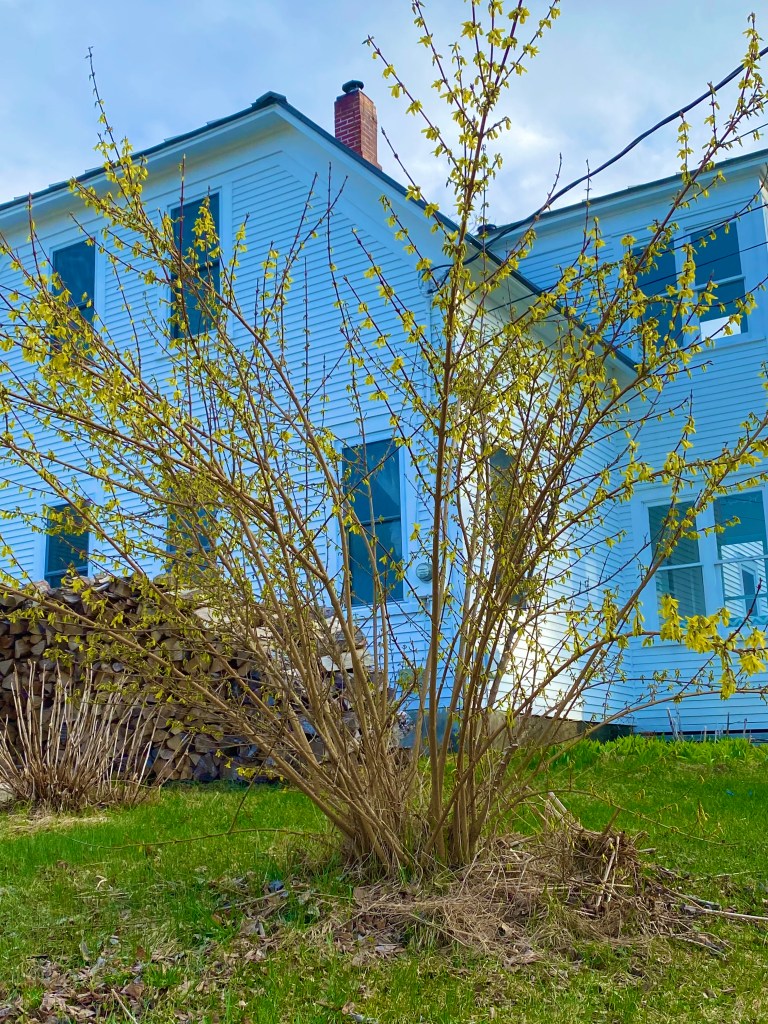
A few years ago, I bought a stick of a forsythia plant. The plant had withered in a nursery which hadn’t cared much for this plant, one of the three or four remaining perennials at the season’s end. For years, I had wanted to plant a forsythia with its cheery early-spring blooms, but I stood there and considered. The plant was about ten dollars. I eventually opened my wallet and took the admittedly meager risk.

The plant thrived. A few years later, I sold that house, dug up the forsythia, and carried the pot in the back of a friend’s pickup to my new house. The plant grew but never thrived, more stick and leaf than bloom.

This year, however, seven years into our life here, the blooms are abundant. I am not a Buddhist, not trained or schooled in any formal education at all, but here’s a thing. For a period of time after each of my daughters was born, I lived in a rarefied space, not of the common everyday world, but exposed and tender, as if the sky had opened up. I had labored to carry a six-pound baby into this mortal world. I had a foot in this world, and a foot still lingering in a gauzy undefined realm. But each day of nursing and crying, of meals of roast chicken and buttered toast, bricked up that entrance, planted me securely in this world again.

So, on the other end of mortality, I see my mother lingering yet with us, in profound and complicated manifestations, in the four of us — her husband and three children — and her four grandchildren as she drifts into her new realm.

In the house where I grew up, my mother and her neighbor bickered over ownership of an enormous forsythia that straddled their property line. As I walk around, planting and watering a lilac tree, stacking firewood, raking, I’m tugged to these delicate gold petals, so brief, such a long struggle, so miraculously splendid.

Darkness overtakes us on our way 

in my lodging the roof leaks 

weeping cherries in flower 

— Buson