The Bardo.

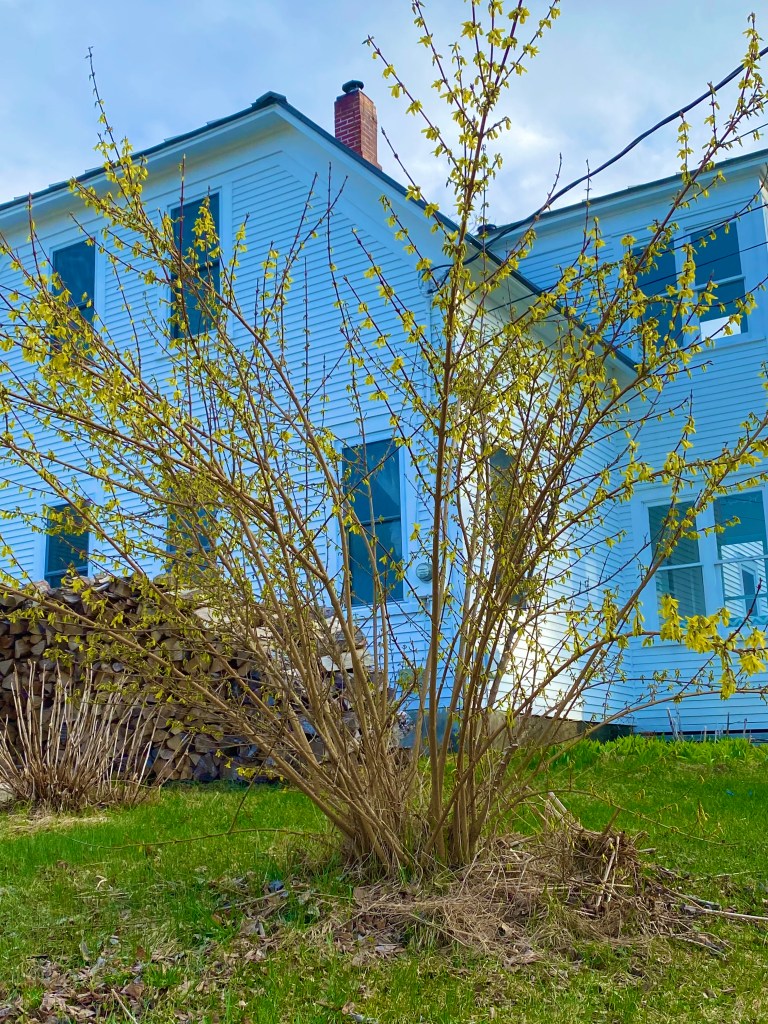
A few years ago, I bought a stick of a forsythia plant. The plant had withered in a nursery which hadn’t cared much for this plant, one of the three or four remaining perennials at the season’s end. For years, I had wanted to plant a forsythia with its cheery early-spring blooms, but I stood there and considered. The plant was about ten dollars. I eventually opened my wallet and took the admittedly meager risk.

The plant thrived. A few years later, I sold that house, dug up the forsythia, and carried the pot in the back of a friend’s pickup to my new house. The plant grew but never thrived, more stick and leaf than bloom.

This year, however, seven years into our life here, the blooms are abundant. I am not a Buddhist, not trained or schooled in any formal education at all, but here’s a thing. For a period of time after each of my daughters was born, I lived in a rarefied space, not of the common everyday world, but exposed and tender, as if the sky had opened up. I had labored to carry a six-pound baby into this mortal world. I had a foot in this world, and a foot still lingering in a gauzy undefined realm. But each day of nursing and crying, of meals of roast chicken and buttered toast, bricked up that entrance, planted me securely in this world again.

So, on the other end of mortality, I see my mother lingering yet with us, in profound and complicated manifestations, in the four of us — her husband and three children — and her four grandchildren as she drifts into her new realm.

In the house where I grew up, my mother and her neighbor bickered over ownership of an enormous forsythia that straddled their property line. As I walk around, planting and watering a lilac tree, stacking firewood, raking, I’m tugged to these delicate gold petals, so brief, such a long struggle, so miraculously splendid.

Darkness overtakes us on our way 

in my lodging the roof leaks 

weeping cherries in flower 

— Buson

Field of Sunflowers.

In a former garden I tended, I planted elecampane whose yellow blossoms bloomed over my head. The plant spread along the garden’s back edge, a natural fence between the bed where I planted greens and tomatoes and the field where I sowed potatoes. We had reclaimed that stretch of field from the forest, and the sparse soil was hungry for manure and the cover crops we rotated.

Now, in search of elecampane to transplant, I find this flower, the long ragged-edge leaves already fading from this year’s growth, the greenery not particularly lovely. I plant this strange flower before our house.

Flowers have the undeserved rap of girlyness, of flimsy decoration, of false medicine. Not so, not so.

how quiet
the light-blue morning glory —
such good manners

— Issa

Love Lies Bleeding.

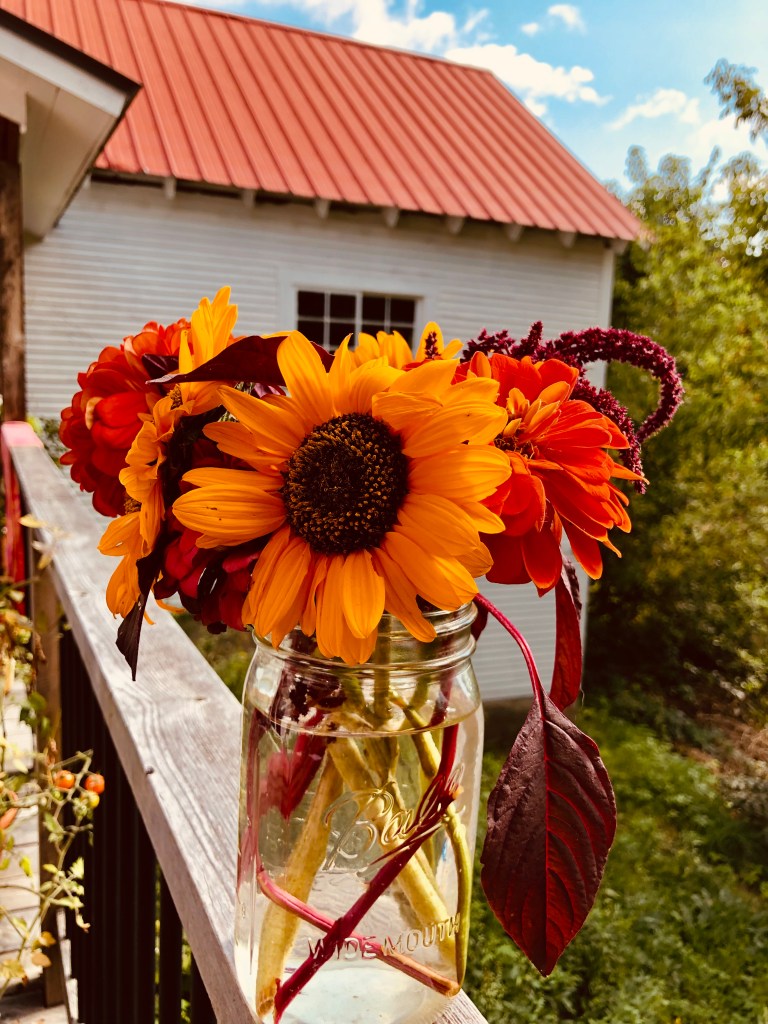
My daughter returns from a hectic work week with a mason jar of flowers from a friend. Our cat immediately gnaws on a zinnia leaf, and so my daughter sets the jar of flowers on our table on the back porch.

A week later, the flowers are still vibrant — giant orange zinnias and sunflowers and maroon amaranth that drapes over the jar’s edge. This, despite the fluctuations of cold and heat for days.

The other name for amaranth is Love Lies Bleeding.

On this Saturday morning, my daughters already at work and soccer, I drink coffee and catch up with email. Next year, I imagine, maybe I’ll plant my entire garden in flowers, vegetables be damned. I won’t; I know that. But I sowed an enormous variety of Love Lies Bleeding in along my brassica this year. We’re devouring all of that.

Crickets

My daughter’s friend spends the afternoon on our back porch. When I come home from work, the girls are still chatting and doing crafts. The sunlight dapples through the box elders. Around us, tomatoes ripen.

We are ensconced in porch life, our half-covered deck redolent with drying garlic, the nasturtiums dangling their delicate, impossibly beautiful blossoms from hanging baskets. In the mornings, we read Henry IV, Part One aloud with my parents in Santa Fe, my sister and nephews in Virginia, circling back to Falstaff’s words — “A plague of sighing and grief! It blows a man up like a bladder.” Beside me, my 15-year-old rubs a finger over the scraps on her knees from blackberry brambles.

August is the sunshine month in Vermont, the season of wild berries, of warm lakes, of flowers in excess, of lying on the grass as the stars come out, of a great long pause before autumn sets in and winter grinds her teeth.

Our deck, our house, and garden might as well be the whole world, with the turkey vultures silently circling overhead, the wood thrush singing sweetly in the ravine. Before dinner, I toss a withering bouquet of giant zinnias in the compost and cut a fresh handful for our dinner table. August is our rainbow month. I know my daughter’s desire for school, for soccer, for this future none of us seem able to imagine — but long may August last, please.

The crickets felt it was their duty to warn everybody that summertime cannot last for ever. Even on the most beautiful days in the whole year – the days when summer is changing into autumn – the crickets spread the rumour of sadness and change.

— E.B. White

IMG_8152

August 1

This morning, the mist lies in the valley. Through the open windows, a coolness steals in with the dawn. For this summer, my daughter informs me, the greatest heat has passed.

July gave us thirty-one gorgeous, sun-drenched beautiful days. Now, on the first of August, I’m wearing jeans near my open window, as my daughters’ cat keeps a hungry eye on a darting goldfinch.

My teenager aches for September and school; I think, slow this down. School may not open its doors this September, maybe not in October, maybe not at all this year. In our little Vermont oasis, that seems theoretical at times. On this first of August, I think again of Hayden Carruth’s poetry.

The world is a
complex fatigue.

Indeed. For this day, green bean picking, handfuls of zinnias, the cosmos as tall as my shoulders, the nasturtiums nestled in the tomatoes. For this day, flowers.

Hayden Carruth

IMG_8121

Car Keys

In the evenings, my daughter lifts the car keys from the hook on the wall, and we drive.

In the passenger seat, I laugh a little, and she looks at me from the edges of her eyes. What?

I haven’t accepted, yet, this switch from driver to passenger seat, and she says seriously, I got this, before smiling with utter pleasure. She no longer asks where we should go; she’s at the wheel.

In the midst of so much other upheaval, from global to personal — my teen has hit the summer of growing up. If I had my license, I’d drive across the country, she says. I have two more months before school starts.

A light rain falls. Neither of us know if school will start, or what her last few years of high school will look like. I’ve driven across country numerous times, but what will her trek look like?

My thirsty garden drinks up the rain. At our house, an enormous mock orange bush reaches our second-floor bedroom windows. For weeks now, I’ve wondered if this bush will bloom this year — here it is, madly blossoming, sprinkling the grass with its fallen white petals.

Such a moon —
the thief
pauses to sing.

— Buson

IMG_4199.JPG

Photo by Gabriela Stanciu