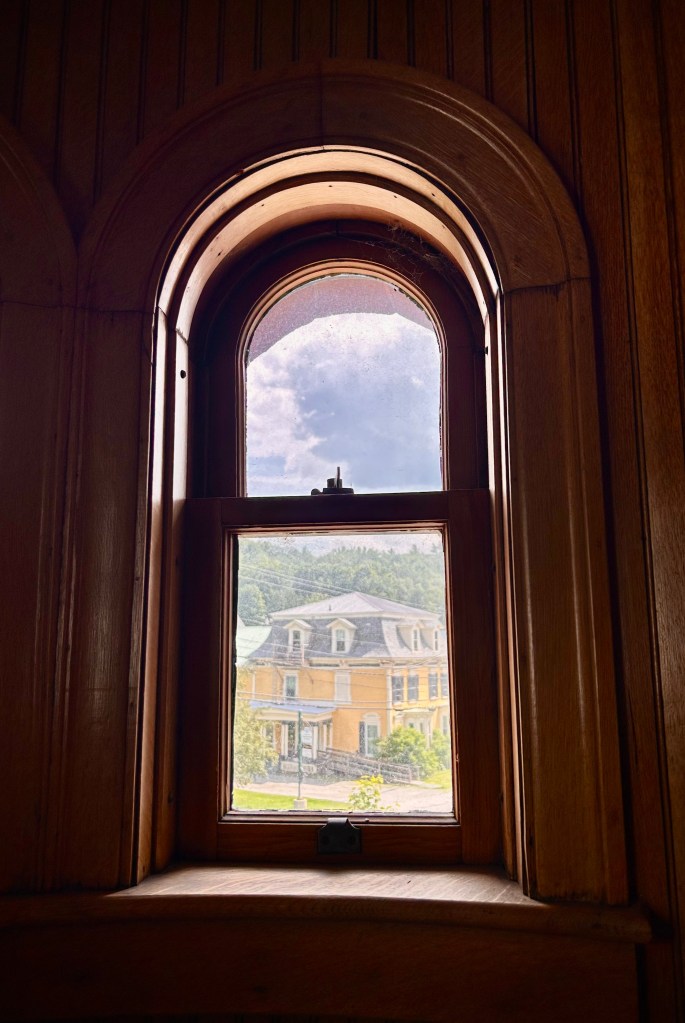
“… hard wind and the rain that unsettled the creek…”

Evening, I linger on the porch swing, talking with my siblings as the long July day ebbs down to twilight. My neighbor texts me that a bear’s been seen in our neighborhood. As the gloaming, like a tide, washes in, I water the tomato plants. The white hydrangeas hover like magical pompoms in the dusk.

July, Vermont’s growing month. Walking with my neighbor, she points out the height of the wild grasses and flowers around her house. Already, this summer, taller than she’s ever seen. The heat and the rain have propelled immense growth. The box elders rub my house; I’ll need to ask another favor from someone with a saw.

I have not forgotten this winter when I drifted from one variation of cold to another, my body and mind fiercely bent to the intertwined goal of finishing cancer treatments and remaining alive. On the other side, what remains is what plagued me before, my own variation of hard wind and rain. And yet, a whole July hangs like a promise: sunshine all day, pink cottage roses, laughter with my neighbor about the burgeoning woodchucks.

In the late afternoon, I take a long walk in the town forest to the reservoir’s edge. Deer prints press into the mud. On this walk, I don’t see a soul. In the distance, children call to each other.

“Kitchen Sink”
Today she would change nothing,
not even the wallpaper peeling,
like dead bark. Nor, outside, the shadows
approaching the yard where ants
toil like women in their houses of sand.
Never mind that the sun will be setting.

When she was young she felt afraid
of hard wind and the rain that unsettled the creek.
But the earth never left her,
not once did the floods reach her feet.
The reward of a long life is faith
in what’s left. Dishes stacked on a strong table,
Jars of dried beans. Scraps of cloth,
And the ten thousand things of her own thoughts,
Incessant as creek water. She has been able
to lay up her treasures on earth,
as if heaven were here, worth believing.
In the water her hands reach
like roots grown accustomed to living,the roots of the cat-briar that hold to the hillside
and can never be torn free of this earth completely.

~ Kathryn Stripling Byer

Hunger.

Curious cat named Acer

A few years back when my youngest was doing odd jobs, she came home with four strawberry plants someone had given her from a garden she weeded. Naturally, I planted these in our garden. The plants spread and have produced beautifully this year. I crouch beside these weedy plants and devour red berries. The crop is so small no berries ever make it into the house. Since it’s usually just me here these days, I eat in the garden. I’m famished for this sweet food. I devour the strawberries, juice dripping down my chin.

I’m ravenous for the sharp June sun, for this morning’s cold dumping rain, for my daily midday reading break, for the purring cats who clamor across my keyboard. Healing from cancer, I’m supposed to sleep (get seven to nine hours!) but, come that glimmer of gold at the horizon, I’m finished with bed, hungry for coffee, oatmeal, maple syrup. Eager to finish my novel revisions.

In those months of chemo, I’d worried my mind and imagination might dull, my fierceness lessen. Six weeks out from surgery, I’m diminished in body but a peculiar power blooms in me. A determination to do what I want. An impatience with artifice. Don’t waste my time.

And yet, the old haste that plagued my days and nights has quelled. Stopping by my neighbor’s, I sink into her armchair, set my feet on her footstool, listen, let the day’s exhaustion drape around me. That fatigue is now familiar to me as the blanket a stranger gifted me at the beginning of this cancer journey. We talk and talk, then wander outside and keep on with these conversational matters, the color of paint she’s considering for her house’s clapboards, how to encourage Columbine to grow among the phlox.

This time, I really want to listen…. I’ve spent my life mistaking instinct for fact, subjective experience for reality. What a waste of time here on earth to spend it as a slave to one story, how boring and repetitive, how many of our days are spent in chains.

From Sarah Gilmartin’s Service.

“Where are you going?”

Photo above taken in a courtyard garden at Dartmouth-Hitchcock. Inside the building, there’s a short flight of stairs to a sunroom. Glass doors lead to the garden. Much of this winter, I couldn’t walk those half-dozen steps. When I finally could, I proofread my daughter’s college essays in the sunroom. We stared out at the blowing snow and wondered what grew in the spring garden.

Today, mid-June, an appointment of good news. The Good Doctor reminds me that I’ve finished treatments, that I’m in remission. Go on and live your life. Gain weight and muscle.

I’ve been so far out of the everyday world that, after this appointment, waiting in a gas line, seems like a small event. For some reason, I remembered the gas station a few miles from my father’s house in Santa Fe, New Mexico. On a random summer morning, I pumped gas and then stood for a moment, breathing in the spiciness from the station’s kitchen vent and staring up at the flawlessly blue sky. The desert’s hot breath touched my cheeks, my hands, my bare knees – at once so familiar to me (my birthplace the New Mexican desert) and enchantingly unknown. The day lay before us like a pie that could be cut any which way, and the result would be enjoyable.

That’s how I felt, leaving the cancer center, walking up the stairs in the parking garage – light – as if I had shed that caul of cancer and pain. I mean nothing easy or innocent about this lightness. One afternoon when I could barely walk around the high school, I sat in a friend’s car and imagined myself as gray – my face ashen, my bones crumpling to cinders. I wondered how I would survive. In December, wandering the halls of yet another hospital, I turned around and couldn’t recognize the only other person in the hallway, my friend Jo who was even calling my name. “Brett, where are you going?”

Living with cancer taught me that we are not creatures of the mind; we live in our bodies. Cancer may return in my flesh this summer, two years from now, or never. I may perish falling down stairs, or expire as an old woman in my bed beneath a quilt my mother sewed. Any hubris I once had about eating organic brown rice and my garden’s bounty vanished this winter; mortality’s blade is ubiquitous, final.

Nonetheless, this day…

Driving home on the interstate, my daughter and I mused about hurried drives through snow to the ER, the repeated treks, northward, home, where we scrutinized roadside trees for the faintest blush of spring green. This time, my daughter pointed out patches of lupines, purple and pink and white, sure sign of summer.

You must do something to make the world more beautiful.

~ Barbara Cooney, Miss Rumphius

Bare soil.

Midnight, I’m sitting outside the local hospital in the balmy night, a few mosquitoes drifting in the streetlights. There’s no one around, save for the young woman in reception poking her phone, the peepers chattering in the wetland down the road. The night is so warm I’m reminded of summer’s open-ended days and nights, the pleasure I’ve taken these last few years sitting outside in the dark, listening to the nightsounds of rustlings and callings, human and wild.

The person who drew my blood just a few hours ago told my sister and me about the local library in nearby Johnson, Vermont. This evening, the library will be moved from where it was built and recently flooded to safer and higher ground near the elementary school. The town will shut down as the brick building is wheeled down Main Street and over a bridge spanning the Lamoille River. In the velvety darkness, I imagine the scene: the floodlights, the crews, the townspeople who will come out to admire and cheer. A small but certainly mighty miracle.

Around the building, I hear the rattle of my Subaru’s loosening heat shield. Then my sister appears in the driver’s seat. Along empty roads, she drives us home. In Wolcott village, I spy a fox rushing across the road. The animal pauses at the weedy edge, head turned towards us, perhaps wondering what we’re up to, too, this creature, like us, in no rush at all. Home again, the cats press against the kitchen glass doors, as if expecting a reckoning from me, an accounting of my absence.

What can I say to these tabbies? When a nurse apologized for dropping a plastic cap on my shoulder, I mused aloud that it wasn’t heavy — and isn’t that a line from Phish? Things are falling down on me, Heavy things I could not see… The nurse knew these lines, too. The heavy falling things are taking a pause, perhaps, in spring, as the earth reorients herself, through peeper song, unfurling leaf, the heady scent of rain on bare soil.

Is that church door open?

About a year before my mother died, I visited my parents in northern New Mexico. My mother was on 24/7 oxygen then, which she understandably chaffed against, and I took her on long drives so she could leave the house. One afternoon, I drove the rural roads to the Lamy train station. Take the Amtrak to Santa Fe, which I’ve done, and you don’t disembark in the quaint plaza town. 20 miles outside the adobe city, there’s the small Lamy station and an old saloon named the Legal Tender, and not much else. I parked at an old church that appeared to be abandoned and told my mother I’d be right back. I called over my shoulder that I wanted to see if the door was open, as church doors often are. When I looked back, my mother had her car door open, one foot on the earth, determined to follow me. She said cheerily, “I’ll come, too.” She was attached to a heavy oxygen tank on tiny wheels. The terrain was rocky, and there was no way I could navigate my mother to that door.

Somehow, I talked her into staying in the car. That was my mother, usually up for an adventure, willing to rattle a locked door, peer through a window, maniacally curious. It’s me, too.

In these brown-grass April days, as I begin to walk again, further and further each day, I think of my mother, how she would search for daffodil buds and admire the blooming snowdrops. Robert Frost is famous for his line, “In three words I can sum up everything I’ve learned about life: it goes on.” Bitter, perhaps, or maybe not so. Having faced my own (blessedly at this moment passed over) demise this winter, I’m beyond happy to immerse myself in the stream of life going on…. This life.

I woke this morning with a dream that I’d never had cancer. In the dream, I’d overslept and was late to work…. I was sweating, nightmarish. The dream haunted me all morning, trailing me, while my dear friend visited and brought me birthday presents that reminded me of my mother, and then fetched my library books so I could lie on the couch these afternoons and recover from this last cancer dose. When she’d left, I slept again. When I woke, the dream had broken and lay on the floor like broken glass: rubbish.

Such a labyrinthine world – mothers and daughters and granddaughters – disease, too. In these still days, waiting for spring’s rushing green, I embrace what I know, and that I never will.

… we are all

the dead, I am not apart from you,

for long, except for breath, except for 

everything.

~ Sharon Olds

“When the electricity shuts off, you boil water, you crack ice.”

In addition to showing up at Dartmouth-Hitchcock for chemo and consults to save my life, which thankfully appears to be going nicely, I also joined a writing group the hospital offers. Because writing saves lives, too.

Here’s a poem I read in this class, too good not to pass along.

“Chickens” by Kate Gale

I come from hay and barns, raising  
chickens. In spring, lambs come.  

You got to get up, fly early, do the orphan run  
sleep till dawn, start the feeding.  

When the electricity shuts off, you boil water, you crack ice.  
You keep the animals watered.  

You walk through the barn, through the hay smell, 
your hair brittle where you chopped it with scissors  

same ones you use for everything. Your sweater has holes.  
When you feed the ram lambs, you say goodbye.  

Summer, choke cherries; your mouth’s dry. Apples, cider.  
Corn picking. Canning for weeks that feel like years.  

Chopping heads off quail, rabbits, chickens.  
You can pluck a chicken, gut it fast.  

You find unformed eggs, unformed chicks.  
They start chirping day nineteen.  

You make biscuits and gravy for hundred kids  
serve them up good. You’re the chick  

who never got past day nineteen, never found your chick voice.  
You make iced tea. They say, you’re a soldier in the king’s army.  

At night, you say to yourself, Kathy, someday.  
We go walking. We go talking. We find a big story.  

A cracking egg story. A walking girl story.  
A walking out of the woods story. A not slapped silly story.  

A not Jesus story. Hush, Kathy you say, we get out of here.  
We find out where chicks go when they learn to fly.