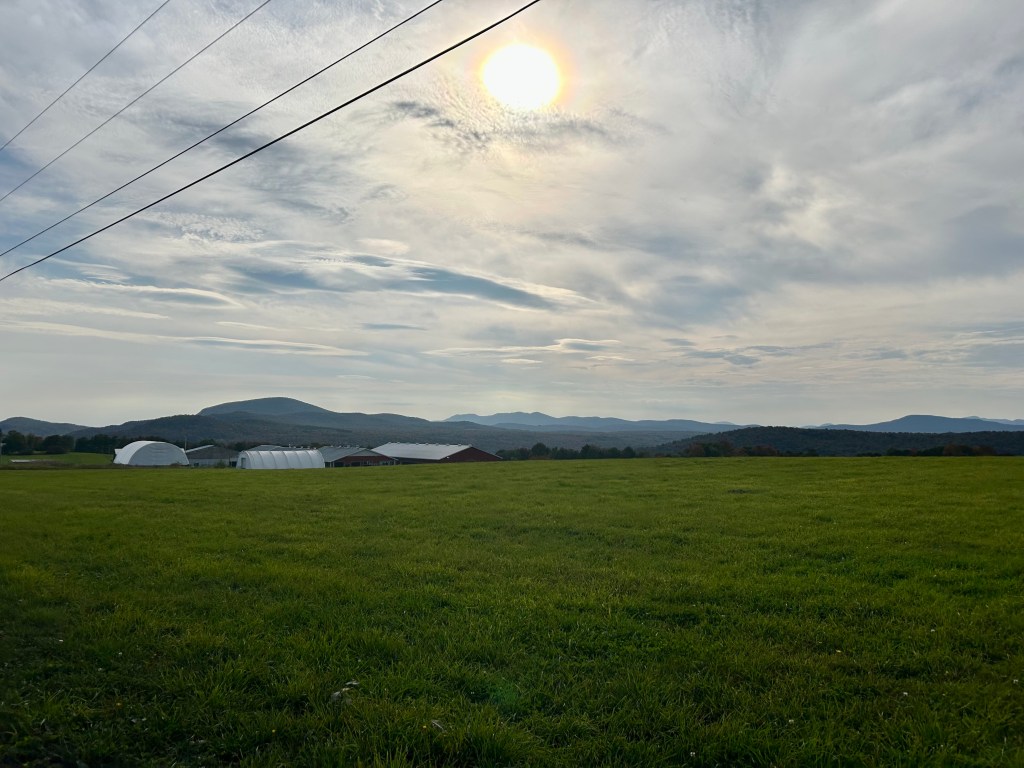
Stopping in the Snowy Forest.

In the woods, I hear voices and pause, thinking a cluster of children might emerge over the hill. Instead, a flock of clangorous geese wings low overhead, then a second V, a third. Town traffic sounds filter into the woods. I am not in the deep wilderness, not so far from high school and road and village, but for this hour, it’s just me and the sweep of wind and drifting snow and the human and dog prints of whoever walked here before me.

As a kid, my father was never one to be daunted by adversity. Evenings, he often set down his coffee cup and took us on walks to the library or around the block, and around the block often meant across a thin-grass soccer field to the woods. Who owned those woods, I never knew. We jumped across the stream and along worn logging roads, past the piles of New Hampshire boulders and stone walls in the forest where fields had dominated not so many years ago. The woods were alive with rabbits and deer, birds and ferns. We wondered about the Natives who lived here and the colonists who cut down the trees, and then the trees grew up again.

On this twilight Monday, I lean against a hemlock, snow in my eyelashes, remembering when my daughters filled their snowsuit pockets with tiny hemlock cones. Intentionally or not, my father instilled love and not fear of the forest in his kids, the understanding that our feet could carry us to unexpected and miraculous places.

Here’s that classic New Hampshire poem threading through my childhood, my daughters’, and so many others:

Stopping by Woods on a Snowy Evening

By Robert Frost

Whose woods these are I think I know.   

His house is in the village though;   

He will not see me stopping here   

To watch his woods fill up with snow.   

My little horse must think it queer   

To stop without a farmhouse near   

Between the woods and frozen lake   

The darkest evening of the year.   

He gives his harness bells a shake   

To ask if there is some mistake.   

The only other sound’s the sweep   

Of easy wind and downy flake.   

The woods are lovely, dark and deep,   

But I have promises to keep,   

And miles to go before I sleep,   

And miles to go before I sleep.

Gifts at the Back Door.

I arrive home in the dark and find one of my red deck chairs at my kitchen door, a white container set on its seat. It’s not late but dark already. On my way home from work, I’d walked along the river and walked further than usual. When I’d returned to my car, darkness had fallen.

I’ve been living in or nearby this village for thirty years. I’ve seen a share of miserable things — from addiction and homicides to petty cattiness — and its goodness, too. How, in times of trouble, folks appear with aid. No questions, often very few words. My god, the grace of this.

Scorched earth is how I consider myself these days, not so many days post-chemo, post-surgery, leering up on a year’s anniversary since I learned I had cancer. See how I write this? Past tense. And yet, transmogrified is a word I used with a friend. How this disease has transmogrified my being.

In the dark, I unlock my door, set down my backpack, a pile of library books, a bag of apples. My cats mewl for their cat supper. The container has soup, barley and beef and spinach. The woodstove has gone cold, my jacket drips rain on the floor and my cats’ dense fur, darkness presses against the windows. And yet, serendipitous soup. I take a spoon from the drawer. As for figuring out the rest of my life, or this week, or even this evening — I let that go.

From my library book stash, Sally Mann:

“As for me, I see both beauty and the dark side of the things; the loveliness of cornfields and full sails, but the ruin as the well…. The Japanese have a phrase for this dual perception: mono no aware. It means “beauty tinged with sadness,” for there cannot be any real beauty without the indolic whiff of decay. For me, living is the same thing as dying, and loving is the same thing as losing, and this does not make me a madwoman; I believe it can make me better at living, and better at loving, and, just possibly, better at seeing.”

Crossroads.

I park at a dirt crossroads this weekend beside a former tavern and walk up the hill to the Old West Church. The sunny afternoon speckles through the roadside maples, and I meet others doing what I am, in pairs or singly, and we greet each other, cheerily. At the Old West Church, I hear two terrific poets, but on my walk back to the tavern the line that runs through my head is from a Franz Wright poem, There is but one heart in my body, have mercy/on me, an incantation.

I keep thinking of my dead mother on this radiant Sunday, my mother who pulled her last breath a year and a half ago, hardly a hopscotch jump ago. In my mind, I’m building the architecture of what I’ve tagged as this Cancer Atlas I’m writing, scaffolding this book’s bones. The book is about the here-and-now, about living (at least for now) through a terrible disease, about walking along Vermont’s autumn-gold back roads, about pulling up this summer’s frost-killed pepper plants that produced so bountifully this summer. And my mother? As I work, I think so often of her, this woman both generous and mercurial, the double blade I harbor in my own heart. Gracious, how much she’d enjoy this picturesque walk. She was a woman who loved old churches, was fascinated by adjacent cemeteries, who would have relished the art in the tavern.

At the tavern, I linger in an open doorway, talking with a curator, drinking iced tea from a half-pint jar. My mother would have drunk the wine, feasted on the cured meat and seeded crackers. Dust kicks up in the road. Old friends appear, and we joke about winter’s ferocity. It’s always a crossroads, isn’t it?

“We are created by being destroyed.”
― Franz Wright

This Glorious Autumn Light.

My sister, a caner survivor, once told me that a cancer diagnosis was a great leveler. This was years before my own cancer experience, and, sure, I had an intellectual understanding of this. Lymphoma schooled me in many ways, among these that I live in my body. Such a simple, profound thing. I had never lived in a body that couldn’t walk up the stairs in my own house, not just because of a sprained ankle or a new baby in arms, but because of weakness in my bones and flesh. I had never considered that I might never be able to enter the bedroom whose walls I painted, where I have slept for so many years.

These days, after a summer devoted to learning how to eat and sleep again and to walk those stairs, outside as much as possible in this gloriously sunny, perishingly dry Vermont summer, I no longer embody the near-translucence of cancer-and-chemo patient. Such pleasure I have when people ask why I’ve cut my hair, and I can reply that I didn’t snip, I lost. The hair I’ve lost is now returning in a metaphor that I can’t ignore: softer but with my childhood cowlick.

Disease hasn’t magically transformed me; if anything, my thorns have proliferated. But here’s a thing: the world where I live is descending into spectacular autumn. Sure, some years the fall foliage bursts brighter than other years, but always, always, heartstopping in beauty. Autumn’s a reminder of my mortality, your mortality, the dearness of this fleeting world. A reminder to pause in our gardens, on our house steps, the sidewalk, whatever trail we may be following. Take a moment. Breathe in, out, in….

From Stephen Jay Gould’s essay “The Median Isn’t the Message”:

Of course I agree with the preacher of Ecclesiastes that there is a time to love and a time to die—and when my skein runs out I hope to face the end calmly and in my own way. For most situations, however, I prefer the more martial view that death is the ultimate enemy—and I find nothing reproachable in those who rage mightily against the dying of the light.

Survive, Thrive.

In search of a story about wool and weaving, about Colonial America and these sultry August days, I discover a trailhead for a nearby town forest. I return with my daughter. We drive on back dirt roads, the terrain unfamiliar to me. But the way the maples are nearly in the road, their leafy branches stretching over the road and touching, is the Vermont I first loved, so many years ago when I was 18.

We pass houses flanked by sunflowers and hydrangeas, gardens with six-foot high fences to keep deer from marauding the kale. Not so many decades ago, these were farm fields. In the forest, we follow a former road beside a stone wall. In New England, a forest moves in quickly, erasing the labor that once cleared this land.

August, the woods are quieting. In a break in the forest, we walk through a field of goldenrod, a strip of pink Joe Pye Weed at its edge. All summer, I’ve written sparsely in this space, intently picking up the stitches of my life: walking to mend lost muscle, relearning habits of sleeping and cooking and eating — such simple things I once did so easily. When an acquaintance’s dog leaped on me on a walking trail, I rushed deeper into the woods and wept. I’ve cried so little during this year of cancer, but there I was, ridiculously weeping beneath pines, so fearful of my own fragility, of breaking.

August, and I’d take a whole summer again, an impossibility. Instead, again, we’re in the edge between seasons, the days shortening, chilly at sunset and sunrise. My cats eye the unused wood stove and then eye me, wondering what my plans might be.

Survive, I think. I’m cooking fish and offer these plump tabbies a second course. Thrive, I add.

We must risk delight. We can do without pleasure,
but not delight. Not enjoyment. We must have
the stubbornness to accept our gladness in the ruthless
furnace of this world. ~ Jack Gilbert

Following the Bear.

Mid-August, the mornings are cool, the leaves of the pin cherry tree sparkling with dew. I find a bruise on my bicep; the cancer’s returned? But no. I remember I snagged my arm on the garden fence. Mid-August suddenly and the tomatoes are ripening. Last year, watching the full solar eclipse in our yard, the eclipse’s heart revealed this world’s ineffable beauty: such pure gold. Likewise, surviving cancer (thus far) revealed for me that knife of mortality within me, within all of us, hidden, ever-present.

Mid-August, mid-afternoon I’m drinking lemonade on a bakery porch and staring across the street at a house nearly obscured by sunflowers and globe thistle. I’m curious as heck about this Italianate with ornate corner boards. Who built this and who lives here now, and is the yard’s intent to cultivate wildness, or is no one at home?

My companion and I are talking about hard stuff, a third novel I’ve sent off to my publisher, the book I’m drafting now, about disease and suffering and how to wring meaning from misery. I’m compelled to write this book; writing this book looms impossibly. The afternoon’s quite hot, but by late afternoon the air will settle and cool. Nights, I walk after sunset, the crickets and tree frogs clamorous. I keep thinking about that house (empty or not?) and the thin line between wild and domestic. Here, this border has blurred. Will I cut the pin cherries to widen the canopy of the walnut tree I planted? The rose bushes seek a crack in my house’s foundation.

Wiser now, or maybe simply tired, I care less about the wild honeysuckle and raspberry canes that fortress around my house. I’m no Rapunzel, squirreled away in a tower, waiting for her Prince Charming. The hungry bear tunnels through the undergrowth, showing me a way.

Summer night—
even the stars
are whispering

~ Issa