On Gaslighting.

Via email, my daughter’s school sends me a survey. The survey poses a question about what I desire for my student. The question is phrased in a way that reminds me of a question I was recently asked, by someone I hardly know. The question was unique; the questioner asked specifically about me and my life, and how I saw my life in the wider context of the town.

I’ve been thinking of that question since that conversation, returning to it in odd moments while opening my post office box or washing the oatmeal pot. It’s a question we might all want to be asking ourselves — not just what would improve our individual lives, but how do we understand ourselves in the landscape of where we live. Or maybe this is simply April musings, cusp of a storm that could go either way, rain or snow or perhaps simply wind, sweetened with the scent of thawing soil.

Here’s a few lines from a New Yorker article that seem contemporarily apt….

Gaslighting essentially turns its targets against themselves, she writes, by harnessing “the very same capacities through which we create lives that have meaning to us as individuals,” such as the capacities to love, to trust, to empathize with others, and to recognize the fallibility of our perceptions and beliefs. This last point has always struck me as one of gaslighting’s keenest betrayals: it takes what is essentially an ethically productive form of humility, the awareness that one might be wrong, and turns it into a liability.

Leslie Jamison

Reading. Fear of Dogs. Starlight.

The July after I graduated from college, I stayed in a cabin a short walk through the woods on a back road. The one-room space had been built as a studio with a wall of windows that faced what had once been a view and now was shaded by leafy maples. In winter, the cabin was heated by a woodstove. An outhouse had been dug behind the cabin. My friend was visiting her mother in California. I stayed in the cabin and fed her dog. The dog didn’t listen to me at all. He ran off and chased the sheep down the road, whose owners claimed they could shoot the dog. I was twenty-two and knew nothing about farming, but I was afraid of the angry farmer and didn’t argue. The dog still didn’t listen to me.

Despite the dog and the farmer, I loved the cabin. The economy was terrible; there were few jobs, and I was trying to figure out my next step. I read a lot of Ann Beattie who was popular in the 1990s. I remembered that small paperback Chilly Scenes of Winter I owned for years, when I stepped outside yesterday evening. I had been reading Tess Gunty‘s The Rabbit Hutch, a novel a far stylistic throw from Beattie. In the dark, a truck towing an empty trailer rattled by.

Down the sidewalk, a dog growled. A man tugged the dog’s leash. No: the dog snarled. I knew the mutually unhappy pair, the man’s sole dominance apparently through that leash. I crossed the street and cut down along the brook through the log yard, walking quickly in the tepid night. On my living room rug, that Gunty library book waited, spread pages-down, spine up. Sure, the world changes, moment by moment. And yet, sometimes not so. Overhead, stars and no moon.

“What will happen can’t be stopped. Aim for Grace.”

— Ann Beattie

The Momentary State of Where We Are

A mother and her little girl stop in my library to stock up on picture books. She reminds me that I have lived in a state of emergency in Vermont before — in the aftermath of Hurricane Irene when the state slowly began putting itself back together. In those days, shovelful by shovelful, we could set our hands to work.

Now, with illness invisibly stealing in, the dynamics are completely different. To keep communities safe, libraries are closing — in utter antithesis of how librarians have always operated. Goodness, keep the library open at all costs! Be a social center. Not so, now.

As the social center becomes our homes, I lean hard into my query about the meaning of writing. Of creation and art? In these trying times — and in the days, months, quite possibly years ahead that will confound and challenge us — I know more than ever that writing and art illuminate the threads that stitch us together. As we inevitably grope through uncertainty, through fear, through a fragmenting of the everyday world we know and expect, art tugs us back to that inevitable story that, this, too, will pass. Writing reminds me that the human story spreads vast as the sea, with each one of us living our own particular story.

Here’s word from my sunny corner of Vermont. I’m so darn glad to be outside, the melting snow running in streams down to the rivers and winding its watery way north to the Atlantic Ocean. I hope your patch of earth is well.

Hope locates itself in the premises that we don’t know what will happen and that in the spaciousness of uncertainty is room to act. When you recognize uncertainty, you recognize that you may be able to influence the outcomes — you alone or you in concert with a few dozen or several million others. Hope is an embrace of the unknown and knowable…

— Rebecca Solnit

IMG_7320

Travels into the Past

My daughter and I stop briefly in the New Hampshire town where I grew up, as part of a much longer day trip. Although Goffstown is three hours from where we live, my younger daughter had never been there. My parents have long ago moved back to New Mexico, my siblings spread out in their own adult lives.

The little village, where I haven’t been in years, is surprisingly unchanged. There’s some sprawl here and there, but not as much as I expected. A town ballfield has been converted to a cemetery, planted with saplings and marked, so far, with a single tombstone. Below that, the small pond where I learned to ice skate is still encroached by weeds and brambles, making for tricky skating but immensely interesting viewing for a child lying on the ice.

The snow has mostly melted here, and the earth is an amber-brown. Not a single shoot of spring green is visible yet. Walking around, I see the places that I loved: the gone-to-wild swathe behind our neighborhood houses — places a child could endlessly explore for years — the Ucancoonuc Mountains, the woods with huge glacial erratics surrounding the town. The library where I read out the children’s section and held my first job as a library page has been expanded. We walk through the library. Tom Wolfe famously wrote that you can’t ever go home. I can’t quibble with that wisdom, but walking through this library I loved so dearly, I step back into my childhood for a few minutes. Crammed with books, the library was both alive for me with the social chatter of the town but also ineffably fed my hungry imagination.

On this Wednesday morning, the library staff says hello and good morning to my daughter and me, and I feel, again, that same hum of life, endlessly unspooling, utterly fascinating. The shelves now stretch far up to the high ceilings, and this makes me so happy, to know the library is loved and funded.

Likewise, walking past my former house, I see a treehouse in the backyard and a tire swing from one of those enormous maples. Every summer, my father — and then his three children — painted the clapboards. Whoever lives there now does the same, I see.

I had expected to be sad, maybe nostalgic, about this town I never visit any longer. But walking around with my teenager, I see immediately that I’ve taken that town with me, that the child and teenager I was then carried that love of woods and wild, of imagination and dreaming, the same quirky family story and laughter with me.

At my parents’ former house, I see children play in that mixture of tended domesticity and the small patch of woods behind that old house. It doesn’t make me feel old; instead, I feel resilient. Driving, we listen to Coronavirus news, to the stock market careening, to the political uncertainty of this world. My daughter and I talk and talk and talk. Listening, I don’t second-guess myself, I don’t wonder what I’ve failed as a mother. I know, instead, I’ve given her a fertile, imaginative childhood, and I know it’s hers, to decide her own course, too.

IMG_7305

After School Snacks

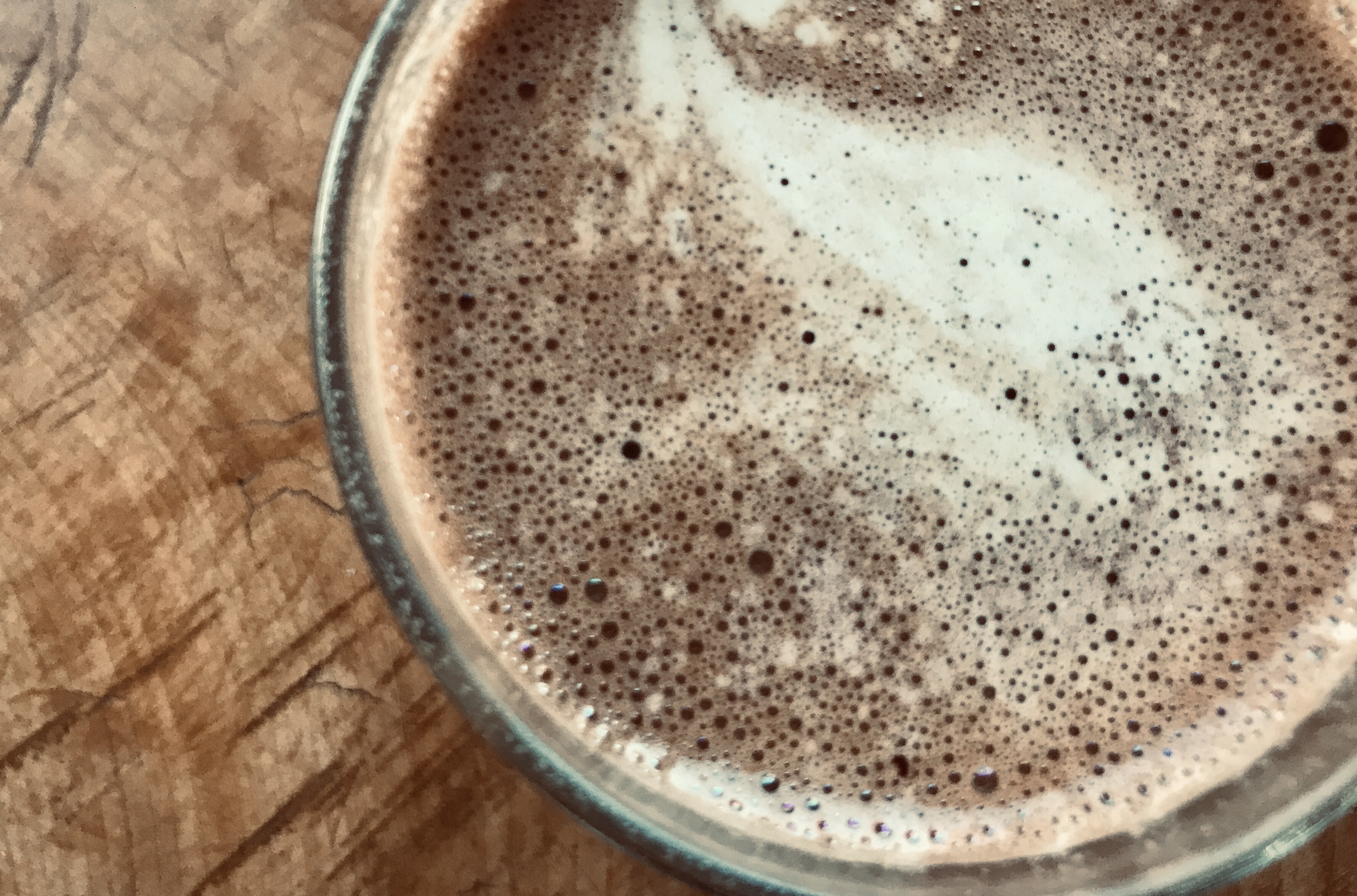
My 14-year-old meets me at the coffee shop in town on her way home from school. I close up my laptop and clear the table of my papers. She sits in the window drinking hot chocolate and talks and talks.

She’s making a phone call that afternoon with a stranger for a program reference, and I see she’s been thinking about that phone call all day. She’s not someone who likes talking on the phone. And to someone she doesn’t know?

In a complete non sequitur, she lifts the gingerbread cookie she’s eating and says that’s exactly the kind of cookie she wants to bake.

Looking at her, I marvel at how she’s all teen — both worrying and taking pleasure in that worrying — in a this is my thing, my life, what I’m doing kind of way.

Her grandparents have a sent her a small box with a card. When she lifts the lid, the box opens into a pop-up Christmas tree, and she laughs and laughs.

A group of teenagers come in the door, stomping snow from their boots. The barista says, Here’s the future.

Do one thing every day that scares you.

Eleanor Roosevelt

IMG_6953.jpg

Bloody Nose

My daughter’s nose has been bleeding for days — a trickle, a stream, and suddenly she bleeds steadily from both nostrils.

7:30 on an utterly dark evening just after Christmas: we’re at a gas station at the edge of town on what feels like the coldest evening of the year. Save for a teenage boy in the convenience store, playing on his phone, no one’s around.

While my older daughter hands paper towels to her sister in the car, I stand under the florescent lights and call the ER. What’s the threshold for a bloody nose? I ask. I get fever, but when I should I worry about a bloody nose?  Utterly unconcerned, the nurse tells me I’ll know.

On a post beside me, I read a dirty sign — Fresh Sandwiches To Go — and wonder how many years ago that sign was someone’s bright idea.

I’ll know?

Through the car window, I see my daughter’s eyes, frightened.

Over the holidays, my brother told her all minerals were formed in supernovas and made their far way to earth through meteorites. How cool is that? he said. Our bodies are created from ancient stars.

A single pickup truck passes along the two-lane highway.

The night is utterly still, the darkness beating around us — alive — the pulse of the universe, miraculous with ancient remnants of stars, my open eyes at the edge of the infinite unknown.

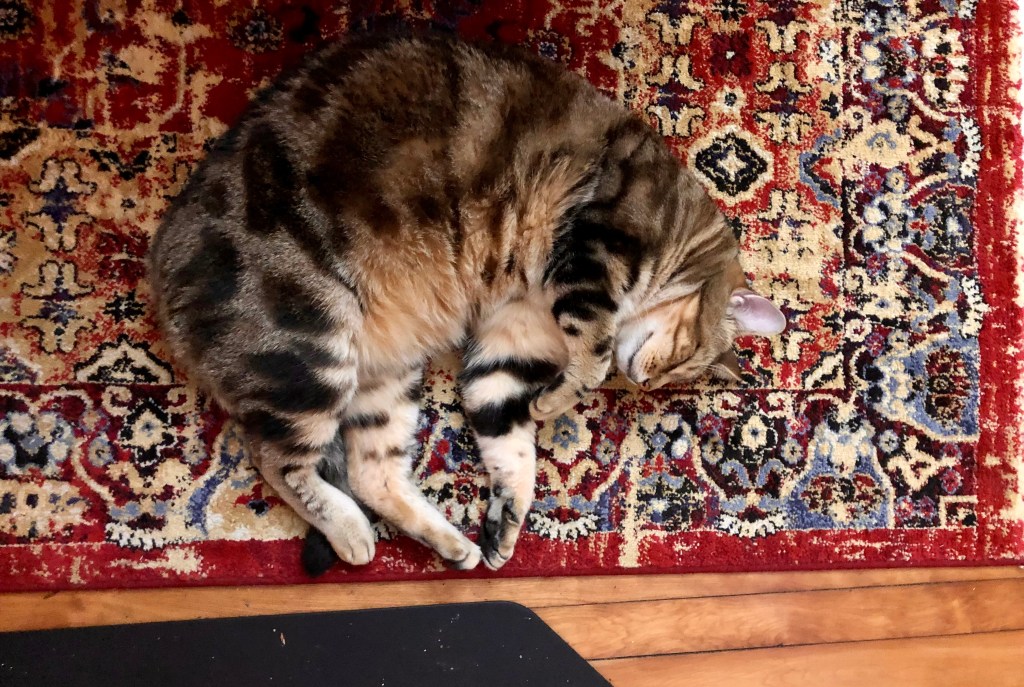
Then we head home, where the cats sprawl, sleeping.

IMG_4259.jpg