What’s at the heart of a story?

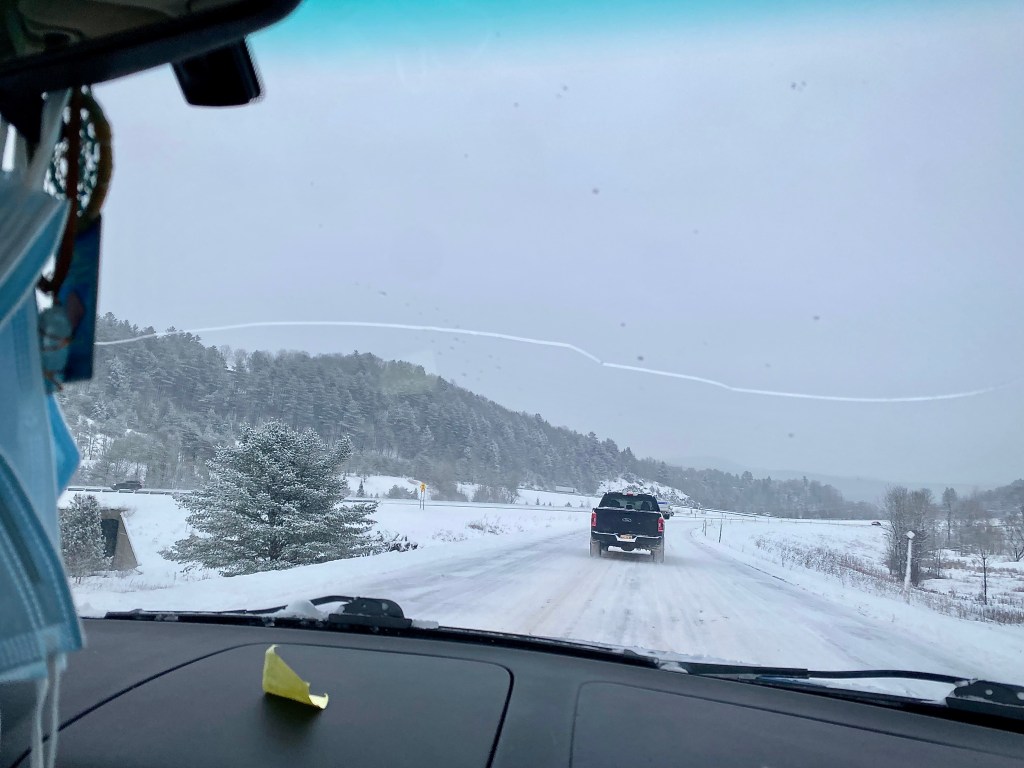
Crack in the windshield, the snowy interstate, the winter metaphor for this cancer journey.

25 hours. Here’s a smattering of highlights… A hard-knuckled drive on unplowed and marginally plowed roads, a side stop to avoid a collision on the exit ramp. Who knew these things gathered such snow? The town lights dimmed by snowfall. On a hotel’s second floor, I lay in bed talking to my siblings while my daughter ate chicken curry. In the bleach-smelling night, I limped up and turned off the heat, stood at the wide window looking out at the neon lights across the midnight-empty highway. The storm had ceased; the neon gleamed GARDEN, so brilliantly red and commercial that, in my sleep-addled mind, I couldn’t pair that word with loamy soil, coiled earthworms, the promising nub of May sugarsnap peas. Unable to sleep, I lay awake, parsing together a story: hook, conflict, and what does resolution mean, anyway? What’s at the heart of a story?

In the early morning, two full lanes of traffic streamed towards Dartmouth Medical Center. On the short cold drive, we drank hot coffee. From here, the story unfolds into the parking garage, blue paper masks, the complexity of so many stories, with so many words. The words alone are brand-new to me — Doxorubicin, Methotrexate— and I labor to learn these, to put pieces of what I can know of my story together. The wide halls in this building soar high, softening voices as the daylight falls down. Always, I hold in my body this conflicted and twisted sense of how much I do not want to be here and how immeasurably grateful I am to be here — but more, too, the profound and sacred sense of so many people, patients and families and the immense staff, each with their own mighty stories, living these stories, in pain and in joy.

In the infusion room, where I sleep and sleep, this time no longer needing small talk, I wake and watch the juncos and chickadees, the nuthatches, flitter in and out of the hydrangea bushes with their brown last-year’s blossoms, perch on the feeders the nurses fill and tend.

The interstate home is clear. The cats yowl for dinner. My house is warm, the dishes washed, the hearth fed. February. The story spins on.

Born in 1933…

William Maxwell writes in his riveting short novel So Long, See you Tomorrow: “The reason life is so strange is that so often people have no choice.”

This strange world, indeed. My daughter drives us up Vermont’s long loneliness of I-91, the interstate running above the river. Villages are tucked into the blue and snow-sprinkled mountains, these tiny clusters dominated by spires of white clapboard churches. This has been a week of in-and-out of ERs and hospital rooms, of resurgence in energy and a low so low I’m unable to bother to speak. Now, the ride home, the passing through of this winter country, where the new snow (so pure white) piles high on tree branches. This northern land in midwinter is territory I know with a familiarity akin to the veins on the backs of my hands. A haven of cold, often slow-going, a muted palette of pale blue, sooty gray, evergreen nearly black.

We talk until we’re spun out from chatter. I lean my head against the cold Subaru window. In the last room where I stayed, my companion was a woman born in 1933. 1933 marked the end of Prohibition, the year stenciled on the green-glass-bottled Rolling Rock beer we drank in college. 1933, the year of Roosevelt’s New Deal. The woman’s voice was clear as a spring stream, often studded with small wry jokes. When she saw me, her face glowed in a smile. Of all the things I’ve learned from this week and scribbled into my notebook, this woman’s radiant smile and easy language sticks with me. A few times, I wandered her way, hoping to have some of her joy rub my way.

Mirth in the mirthless. A great mercy.

Mirth in messiness… another night drive to the ER, so cold, what were we leaning into? Five degrees, maybe six? The stars above the river ice a mockery of light. Kindness and Dilaudid, another scan, a hurry-up-and-wait, the three of us talking about nothing in particular save for a hike we once took in a thunderstorm and an orange water bottle confiscated (gone, forever) at the Albuquerque airport.

It’s the small hospital not far from our house, not the cancer complex with its soaring blue-green glass. On this zero-degree night, my daughter presses her feet against the room’s wall heater. There’s hardly any patients, save for a man we never see who insists that he must be heard. In the night of dim small lamps, I sleep and wake, talk with a woman from the high plateau country of the upper midwest. She remarks wistfully that Vermont is too tiny and cramped for the sweep of the midwestern sky. Maybe it’s just the Dilaudid, but when sleep folds over me, I dream of those childhood summers my siblings and cousins and I chased fireflies while the grownups drank bourbon and ate our leftover birthday cake and kept at their two-week conversation. The dew washed our bare feet.

The hospital morning flicks on before the sun has dulled the night’s darkness. Mirthless, indeed, I become, crabby with human lack and inhuman fate. Words, words, mine and others’, in a repeating loop. I text my nurse friend. On her lunch break, she appears, and then there’s laughter from nurses in my room. People come and go. I sign for more billing. (How much is this going to cost me, anyway?) The chaplain appears who’s read my book and wants to talk Flannery O’Connor and death. I’m not about to be funeral planning for myself anytime soon, but I plunge right into that death question. Indeed, this wretched cancer, my uninvited guest, perhaps the truest teacher of my life.

He asks, To know to savor every day?

Oh sure. But the disease has whittled me down to a glittering core, to ignore the petty fluff that not so long ago stung my eyes, and certainly my heart, too. What remains is real, both beautiful as those fireflies winking in the sultry midwest night, and ineffably, unbearably sorrowful.

I intend to live a long life; I’ll at least go on for some while, which is all any of us can say. In the meantime, this rarefied illness journey? Not lacking for writing material.

From Flannery O’Connor, The Habit of Being (1988):

In a sense sickness is a place, more instructive than a long trip to Europe, and it’s always a place where there’s no company, where nobody can follow. Sickness before death is a very appropriate thing and I think those who don’t have it miss one of God’s mercies.

What the living do.

I’ve written about the strange and often terrifying world of cancer here over the past few months. In the past week, my eyelashes have thinned. At first, my eyelashes looked as though I had walked through a rainstorm. I’m not at all adverse to rain and lousy about remembering a jacket, so I often end up in a deluge. Last July, I explored trails on a friend’s property. Over the past years, she’d designed and cut narrow trails. I walked through what seemed like enchanting forests of moss, stands of cedar so dense the light darkened, around a former beaver pond filled in as swamp, and finally discovered great white pines. She had unearthed pieces of white quartz and marked the edges of the trail. Walking back, rain fell, hard. By the time I reached my Subaru, I was drenched. I wiped my face on a sweater I’d left on the passenger seat. In the rearview mirror, my eyelashes held crystals of raindrops, diminutive pieces of that forest’s quartz.

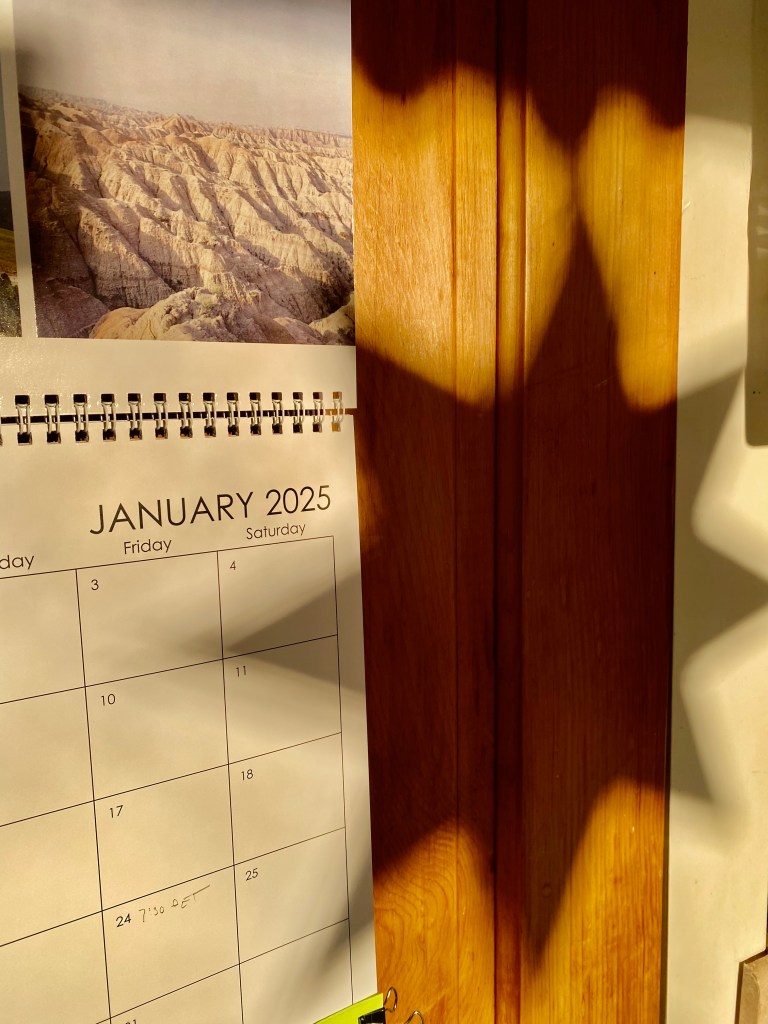
January, temperature hovering around ten degrees, rainfall is in no immediate forecast.

As an andidote to the national clamor, here’s a few lines poet Marie Howe wrote for her brother from “What the Living Do.”

Johnny, the kitchen sink has been clogged for days, some utensil probably fell down there.
And the Drano won’t work but smells dangerous, and the crusty dishes have piled up

waiting for the plumber I still haven’t called. This is the everyday we spoke of.
It’s winter again: the sky’s a deep, headstrong blue, and the sunlight pours through

the open living-room windows because the heat’s on too high in here and I can’t turn it off.
For weeks now, driving, or dropping a bag of groceries in the street, the bag breaking,

I’ve been thinking: This is what the living do….

In-Between Season.

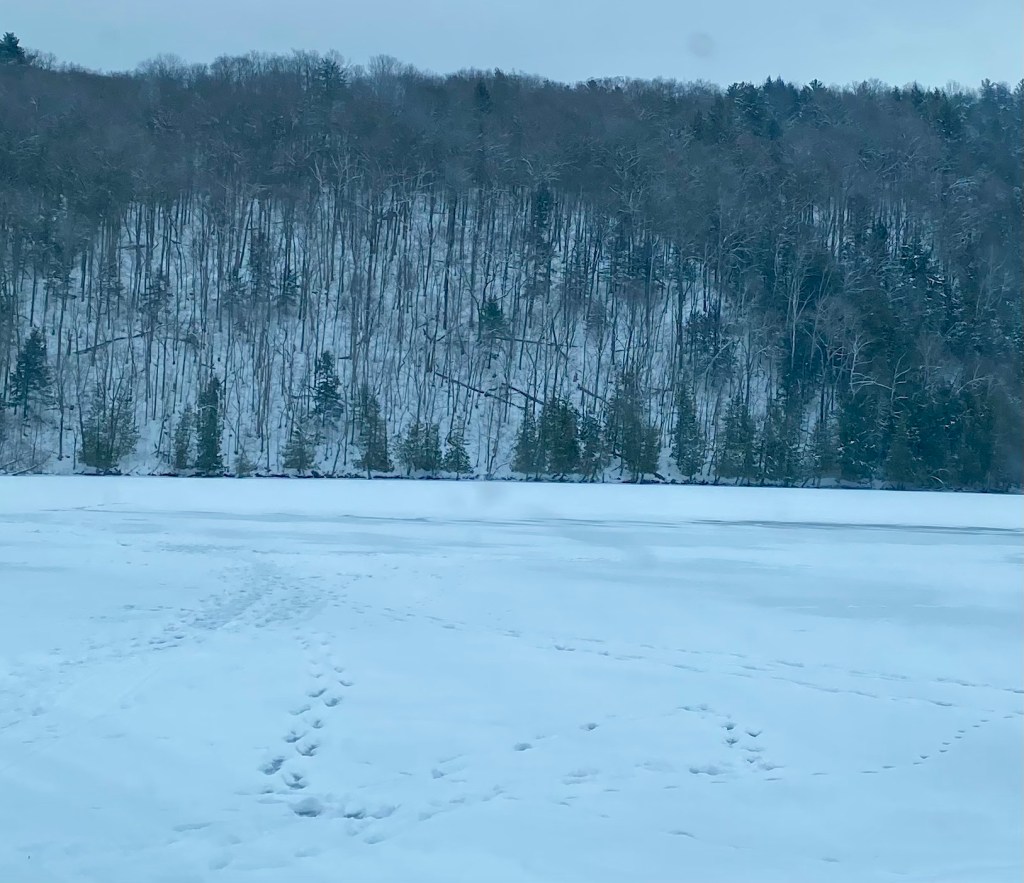
My daughter drives me to the high school where a few cars are parked, likely basketball players getting in a few extra workouts. We walk for a slow bit on the sidewalk and then drive north, up along the Black River towards Eligo Lake. At the boat launch, she turns off. We sit. Someone’s been out on the ice.

We are in the in-between season, neither Christmas nor New Year’s, 2024 finally spun down to nearly nothing, a whole new year, beginning with that wintry January looming large.

I am in the in-between season, too. Were it not for antibiotics and chemo, I would have passed from this world, or surely be heading that way. I am in the holding season, enduring, enduring, the chemo (and I’ll admit how terrifying chemo is, crimson red, fluorescent orange) destroying the lymphoma, draining my strength — and yet I’m still me, mellowed in many ways, stripped of patience with foolishness in other ways.

The December this daughter was two, snow fell every day. In January, the snow kept falling. The garden fence, the sugarhouse, the driveway and road, vanished in windswept white. This was before the age of internet. I stirred batch after batch of homemade play-doh. She had a doll stroller with a striped seat and pushed her babies around the house. Outside, I pulled her on a sled though the woods We looked for tracks, caught perfect snowflakes on our mittens. That winter seemed eternal, too, but it was not.

In the cancer world, or not, we’re always in the in-between season, life ebbing and rising, children growing, the snow pillowy but for a moment before settling to ice, washing away in rain.

Everything Is Made Of Labor
Farnaz Fatemi

The inchworm’s trajectory:
pulse of impulse. The worm
is tender. It won’t live
long. Its green glows.
It found a place to go.
Arrange us with meaning,
the words plead. Find the thread
through the dark.

❤️

In the night, snow. My youngest ventures downstairs from her second-floor lair and feeds the wood stove, asks if I’m still reading, and don’t I think I should be getting some sleep… Around my knees, the cats yawn at her, nestling into their cat-dreams for a winter’s sleep. Outside, the town plow rumbles up our road, backs around, beeping, and disappears into the falling snow.

2024, a year that’s meant so much to so many. In our house, the year my mother died, the year I almost died, too. The inside-out year of reversal. In these quiet December days, getting better, getting stronger, getting weaker, moving along that jagged zigzag towards health, I’ve been lucky to read and think, to be warm and tended, to savor small sweets. Games of gin rummy. Poems Jo reads in her clear strong voice and sends every day. Brad’s photos of wintry Lake Champlain, luminescent portals of ice and drooping snow and runny sunsets. For so many of you, some whom I know well and have gone in and out of the depths of friendship and family, and some whom I hardly know, the circle around me has made all the difference.

When I first knew I had cancer, an acquaintance who had survived breast cancer told me it was the loneliest experience of her life. Like anyone, I’m well-acquainted with loneliness, have battled this shackled companion through divorce and betrayal. Where now has fate sent me? Illness was a forbidding shore where I never wanted to land my kayak, bend down in the cold murky waters and hoist my flimsy craft to safety. But illness is our common terrain, and those who dwell here – through happenstance or vocation – welcomed me in with compassion. As The Good Doctor told me, We are all patients. More plainly, perhaps, we are all mortal, conjoined.

Wishing you all some radiance from Vermont, prettied up this early morning beneath a downy snowfall….

“The Verge”

Reason is a fine thing, but remember there are other ways
to live: by instinct or passion, or even,
maybe, by revelation. Try it. Come around again to the verge –
that place of about-to-open, near where we comprehend
and laugh and see. Why shouldn’t something marvelous
happen to you? Take even an occasion like this:
A man reading at night looked up at the window to find
a moose looking in, interested and unafraid
with quiet dark eyes. He reports he has never been the same;
he finds the ungainly and miraculous everywhere.
He said it started the next night in the empty window
as he watched his reflection looking right back through.
He said he saw his own beauty, how even in his same old face
the quiet eyes were curious and ready to be true.

– Annie Lighthart