Is that church door open?

About a year before my mother died, I visited my parents in northern New Mexico. My mother was on 24/7 oxygen then, which she understandably chaffed against, and I took her on long drives so she could leave the house. One afternoon, I drove the rural roads to the Lamy train station. Take the Amtrak to Santa Fe, which I’ve done, and you don’t disembark in the quaint plaza town. 20 miles outside the adobe city, there’s the small Lamy station and an old saloon named the Legal Tender, and not much else. I parked at an old church that appeared to be abandoned and told my mother I’d be right back. I called over my shoulder that I wanted to see if the door was open, as church doors often are. When I looked back, my mother had her car door open, one foot on the earth, determined to follow me. She said cheerily, “I’ll come, too.” She was attached to a heavy oxygen tank on tiny wheels. The terrain was rocky, and there was no way I could navigate my mother to that door.

Somehow, I talked her into staying in the car. That was my mother, usually up for an adventure, willing to rattle a locked door, peer through a window, maniacally curious. It’s me, too.

In these brown-grass April days, as I begin to walk again, further and further each day, I think of my mother, how she would search for daffodil buds and admire the blooming snowdrops. Robert Frost is famous for his line, “In three words I can sum up everything I’ve learned about life: it goes on.” Bitter, perhaps, or maybe not so. Having faced my own (blessedly at this moment passed over) demise this winter, I’m beyond happy to immerse myself in the stream of life going on…. This life.

I woke this morning with a dream that I’d never had cancer. In the dream, I’d overslept and was late to work…. I was sweating, nightmarish. The dream haunted me all morning, trailing me, while my dear friend visited and brought me birthday presents that reminded me of my mother, and then fetched my library books so I could lie on the couch these afternoons and recover from this last cancer dose. When she’d left, I slept again. When I woke, the dream had broken and lay on the floor like broken glass: rubbish.

Such a labyrinthine world – mothers and daughters and granddaughters – disease, too. In these still days, waiting for spring’s rushing green, I embrace what I know, and that I never will.

… we are all

the dead, I am not apart from you,

for long, except for breath, except for 

everything.

~ Sharon Olds

A fluttering stir like a fledgling first stretching its wings…

On my way home (again) from Dartmouth-Hitchcock Medical Center, I’m at a pharmacy, picking up prescriptions. The one I really want – the pain meds – is apparently not available, simply not stocked, which surprises the heck out of me. It’s a common opioid. In my brother’s car, I phone Dartmouth, miraculously reach a nurse who sorts out my problem swiftly. My brother drives down the road, where another pharmacy tells me I’ll need to wait.

In a dusty midafternoon sunlight, I take him on a downtown tour of Barre, around the courthouse where I spent so many hours. I point out the window where I stared at the chickadees in the crabapple trees. We keep going and walk around the Civic Center where my daughter and I went to basketball games. The lot is empty, dirty with winter sand. We talk for a bit about these neighborhoods and where we grew up, our mutual interest and speculation in local history, how towns rise and diminish.

In the Walgreens parking lot again, I pull up my sleeve. Where a nurse recently pulled out an IV, the band-aid is soaked. I show it to my brother. “Don’t touch,” he tells me, as I wince, creeped out. “We’ll clean it when I get you home.”

That blood-soaked band-aid, in a filthy parking lot, feeling beat down to hell and just wanting to head home, wash off the hospital reek and nuzzle a cat, but waiting for pain meds… is a sliver of cancer. In Walgreens, they’ve received my prescription. The pharmacist asks me if this is going to be an ongoing thing or what.

Hello, I think. I am clearly a cancer patient, with my scalp wrapped in a sparkly scarf and my eyes underscored by lines. The backs of my hands are red-dotted with red needle sticks from blood draws. My fingernails are broken by chemo. But there’s enough of me, yet, to lay into the pharmacist and both get my prescription and make him apologize. I know the deal about opioids. I’ve published a book that included Walgreens’ role in the devastating opioid crisis. Nonetheless, I’m determined to get my 21 pills, and I’ll send family back for the remaining allotted 21 pills, and I’m darn grateful for that. This, I tell him, is getting me to the finish line. And I’m going to get there.

I ante up my $4 copay, and then my brother drives north, over the Winooski River, where I happily point out the first spill I’ve seen of coltsfoot this year.

Later, at home again and opening my email, I’m gratified to read that my essay “Red Devil, Survivor Herself,” has been accepted for publication this April, my way of rowing against disease. A line from the essay reads: “Here’s a lesser known side effect of my chemo mixture, cisplatin: lying in bed, a whooshing revolved in my left ear, a fluttering stir like a fledgling first stretching its wings.”

Last, if anyone is so inclined, my youngest has signed up to walk in Dartmouth’s Cancer Center‘s annual fundraiser. Many thanks again, all, for reading my words. Happy April, wherever you may be.

From Donna Tartt’s The Goldfinch, my hospital read:

And I add my own love to the history of people who have loved beautiful things, and looked out for them, and pulled them from the fire, and sought them when they were lost, and tried to preserve them and save them while passing them along literally from hand to hand, singing out brilliantly from the wreck of time to the next generation of lovers, and the next.

An umbrella walks past…

File this week under “the best-laid plans of mice and men go oft astray,” or, just because I desire something has no factual bearing on reality. (Is there a message for national politics here?)

My sixth and infusion has been delayed, as I’m admitted, again, at Dartmouth-Hitchcock. Two days before that scheduled infusion, I woke around 11 at night and phoned my older daughter who was just getting into bed. I said, “You’ll have to take me back to Dartmouth again.”

In a thick fog, she drove my mother’s blue Subaru down the interstate along the wide river, with sparse traffic and scant words from me. In the ER, late, late, we’re taken into a room, and the usual questions and IV and meds began. The nurse remembered me from my previous visits. In a rocking glider, my daughter slept a bit while I wondered at the light’s hue: amber, or tinged with orange, like heating lamp mixed with a gentle reading light.

Eventually, awake for over 24 hours, my daughter heads home to sleep. My oncologist appears and reassures me. “You’re getting there. A few days later, but getting there.” Our conversation drifts into where I’m heading in this new phase of disease – recovery, oh say that word again, recovery. What will this mean for me, and how will my life change? We talk a little about trust, and he mentions that, once trust is broken, it’s nearly impossible to mend that damage, a fine thing ruined.

So here I am, in yet another bend of this journey, learning patience, learning something more along the tenor of faith, that whatever is not within my sphere of influence is not mine to alter, such as these days here.

April. My younger daughter brings me blooming hyacinths and bulbs in a glass vase. The doctors talk with me about Donna Tartt’s The Goldfinch, and if the federal funding for Vermont’s interlibrary loan system is jeopardized. I tug at the strings of normalcy coming my way: a nurse’s trip to Des Moines a few springs ago and the city’s tulip beds; a friend’s email about dropping a car at airport for her husband; another friend reads Mary Oliver and sends me recordings; will my cat sitter eat whatever I’ve left in the fridge? Small things that stitch our lives together.

Spring rain:

telling stories,

a straw coat and umbrella walk past

~ Yosa Buson

Backaches and all.

Snow returns to Vermont; I remember an April 1st years ago when the snow fell so mightily our sugarhouse was hidden. I worried our toddler might get lost in the drifts.

These (early spring) afternoons, I walk around my garden where last autumn’s sunflower stalks still stand. The robins, those cheery birds, cluster. Redwing blackbirds sing joyously.

I’m nearly at my last chemo session – yes, counting down day by day, my simple math calculations and not-so-simple life. Mornings, I pull myself together to work; afternoons, I lie on the couch with my cat and read. The town library orders me interlibrary books. Recently, Blue, an illustrated memoir of St. Bart’s that I read in a few hours, a sojourn into a Caribbean vacation with a sweet family. I will be traveling nowhere outside the country, anytime soon, although I dream…

Where I am now is different terrain. My house has sheltered me (and my family) so warmly and kindly during this winter of disease. Now, I see where our house needs tending – paint on the barn, boards hammered back on the porch where the ice crashed. Every spring and summer, too, I plant more in the gardens, cultivating good living for birds and pollinators, not necessarily the woodchucks who come, unbidden. There will be no wars on my patch of hillside.

The bigger work for me now is healing; how happily I’ll shed medical appointments, the world of sickness, and savor my long walks again. My oncologist told me last fall that someday I’d forget I ever had lymphoma, and I’d forget him, too. Maybe someday if dementia drills into me (many many years from now). I would need to live a long long life if I were to forget this year.

In these winter months of cancer suffering, I’ve longed for many things, but prominent among these desires is to imbue this cancer with meaning. So now, as I’m beginning to contemplate my next steps, the spring and recovery phase, I’m determined to not slip into old habits or careless living. I mean nothing sentimental about this, as if plastering a gratitude sticker on my life will fix up my world.

Which way this will go is yet to be determined. Certainly, planting more perennials.

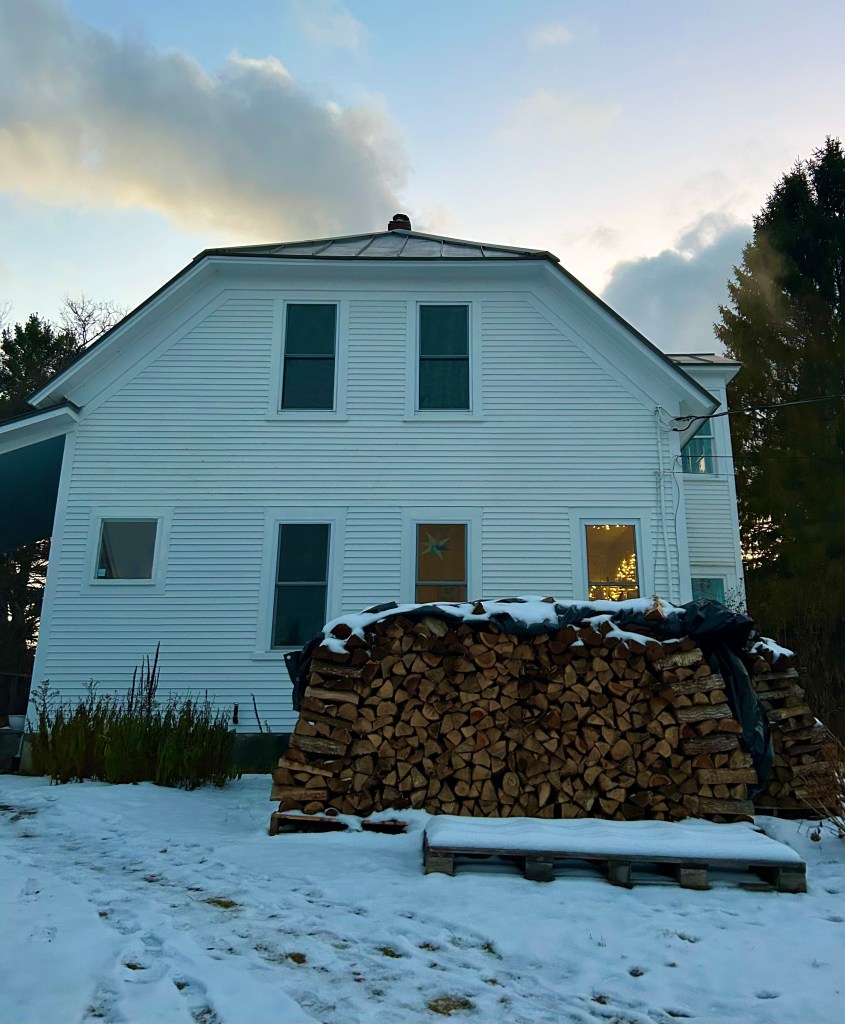
Stacking wood today

I thought how much I loved this life,

Backaches and all.

~ John Straley

After an absence, return.

Photo by Molly S.

A long while away from this space after a day last week that began easily enough in our kitchen with my daughter and transpired into another Dartmouth ER visit and a prolonged stay. Days and nights chopped into mosaic pieces. MDs and RNs, the revolving cast of the Dartmouth surgical team, my daughters, pain meds, ice chips, me sitting up and begging for a patch-up to get me to my next chemo appointment… Get me out of this chronic patient repeat.

Now, five of the six chemo treatments completed, I am in the final haul. While my in-box filled up (thank you for your patience), and I was moved from room to room by kind people, I kept thinking of this cancer in a narrative arc. I had hit the section of story where the impossible commences. Before, things looked grim. But now, as protagonist in my own story, the arc swerves sharply, the longed-for light-at-the-end of the tunnel snuffs out, the path is hidden.

I’m not a writer for naught, for make-believe or play. I’m a writer because I know our lives tread meaningful albeit sometimes horribly hard paths. Lean in, I counseled myself, my shoulders far skinnier now but just as fierce. Use math. Get to the fifth infusion. Get to the sixth. Count down the finite days to the end of this treatment, which is, thankfully, eradicating the cancer. In the mosaic: my two daughters, the plastic IV tubing, the doctors in their masks, the ER nurse who stayed long past his shift in the middle of the night, holding my hand and assuring me that, yes, indeed, I would endure.

This is my story, but also the human story, in all our infinite variations of human desire, choice, the immutability of fate.

Sunny morning in our kitchen, birdsong, the fierce thrust towards spring.

Go for a walk around the block?

March 7, my father’s 88th birthday today in what is doubtlessly sunny New Mexico. So much for my plans, months ago, to visit him on this day.

Here’s the thing about living such a long life — I could pick countless numbers of things to write about, but what I woke up thinking about this morning was how my dad would often say, “Let’s go for a walk around the block.” At any time of day, we’d set off. Sometimes just up the street and actually around the block, or other afternoons on hours-long rambles through the woods behind our neighborhood. We walked in sunny days, through sleet, through knee-deep snow, in the sweet spring rain. It’s a habit all three of his children have continued our whole lives, and his four grandchildren, too.

Sunny, here, in northern Vermont, too, a day of such optimism that the blue sky choruses the inevitable promise of spring. And for my father, one of our favorite poems from the unmatchable Hayden Carruth.

Birthday Cake

For breakfast I have eaten the last of your birthday cake that you
had left uneaten for five days
and would have left five more before throwing it away.
It is early March now. The winter of illness
is ending. Across the valley
patches of remaining snow make patterns among the hill farms,
among fields and knolls and woodlots,
like forms in a painting, as sure and significant as forms
in a painting. The cake was stale.
But I like stale cake, I even prefer it, which you don’t
understand, as I don’t understand how you can open
a new box of cereal when the old one is still unfinished.
So many differences. You a woman, I a man,
you still young at forty-two and I growing old at seventy.
Yet how much we love one another.
It seems a miracle. Not mystical, nothing occult,
just the ordinary improbability that occurs
over and over, the stupendousness
of life. Out on the highway on the pavement wet
with snow-melt, cars go whistling past. 
And our poetry, yours short-lined and sounding
beautifully vulgar and bluesy
in your woman’s bitterness, and mine almost 
anything, unpredictable, though people say
too ready a harkening back
to the useless expressiveness and ardor of another
era. But how lovely it was, that time
in my restless memory.
This is the season of mud and thrash, broken limbs and crushed briers
from the winter storms, wetness and rust,
the season of differences, articulable differences that signify
deeper and inarticulable and almost paleolithic
perplexities in our lives, and still
we love one another. We love this house
and this hillside by the highway in upstate New York.
I am too old to write love songs now. I no longer
assert that I love you, but that you love me,
confident in my amazement. The spring
will come soon. We will have more birthdays
with cakes and wine. This valley
will be full of flowers and birds.