Crisis of Faith

Exiting the interstate at midnight last night in rainy St. Johnsbury, it’s just me in my little silver car, the strange combination of lonely hearts’ radio and tinny country music, and that profound country Vermont darkness. That stretch of interstate rims the outer edge of utter nowhere.

Year ago, returning from a trip to my sister and her husband and their hospital-bound infant, my brother and I had trouble finding his snow-covered truck in the New Hampshire airport parking lot. Maybe it was midnight already, maybe not, but we certainly passed it, driving north on the interstate, where we stopped at a gas station and bought (and drank) terrible coffee. We were so tired we laughed until we were too tired to laugh, and then too tired to talk. Finally, at his house, his wife sat on the stairs and offered us take-out Indian food. I lay on the kitchen floor. Possibly, I even slept there, in a pile of boots and cat food bowls.

The next day, my friend and her 4-year-old drove over the White Mountains in a snowstorm to bring me home to my family — and my four-year-old. At the top of the Crawford pass, I got out of the pickup and brushed snow from the windshield and stood for a moment in all that white, not sure entirely where the unplowed road lay.

But I got back in. Her son waited patiently in his carseat between us. She kept driving. What else could we do? We couldn’t stay there. And, that, perhaps, is all I ever needed to learn about faith.

Miraculously, the snow lessened as we neared the Connecticut River, heading home.
IMG_5254

Return From Hibernation

On this unsurpassable, sunny, snow-melting April afternoon, I prop open the library door and stand on the walk. My patrons — a teenage boy, a near retirement age woman — stand there with me, the three of us collectively thinking, what the fuck?!  about this winter — as if a months-long temper tantrum has just passed by.

The school field is still a foot-rich with snow.

Later, as the evening cools, I walk through the crusty patches of remaining snow behind the house, discover there’s a patch of the garden open where I may plant my pea seeds.

I’m back in the cemetery, in my own sacred spot in this town. From the crest, I see the Dollar General with its faux brick and Woodbury Mountain, where bear live. Someone in the trailer park nearly concealed in a hollow is burning something, and smoke rings the mountain’s base. Overhead, a hawk catches an air current so fine the raptor sails out of my sight without a single flap of its wing.

The world? Moonlit
Drops shaken
From the crane’s bill.

— Eihei Dōgen

IMG_5201.jpg

spring kid crafts

After Unraveling the Sweater, Not the Mistake

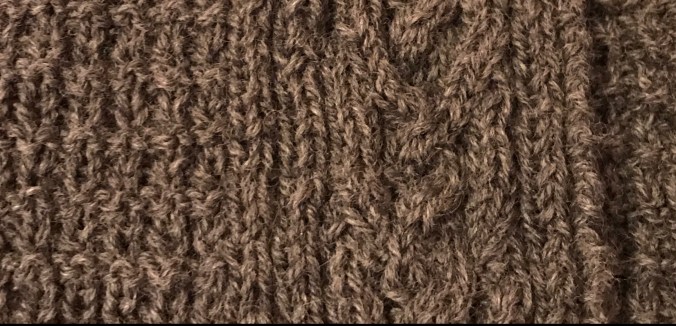
I’ve been knitting the same three balls of yarn over and over in different patterns for months now — perhaps a silly amount of time. I’ve knit half a vest, decided the shaping was off, abandoned that vest, begun a sweater whose gauge I never measured correctly, unraveled that and began again.

Sometimes at night, as I say good night to my daughters, I wonder about this day we’re closing our eyes to — and maybe this illuminates nothing more than my own crazy mind — but that day’s gone, over.

So many of my parenting days when the girls were young, I greeted the night with relief — the chance to close my eyes and be still. But there’s no re-dos on life, no taking apart and casting on again. That’s obvious maybe — that my life is not a ball of yarn to knit and knit — but those obvious things can be so difficult.

Hence, this early morning, gifted with a few more inches of wet white snow, I’m in my bare feet on the back porch, listening to the wind chimes, for the robins’ first clear notes of the long day ahead.

...It is no surprise 
that danger and suffering surround us.
What astonishes is the singing...

From Jack Gilbert’s “Horses at Midnight Without a Moon” — a short spring poem well worth the read…

img_5196.jpg

Magic Trick

Like a great joke, a few more inches of snow arrived on April Fool’s Day. By afternoon, however, the day evolved to a breezy sunniness, brisk but radiant. I walked with writer Natalie Kinsey-Warnock to her car in the Woodbury School’s dirt parking lot. It’s Woodbury — the village built in a swamp — and, for that moment, there’s nowhere I’d rather be. In the treetops, blackbirds sang crazily. Why not? It’s Vermont spring.

Natalie shared stories with the school kids today, and at one point, I couldn’t figure out what she was headed — how did a 1865 steamboat catastrophe in the Mississippi River figure into rural Vermont?

Then, abruptly, like whisking an indigo rabbit from a top hat, the story shimmered. It’s as though Natalie unfurled one of her grandmother’s handstitched quilts, and the connections between the history’s enormity and this woman, and these children and their own place in history, lie visible as much as can anything can be seen in history’s rough beauty, the concealed pieces teasingly beckoning.

I’m the librarian, the hostess of this event, the timekeeper to move this along, make sure the kids have time to grab their coats and catch the school bus, but for these moments I’m merely me, surrounded by these rapt children, loving this particular story.

Oh, the long days of circling to sow and reap,
but, O, those few days on the river each year.

— Leland Kinsey, from “Northern Traverse”

IMG_5082.jpg

One Gallon of Paint: What It Creates

My daughter and I paint my bedroom a light blue that reminds me of a bedroom I painted the summer I was 21 and living in an old house in Brattleboro. Those hot months, I was waitressing at the Skyline Restaurant, making great tips. On my days off, a friend and I painted much of that house and drank gin and tonics. While my afternoons of G&Ts have long passed, painting hasn’t.

I pour the paint into the pan; my daughter gently sets her cats outside the door and then takes the roller from my hand. I got it, she says. I stand back, offering my pro tips about using enough paint, and she repeats again, gently, I got it.

Truth is, she does.

I pick up the paintbrush and continue cutting in, keeping ahead of her in some kind of way. After a while, she hands me back the roller and heads out to her cats who are stretching their paws under the door.

Listening to the redwing blackbirds through the open window, I wonder about the paint and wallpaper layers in this 100-year-old house. Who’s been here, over these years? Us, now.

“Finding A Long Gray Hair” by Jane Kenyon

I scrub the long floorboards
in the kitchen, repeating
the motions of other women
who have lived in this house.
And when I find a long gray hair
floating in the pail,
I feel my life added to theirs.

IMG_5047.jpg

Birdsong, Mortality

Where the fields have opened up, robins flock in the trees, singing the melodies that always remind me of spring’s running water — icy cold and much welcomed, harbingers of green. These are the first flocks we’ve seen this year, and we’re doing what I’ve done with this daughter since she was a little one on my back — we’re searching out robins, these beloved spring birds.

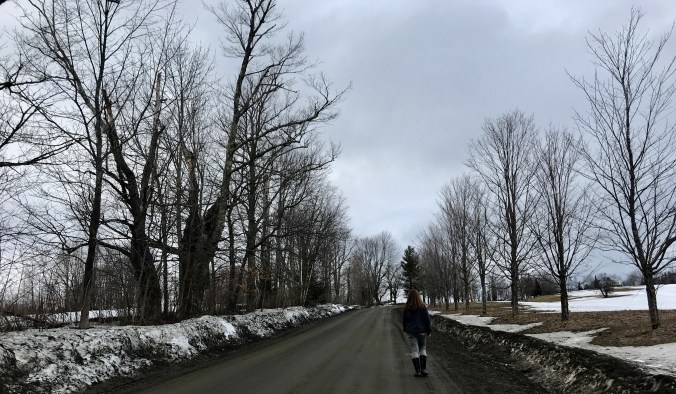
Same activity, different backroad. We’ve moved towns and houses, and so tinged through all of this cusp-of-adolescence for this girl is both the headiness of new experiences threaded through with loss. Impermanence, I remind myself over and over, sometimes daily, is the ticket price for all of us, even these little palm-sized birdies, the fat earthworms they’re devouring, and the stones in the fields, gradually giving up their edges to the elements.

We stop for a moment and talk about the dirt road behind our boots, the shape of its crown in the middle. Birdsong, wind, running streams. The fields are so wide open here we glimpse a herd of deer at the distant crest, just a quicksilver moment as they rush across the ridge and vanish again.

My daughter, humoring me, hungry for her late dinner, asks me, Are you actually talking to those robins?

Oh, that thin scrim between mind, body, landscape….

The more a thing tends to be permanent, the more it tends to be lifeless.

— Alan Watts

IMG_5030

Hardwick, Vermont