Rivers’ Roar.

Caspian Lake, Greensboro, Vermont

The rivers are running again. I pause on a Sunday morning run, on a large bridge state money funded for the rail trail project. The river roars in spring lust. People can — and do — drown in April. This season is as fierce as winter.

The countdown has begun, the green steadily eroding the brown.

A year ago, my family was quarantined with my daughter’s positive Covid test. Yet unvaccinated, I lay awake at night, wondering why I hadn’t yet written a will, why I hadn’t added my oldest to my skimpy bank account. During the day, I painted the inside of our porch windows a brilliant blue and listened to Derek Chauvin’s trial for the murder of George Floyd.

When the jury verdict was read, our quarantine had ended. My youngest and I were sitting my car, listening to the radio, waiting for her soccer practice to begin on a cold evening. A V of geese flew over the wet field.

Years fly by. Sure. But that year doesn’t seem like yesterday. It was one full year. While my daughter played soccer, I walked among the cedars along the river, watching the remaining pieces of ice dislodge and wash into water.

…. In other news, grateful for two lovely review of Unstitched in Montpelier’s The Bridge by Tom McKone and for Tyler Orion Glauz-Todrank’s review in Lucky Cloud Books.

Mixing Memory and Desire.

Note the wood smoke from our chimney….

Note this photo was taken yesterday afternoon, when I walked outside and nearly froze the soles of my feet. Note snow surrounded our house this morning….

Note that spring comes hard, hard, in Vermont. Jumping the starting block a few days, I keep thinking of T.S. Eliot’s lines:

“April is the cruelest month, breeding

lilacs out of the dead land, mixing

memory and desire, stirring

dull roots with spring rain.”

The first time I read these lines was in high school, digging into the poetry stacks in the school library, mesmerized by lines like Let us go then, you and I, when the evening is spread out against the sky….

Later, later, spring will bloom in all its tender-petal beauty. But for now…. T.S. Eliot knows the score in Vermont.

Somewhere in March.

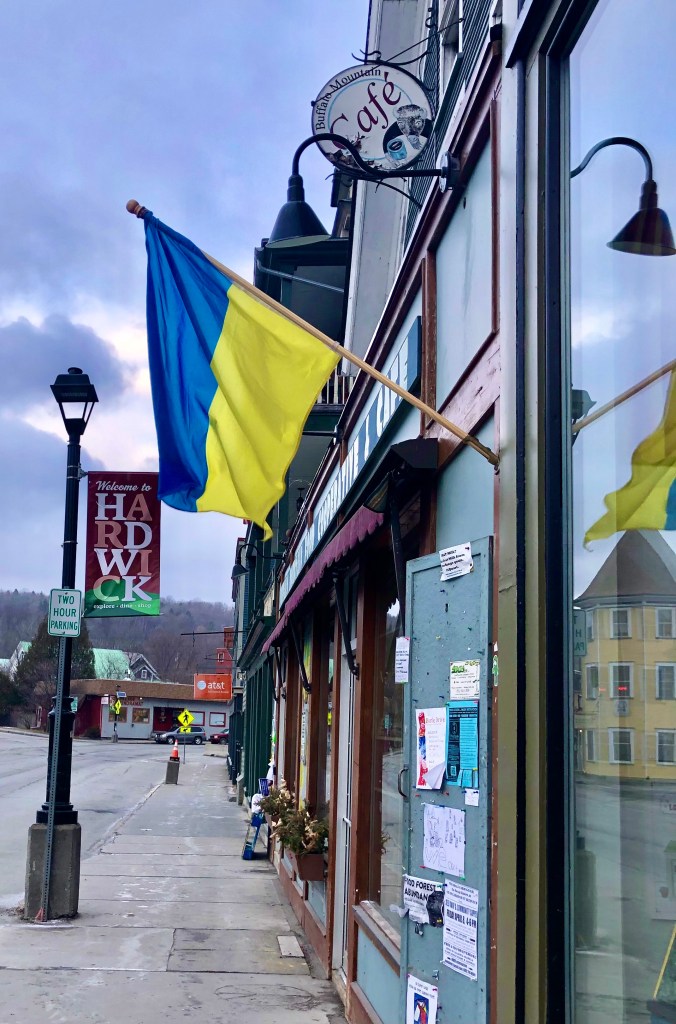
Hardwick, Vermont

Mud season is fierce this year. The school busses cease running on some roads. Families share photos of kids waist deep in mud ruts. Time, more than all the gravel in the state, is more likely to true up the roads than anything else.

Mud season is the odd shoulder season in Vermont. The skiing winds down. There’s no good biking. The tourists are all in sunnier southern locations, and Vermonters muddle along.

All day long, the prettiest and lightest snow falls — nothing serious, nothing much at all — just a scattering of the purest white and enough of a chill that the wood stove is welcoming when I come in with cold cheeks and armfuls of wood. I put a quiche in the oven and head out for a walk. The snow has (mostly) melted here now, and so my paths through the fields and woods have opened up again. Behind the elementary school, the turkey vultures circle over my head. They’ve just returned from their winter sojourn, to their long-time nest in a stand of white pines. I know what they want; there’s no secret here.

I hurry down the hill and along Main Street. A woman stands outside the laundromat, hands in overall pockets, staring up at the drifting snow. She raises one hand to me. I do the same, round the corner, and head home.

Gloves. Rain. A Few Sentences.

I spend some phone time with a woman who works for Delta Airlines, straightening out a cancelled ticket I need refunded. While she does whatever she needs to do on her end, I lean my head against the glass kitchen door. A light rain falls. I’ve just come in from moving firewood from our stacks to the porch, and my sweatshirt is sprinkled with damp bark shavings. I’ve forgotten my gloves on the back step.

I guess this woman is working at home as the phone line is quiet around her voice. She takes her time, sorting through my request and answering the questions I keep asking about airports and taxes and if she has any suggestions for better flight prices. (Nope.)

We exchange a mutual thanking each other for our patience, and inevitably our conversation tips over into the world’s instability. She tells me about her son, a college student majoring in history, and reminds me that human history is infinitely complicated. Finished, she’s on her way to some other phone call, with someone who might be impatient and angry, or perhaps someone funnier or more eloquent than me.

Through the glass, rain falls steadily on my gloves.

March in Vermont is wet and cold. This morning, stepping out for kindling, I stood in the dark listening to robins singing in the day. I remembered to bring in my sodden gloves.

Dirty Mud Puddle.

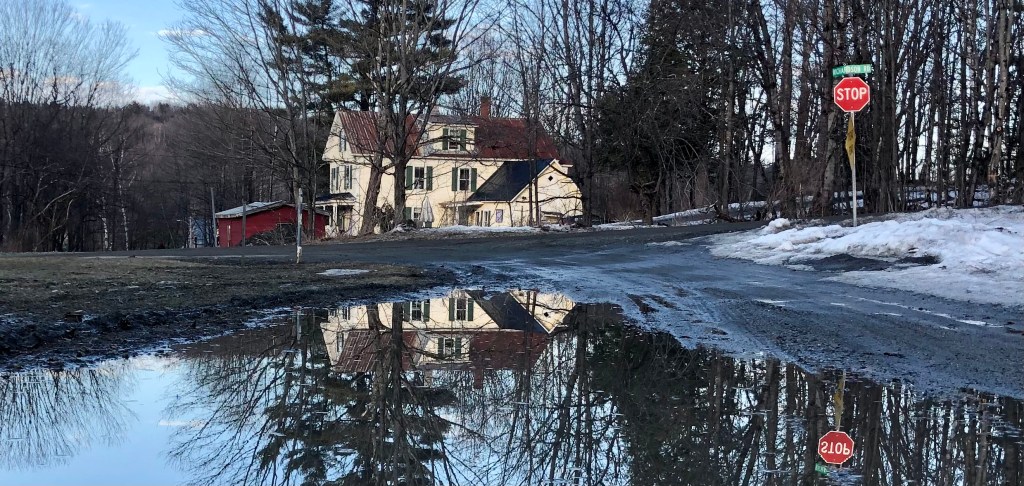
The old yellow house where my daughter attended preschool and, one afternoon, gave me a purple pansy she had potted herself. In the scheme of our lives, such a tiny sweet thing.

In the face of such hard news overseas, this splash of sky reflected in a dirty mud puddle is all I can offer. Be well, friends. Savor sweetness, where you stumble upon it.

House of Glass and Copper.

Albuquerque

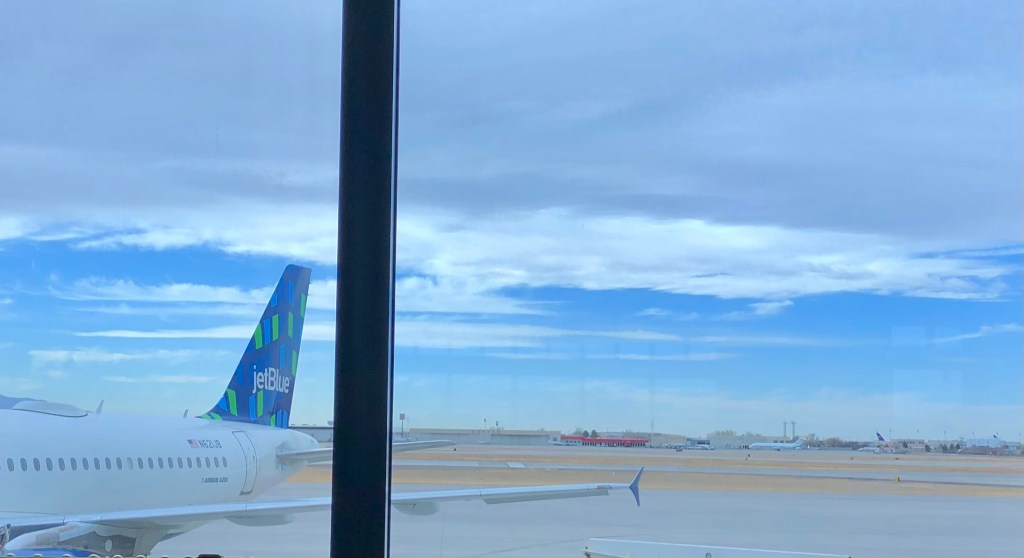
I sit between two strangers in the stratosphere between Newark and Denver. In the plane’s window seat, a young man reads The Habits of Seven Highly Effective People and encourages me to read it, too. He tells me he’s twenty-one and has begun reading books. Then he offers to adjust the window shade in whatever way I prefer. He asks how I can knit and read. I demonstrate how to do a knit stitch.

On my other side, a man is headed to visit his son. The three of us share pieces of why we’re flying, little scraps of our complicated stories. As we begin the long descent into Denver, the man to my left shares that this date is the third anniversary of his wife’s passing. He shows my seat companion and me photos of the slate and copper memorial he made for his wife. As his camera roll unfurls, glass conservatories appear. He builds these custom houses of copper and glass across the country.

The plane lands, and we exchange good wishes for our different journeys. The Colorado sunlight streams in through the window. Tired, I lean on the setback in front of me. We’re in a vessel of metal and glass, too, not so pretty as the stranger’s creations, but just as miraculous.

The Denver airport is suffused with sunlight from overhead skylights, too. I stand beside a potted tree, talking with my daughter about her plans for giving blood for the first time the following morning. Crowds part around me, looking up at the timetable on a screen, parents herding their little children. The line for my next flight forms. All of us are coming and going, joining and separating. I say goodbye to my daughter, walk to my gate, and head back up into the sky in that metal craft.