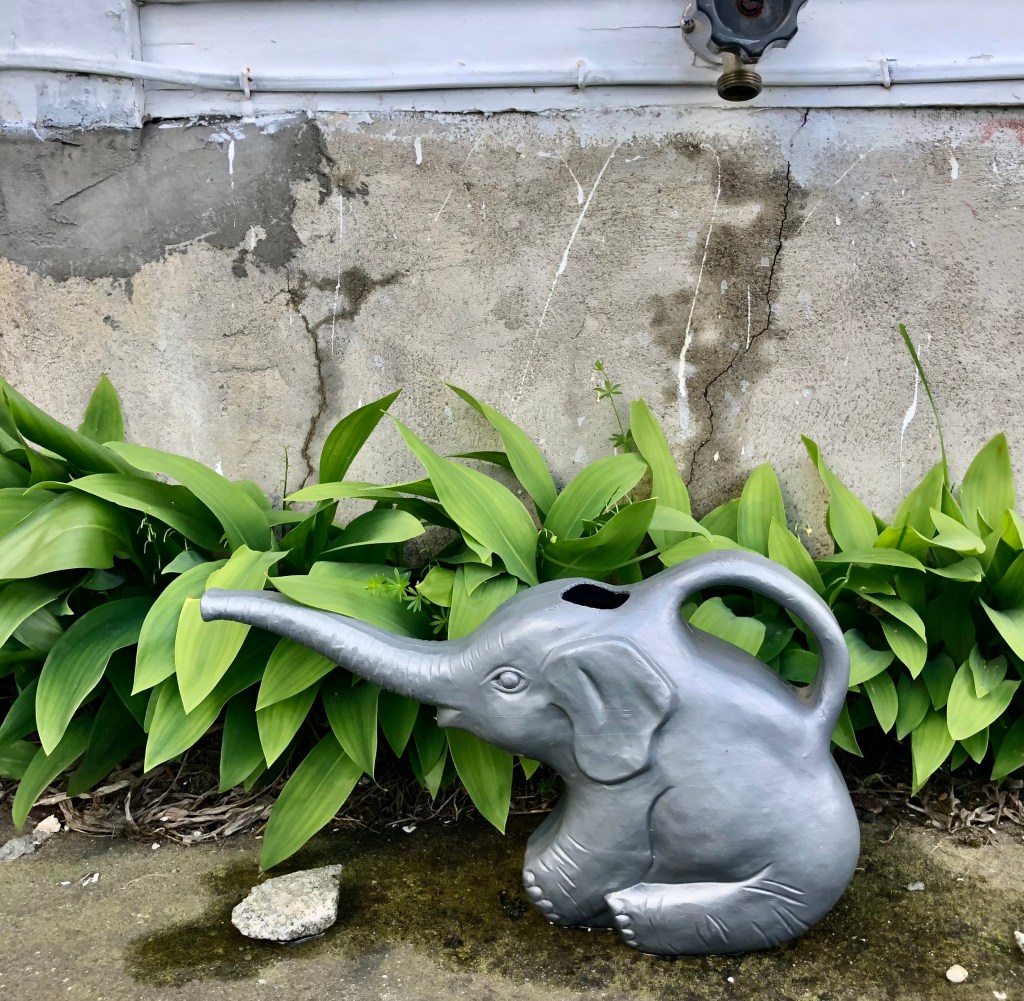
Peony Metaphor.

A few years back, owners of a stellar nursery gave me a cardboard box with a twisted root inside, tangled ends clotted with dirt. I planted as directed, and then the bartzella was at the mercy of nature and its own self whether it would grow, or not.

This June, the irises have flooded a purple pond around the lilacs. The mock orange is opening its snowy petals. And these yellow peonies with their ugly name — a few days of inimitable beauty.

A day of cold rain in the forecast today. A Saturday of writing and catch-up chores and my determination to do something about the mold on the bathroom ceiling. It’s mid-June. We’ve lived in this house for five years. The blossoms are rampart. I’ve added my own gifted dull root. For a few days, heart-pausing beauty.

This morning the green fists of the peonies are getting ready

to break my heart

as the sun rises, 

as the sun strokes them with his old, buttery fingers…

— Mary Oliver, “Peonies”

Acquaintance. Full Moon.

In an evening walk, I meet a woman I haven’t seen in years. We stop and talk for a few moments. She’s hardly been anywhere for the past two years, and we talk about how that feels. In the balmy evening, little bits of tree pollen float through the sunlight.

Never tall, she’s about my height now, and I’m really short, and I’ve gotten shorter in the past two years. But here we are, talking about lupines, happy to be alive. We exchange a hug — something that seemed forbidden, utterly scary, not that long ago.

Later, as I close up the house for the night, I walk across the dark lawn to my garden. The round moon, like a perfect drop of cream, rises. Frogs chirp.

Here’s one thing: the pandemic has made me think of each day as each day. A whole day — filled sometimes with hard things, or dull things, sweetness, or all kinds of things. But what does a day mean? A night? Nothing more, perhaps, than this: full and frogs and a moment to revel in this.

Mother Noise.

Summer study…

In the middle of the night, I read Cindy House’s memoir Mother Noise. House struggled with a heroin addiction. Eventually, I turned off the light and lay awake, listening to the cricket song through the open window. It was the deepest, loneliest part of the night, somewhere in the stretch from midnight to four a.m. Four a.m. is the hour that seems reasonable to rise and get the coffee brewing. For years, I dreaded this time of night. One of the great pleasures of sobriety is that the nether world of dreaming has returned to me.

For days, the trifecta of my daughter’s 17th birthday, her junior prom, and the anniversary date I was married 28 years ago has soured my mood. Here’s the thing about being a solo parent: you’re forever cut in half, wondering why the hell the other parenting half of the children is attending a party elsewhere.

But in those hours, thinking of Cindy Noise, I began wondering about what else might have happened rather than the story I keep telling myself of a father still parenting his daughters. The thing is, my life — like anyone’s — might have turned out entirely differently. I became sober. But I could have become a heroin addict. Given a different set of circumstances, sure, why not? I loved inebriation, as long as it was good. For the first time, the real possibility of this looms before me.

The crickets chirp on. I begin to sense my life shifting, just a little, just the smallest way out of sour.

Later that afternoon, I’m driving with my daughter. She parks at an empty storefront beside the run-down laundromat in town. On the granite steps of that former bank building, a little girl, about five or so, is sitting beside a large stuffed giraffe. The giraffe is hard-worn, well-loved. The little girl holds a picture book between the two of them, her lips moving. She stops when she sees me standing on the sidewalk. I glance down at her pink sandals, her purse open with a memo notebook inside. Then I nod and hurry along, leaving this child to what she’s doing.

Oh, sweet world. So much harshness. So much to cherish.

Somewhere in the Pandemic.

A colleague and I discuss our somewhere-in-the-pandemic plans: gardening and creativity and as much outdoor time as possible. We’re somewhere in the pandemic; that’s our determination. This somewhere might extend for a very long time yet.

This week, I was invited to a FB event where people all over the country signed in. I began by talking a little about my own dear state — tiny Vermont — whose entire population of 650,00 souls is less than many cities in this country. Some villages have a post office and a single paved road, a scattering of houses, streams and trees, gardens and swing sets. Since I was talking about my book and addiction, I spoke about how the wide world seeps into the most hidden places in my world, too. And yet, our lives go on. That same, age-old question — how to find meaning in our lives?

Memorial Day in Vermont is a big deal. The town cemetery beside my house is freshly mowed. New flags wave near stones. All week long, families have been tending gravestones. May is the season of lilacs and green. I make notes for the weekend: tend my garden. Make friends with the new neighbor and the scary dog.

Small, Good Things.

A friend and I drive to a nursery on a back road in Plainfield, VT, through fields that seem impossibly green. The trees have barely begun to bud. I buy a snowdrift crabapple tree there. The tree is so tall that my friend and I spend some time carefully nudging it into the back of my Subaru.

I’ve met the staff on my annual pilgrimage there. They all speak quietly, as if our words might disturb the rows of potted currents and grapes. I ask again for planting advice. As I listen, I suddenly realize I’ve gone at this tree planting and cultivating thing all wrong. Beneath my trees, I should create a forest garden of duff and broken up straw and that humus-y compost that plants must love like chocolate. Daffodils bloom in the gardens beneath their trees.

I expect the staff has told me this before, but for whatever I reason I didn’t listen, or their advice drifted the way of so many words.

All the way home and all afternoon, I keep thinking about these woodland gardens and about a Raymond Carver story, “A Small Good Thing.” Two years plus into the pandemic, in this jumbled world, a small good thing….

That night, my teenager comes home and suggests we get a creemee. Friday night, and there’s no one out. We stand under the moon, licking ice cream cones, the peeper screeching in the swamp behind the pizza joint. A small good thing.

Daffodils: Verb?

I’ve been a patient at numerous Planned Parenthoods, in three different states, since I was a young woman. These days, I keep remembering a nurse practitioner I met in Bellingham’s Planned Parenthood. I had waited a long time. It was a very hot afternoon. Dust blew in through the open window. She apologized as she washed her hands and simply said it had been a busy day.

I was in my early twenties, had brought a book to read, and I didn’t care.

The staff at Planned Parenthood gave me information I needed when no one else did. This was information and advice that shaped my entire adult life. I was never turned away — even when I had nothing to offer as payment — never denigrated, never treated coldly. My oldest daughter is now the age I was that afternoon. In those young optimistic days, I believed inherently in progression. I didn’t see then that history repeats itself, turns back and bites the same wounds.

In this sunny, hopeful month of May — daffodils. Maybe I’ll think of this as a verb, not a noun: daffodilling.