Election Day.

On this election day, I hang out the laundry in a bitter wind, sharply turned from the weekend’s balminess. Pinning up t-shirts and dresses, I think of Henry David Thoreau’s famous words:

“Take long walks in stormy weather or through deep snows in the fields and woods, if you would keep your spirits up. Deal with brute nature. Be cold and hungry and weary.” 

I read in Walden in high school and took that copy with me when I moved to Vermont. I simply never returned it, and imagined Thoreau wouldn’t have been particularly opposed to my theft. On this windy day, the laundry won’t need long to dry, which is perhaps just as well as the dark moves in now by suppertime. Last night, in the passenger seat of my daughter’s car, the early night pressed around us — enchanting or foreboding? I could have leaned either way. As I pin up the last of the kitchen towels, I keep thinking of the line There will be no catharsis. These words came in a conversation about a recent death in our town. How much we all seem to long for a revelation, the loaves and fishes thing, the who’s in the know and has the real scoop about the true and genuine causes of this or that unhappiness. History, of course, prevails upon all of us, pushing down our small lives, our dear dramas.

Like Thoreau, I am a New Englander, and November leans in with her force.We all might be the wiser for being out in her wind today.

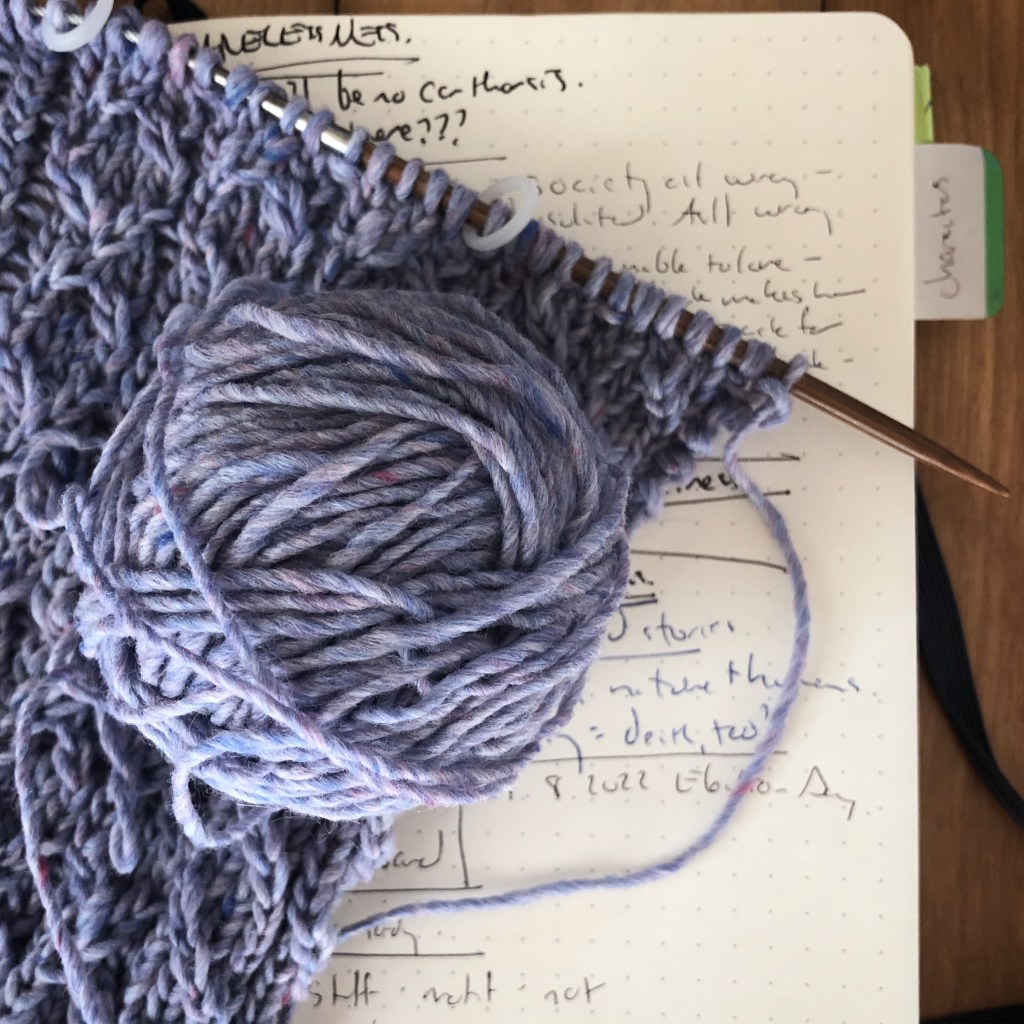
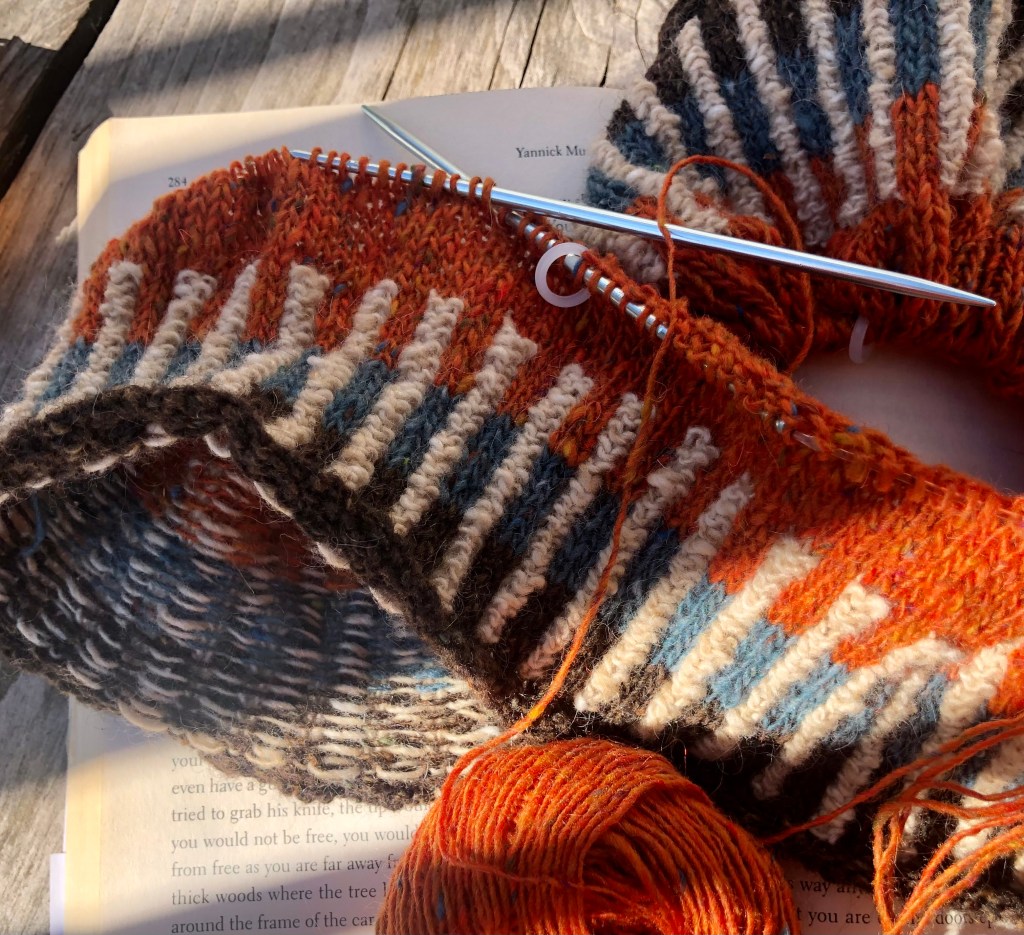
Stitch, Stitch.

As the days shorten, I appraise my woodpile. Borrow knitting needles. Read outside in my coat, the sun on my face. Our cats sprawl before the wood stove, savoring radiant feline bliss.

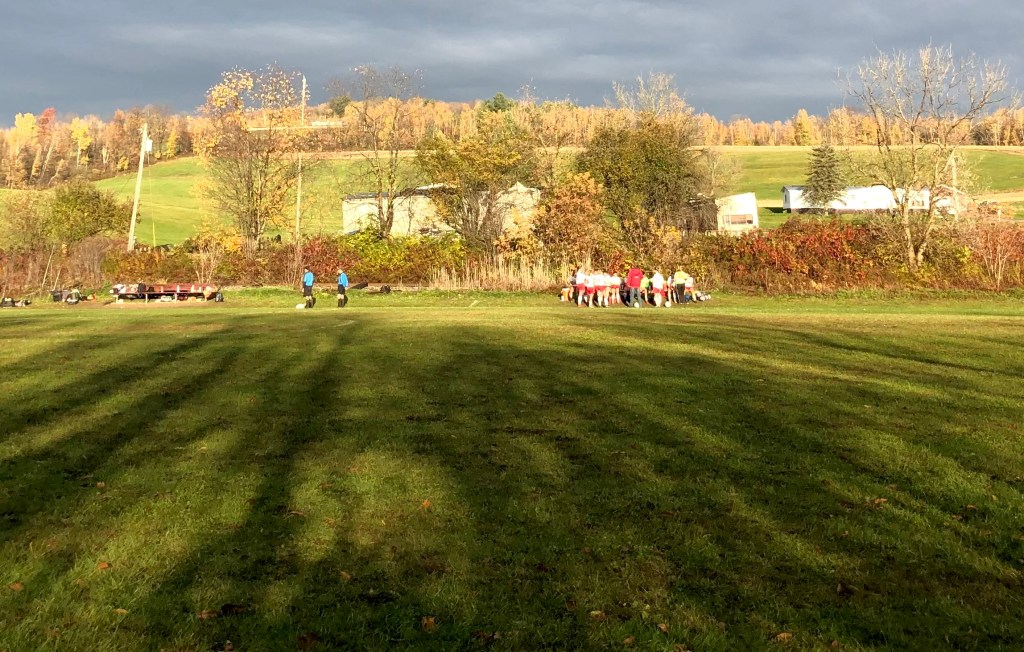
My brother comes to visit for my daughter’s final soccer game. Nine years of games and uniform washing, and I still don’t understand fully the rules of the game. Vs of geese cross the sky. As we idle afterwards, talking, a flock of starlings sweeps low over our heads and disappears around the school.

Back at our house, I gather my things from the car — my jacket, her gifts of balloons and chocolates, the signs her sister made. Photographs. Near sunset, the sky is a luminescent pink that will endure for a few minutes, no more. Their coach, son of glassblowers, made each of the senior girls a glass. In our kitchen, we admire my daughter’s beautiful gift. I wonder how she will fill it.

“Great things are not done by impulse, but by a series of small things brought together.” 

― Vincent Van Gogh

Peony Roots.

Nearing the end of soccer season, my daughter’s high school community suffers a second tragic death in just a few years. In this little rural school, the news seems almost unbelievable, except it’s not.

The loss is not my own personal grief, and so I keep on, of course. On a Tuesday, I leave work early and drive to a game in a northern town where I’ve never been. All morning, a cold rain had fallen. The school is in a town where a Blue Seal Feed plant dominates the shabby downtown. I appear with my knitting needles and a ball of yarn. I’ve forgotten a chair, and another mother takes pity on me and walks back through the mud to her car to retrieve an extra. I end up at the end of the row of spectators. A black cat with white paws wanders by and jumps into my lap. Beside me is a high school boy whose name I never asked who christens the cat Mittens and tells me about his cat named Turkey who was born on Thanksgiving. He speaks slowly and calmly about ordinary things like the railroad workers driving along the tracks in their trucks at the end of the workday. Cigarette smoke streams through their opened windows.

I drive home alone, missing my friend who is no longer my friend because of some certainly unforgivable thing that passed between us. Nonetheless, I miss her as I drive through the long autumn twilight. In this unfamiliar territory, I pass through farm fields where tractors are silhouetted against the sunset, through fields harrowed up black or still emerald green from the year’s final hay cutting. Mist floats over still ponds. The forests are a mixture of gold and russet, gray where branches emerge. Shot through with the day’s final sunlight, the landscape might be an 18th century oil painting.

The darkness catches up with me. At home, the cats will be hungry, the fire in the wood stove gone down to embers. I pass through a village where I haven’t been in twenty years. I had visited with a young woman both baked cakes for a living and built bridges.

As I drive through the forests and over mountains a few other vehicles pass my way — a milk truck, scattered cars. This American Life tells me stories as I live through my own American Life. Both times when Covid entered my house I felt the thinness of my life. Beneath a red-neon GAS sign, I stop for gas. My jeans are mud-splattered. Despite the drive and my car’s heat, I’m shivering although the air here, away from the sodden field and the river, feels almost balmy against my face.

I screw on the gas cap and step away from the pumps where it’s only my car, anyway, with the cardboard box of peony roots someone salvaged from their garden and passed along to me. The evening star gleams over Elmore Mountain. For some inexplicable reason, I remember stepping out into the New Mexico night the last time I visited with my brother, relishing the night’s splendor. We talked about those numberless nights camping as children, sometimes humid, sometimes frosty, in good times and bad. The night is an ancient, ubiquitous realm. Red and white lights of traffic glide along the road. I get back in my car and place my hands over the heater’s blowing vents.
Gifts.

Before I leave for the North Danville Library on Tuesday, I sit for a moment with my daughter at our kitchen table. She eats a quesadilla, and we talk about things that matter — who’s behaving in what way and why that might be. The rain has knocked off for a bit, and I drive the way I often knit, more by feel and memory than anything else.

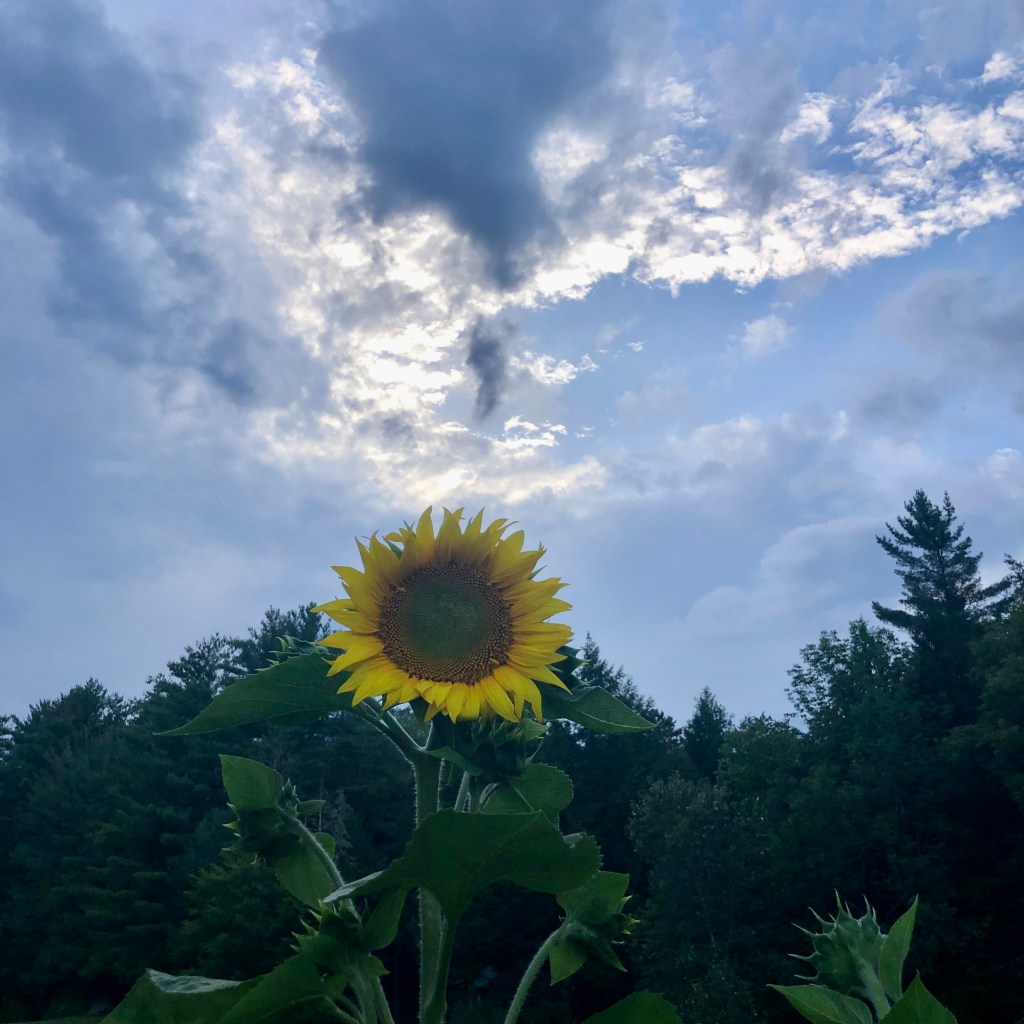
At this time of year, the farm fields are their deepest green. Sunflowers appear in gardens and along houses, their yellow leaves weathered by cold nights. I passed the house where my former sister-in-law lived when her four children were little. In the backyard, we built a playhouse. Her oldest daughter slept in the upstairs bedroom, and milk trucks rumbled down the road in the very early mornings.

The Brainerd library is housed in a former schoolhouse. I parked and stood for a moment in the lot shared by the library and a church. Cows ambled in the field behind the parking lot. Across the street, children pushed each other in a swing hung in an enormous tree. I imagined these were a few after-dinner moments gleaned in the falling twilight before bedtime.

I had been generously invited to talk and read a little about my book Unstitched. Driving over, I remembered the two years I spent writing this book, much of these hours at my kitchen table. Writing a book can be such a long and lonely process. So these moments of connection and resonance, of meeting readers and other writers, are manna to my soul. The library was well-cared for and had a real sense of so much living that had happened in those walls.

Unstitched is about hard things — addiction and guilt, poverty and illness. But I left that night and drove back home along the roads that had no traffic with my heart full of happiness kindled by an evening of literature and discussion and homemade cookies in a beautiful library with kind people. At home, the stars sprinkled over the sky, and the night was still warm enough that I could pretend winter was not in the near offing. Inside, my daughter and I picked up our conversation where we had left off.

August: Complex Fatigue

On this August evening, a sparrow flies out of the wild raspberries along my walk and startles me just the slightest. Stunned a little from its flight through the leaves and small prickles, the sparrow fumbles from foot to foot on the path and then rises up on its wings and disappears. The swifts are out, too.

A downpour has fallen and the humidity has thickened right up again. I walk through the village, and folks are hanging out on porches. A three-quarters moon hangs over the empty high school soccer field, stunning. I’d write that it’s otherworldly in its beauty — but in this slow, sticky night it’s hard to imagine a sweeter world, even this one chockfull with chaos.

In the heat, tempers are either short or silly. Tomorrow is Vermont’s primary, so much fervor, and I wonder what all that might come to. In the evening, I talk to my cat, a tête-à-tête about why he cowers at the slightest noise, as if the house might be under attack by coyotes. You’re a housecat, I remind him, one of the most pampered creatures on the planet. He looks at me, poor ignorant thing that I am, and wisely keeps his ears pressed down and low like a spooked owl.

August. Time to share again one of the loveliest poems.

The world is a 

complex fatigue. The moth tries

once more, wavering desperately

up the screen, beating, insane,

behind the geranium. It is an

immense geranium,

the biggest I’ve ever seen,

with a stem like a small tree

branching, so that the two thick arms

rise against the blackness of

this summer sky, and hold up

ten blossom clusters, bright bursts

of color.

Hayden Carruth, “August First”

Water. Sky. Lilies.

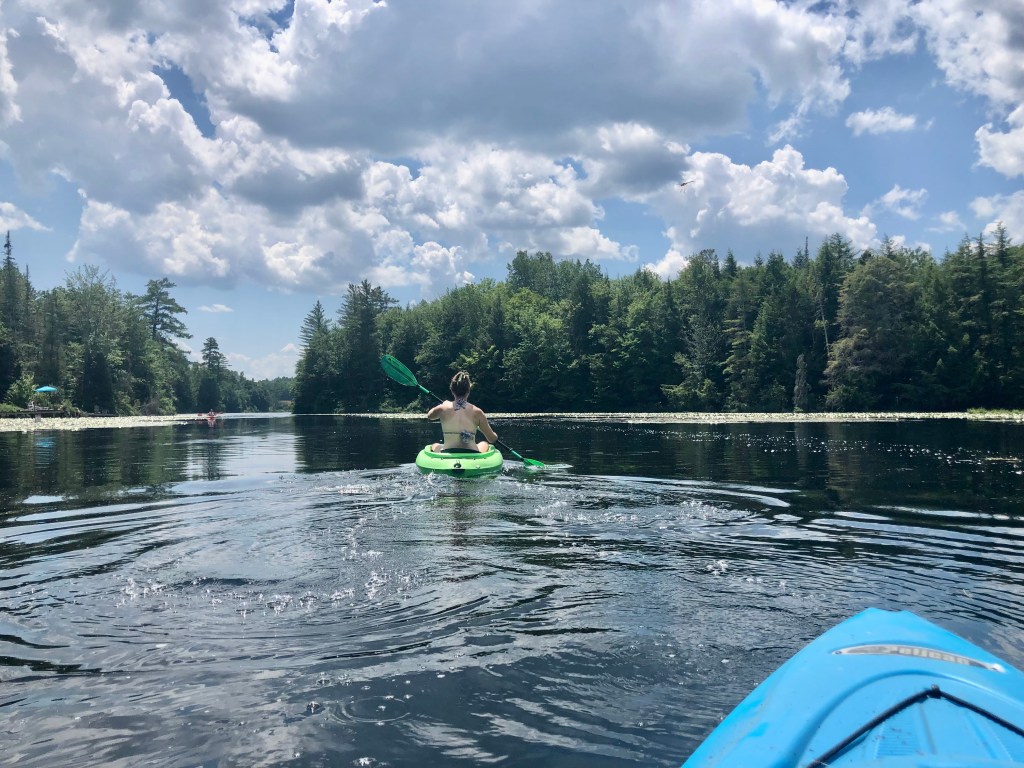
Sunday morning begins hot and out-of-sorts in our house. As antidote, we load the kayaks on the car. We paddle through a passage between floes of waterlilies in a breathtaking landscape — clouds reflected in water and all those perfect flowers. We’re not far from home, but the kayakers and canoeists we pass are all strangers who raise hands in quiet hellos.

In no rush at all, we paddle to the pond’s far end, where we drift for a long while, talking and handing a box of crackers between us. A loon and a single chick bob nearby. The other loon parent appears with a string of lunch in her or his mouth.

Later, we pull our kayaks on a shore and swim out to a raft where we lie in the sun and talk about where we might be five years, ten years, down the line. A man swims out with his two daughters, and we talk a little with him about the raft and the sun and the waterlilies that cover the pond.

I’m reminded of William Blake’s line about seeing the world in a grain of sand as we slowly paddle back to where we began. I’ve walked across sections of this pond in the midwinter around ice fishing holes. A number of years ago, a teenager drowned here, a boy I knew as a baby. His parents were vendors in the same farmers market where my husband and I sold maple syrup and ice cream. We all had little ones in those days. On those hot afternoons, we shared stories while swaying with babies on our backs.

The pond this July day reflects only sweetness and beauty. At the shore, my daughters load our kayaks back on our car. I rinse off my bare feet at the water’s edge. A little boy runs to the end of the dock. His father stands waist deep in the water. He raises his arms and says, Jump. I’ll catch you.