The awful rowing towards God.

Hardwick, Vermont

My buddy Ben Hewitt writes about waking from a deep sleep where he’s lying in the back of a pickup driven by a woman with bejeweled fingers — but I wake from a dream where I reach under the bed for a bowl of brown rice and curried onions, strings of sautéed chard, diced tomatoes. Who dreams of that? But perhaps I’m dreaming of keeping cake beneath the bed from an old article my friend Dave showed me…. The cat sits in the screened window. Rain falls hard.

In the buttery dawn, my youngest and I walk around town, coffee cup in my hand. The river and brooks have taken over Hardwick again. A man sits on his porch, water a swirl around his house, and I sense he’s been sitting there all night. A year ago, to this day, the town broke apart in a flood.

Again, the river roars, mud-dark, boulders banging. Fall into that, and you’ll drown. The town reeks of clay and rot, the earth’s innards that are better off left unturned.

I’m working these days for a small nearby town Selectboard. This early morning there’s the stream of road crew and public, of the orchardist hired for last year’s FEMA reimbursement — which we’ve not yet received — who arrives in his orange vest. The phone rings and rings. The Selectboard members arrive with donuts and freshly made banana bread and a cheerful Irish Setter. The woman who’s just joined this limping Board (who, really, in their right mind would join a Selectboard these churned-up days?), explains in her calm way precisely her motivation. She’s neither young nor naive and says just simply that the world is falling apart; but this Vermont town doesn’t need to follow that course. In this strangely remarkable day of the world we know and broken badly again, I am caught in an upswell of her plain-spoken and can-do words, her confidence as she sets down that waxed-paper-wrapped sweet loaf. I am aligned. The alternative is narcissism or nihilism or simply foolishness, and I have been waiting for her words.

In this same unexpected morning, I sit with the Selectboard as the rain falls again. They agree on a mending plan which relies on that wing and a prayer of federal money. The town, well-off a year ago, is now running on debt.

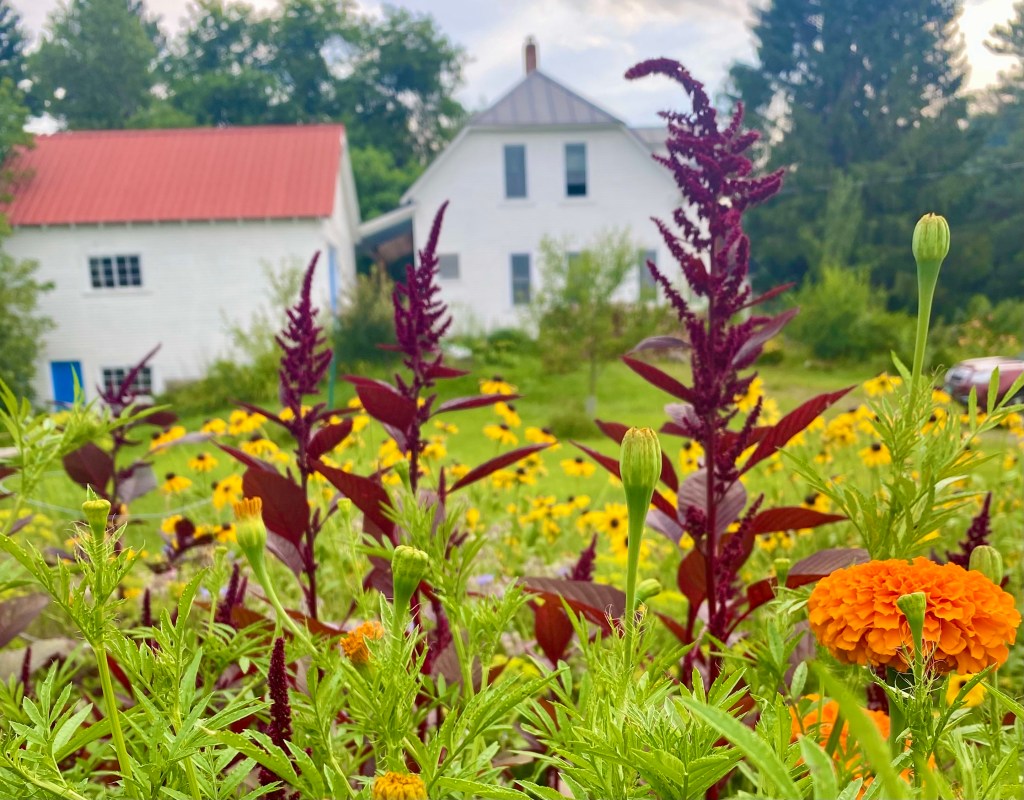
In my own one-woman world, standing in the dark against my house that rainy night and listening to the river’s roar increase and gain, I especially miss the shelter I once had in a marriage when the world’s chaos smacks into my face, as happens more and more these days. But fiercely pounding waters are never one single thing; even the next morning, bleary-eyed and soaked, I can’t help but marvel at the creamy orbs of blooming hydrangeas, the gold rudbeckia. Drinking my bitter coffee, I think of Anne Sexton’s poem “The Awful Rowing Towards God.” I once chose to dig my oars into turbulent waters and pull myself and my daughters to dry land. Now my youngest, shimmering with the pollen of young womanhood, drives, her eyes wary over the dirty water.

Oh us, all of us, in our little boats, our dinky cars and pickups, our great complicated lives. These mud-choked whirlpools, the fallen trunks smashing into rubble, the rushing waters that have not yet stilled. Which way will we row? Remarkable, all of it, remarkable.

… I am rowing, I am rowing,
though the wind pushes me back
and I know that that island will not be perfect,
it will have the flaws of life,
the absurdities of the dinner table,
but there will be a door
and I will open it…

— Anne Sexton

Pay it forward: a debt.

In the local coffeeshop, a stranger kicks up a conversation, and we bat around our mutual appreciation for this early summer – the blossoms profuse. He buys his order and adds my coffee, too. Pay it forward, he says, and vanishes into the morning.

I take my coffee to the courtyard down the street, empty at this time of day. Ahead of me, after this bench work stint, the day sprawls. I move from eddy to eddy.

In the late morning, a friend I haven’t seen in a few years calls. I’m now in a dim basement room. As we talk, our conversation dips into the past. I feel as if I’m lifting silty strands of stories, stringing them through my hands, searching for clues to tie pieces together.

All day long, I ponder our conversation, how the actions of one person ripple through friends and acquaintances, shift through strangers’ lives, how I’ve always been interested in this since I was a teenager, holed up in my parents’ hammock, reading John Steinbeck’s East of Eden. Later in the day, still stuck on this, I stack firewood, listening to news about the Trump trial. In the hot June sunlight, the freshly cut wood is redolent with sap. An earthworm wriggles. The neighbor boys bike into my driveway, circle around through the grass, ever curious about whatever mundane thing I’m doing. Overhead, those turkey vultures circle their late afternoon sweep, ever hungry. Little snapshot of my terrain.

I believe that there is one story in the world, and only one. . . . Humans are caught—in their lives, in their thoughts, in their hungers and ambitions, in their avarice and cruelty, and in their kindness and generosity too—in a net of good and evil. . . . There is no other story.

— John Steinbeck

A little Madness in the Spring.

Post-eclipse, rain moves in, balmy tinged with cold. Rain will force spring’s green. Our lives spin on — of course, of course — but the eclipse and all its radiant glory trails us, the collective experience of the cosmos’ unflinching steadiness and how the heavenly bodies align, majestically moving in their infinite complexity. No stasis in this life.

Someone recently asserted to me the caliber of her character — I’m a good person — and the phrase lingers with me, far more a reflection of my wavering self than of the speaker. We’re so unlike the celestial bodies, our mortal bodies driven by gravity and time, but our actions dominated by our uniquely strange brew of our jumbled lives, passions, weaknesses.

The eclipse’s profound beauty for a few moments swept away the pettiness of our thin ideas, our nattering chatter about so much that, in reality, amounts to scant little. Perhaps the eclipse unified us not only by its luminescent beauty, but tugged out the finer strands of us, too.

For a day or two, Vermont was jammed with visitors from so many places. Vermont’s not unique with much that’s happened in recent history — floods and wildfire smoke, the pandemic, and division and division and division. My state also has some of the greatest privileges on the planet: absence of warfare, significant wealth. Let the eclipse bloom last long, carry us through a muddy spring and into summer, keep us questioning what our own goodness might mean, and how goodness transmutes into action.

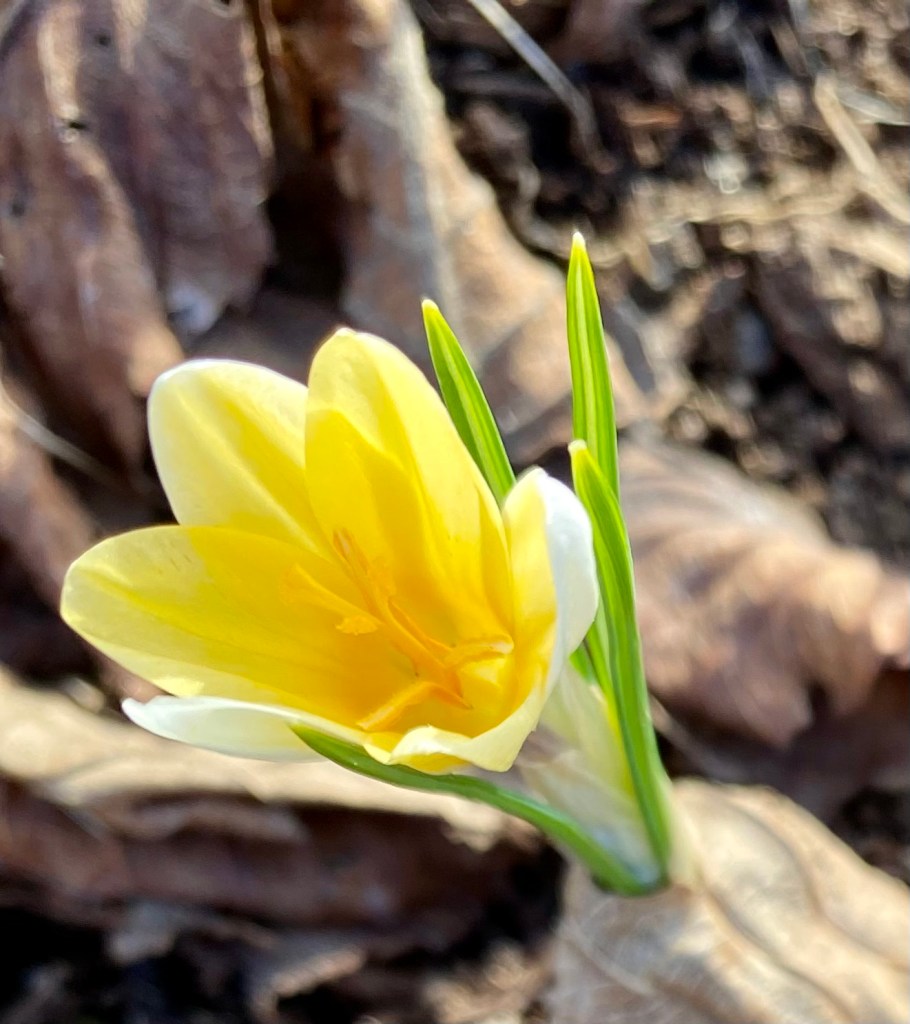
Last, not least: my giddy joy of gold crocuses. Chionodoxa, AKA glory of the snow, scattered over muddy hillsides, last year’s dull lawns.

A little Madness in the Spring
Is wholesome even for the King,
But God be with the Clown—

Who ponders this tremendous scene—
This whole Experiment of Green—
As if it were his own!

— Emily Dickinson

On Gaslighting.

Via email, my daughter’s school sends me a survey. The survey poses a question about what I desire for my student. The question is phrased in a way that reminds me of a question I was recently asked, by someone I hardly know. The question was unique; the questioner asked specifically about me and my life, and how I saw my life in the wider context of the town.

I’ve been thinking of that question since that conversation, returning to it in odd moments while opening my post office box or washing the oatmeal pot. It’s a question we might all want to be asking ourselves — not just what would improve our individual lives, but how do we understand ourselves in the landscape of where we live. Or maybe this is simply April musings, cusp of a storm that could go either way, rain or snow or perhaps simply wind, sweetened with the scent of thawing soil.

Here’s a few lines from a New Yorker article that seem contemporarily apt….

Gaslighting essentially turns its targets against themselves, she writes, by harnessing “the very same capacities through which we create lives that have meaning to us as individuals,” such as the capacities to love, to trust, to empathize with others, and to recognize the fallibility of our perceptions and beliefs. This last point has always struck me as one of gaslighting’s keenest betrayals: it takes what is essentially an ethically productive form of humility, the awareness that one might be wrong, and turns it into a liability.

Leslie Jamison

Kindness of strangers.

If there’s a sadder building in Vermont than the county courthouse in Barre, I don’t know where that might be. Over the last nine years, I’ve been here again and again and again and again. On Friday, I arrive again, stepping through the metal detectors and removing my knitted hat to show my barrette. My errand is to leave a handful of copies. I wait behind a man in an orange jacket at the counter who cannot understand what the clerk is saying. She repeats her instructions. Another clerk calls to me. I ask my questions, repeat back her answers to confirm. The man beside me weeps.

The last time I was here, I waited in a room of women waiting to be heard by a judge. In those days, I had survived those court appearances and the craziness of my life by imagining myself a mother wolf. I slunk in, took what I needed, and ran. All morning, the room gradually emptied, until only myself and one other woman remained. She was young enough to be my daughter. The bailiff appeared and said it was the judge’s lunchtime, and we could return in two weeks. Wolf, I stood up, all 4’9″ of rage, and said I wasn’t leaving. The bailiff muttered and disappeared behind the wooden door.

The woman’s name was before mine on the court’s list. She offered to let me go before her. You have a child, she said, and I don’t. I didn’t one single strand of this woman’s story. The judge delayed his lunchtime.

On this Friday afternoon, six years later, when I return to this courthouse I had promised myself never to enter again in this lifetime, I carry the memory of this stranger’s kindness.

Outside, at my car, I can’t find my keys, and so I return again, back through security, back to the window where the man is yet weeping, the clerk repeating the same impossible words. Then I realize my keys were in my hand; I hadn’t looked.

Here’s a poem very much in this sentiment, emailed from my father. Listening to the audio is highly recommended.

Are you for real?!

The other night, I’m leaving a meeting in the high school library devoted, more or less, to hashing out what community means (nothing to be solved in a few hours). In the parking lot, a woman says Goodbye, Brett — and quicksilver, I shout, Are you for real?!

As the other folks empty out of the school into the spitting snow, she and I talk beneath the ghostly streetlamp. Very quickly, it’s clear to me how utterly wrong I am about this woman. What I believed was true was not. I once ate chocolate covered strawberries in her house with my youngest daughter. The woman packed up a bowl of these delicacies for one sister to give to another.

In ten minutes, we are speaking animatedly of matters of our hearts. We’re both shivering by then in the damp snow. We hug and head to our homes.

I don’t know what’s happening in the rest of the country, and I surely can’t speak for anyone else, but how glad I am that I called out in anger. And how much more grateful I am that she took the time to listen to me, to lend me her shoulder, and I could do the same for her. Indeed: real.

A community… is the knowledge that people have of each other, their concern for each other, their trust in each other, the freedom with which they come and go among themselves.

— Wendell Berry