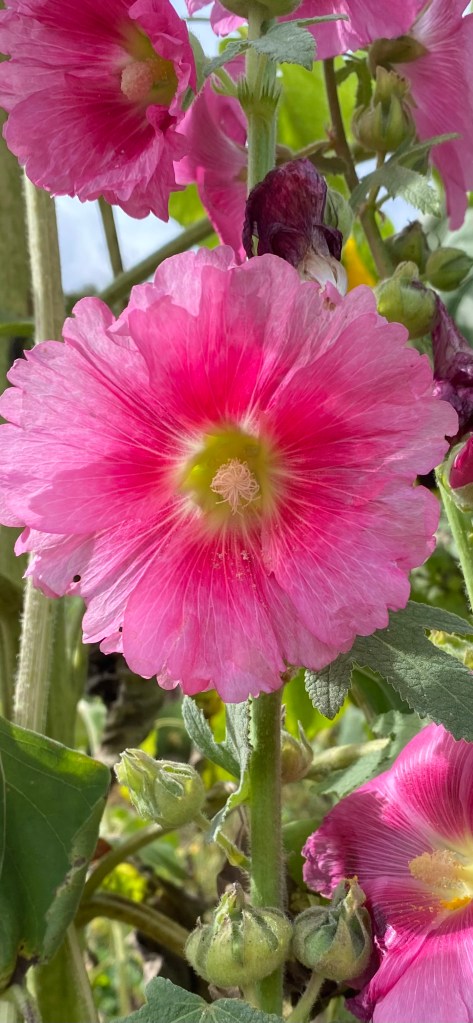
In the spring, I moved my remaining hollyhocks into the fenced vegetable garden to save these flowers from feasting groundhogs. Spring, summer churned along. Now autumn, my garden still blooms its rainbow. Gathering tomatoes and basil for dinner, scraps of birch bark and kindling to start a fire, I pause for a moment in the drizzle, soaking in the delicate petals, the mist brushing in for the night, the trees already doing each their own foliage thing — some gold and orange, some already shaken down to bare twigs, others green, green, as if in defiance of winter.
Across the valley, the coyotes call, once, twice, as if testing their voices.
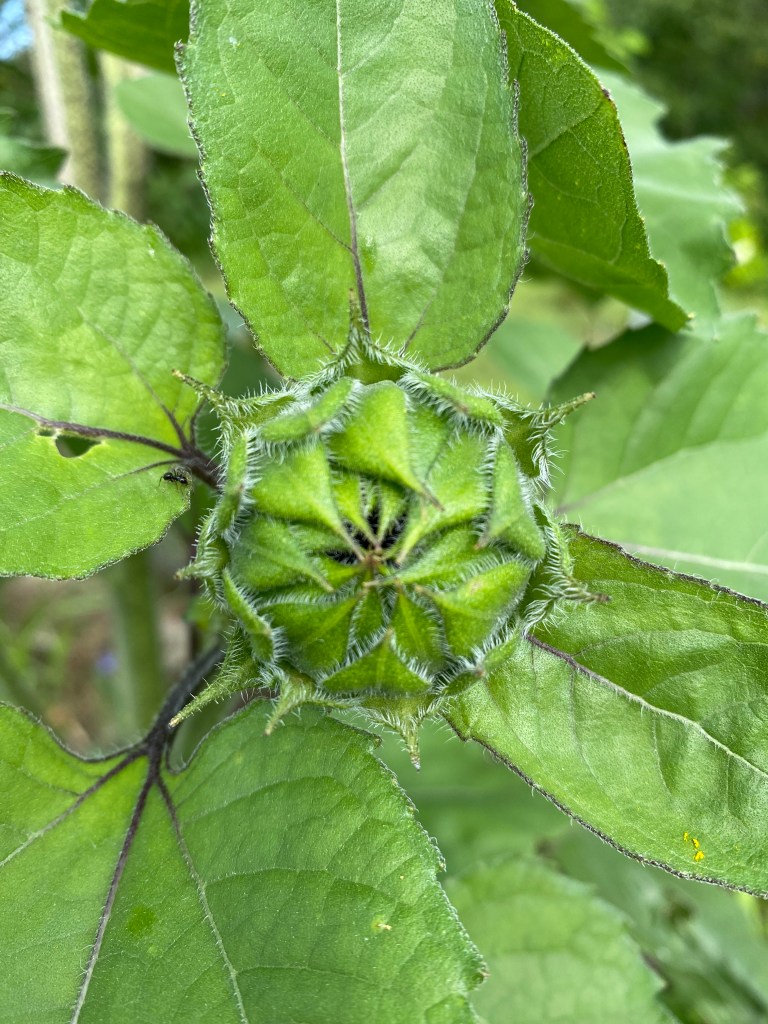
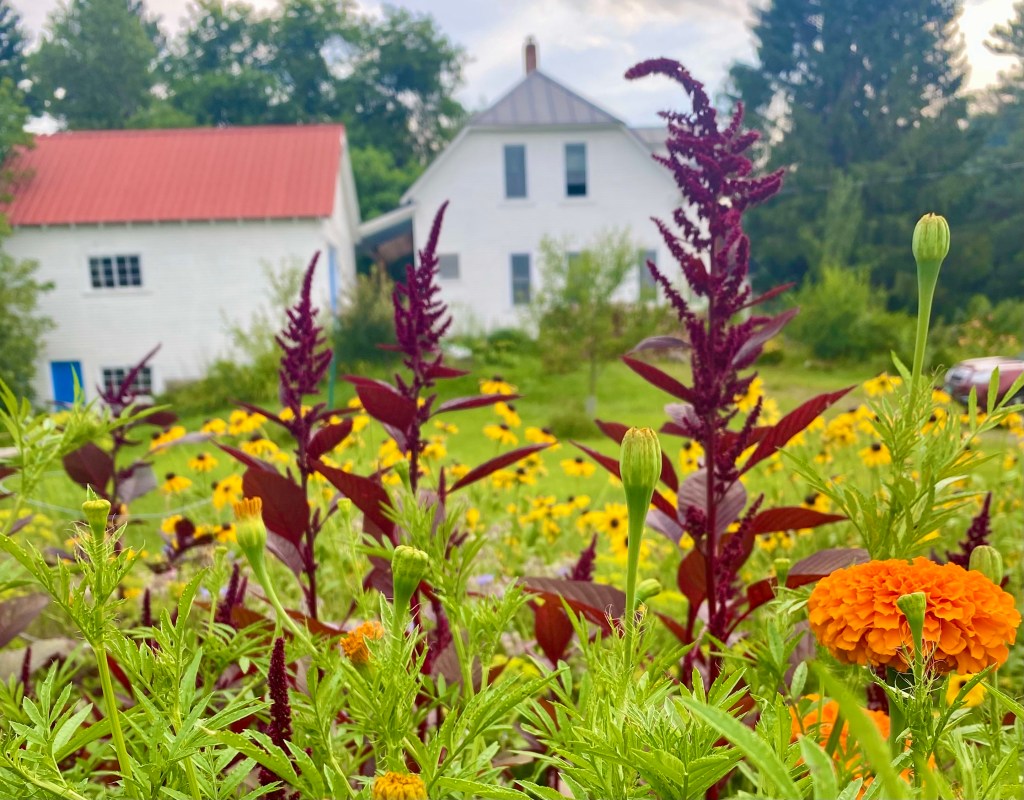
I snip bunchy orange marigolds for my table, their centers spicy. Overhead, the geese are always winging away these days, gathering their Vs, heading for their winter quarters, elsewhere. The clustered sunflowers, in their different heights and states of disarray from gold petal to curled brown leaf, rustle with the fat little chickadees dipping in and out, scavenging. Oh, sunflowers, so easily grown: scattered seeds, my palms pressing soil, water and sunlight. For me and the birds I imagine I sow these beauties, but of course that’s not true at all. The sunflowers are the waving prayer flags of my garden, this small territory.
The neighbor boys pile their sweatshirts and run in their t-shirts, the smallest hustling in and out of the lilac bushes, hide-and-seek. Rain pitters on leaves. A T.S. Eliot line runs through my memory, that graceful dismal poet, “…music heard so deeply/That it is not heard at all…”
I leave the garden to do its final hallelujah of the season, the tithonia and sunflowers and cosmos fraying now, the basil still slipping into my cooking pot. September 11, the morning I stood in my sun-filled kitchen watching my toddler tricycle around the table, listening to public radio and wondering what was happening. My youngest was not yet born. Now, 23 years later, my daughters and I text during the debate. My cats are curled at my feet, in their usual, wise cat-disdain way, thinking their feline thoughts, savoring like any smart creature the warmth from the wood stove.
On my evening walk, I meandered the long way home. A half moon hung in the sky, sweet as maple pudding, so near I imagined I could reach out and lay my fingertips on its smooth sheen. Early autumn. So much more to come.
So this whole democracy thing? Since we’re in an election year and all?
I work in a small town for a Selectboard. Monday morning, I pull into work (late, again), and a Selectboard member is eating a blueberry muffin as fast as he can in the parking lot, a muffin I’m certain the town clerk made. I get out and make some comment roughly along the lines of it’s a good thing I don’t do drugs anymore because Your Town….
He counters with, Let’s get serious. What’s your cucumber and zucchini situation? I’m coming back at noon with four full boxes.
Monday morning, it’s revealed that people have stolen signs. People have written letters to the Selectboard and newspapers and the Sheriff about the theft. People arrive in the office with dogs and laptops and questions, eat muffins and disappear. I walk outside with the phone. It’s possible that the thief arrives. It’s also possible there’s some laughter. Or maybe I’m making all this up.
Democracy is messy, chaotic, often brutal. People arrive who look as though they’ve slept in ditches for their entire adult lives and complain about the flood. People complain about their neighbors. People run for election. In all of this, I take off my shoes and walk around barefoot. I do all the things I’m supposed to do and I keep wondering if I’m doing any of these right. I give an old woman a bottle of water. I am always trying to leave, disappearing into the asters around the lake, into the rooms upstairs where it’s just me and the wasps and the open windows. I am always trying to sew the pieces of my life together. Sometimes I crumple paper and throw it at my coworkers, which is not really at all charming or funny.
As a writer, I learned from reading. I learned so much from sugaring — the majesty of the world, the inarguableness of cause and consequence. I learned joy and love as a parent. I learned grief as a broken wife. Working for a small town, I’ve learned the peculiar American craziness of little towns and politics, of gossip. How to spy cowardice and when to lean against the courageous.
There’s not one damn thing perfect about any of this. Here I am as usual, half in, my head and heart filled with my garden gone rampart with rudbeckia and coneflowers. But we’re all that way…. July is the season of joy, January the season of despondence and loneliness. In the heart of midwinter, I leap from the snowy shore to the frozen lake. Far out, I sometimes lie down in the middle of the day, the ice a bed between my bones and the sludgy lightless waters. Overhead, the infinity of the heavens.
But today it’s Good Old July. In the afternoon, I walk with a woman along the forest trails she’s cut. She’s eased white quartz from the soil. The rocks gleam, as if freshly scrubbed with rain.
In the Albuquerque airport, I’ve tucked myself into a corner, editing a manuscript and drinking coffee, when suddenly I see the small airport is jammed. I pack up my things. In search of my gate, I ask a man if he’s headed to Chicago. “Houston. We’ve been deplaned from the tarmac, twice, and I’m pretty sure everyone here is about to have a nuclear meltdown.” Edging away, I hear a woman cajole her child to “let daddy figure this out.” The ruddy-faced daddy glares at a monitor.
At the terminal’s far end, I join an elderly couple (retired psychiatrists), a pediatric oncologist, and a mechanic who’s hoping to visit his mother before her open heart surgery. They tell me the news of Biden’s withdrawal.
Our plane has not arrived, and we step to one side of the swirling crowd. The oncologist shares that he’s been a fan of Biden. Such suffering in that family, he says; it changed him. The psychiatrists nod, listening. He tells us that his experimental research department received a flood of funding, but that’s all ceased now, with staff layoffs in anticipation of the election. He plans to retire in a few years and return to Botswana to volunteer. I don’t want to be dismal, he says, but the need for help won’t end.
We spy two pilots, admire their youth — but not too young — and gladly note they disappear through a door towards the tarmac. The loudspeaker voice informs us the pilots will have a short meeting with the cabin crew and then we’ll board. We’re not quite sure what that huddle is about — go team? keep the plane in the air? — and the oncologist muses that airports are one of the few places he’s experienced where strangers keep the social fabric together. No one, he tells us, says anything to strangers on D.C. public transportation.
That does not bode well, I think.
Just before we board, we shake hands and wish each other well. All these matryoshka doll layers in us: I walk down the ramp with the sign maker, who confesses his worries about his mother. Like a kind of magic, then, we’re in the air. Hours later, I land in Burlington, Vermont. Under a crimson full moon, I cross the street. The night sprinklers are watering a swathe of grass. All those dark miles of driving ahead of me. At home, the hydrangeas shine in the moonlight, boughs weighted with blossoms touching the ground.
IN A STATION OF THE METRO
The apparition of these faces in the crowd: Petals on a wet, black bough.
These few days I’ve spent in New Mexico, my mother is a constant presence and absence. She’s powerfully here, in her sunny kitchen or in the stacks of empty flower pots in the garage. Yet, she’s vanished, too. All night, the desert breathes into this house, sage-sweet wind and coyotes barking and the robin songs here, too, like in my Vermont world. These days, the skies have been layered with lightening and sooty storms, golden sun, the blowing gritty sand that scours my skin to softness.
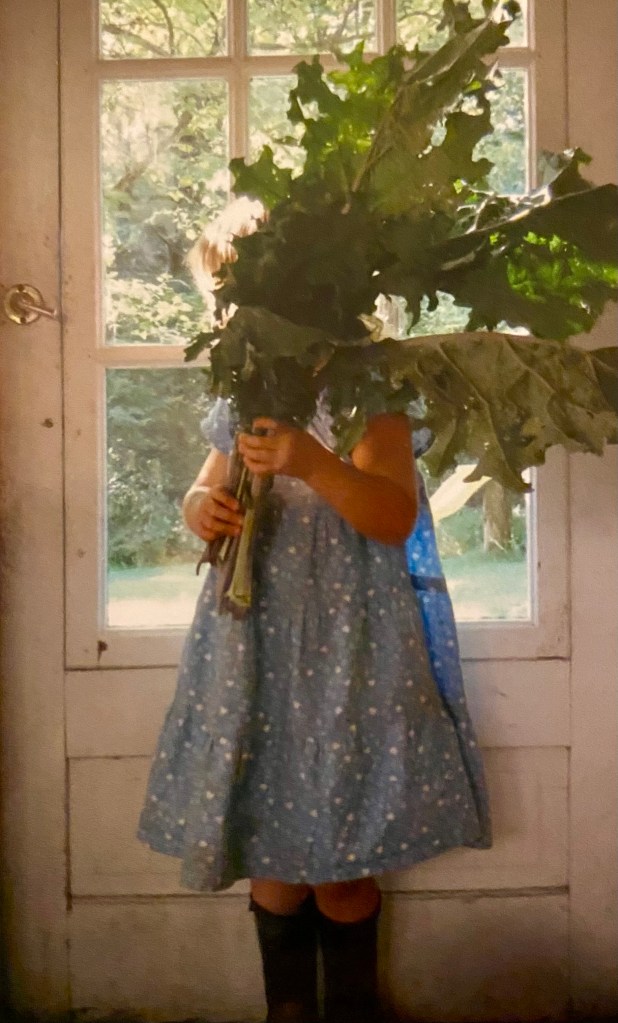
The world far beyond my small family’s sorrows teeters towards deceit and collapse. There’s no inoculation against any spiritual ailment, really. Measles, sure, but never the terrifying largeness of grief or rage, or losing safety or love. Which leads me back to the photo above, my little daughter as she was at our kitchen door, in her hand-me-down mud boots and a handmade cotton dress, carrying stalks of garden-cut kale. A reminder never to sentimentalize or diminish the rugged and real lives we live.
A Pretty Song
From the complications of loving you I think there is no end or return. No answer, no coming out of it.
Which is the only way to love, isn’t it? This isn’t a playground, this is earth, our heaven, for a while.
Therefore I have given precedence to all my sudden, sullen, dark moods that hold you in the center of my world.
And I say to my body: grow thinner still. And I say to my fingers, type me a pretty song. And I say to my heart: rave on.
My buddy Ben Hewitt writes about waking from a deep sleep where he’s lying in the back of a pickup driven by a woman with bejeweled fingers — but I wake from a dream where I reach under the bed for a bowl of brown rice and curried onions, strings of sautéed chard, diced tomatoes. Who dreams of that? But perhaps I’m dreaming of keeping cake beneath the bed from an old article my friend Dave showed me…. The cat sits in the screened window. Rain falls hard.
In the buttery dawn, my youngest and I walk around town, coffee cup in my hand. The river and brooks have taken over Hardwick again. A man sits on his porch, water a swirl around his house, and I sense he’s been sitting there all night. A year ago, to this day, the town broke apart in a flood.
Again, the river roars, mud-dark, boulders banging. Fall into that, and you’ll drown. The town reeks of clay and rot, the earth’s innards that are better off left unturned.
I’m working these days for a small nearby town Selectboard. This early morning there’s the stream of road crew and public, of the orchardist hired for last year’s FEMA reimbursement — which we’ve not yet received — who arrives in his orange vest. The phone rings and rings. The Selectboard members arrive with donuts and freshly made banana bread and a cheerful Irish Setter. The woman who’s just joined this limping Board (who, really, in their right mind would join a Selectboard these churned-up days?), explains in her calm way precisely her motivation. She’s neither young nor naive and says just simply that the world is falling apart; but this Vermont town doesn’t need to follow that course. In this strangely remarkable day of the world we know and broken badly again, I am caught in an upswell of her plain-spoken and can-do words, her confidence as she sets down that waxed-paper-wrapped sweet loaf. I am aligned. The alternative is narcissism or nihilism or simply foolishness, and I have been waiting for her words.
In this same unexpected morning, I sit with the Selectboard as the rain falls again. They agree on a mending plan which relies on that wing and a prayer of federal money. The town, well-off a year ago, is now running on debt.
In my own one-woman world, standing in the dark against my house that rainy night and listening to the river’s roar increase and gain, I especially miss the shelter I once had in a marriage when the world’s chaos smacks into my face, as happens more and more these days. But fiercely pounding waters are never one single thing; even the next morning, bleary-eyed and soaked, I can’t help but marvel at the creamy orbs of blooming hydrangeas, the gold rudbeckia. Drinking my bitter coffee, I think of Anne Sexton’s poem “The Awful Rowing Towards God.” I once chose to dig my oars into turbulent waters and pull myself and my daughters to dry land. Now my youngest, shimmering with the pollen of young womanhood, drives, her eyes wary over the dirty water.
Oh us, all of us, in our little boats, our dinky cars and pickups, our great complicated lives. These mud-choked whirlpools, the fallen trunks smashing into rubble, the rushing waters that have not yet stilled. Which way will we row? Remarkable, all of it, remarkable.
… I am rowing, I am rowing, though the wind pushes me back and I know that that island will not be perfect, it will have the flaws of life, the absurdities of the dinner table, but there will be a door and I will open it…


 Stony Soil Vermont