Hunger.

Curious cat named Acer

A few years back when my youngest was doing odd jobs, she came home with four strawberry plants someone had given her from a garden she weeded. Naturally, I planted these in our garden. The plants spread and have produced beautifully this year. I crouch beside these weedy plants and devour red berries. The crop is so small no berries ever make it into the house. Since it’s usually just me here these days, I eat in the garden. I’m famished for this sweet food. I devour the strawberries, juice dripping down my chin.

I’m ravenous for the sharp June sun, for this morning’s cold dumping rain, for my daily midday reading break, for the purring cats who clamor across my keyboard. Healing from cancer, I’m supposed to sleep (get seven to nine hours!) but, come that glimmer of gold at the horizon, I’m finished with bed, hungry for coffee, oatmeal, maple syrup. Eager to finish my novel revisions.

In those months of chemo, I’d worried my mind and imagination might dull, my fierceness lessen. Six weeks out from surgery, I’m diminished in body but a peculiar power blooms in me. A determination to do what I want. An impatience with artifice. Don’t waste my time.

And yet, the old haste that plagued my days and nights has quelled. Stopping by my neighbor’s, I sink into her armchair, set my feet on her footstool, listen, let the day’s exhaustion drape around me. That fatigue is now familiar to me as the blanket a stranger gifted me at the beginning of this cancer journey. We talk and talk, then wander outside and keep on with these conversational matters, the color of paint she’s considering for her house’s clapboards, how to encourage Columbine to grow among the phlox.

This time, I really want to listen…. I’ve spent my life mistaking instinct for fact, subjective experience for reality. What a waste of time here on earth to spend it as a slave to one story, how boring and repetitive, how many of our days are spent in chains.

From Sarah Gilmartin’s Service.

“Quite Serious”

My neighbor runs out his back door, shouting and waving his arms. I’m working on my upstairs glassed-in porch. He cranks up the volume on VPR’s Morning Edition. I’m guessing he hopes the young woodchucks burrowing beneath his deck aren’t NPR fans.

Like my neighbor, I am a VPR fan. This morning, news of Iran dominates the air. As I labor to join noun to verb, I notice my heart beating at Steve Inskeep’s words. Eventually, I leave my cat sprawled on the windowsill and head downstairs to wash the dishes. I’ve listened to NPR my entire life. Heck, the radio was probably playing when my parents brought newborn me home from Presbyterian Hospital in Abuquerque. Little these days is good news.

This winter, I’ve written in this space about my obsessive struggle to remain among the living on this planet. Only now—two surgeries, six rounds of chemo, 11 hospitalizations later—do I realize the diciness of my determination to live. A few weeks ago, driving with my daughter, she showed me a lawn where she cried on a bench because I believed my mother would die. Every day now, as I begin by feeding my two cats and drinking coffee, I carry this winter, those months of spitting distance from my grave, within me. As at the beginning, my greatest worry was/is my daughters. So many months later, I understand how my life is connected intrinsically to so many others. That what lies before my eyes are the twig tips of stories.

In my younger, brasher years, I might have written about politics and conflict, but the Mideast is a place I’ve never been, with people I’ve never met, for whom I will never speak. Too, I’ve knocked around this planet long enough to know that violence changes the world, irredeemably. That the combination of deceit and anger and hubris wrecks destruction. And that cruelty wrought can never be undone. We hurtle onward. I keep listening.

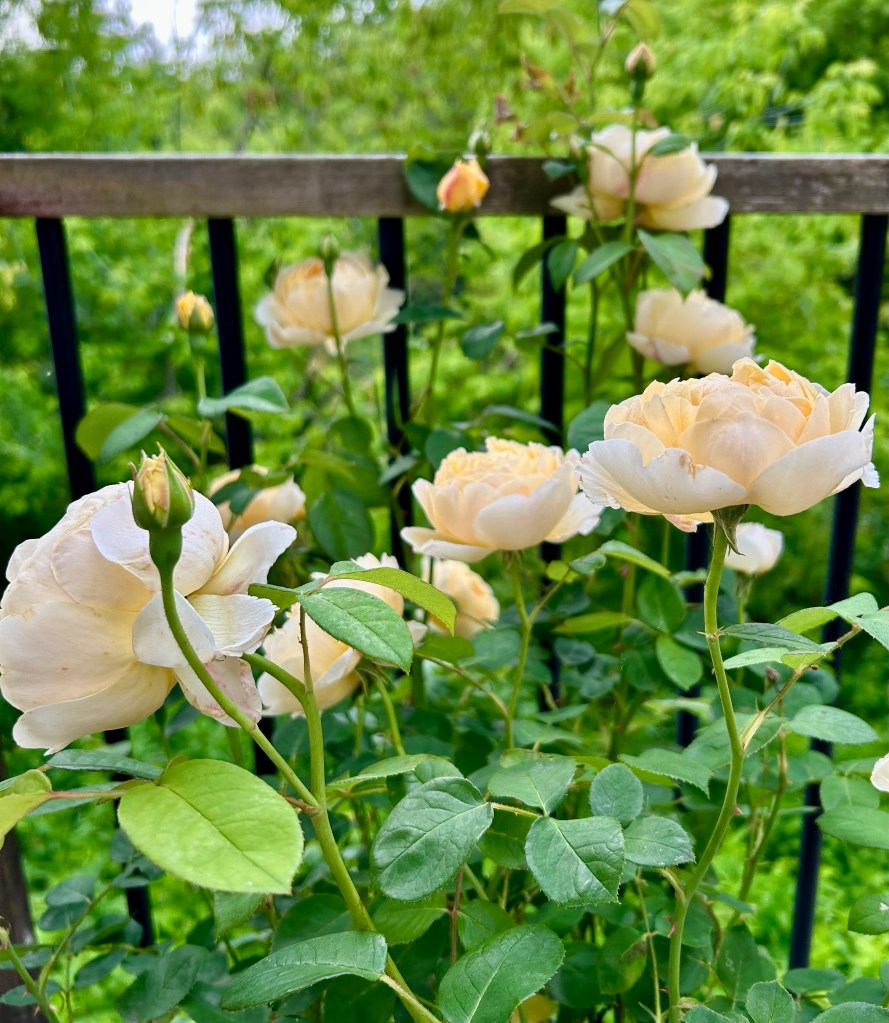
June, and pink roses bloom against my house, planted by someone I never knew, perhaps the woman known as Grandma Bea buried in the adjacent cemetery’s crest. My daughters climb a mountain with a view of Vermont’s shimmering Lake Champlain and the emerald patchwork of farms stitched together. They return with a gift for me, a thorny rosebush with fragrant blossoms that fill my cupped hand. In the evening, shortly before dark, I walk in my bare feet, the long grass already cool with dew. High heat is predicted, the planet is surely burning up, but this ruby-and-gold sunset drags in a coolness. Lush, so lush this month. The butternut tree I planted stretches towards the apple someone else carefully cultivated and noted in pencil on the barn’s bottom wall. A record someone held dear.

In 1956, Allen Ginsburg wrote: “America this is quite serious.”

A fluttering stir like a fledgling first stretching its wings…

On my way home (again) from Dartmouth-Hitchcock Medical Center, I’m at a pharmacy, picking up prescriptions. The one I really want – the pain meds – is apparently not available, simply not stocked, which surprises the heck out of me. It’s a common opioid. In my brother’s car, I phone Dartmouth, miraculously reach a nurse who sorts out my problem swiftly. My brother drives down the road, where another pharmacy tells me I’ll need to wait.

In a dusty midafternoon sunlight, I take him on a downtown tour of Barre, around the courthouse where I spent so many hours. I point out the window where I stared at the chickadees in the crabapple trees. We keep going and walk around the Civic Center where my daughter and I went to basketball games. The lot is empty, dirty with winter sand. We talk for a bit about these neighborhoods and where we grew up, our mutual interest and speculation in local history, how towns rise and diminish.

In the Walgreens parking lot again, I pull up my sleeve. Where a nurse recently pulled out an IV, the band-aid is soaked. I show it to my brother. “Don’t touch,” he tells me, as I wince, creeped out. “We’ll clean it when I get you home.”

That blood-soaked band-aid, in a filthy parking lot, feeling beat down to hell and just wanting to head home, wash off the hospital reek and nuzzle a cat, but waiting for pain meds… is a sliver of cancer. In Walgreens, they’ve received my prescription. The pharmacist asks me if this is going to be an ongoing thing or what.

Hello, I think. I am clearly a cancer patient, with my scalp wrapped in a sparkly scarf and my eyes underscored by lines. The backs of my hands are red-dotted with red needle sticks from blood draws. My fingernails are broken by chemo. But there’s enough of me, yet, to lay into the pharmacist and both get my prescription and make him apologize. I know the deal about opioids. I’ve published a book that included Walgreens’ role in the devastating opioid crisis. Nonetheless, I’m determined to get my 21 pills, and I’ll send family back for the remaining allotted 21 pills, and I’m darn grateful for that. This, I tell him, is getting me to the finish line. And I’m going to get there.

I ante up my $4 copay, and then my brother drives north, over the Winooski River, where I happily point out the first spill I’ve seen of coltsfoot this year.

Later, at home again and opening my email, I’m gratified to read that my essay “Red Devil, Survivor Herself,” has been accepted for publication this April, my way of rowing against disease. A line from the essay reads: “Here’s a lesser known side effect of my chemo mixture, cisplatin: lying in bed, a whooshing revolved in my left ear, a fluttering stir like a fledgling first stretching its wings.”

Last, if anyone is so inclined, my youngest has signed up to walk in Dartmouth’s Cancer Center‘s annual fundraiser. Many thanks again, all, for reading my words. Happy April, wherever you may be.

From Donna Tartt’s The Goldfinch, my hospital read:

And I add my own love to the history of people who have loved beautiful things, and looked out for them, and pulled them from the fire, and sought them when they were lost, and tried to preserve them and save them while passing them along literally from hand to hand, singing out brilliantly from the wreck of time to the next generation of lovers, and the next.

“You ask the sea, what can you promise me…”

About 17 years ago – in what doesn’t at all seem like another lifetime but part of these continuous decades I’m living, I walked in the dark from our sugarhouse to our house with my two children. Having worked all day, I’d received a reprieve from sugaring and carried up the dinner chili pot and dirty bowls and spoons. March, the nights are always cold, although sometimes a balmy breeze stirs up as a teasing promise of spring.

I threw the kids’ soaked snowsuits in the washing machine (in those days, the washing machine was always churning) and banked the wood stove. I was knitting something from yellow yarn. What this was – a child’s cap, a gift pair of mittens – I can no longer remember. But I remember reading Maurice Sendak’s Chicken Noodle Soup with Rice to my five-year-old, who slept beside me, profoundly as a child sleeps, her cheeks flushed rosy from a day outdoors. In these hours of making syrup, the children had brought in the mail from the driveway box.

The house was warm after hours in the unheated sugarhouse and also cold, since no one had fed the fire all day. I opened The New Yorker and read “March” by Louise Glück, a poem I probably quote every March in this blog. 17 years later, I’m still reading this poem, even as that kindergartener is now a college sophomore. There’s that cliché, in like a lamb, out like a lion, but March is often lion and lamb, all the time. Now, 17 years later, less impatient with spring’s maddening dawdle, I no longer read Maurice Sendak. Yet, unlike the triteness that when the children are grown, they’re flown, our family delves into my disease, digs hard at the stuff of what family means.

Still at Dartmouth, the nurse muses this morning about nine degree temperatures. March is a brutal tease and may leave more sharply than she arrives. But it’s March. The earth will thaw. The universe ambles along, dragging us, too.

You ask the sea, what can you promise me
and it speaks the truth; it says erasure….


The earth is like a drug now, like a voice from far away,
a lover or master. In the end, you do what the voice tells you.

Born in 1933…

William Maxwell writes in his riveting short novel So Long, See you Tomorrow: “The reason life is so strange is that so often people have no choice.”

This strange world, indeed. My daughter drives us up Vermont’s long loneliness of I-91, the interstate running above the river. Villages are tucked into the blue and snow-sprinkled mountains, these tiny clusters dominated by spires of white clapboard churches. This has been a week of in-and-out of ERs and hospital rooms, of resurgence in energy and a low so low I’m unable to bother to speak. Now, the ride home, the passing through of this winter country, where the new snow (so pure white) piles high on tree branches. This northern land in midwinter is territory I know with a familiarity akin to the veins on the backs of my hands. A haven of cold, often slow-going, a muted palette of pale blue, sooty gray, evergreen nearly black.

We talk until we’re spun out from chatter. I lean my head against the cold Subaru window. In the last room where I stayed, my companion was a woman born in 1933. 1933 marked the end of Prohibition, the year stenciled on the green-glass-bottled Rolling Rock beer we drank in college. 1933, the year of Roosevelt’s New Deal. The woman’s voice was clear as a spring stream, often studded with small wry jokes. When she saw me, her face glowed in a smile. Of all the things I’ve learned from this week and scribbled into my notebook, this woman’s radiant smile and easy language sticks with me. A few times, I wandered her way, hoping to have some of her joy rub my way.

Mirth in the mirthless. A great mercy.

Mirth in messiness… another night drive to the ER, so cold, what were we leaning into? Five degrees, maybe six? The stars above the river ice a mockery of light. Kindness and Dilaudid, another scan, a hurry-up-and-wait, the three of us talking about nothing in particular save for a hike we once took in a thunderstorm and an orange water bottle confiscated (gone, forever) at the Albuquerque airport.

It’s the small hospital not far from our house, not the cancer complex with its soaring blue-green glass. On this zero-degree night, my daughter presses her feet against the room’s wall heater. There’s hardly any patients, save for a man we never see who insists that he must be heard. In the night of dim small lamps, I sleep and wake, talk with a woman from the high plateau country of the upper midwest. She remarks wistfully that Vermont is too tiny and cramped for the sweep of the midwestern sky. Maybe it’s just the Dilaudid, but when sleep folds over me, I dream of those childhood summers my siblings and cousins and I chased fireflies while the grownups drank bourbon and ate our leftover birthday cake and kept at their two-week conversation. The dew washed our bare feet.

The hospital morning flicks on before the sun has dulled the night’s darkness. Mirthless, indeed, I become, crabby with human lack and inhuman fate. Words, words, mine and others’, in a repeating loop. I text my nurse friend. On her lunch break, she appears, and then there’s laughter from nurses in my room. People come and go. I sign for more billing. (How much is this going to cost me, anyway?) The chaplain appears who’s read my book and wants to talk Flannery O’Connor and death. I’m not about to be funeral planning for myself anytime soon, but I plunge right into that death question. Indeed, this wretched cancer, my uninvited guest, perhaps the truest teacher of my life.

He asks, To know to savor every day?

Oh sure. But the disease has whittled me down to a glittering core, to ignore the petty fluff that not so long ago stung my eyes, and certainly my heart, too. What remains is real, both beautiful as those fireflies winking in the sultry midwest night, and ineffably, unbearably sorrowful.

I intend to live a long life; I’ll at least go on for some while, which is all any of us can say. In the meantime, this rarefied illness journey? Not lacking for writing material.

From Flannery O’Connor, The Habit of Being (1988):

In a sense sickness is a place, more instructive than a long trip to Europe, and it’s always a place where there’s no company, where nobody can follow. Sickness before death is a very appropriate thing and I think those who don’t have it miss one of God’s mercies.