Making Effort

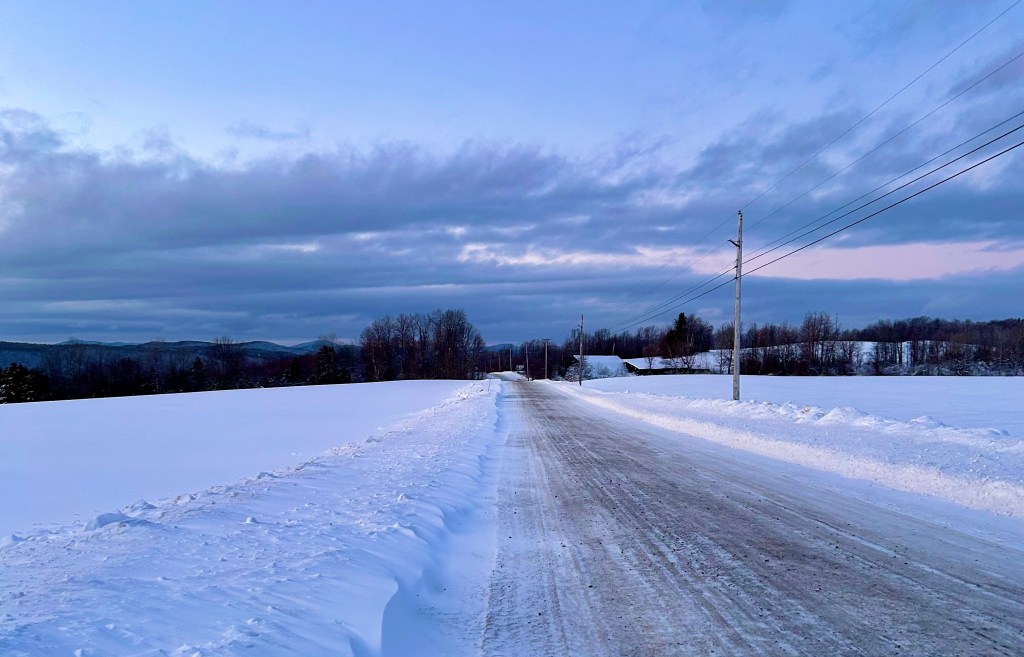
Under the waxing full moon, January’s hungry Wolf Moon, I hurry along in the few degrees above zero. I’ve forgotten my scarf, so when I turn and lean into the wind, I cover my cheeks and lips with my mittens and breathe in the scent of wool. It’s too cold for wetness, yet my mittens are redolent with sheep.

The wide sky and the fierce cold winnow me to shivering bones. Nonetheless, I walk further than I’d planned, thinking through a piece of writing, and then, so cold, words abandon me for images, then those, too, vanish, and it’s me in my boots and that good down jacket and the mittens just beneath my fluttering eyelashes, and intermittent pickups passing, their drivers lifting their hands silently.

My life flickers as a candle flame in my curved ribs. What great fortune to be walking along the earth’s curve as the planet bends into twilight, the ancient moon electrifying the new snow. By the time I return to the village, it’s not long after five and the darkness has settled in for the long go of the night. Nonetheless, it seems to me these wintry days are gradually lengthening. I mail a letter at the post office and then talk with an acquaintance for a few minutes in the co-op, a waxed bag of curry power in one mitten, an onion in the other. At the last moment, I remember to buy milk for the morning’s coffee.

Winter. This starkly elegant season, straight-forward, no fussing around. A librarian friend passed me Andrew Miller’s The Land in Winter, a novel I’d longed to hold and read. A book of my soul. My cat Acer, eight-years-old, has discovered the pleasure of purring. We lie stacked on the couch—me, this tabby, library book—content. Who knew this was possible, my slow learner cat, my slow learner self?

“And though he was not much given to thinking about love, did not much care for the word… it struck him that in the end it might just mean a willingness to imagine another’s life. To do that. To make the effort.”
― Andrew Miller

Another Plot Point.

A friend inquires if my summer’s adrenaline, the post-chemo and post-surgery and cancer-remission wave of energy has waned, and, indeed, that has, the winter and cold and what’s called fatigue but is actually a lifeless bleak plain setting up quarters in my household.

Winter is a reckoning time. In a strange kind of way I begin to see the pieces of my life jostle into a pattern — childhood and college years and those years in my twenties when I ran back and forth across the country and then to northern Vermont, how I built a marriage and house, the young mothering years of children and friends, how we taught ourselves to sugar and run a business and I taught myself to write. Then I broke that life apart and took the children, created a new life, kept writing books, learned to view the world askance to keep danger from our door. Danger slunk in anyway. The world, indeed, is cause and effect, not a linear straight-shot but a dense sphere. Surely the human story is the same for you and me, with its endlessly profound and terrible and awesome variations.

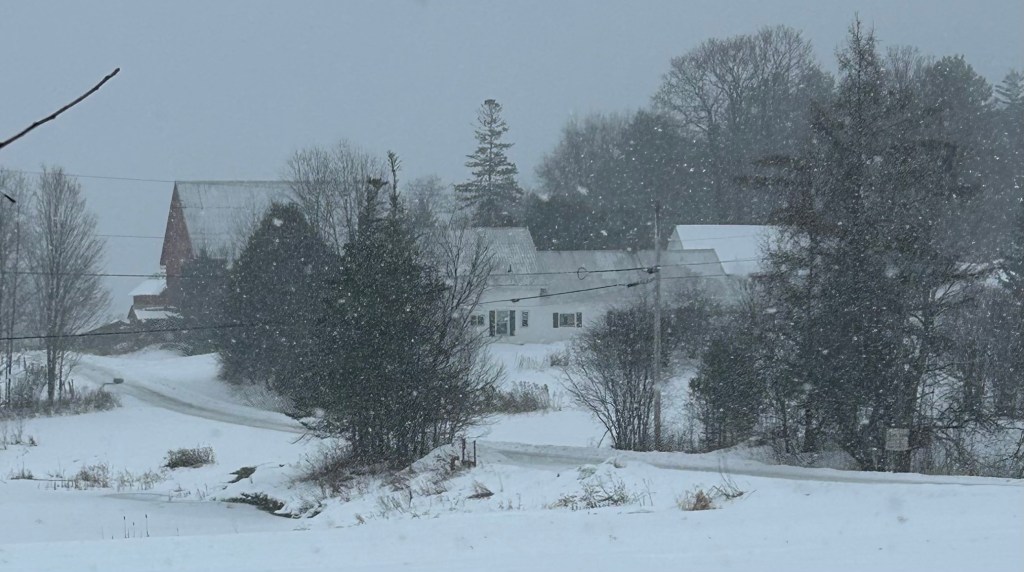
This morning, the harsh cold has relented, just the slightest, snow sifting down, the blue dawn pushing away the night’s darkness.

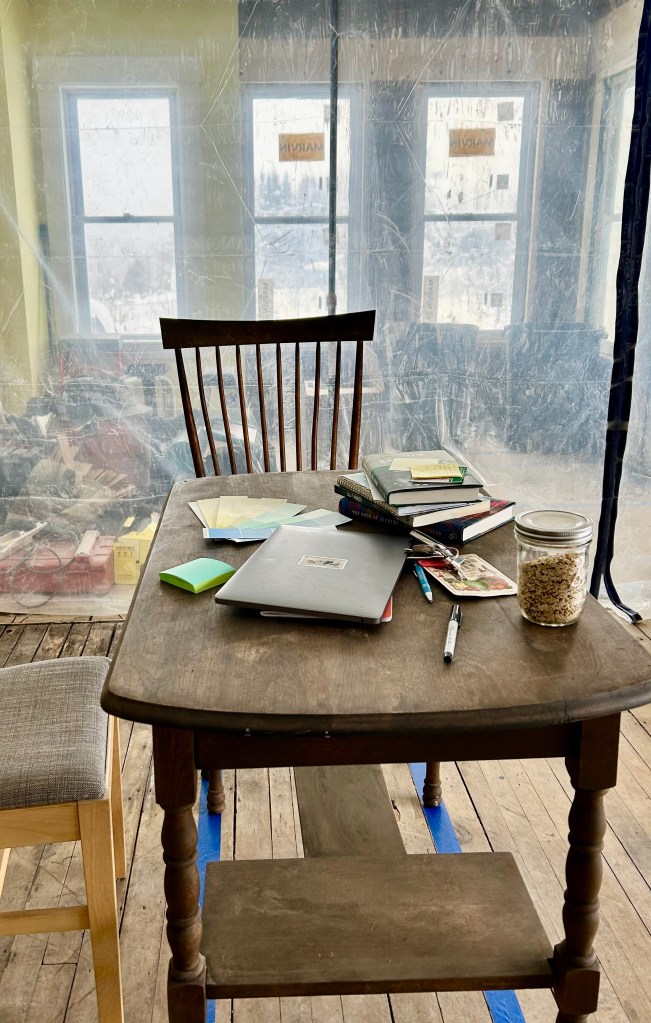
I’m encouraged to seek “protective factors” which I glean as my daughters’ merriment, a purring cat on my chest as a I read by the woodstove, a walk with a friend on a snowy road. My heart longs for the season of those #10 Pond swims, with friends or without, the sun hot on my bare knees. Spectator to the loon world. Not iced coffee but hot coffee. Now, these days of small light. In a considered burst of optimism, I mail a carpenter a check in a card with snowy evergreens and seal our agreement. Come when the weather splits and put two more windows in my house. Open the view of the valley and the village. Another plot point.

What would people look like

if we could see them as they are,

soaked in honey, stung and swollen,

reckless, pinned against time? — Ellen Bass

The Scythe, the Past.

Twilight, 25 degrees yesterday, the temperature dropping, I’m walking back and forth by the town garage, a tumbling-down quonset hut beside the town’s towering sand pile. Such much winter yet to come. On the snowy road, I pace back and forth, watching the sky turn from blue towards black, the stars hidden behind the clouds, talking with my friend about family and politics. Listening, I remember the Christmas manicotti she brought me last year. My daughter and I ate that delicious meal at the kitchen table; through our glass doors, I watched the snow fall, wondering if I would live another year.

Another year is not a guarantee for a single one of us. Another lymphoma lesson. I’d woken that morning with that now-familiar fatigue, as though sandbags were tied to every bone in my bone, pulling me earthward. I fed the wood stove, drank coffee, rallied and did my writing, rallied again and pulled on my coat and boots and left the house.

Later, by chance, at an outdoor fair I see a woman I’ve known for many years, who was part of a trying time in my life when my daughters were young. She offers me a particular kindness, and I thank her, wondering what I’m supposed to say. She does not seem to expect the standard answer of all’s well, that’s over and done because of course any fool knows, once cancer has rooted profoundly in a body, the reaper’s scythe does not hide. By now, it’s not so much the scythe that frightens me, it’s the suffering to get there.

On my way home from the fair, I pull over and get out of my car. The sun shines brightly, but it’s freezing, and I’m shivering. I walk back down the dirt road that’s empty of everyone, not even a crow perched in a bare-branch maple. Far up the valley I see enormous white wind towers, the Lowell Mountain Project. To my left is a house where one of the leaders of a group that protested the towers now lives. When the tower project began, my then-husband joined that protest group. The experience broke my naive love affair with Vermont and my blind faith in that too-hard-used word community. Not so long after, the husband and I divorced. My life went on, and I became intimately familiar with my own fallibility, my own deep pockets of untrustworthiness. I devoted two years of my life to writing and publishing a book in atonement for my own callous actions. Which never changed the consequences but widened the story. Then, cancer — the plot turn.

Robert Frost, no stranger to suffering, famously wrote that everything he knew about life could be summed up in three words: it goes on. Standing alone on that roadside, I imagine myself as the mangiest cur, footsore, half-starved, near mad. Disease may yet be rising within me. If not now, perhaps soon, perhaps never. This hillside above the Black River valley will endure long beyond my bones and flesh, long beyond yours, too. The sun and wind cut into my eyes. Why do I refuse to remember my mittens? Rather than letting all this go, I stuff these stories back into my heart and trek back to the village. I’m not finished with any of this. I’m still following the strands of all these stories.

…. and last, Rick Agran of Bon Mot has kindly invited me to his radio show at 5 p.m. EST tonight…

Stopping in the Snowy Forest.

In the woods, I hear voices and pause, thinking a cluster of children might emerge over the hill. Instead, a flock of clangorous geese wings low overhead, then a second V, a third. Town traffic sounds filter into the woods. I am not in the deep wilderness, not so far from high school and road and village, but for this hour, it’s just me and the sweep of wind and drifting snow and the human and dog prints of whoever walked here before me.

As a kid, my father was never one to be daunted by adversity. Evenings, he often set down his coffee cup and took us on walks to the library or around the block, and around the block often meant across a thin-grass soccer field to the woods. Who owned those woods, I never knew. We jumped across the stream and along worn logging roads, past the piles of New Hampshire boulders and stone walls in the forest where fields had dominated not so many years ago. The woods were alive with rabbits and deer, birds and ferns. We wondered about the Natives who lived here and the colonists who cut down the trees, and then the trees grew up again.

On this twilight Monday, I lean against a hemlock, snow in my eyelashes, remembering when my daughters filled their snowsuit pockets with tiny hemlock cones. Intentionally or not, my father instilled love and not fear of the forest in his kids, the understanding that our feet could carry us to unexpected and miraculous places.

Here’s that classic New Hampshire poem threading through my childhood, my daughters’, and so many others:

Stopping by Woods on a Snowy Evening

By Robert Frost

Whose woods these are I think I know.   

His house is in the village though;   

He will not see me stopping here   

To watch his woods fill up with snow.   

My little horse must think it queer   

To stop without a farmhouse near   

Between the woods and frozen lake   

The darkest evening of the year.   

He gives his harness bells a shake   

To ask if there is some mistake.   

The only other sound’s the sweep   

Of easy wind and downy flake.   

The woods are lovely, dark and deep,   

But I have promises to keep,   

And miles to go before I sleep,   

And miles to go before I sleep.

Gifts at the Back Door.

I arrive home in the dark and find one of my red deck chairs at my kitchen door, a white container set on its seat. It’s not late but dark already. On my way home from work, I’d walked along the river and walked further than usual. When I’d returned to my car, darkness had fallen.

I’ve been living in or nearby this village for thirty years. I’ve seen a share of miserable things — from addiction and homicides to petty cattiness — and its goodness, too. How, in times of trouble, folks appear with aid. No questions, often very few words. My god, the grace of this.

Scorched earth is how I consider myself these days, not so many days post-chemo, post-surgery, leering up on a year’s anniversary since I learned I had cancer. See how I write this? Past tense. And yet, transmogrified is a word I used with a friend. How this disease has transmogrified my being.

In the dark, I unlock my door, set down my backpack, a pile of library books, a bag of apples. My cats mewl for their cat supper. The container has soup, barley and beef and spinach. The woodstove has gone cold, my jacket drips rain on the floor and my cats’ dense fur, darkness presses against the windows. And yet, serendipitous soup. I take a spoon from the drawer. As for figuring out the rest of my life, or this week, or even this evening — I let that go.

From my library book stash, Sally Mann:

“As for me, I see both beauty and the dark side of the things; the loveliness of cornfields and full sails, but the ruin as the well…. The Japanese have a phrase for this dual perception: mono no aware. It means “beauty tinged with sadness,” for there cannot be any real beauty without the indolic whiff of decay. For me, living is the same thing as dying, and loving is the same thing as losing, and this does not make me a madwoman; I believe it can make me better at living, and better at loving, and, just possibly, better at seeing.”

Following the Bear.

Mid-August, the mornings are cool, the leaves of the pin cherry tree sparkling with dew. I find a bruise on my bicep; the cancer’s returned? But no. I remember I snagged my arm on the garden fence. Mid-August suddenly and the tomatoes are ripening. Last year, watching the full solar eclipse in our yard, the eclipse’s heart revealed this world’s ineffable beauty: such pure gold. Likewise, surviving cancer (thus far) revealed for me that knife of mortality within me, within all of us, hidden, ever-present.

Mid-August, mid-afternoon I’m drinking lemonade on a bakery porch and staring across the street at a house nearly obscured by sunflowers and globe thistle. I’m curious as heck about this Italianate with ornate corner boards. Who built this and who lives here now, and is the yard’s intent to cultivate wildness, or is no one at home?

My companion and I are talking about hard stuff, a third novel I’ve sent off to my publisher, the book I’m drafting now, about disease and suffering and how to wring meaning from misery. I’m compelled to write this book; writing this book looms impossibly. The afternoon’s quite hot, but by late afternoon the air will settle and cool. Nights, I walk after sunset, the crickets and tree frogs clamorous. I keep thinking about that house (empty or not?) and the thin line between wild and domestic. Here, this border has blurred. Will I cut the pin cherries to widen the canopy of the walnut tree I planted? The rose bushes seek a crack in my house’s foundation.

Wiser now, or maybe simply tired, I care less about the wild honeysuckle and raspberry canes that fortress around my house. I’m no Rapunzel, squirreled away in a tower, waiting for her Prince Charming. The hungry bear tunnels through the undergrowth, showing me a way.

Summer night—
even the stars
are whispering

~ Issa