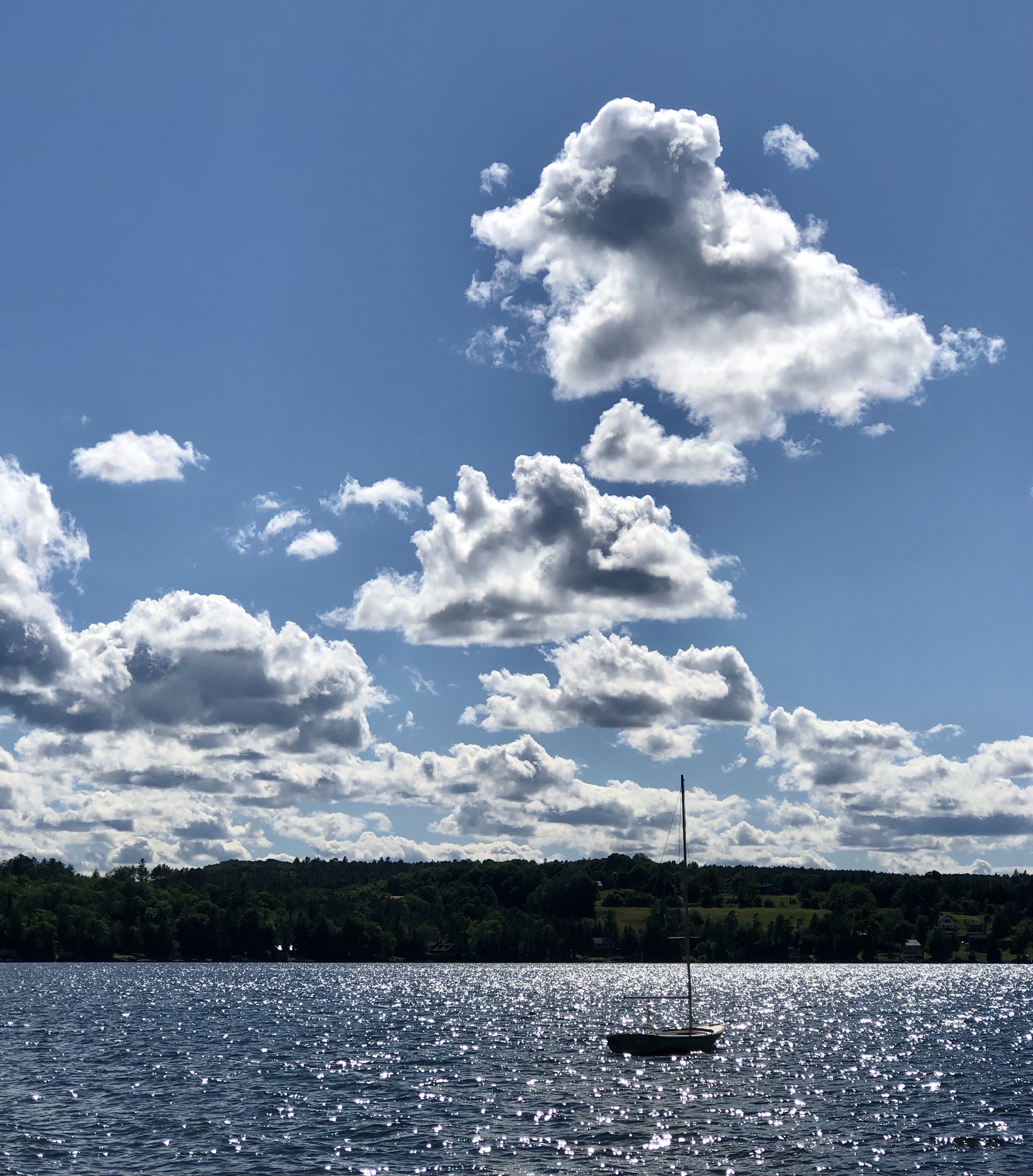
Early April, hot midday sun, I spy a Mourning Cloak butterfly darting over frozen Caspian Lake. The water has thawed blue holes in sporadic places around the shore, but the snow still crumbles into my boots as I follow the butterfly. The butterfly darts into a stand of cedars and disappears. On this afternoon, how lovely the lake lies, just me and the boarded-up summer cottages, the rusting can used for worms or smokes emerging from its wintering over beside a porch post. The ice spreads out in varying ribbons of pale blue and pearl.
On my back through town, my boot avoids the first of miniature grape hyacinths, tiny buds and furled leaves emerging from gravel.
This spring day, Van Gogh is on my mind, his immense talent, troubled mind, these words: “Great things are not done by impulse, but by a series of small things brought together. And great things are not something accidental, but must certainly be willed.”
A few streets down from me, a pregnant woman leans on a shovel in a driveway covered with a few inches of dense, soggy snow. It’s late afternoon, and a light snow swirls down as I walk. A pickup truck stops on the road, and I hear the driver offer to plow. There’s a little back and forth, and then she steps back. He sets down his plow and goes to work.
Every snowfall has its own kind of knowledge. As I walk through the streets and then across the former railroad bed and into the woods, I marvel at how much I know about snow, too. How a scattering of snowflakes can remind me of being 10 years old again, and a fourth grade teacher caught snowflakes on her tongue. Delicious,delicious, she said. Or how the three-foot Valentine’s Day storm snowed us in when my daughters had fevers and I wondered if I would ever return to the world of adults.
In the woods, the snow swallows up all sound for a handful of hours.
In these winter months, I’m reading about Claude Monet and his gardens. Here’s a line from the master: “… people must first of all learn to look at nature, and only then may they see and understand what we are trying to do.
Every bird around us is singing this morning. The garden luxuriates in a clinging dew.
Unexpectedly, a woman I worked with for a number of years texts me with news she’s in town for a few days. We had last in early March, just before our world shut down.
We take a walk through the town forest and catch up on kids and work. Then, for a few minutes we stand in the parking lot, and our conversation branches a different way.
She asks about when my daughter and I were quarantining after my daughter contracted Covid. In those long days, waiting to see whether I (who wasn’t yet vaccinated) would contract Covid, too, I painted the window trim in our front porches, a blue light blue color called Innocence. While painting, I listened to hours of Derek Chauvin’s homicide trial.
So much of our lives, I muse, is simply circumstance — we’re white women, living in Vermont, with particular backgrounds and education. How much of our lives do we choose, and how smartly do we make decisions of what we do choose? It’s a question that’s been asked myriad ways in the past year, in innumerable ways.
Driving home, I keep wondering, what do we do with this now?
We pulled into the DMV exactly on time for my daughter’s driving test exam. I sped while driving there — lousy parenting example — but at the very last moment before we left, it seemed we needed my daughter’s social security card for her license — as if I knew where that was. So we left without it.
Driving there, I remembered the card is in her baby book, in the blue hope chest.
Fortunately, the DMV staff was cheerful on this Tuesday afternoon after the long holiday weekend. The missing card was glossed over; I produced her birth certificate; and then they asked me if I had a utility bill or a piece of mail with me. Weirdly, I had brought the electric bill that arrived in the day’s mail, so I could read it over while she took her road test.
When we finally walked through the doors to wait outside, my daughter and I exhaled an unintentional collective sigh.
For these 15 minutes or so, I had absolutely nothing else to do at all, but sit there — something that seemed unimaginable to me for so many years as a mother. I had things, of course, I brought with me to do — reading that electric bill, for instance. But for these moments, I slipped off my sandals and dug my fingers into the warm clover.
In the sunlight, I soaked up my gratefulness to live in gorgeous Vermont, one of the sweet spots on the globe. Sixteen years ago, as I was driven away from the hospital after a surgeon’s scalpel made this daughter’s life possible, I saw corn nubs emerging through the black soil. Corn! What a miracle!
Sixteen years ago, I never would have predicted that one member of our family of four would have absconded for another life, that the life I have with my daughters would evolve into a version of Elizabeth McCracken’s line, It’s a happy life, but someone is missing.
So much of this past year I often imagined myself in a twisted story, a freak Camus novel, but now here I was on the flip side. Meanwhile, my daughter channeled her life into literally her own hands. Sixteen years ago, I was still foolish enough to believe that my children’s lives could be buffered, that they could live in a make-believe world of no bad things. I was still naive enough to believe that was desirable.
My daughter passed her exam. On our way out of the DMV this time, we didn’t sigh. In the sunlight, we spoke of little things — what to cook for dinner, tomorrow’s plans — the stuff of everyday life that makes a life together.
…we barely know the world around us, even the simplest things under our feet..we have been wrong before and we will be wrong again…the true path to progress is paved not with certainty but doubt, with being “open to revision.”
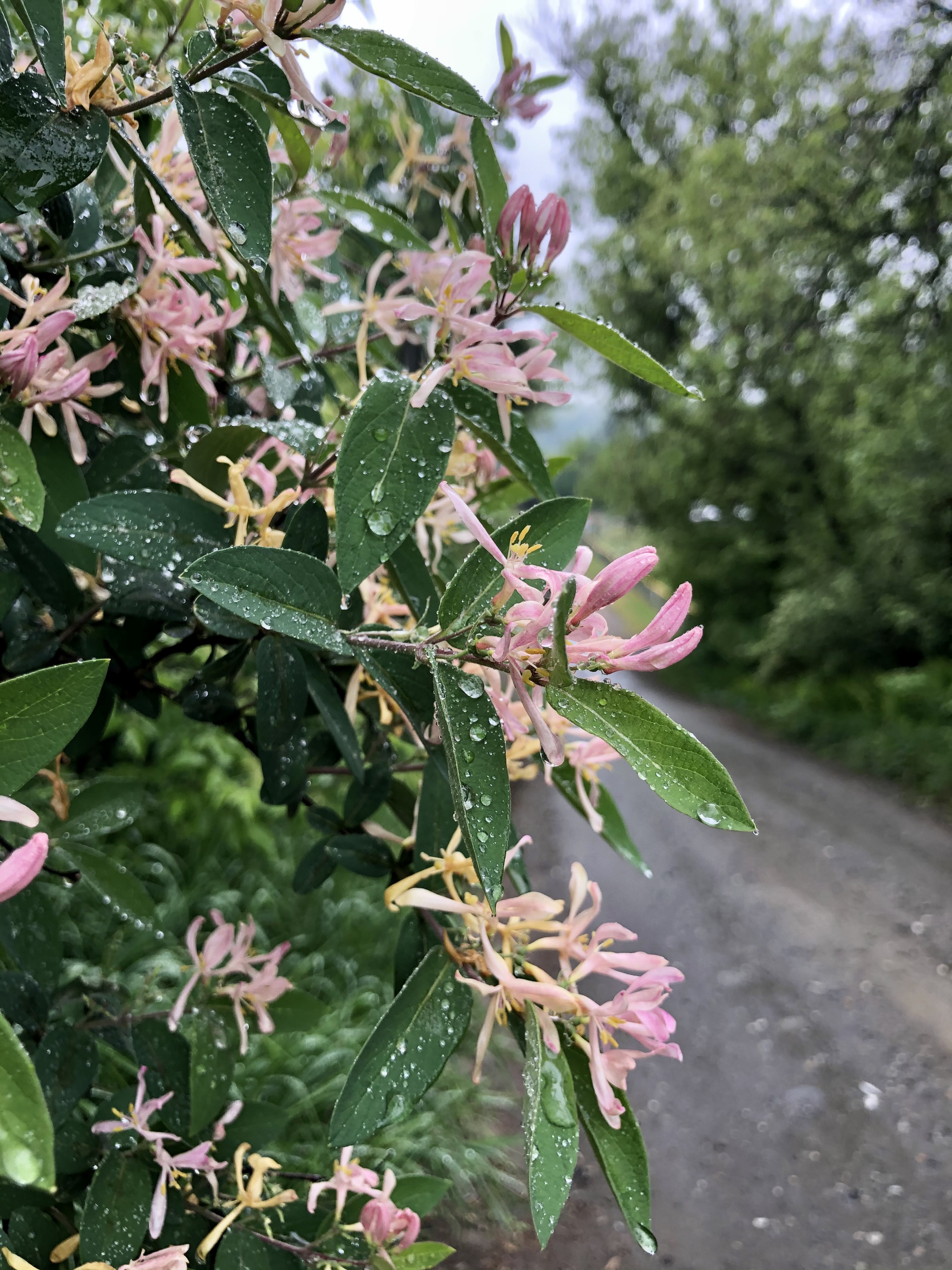
May ends in a welcome rain, and June begins with a watercolor-esque sunrise over our wall of fading lilac blossoms.
This is the weekend when our vaccinated friends stood in our kitchen, talking and talking, and then walked slowly around our downstairs, asking, “What’s happened here in the last sixteen months?”
I showed the window trim I had painted a pale blue, called Innocence.
This was also the weekend I drove my friend and her daughter. Over years, this friend and I have drove endless hours together, and the car I’ve owned for over a year she’d hadn’t even sat in.
The afternoon was rainy. I drove along a dirt road, and the maple trees gleamed a brilliant green. We had been at a ceremony that was both happy and terribly sad, and I was cold to the bone. I turned on the seat warmers.
Seat warmers! my friend said. That’s wonderful.
We started laughing, my friend still hunched against the partly open window, as if that mattered now.
Bring on the wonderful, please.
(Highly recommended reading below…. :))
It was the dandelion principle! To some people a dandelion might look like a weed, but to others that same plant can be so much more. To an herbalist, it’s a medicine—a way of detoxifying the liver, clearing the skin, and strengthening the eyes. To a painter, it’s a pigment; to a hippie, a crown; a child, a wish. To a butterfly, it’s sustenance; to a bee, a mating bed; to an ant, one point in a vast olfactory atlas.
When I was a girl, someone gave me a Sweet 16 barbie doll. We didn’t have a lot of barbie dolls in our house, and these were prized possessions. For years, I thought of my sweet 16 birthday as some vaguely hallowed ground, where I might sprout to 5’9″, with long legs.
That didn’t happen. I never even hit 5′. Doubtlessly, I never grew into that Barbie-and-Ken life, because I’m not plastic. I was a girl and grew into a woman, with a life filled with all kinds of things.
My daughter is just days from her 16th birthday. I’ve been dwelling on this birthday for weeks. In this time, I keep thinking of poet Mary Oliver’s line about her “box of darkness,” and how that box became her fortuitous strength. So much of our culture still pushes our daughters to be that barbie doll, to pretend all is well with the world, to set a placid example of good behavior.
I see my daughter struggle with her desire to succeed at this sugary, glossy image, juxtaposed with her reality as girl edging toward woman.
We all have our unwarranted boxes of darkness. Use yours, I counsel.