“Like a definition of love…”

Eight summers ago when my daughters and I first moved into this house, we swam in a nearby pond, usually with friends who lived nearby. In those eight summers, the kids grew up and are now swimming in other lakes, other ponds. I kept on. The swimming and conversation was a peaceful way to end jammed and often chaotic working days.

Late last fall, as part of extensive testing after I was diagnosed with lymphoma, I realized I had Giardia, too, proverberial small potatoes compared to cancer and easily treated. This year, I never started swimming. In May, I’d endured a painful surgery with a lengthy incision that needed to heal. That nearby pond was the most likely source of the Giardia.

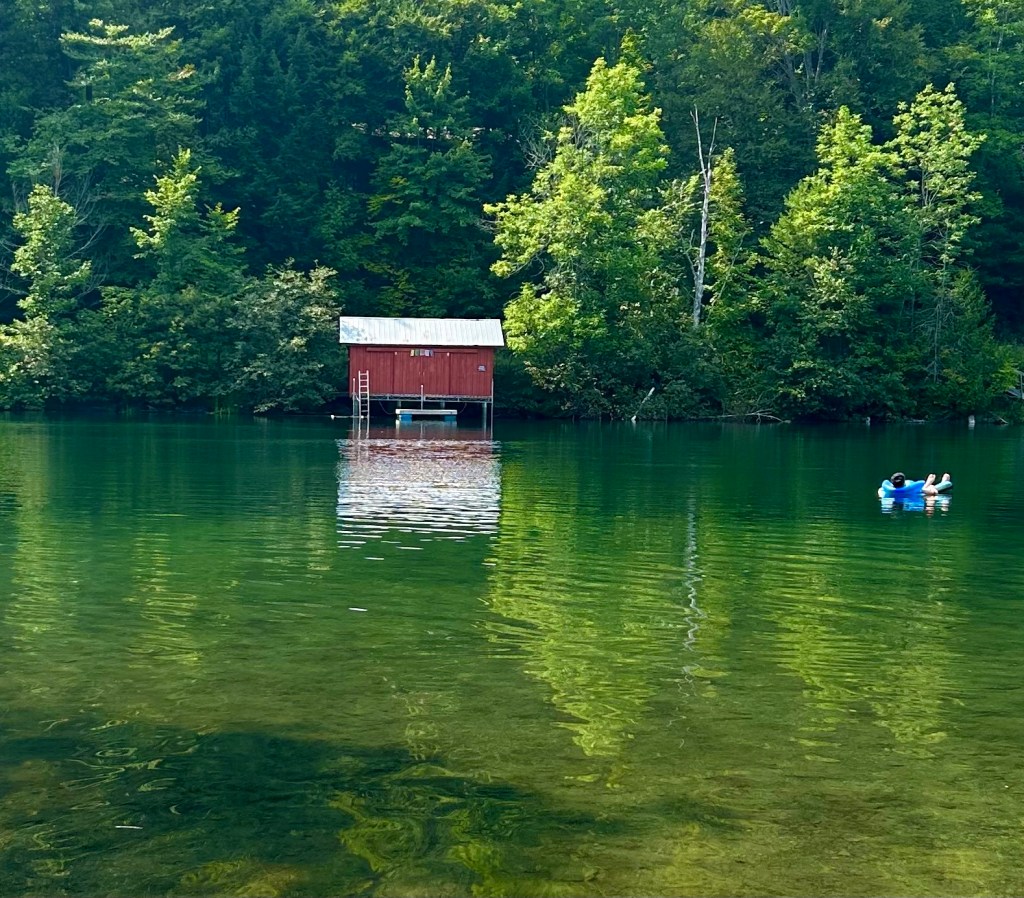
This August, a friend convinced me to swim at #10 Pond, familiar territory between our two houses, another place where my daughters and I swam and kayaked and picnicked. I arrived a few minutes early, opened my book, and the loons cued. This pond has always been one of my favorites: clear water, friendly fellow swimmers, scant motorized boats, little development. The water was cool. Kicking my legs, I felt my incision tug, but it was a sensation, nothing more. Afterwards, we lingered, drying and warming in the sun.

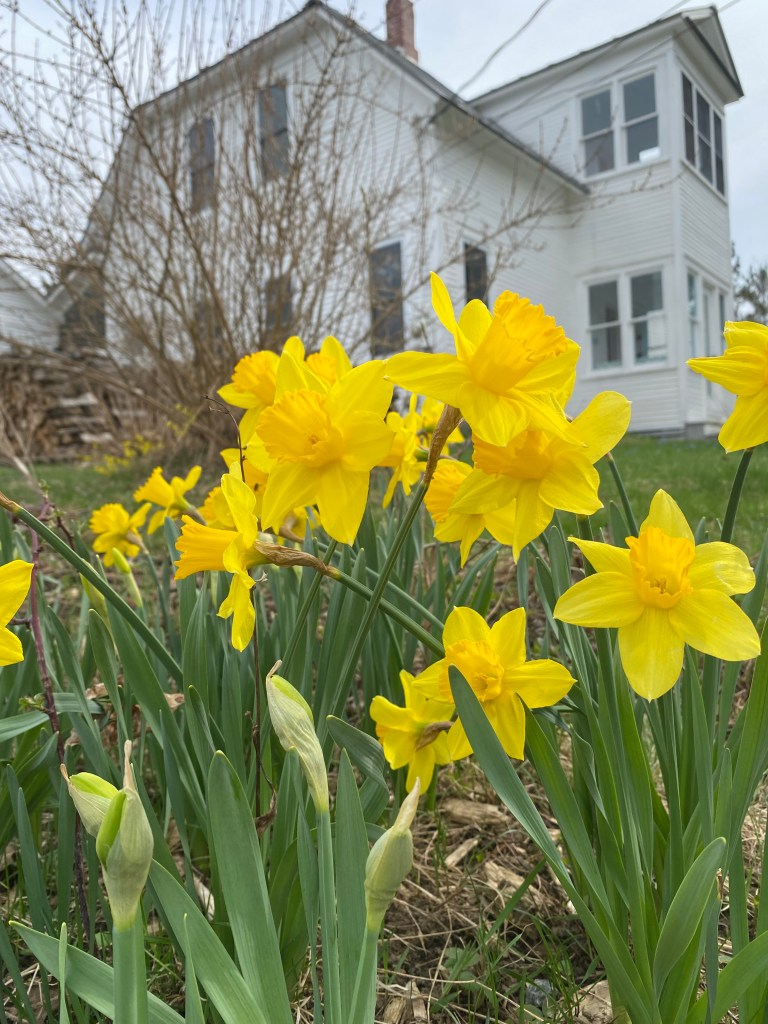
Yesterday, I was in sultry Barre and drove by the pharmacy where I had the go-around with the pharmacist and sharply insisted he fill my dilaudid prescription. I was on my way home from yet another lengthy stay at Dartmouth. We had to wait for the prescription, so my brother and I walked around Barre. It was early spring, hot, and the trees hadn’t yet leafed out. He’d parked on a hill and worried I couldn’t walk back up. I’d been on blood thinners, and the bandage around my IV site was soaked with blood. Don’t open it up! he warned me. It was so dusty and hot, and I was exuberant to be in the world where daffodils were blooming.

So yesterday, on my way home, I stopped at #10 Pond again, swam and read and listened to a nearby conversation between two men who were fishing — and the loons, of course, the loons.

We’ve now crested beyond the high summer. Each August day offers its own potential, for swimming or heartbreak or simply eating ripe peaches. Reader, wherever you are, love at least slices of your lives and places.

I’m about to send off a third novel manuscript to an interested party. In the dark this morning, I woke and began the book I’ll write about cancer and motherhood. Sure, cancer changed my life in small and great ways, but a year later it’s still the same me, rowing my life against the common current, compelled to write something that seems impossible.

And, for historical and record-keeping notes, I’ll add that the full moon, the Sturgeon Moon, rose smoky and red, ineffably beautiful over the cricket chorus.

“Green Apples” by Ruth Stone

In August we carried the old horsehair mattress
To the back porch
And slept with our children in a row.
The wind came up the mountain into the orchard
Telling me something:
Saying something urgent.
I was happy.
The green apples fell on the sloping roof
And rattled down.
The wind was shaking me all night long;
Shaking me in my sleep
Like a definition of love,
Saying, this is the moment,
Here, now.
“…the strange idea of continuous living…”

A knock at my kitchen door wakes me. Midafternoon, home from a long morning at Dartmouth for routine things, nothing major, but a day that began in the dark after scant sleep. The week before, I’d left a message for a man who painted three sides of my house a few years ago to ask about an estimate for my barn and that fourth side that somehow I’d never painted. Last fall, sick and not knowing the (cancer) reason why, I’d managed to get out my sander, but that was about as far as that plan went.

The painter is a person my daughter and I know in our overlapping circles, so I’m not surprised when he says he’d heard of my illness. We talk for a bit in my kitchen. Then I grab my sweater, and we walk around the barn. A stunning sunlight makes me blink. Our conversation winds around primer and caulking and ladders. In the back, where the woodchucks claim domain, the painter turns the conversation towards politics and the word that’s so commonly used now — cutting. We talk about cancer research (which saved my life) and the bitch of enduring chemotherapy. A house finch perches in the honeysuckle in the wild tangles below my house. The honeysuckle’s bent branches are dotted with tiny fans of new leaves.

It’s been a day for me. I once had unbounded energy that I spent so easily with my garden shovel, my paintbrush, laptop, trowel, my two hands. I lean back against the barn’s peeling clapboards, beside last summer’s clematis vine that appears shriveled, used-up, no good. I have complete faith this beauty will bloom again this year. Listening to the painter, I wonder, why make any guesses about anyone or anything, really? What will happen will happen. Yet, I can’t help myself. I’m betting on the clematis and its purple flowers. The painter offers me his good will, and I take that, too.

Instructions on Not Giving Up

More than the fuchsia funnels breaking out
of the crabapple tree, more than the neighbor’s
almost obscene display of cherry limbs shoving
their cotton candy-colored blossoms to the slate
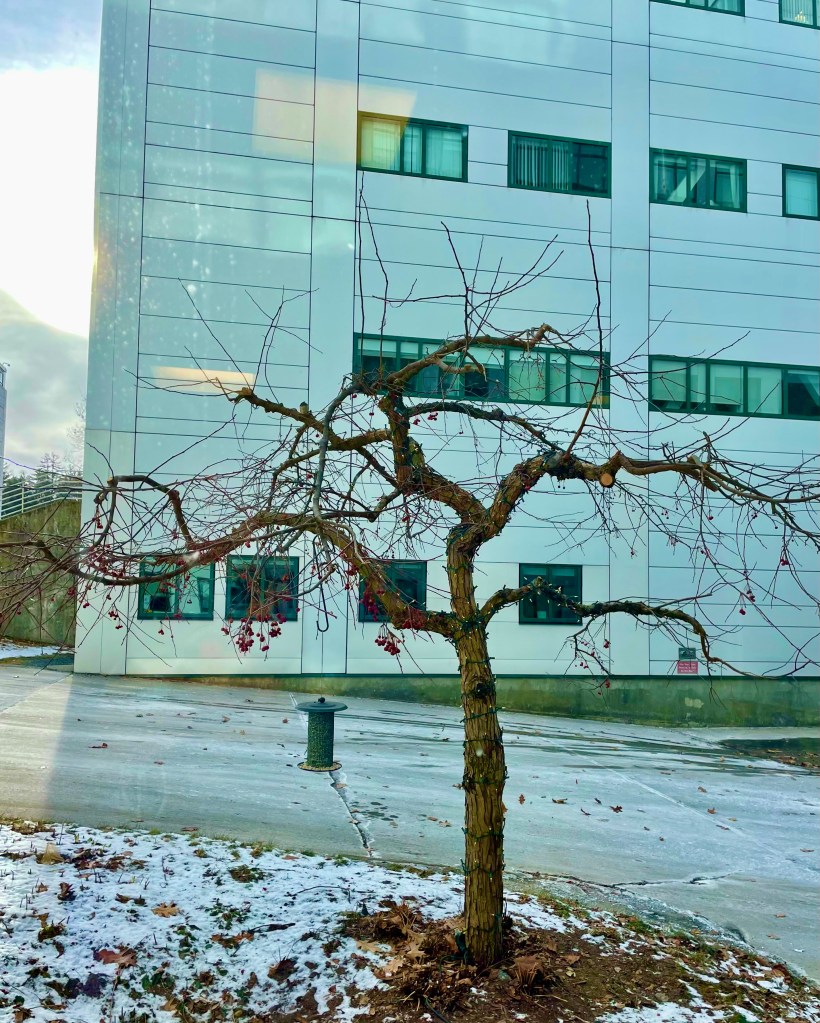
sky of Spring rains, it’s the greening of the trees
that really gets to me. When all the shock of white
and taffy, the world’s baubles and trinkets, leave
the pavement strewn with the confetti of aftermath,
the leaves come. Patient, plodding, a green skin
growing over whatever winter did to us, a return
to the strange idea of continuous living despite
the mess of us, the hurt, the empty. Fine then,
I’ll take it, the tree seems to say, a new slick leaf
unfurling like a fist to an open palm, I’ll take it all.

~ Ada Limón

Three things of varying importance…

Because I’m writing from Vermont, first, the weather: cheek-slashing cold, furious wind.

Second, back at Dartmouth these past few days for a consult and an infusion. Checking in, my insurance card was denied. Denied because it’s January and the new year wasn’t set correctly, or denied because some system is broken? I imagine these numerous co-pays, from ninety-cents to $750, piling up in my electronic portal. I’ll kick that to Monday, begin to straighten that out then…

Halfway through my treatments, the Good Doctor gives me the heads up about what’s to come, including the shift from what I’m calling Cancer Land back to the Everyday World. Although I’m sure he hears this repeatedly, I say how otherworldly is this cancer journey. Rarefied isn’t precisely the word I’m looking for, as so much of disease isn’t lofty or grandiose but mundane and sometimes miserable. But the journey is like nothing else I’ve undertaken, laced through at times with impending death, elevating the stakes to the utter center point of what matters. There’s nothing trivial here.

Third (and certainly not last), I’m so grateful for the lovely mail in my P.O. Box – cards and books, seeds and poems, such as this one by Danusha Laméris.

Insha’Allah

I don’t know when it slipped into my speech

that soft word meaning, “if God wills it.”

… How lightly we learn to hold hope,

as if it were an animal that could turn around

and bite your hand. And still we carry it

the way a mother would, carefully,

from one day to the next.

Refusal that the World is Random.

Cancer or not, the everyday world proceeds. I renegotiate the dullard car insurance (why would I pay to insure myself when I’m not driving?). This morning, the cat, seeking the milk jug on the counter, leaps on the kibble container I didn’t properly close. Kibble mounds over the kitchen floor. For the briefest moment, both cats stare, unable to process their astounding luck: a landslide of food.

Among minor domestic changes which involved a ridiculous amount of discussion: we swapped one washing machine for another. I posted the old one (a workhorse from the previous century) for free on the local digital bulletin board. While I was heating up the pot roast my friend dropped off, a young man I’ve known since he before he lost his milk teeth asked if the washing machine was available.

He arrived not long afterwards. We stood in the kitchen, talking about infected wisdom teeth (his, removed) and cancer (mine, in process of removal) and the medical system and capitalism. He asked if I knew what gave me the cancer, what empowered one gene to divide and divide again and again.

I have my theories, my guesses about this answer, nothing hard and set chiseled into stone. But isn’t it often the way that a sudden shift in events is triggered by multiple strands of actions, working seen or unseen? Leaning against the door, rose-cheeked with cold, he posits that nothing happens without a reason, that the universe is never capricious. I set my wooden spoon on the counter.

Here’s a thing: two months — 60 days — into the cancer world, with two rushed ER visits and two dodges of the grave, two chemo sessions, a complete upheaval of my life, my family’s, my colleagues’ — I woke early one recent morning and realized cancer will be with me until I cross into the next realm. But likewise, what I’ve labored hardest and most tenaciously and (often) most joyously will be with me, too. Raising babies into women, writing books, sobriety, cutting off a troubled marriage and recreating my life. But aren’t we all that way? Shouldering along with us the stones of our lives we’ve chosen, and the rain that’s fallen from the heavens and soaked us, too?

Here’s a Vermont Public Radio interview with Vermont Almanac editors Dave Mance and Patrick White, about this unique books and the non-cliché Vermont world.

A few lines from Dave Mance’s preamble to a book packed with plenty more….

…. seek out things that are real and hard…. Gravitate towards things that are beautiful. Lean in to things you cannot understand…. Tell stories where trees are protagonists. Look at the lines on your palm and see that, like wood, your skin has grain.

❤️

In the night, snow. My youngest ventures downstairs from her second-floor lair and feeds the wood stove, asks if I’m still reading, and don’t I think I should be getting some sleep… Around my knees, the cats yawn at her, nestling into their cat-dreams for a winter’s sleep. Outside, the town plow rumbles up our road, backs around, beeping, and disappears into the falling snow.

2024, a year that’s meant so much to so many. In our house, the year my mother died, the year I almost died, too. The inside-out year of reversal. In these quiet December days, getting better, getting stronger, getting weaker, moving along that jagged zigzag towards health, I’ve been lucky to read and think, to be warm and tended, to savor small sweets. Games of gin rummy. Poems Jo reads in her clear strong voice and sends every day. Brad’s photos of wintry Lake Champlain, luminescent portals of ice and drooping snow and runny sunsets. For so many of you, some whom I know well and have gone in and out of the depths of friendship and family, and some whom I hardly know, the circle around me has made all the difference.

When I first knew I had cancer, an acquaintance who had survived breast cancer told me it was the loneliest experience of her life. Like anyone, I’m well-acquainted with loneliness, have battled this shackled companion through divorce and betrayal. Where now has fate sent me? Illness was a forbidding shore where I never wanted to land my kayak, bend down in the cold murky waters and hoist my flimsy craft to safety. But illness is our common terrain, and those who dwell here – through happenstance or vocation – welcomed me in with compassion. As The Good Doctor told me, We are all patients. More plainly, perhaps, we are all mortal, conjoined.

Wishing you all some radiance from Vermont, prettied up this early morning beneath a downy snowfall….

“The Verge”

Reason is a fine thing, but remember there are other ways
to live: by instinct or passion, or even,
maybe, by revelation. Try it. Come around again to the verge –
that place of about-to-open, near where we comprehend
and laugh and see. Why shouldn’t something marvelous
happen to you? Take even an occasion like this:
A man reading at night looked up at the window to find
a moose looking in, interested and unafraid
with quiet dark eyes. He reports he has never been the same;
he finds the ungainly and miraculous everywhere.
He said it started the next night in the empty window
as he watched his reflection looking right back through.
He said he saw his own beauty, how even in his same old face
the quiet eyes were curious and ready to be true.

– Annie Lighthart

December, Holy/Unholy/Holy Season

Anyone who lives in a northern climate must inevitably come to some reckoning with the descent into this month’s darkness, the steady whittling away of daylight at either end, noontime oftentimes scrubbed to a soapy haze.

To my surprise, this month began on an ascent for me, an elevator rise at the end of November, crammed into a silver metal box on a gurney with my weeping daughters and brother, and an anesthesiologist who might have drawn the short straw to collect the patient in the otherwise sleeping hospital. He was actually assured me he was a much better anesthesiologist than a gurney driver. Bring me back safely to these people, I pleaded.

Here at Dartmouth, I’m in a major medical facility (of which I’ll someday write much more). There’s no illusion that this is giant Health Care. Within this, my tiny 4’8″ body and the fraughtness of grave disease and uncertainty, and so so many patients. Yet all these interwoven days and nights, I’m surrounded by an arch of kindness, by skilled and unskilled staff who labor so patiently. I’m humbled by this secular holiness. The respect is repeated among colleagues here, aiding each other (and all us needy patients) with their own thank you, thank you as they work together.

A friend, driving home to Vermont from family Thanksgiving, leaves me Time of the Child by Niall Williams. Late into the night I read, taking these hours to relearn the slow joy of novel immersion. Sleep, sleep, I urge myself, and yet Williams’ world entrances me. Here’s line from this novel that an elderly Irish country doctor remembers from his doctor father: “The sick are ourselves, was a thing his father had said. When you stop understanding that, take your name off the wall and throw your bag in the river.

…. Whatever way this month transpires — for rise or for misery — and it’s all holy, isn’t it, this sacred and profane mixture of spirit and blood and bowel. The journey itself we take together is the gem.

Although I will say, I was ineffably joyous to return from that dismal night and see my curved-to-exhaustion people. After all, I am in the only one in our household who devours the cold leftover French fries with gusto. Why would we waste cold potatoes?

Thank you again, all.